You looked at the calendar, looked at your schedule, and felt that little jolt of nausea. Step 3 is coming. You've got maybe 10 days. Not 10 free days. Ten actual calendar days stuffed with shifts, commute time, post-call brain fog, and whatever fragments of sleep residency hasn't stolen yet.
That's the problem.
Traditional Step study advice is built for imaginary people. People with clean schedules, perfect energy, and six-hour study blocks. That is not your life. If you're on nights, flipping to days, covering call, or dragging yourself home after a 14-hour shift, the usual "do 80 questions, review all explanations, then read a chapter" plan is nonsense.
Step 3 is also not Step 1 or Step 2. You do not win by hoarding random facts. This exam leans hard on management, next best step, risk-benefit decisions, ethics, biostats, and CCS execution. It rewards clinical judgment and stamina. Not brilliance. Not perfection. Execution.
So let's be blunt about the mission: your job is to pass efficiently.
Not rebuild your entire knowledge base. Not become the world authority on rheumatology. Not punish yourself for being busy.
Pass. Efficiently.
That means short, repeatable study blocks. Question-heavy prep. Deliberate CCS practice. Protection of sleep like it's part of the curriculum, because it is. I've seen residents sink themselves by chasing ideal study days that never came, then panic-reading for 11 straight hours before the test. Dumb plan. It feels productive and usually performs worse than steady, targeted work.
If you're a shift-based resident, your rescue plan has to fit the life you actually have. Pre-shift. Post-shift. Off-day. Low-energy day. Post-call zombie day. That's what this is for.
Day 0 Triage: What to Do Before You Start Studying
Before you answer a single question, do triage. Real triage. Fast, honest, a little ruthless.
First, map the next 10 days. Not vaguely. Literally write them down:
- work days
- off days
- call days
- commute windows
- protected sleep windows
- non-negotiable obligations
Block sleep first. Yes, first. If you start by stuffing every open space with study tasks, you'll build a plan that collapses by Day 3.
Second, choose one resource stack. One. Step 3 panic makes people do stupid collector behavior, UWorld, AMBOSS, Anki deck, random PDFs, old notes, YouTube playlists, "high-yield secrets," and some forum post from 2019. Cut that out.
Your minimum viable stack should be:
- Primary question bank: usually UWorld
- CCS practice: enough to learn the interface and workflow
- Biostats/ethics review: focused and intentional
- Rapid review source: something brief for skim-level reinforcement
Third, identify your weak spot quickly. You do not need a dramatic diagnostic exam. Do 20-40 mixed timed questions and ask:
- Are you missing basic knowledge?
- Are you missing management/next-step questions?
- Are you getting lost in CCS flow?
That answer shapes the next 10 days.
Your 10-Day Study Blueprint: Shift-Friendly Daily Blocks That Actually Fit
Here's the core rule: use question blocks as the backbone. Everything else supports that.
You need three versions of a study day.
1) Pre-shift day
If you work later and have usable morning energy:
- 30-45 min: timed question block or half-block
- 20-30 min: review misses and make an error log
- 10-15 min: one micro-topic, usually biostats or ethics
That's enough. Don't blow your whole tank before the shift trying to act like it's a vacation day.
2) Post-shift day
If you're coming home tired:
- 20-30 min: questions first if you can still think
- Or 20 min: review old incorrects if your brain is cooked
- 10-15 min: CCS case or ethics flash review
- Then stop
This is where residents sabotage themselves. They get home at 8:30 p.m., stare at the wall for 40 minutes, then decide they need a heroic three-hour comeback session. They retain nothing and sleep badly. Bad trade.
3) Off-day
This is where you do your heaviest lifting:
- Block 1: 40 timed mixed questions
- Review: detailed review of incorrects and guessed questions
- Break
- Block 2: 20-40 more questions or targeted weak-area set
- CCS: 2-4 cases
- Micro-review: biostats/ethics for 20-30 minutes
That's your momentum day.
A practical 10-day rhythm
You don't need a fancy spreadsheet. You need a workable sequence.
Day 1: Triage + mixed diagnostic questions + set up resource stack Days 2-4: Timed mixed question blocks, review hard, start error patterns Day 5: CCS-heavy day with some mixed questions Day 6: Mixed review + weak-area targeting Day 7: Light day or recovery-adjusted day if you're post-call Days 8-9: Timed practice emphasis, pacing, CCS cleanup Day 10: Rapid high-yield review, logistics, stop the chaos
What each study block should look like
For most residents in a 10-day rescue:
- Questions: highest priority
- CCS: very high priority
- Biostats/ethics: high yield, short sessions
- Deep content reading: low priority unless it fixes a repeated weakness
When reviewing questions, don't review everything equally. That's amateur behavior. Focus on:
- incorrects
- correct guesses
- management mistakes
- questions where you knew the diagnosis but missed the next step
Your error log should be tiny and useful. Not a 17-page diary. Think:
- "PE in pregnancy imaging pathway"
- "DKA management sequence"
- "Screening intervals I keep mixing up"
- "NBME-style ethics: confidentiality vs safety"
The micro-sessions that save points
You must carve out separate small blocks for neglected topics:
- Biostats: formulas, test characteristics, absolute vs relative risk, NNT/NNH, interpreting abstracts
- Ethics: capacity, surrogate decision-making, confidentiality, disclosure, boundaries, informed consent
- CCS: sequence and workflow
These topics are perfect for low-time windows because they're modular. Fifteen focused minutes here matters more than pretending you'll "get to it later."
The recovery rule
Here's the non-negotiable rule: if studying harder will cost you needed sleep before a shift or before the exam, sleep wins.
Every time.
A sleep-deprived resident does not suddenly become noble and high-yield. They become careless. They misread stems, click too fast, and botch CCS timing. If you need a formal rule, use this one:
Never trade more than 60-90 minutes of sleep for study in this 10-day window.
That's your guardrail.
How to Study When You're Exhausted: Tactics for Nights, Calls, and Zero-Motivation Days
Some days you will feel fried before you even open the app. Fine. The plan still works.
The rule for low-energy days is simple: do the smallest effective dose. Do not quit the day entirely unless you're unsafe or desperately sleep-deprived.
Smallest effective dose:
- 10 questions timed
- review only the misses
- 1 CCS case
- 10 minutes of biostats or ethics
That's still a study day. It keeps the engine warm.
If you're on nights, use your best cognitive window, not the morally "correct" one. If your brain works at 4 p.m. before sign-in, study then. If you can do 15 questions during a quiet meal break, do that. If your commute is on public transit, use it for audio review or quick notes. If you drive, don't pretend you're going to absorb dense teaching podcasts after 28 hours awake. You'll hear words. That's not studying.
When your brain is fried, triage tasks in this order:
- Questions
- Review of misses
- Memorization
Why? Because active retrieval beats passive exposure, especially when you're tired. Reading pages of material while exhausted feels comforting. It's also the easiest way to waste an hour.
Watch for the classic traps:
- Passive reading: looks clean, scores poorly
- Too many resources: fake productivity
- Marathon catch-up sessions: punishment, not strategy
- "I'll restart tomorrow" thinking: how 10 days turns into 3
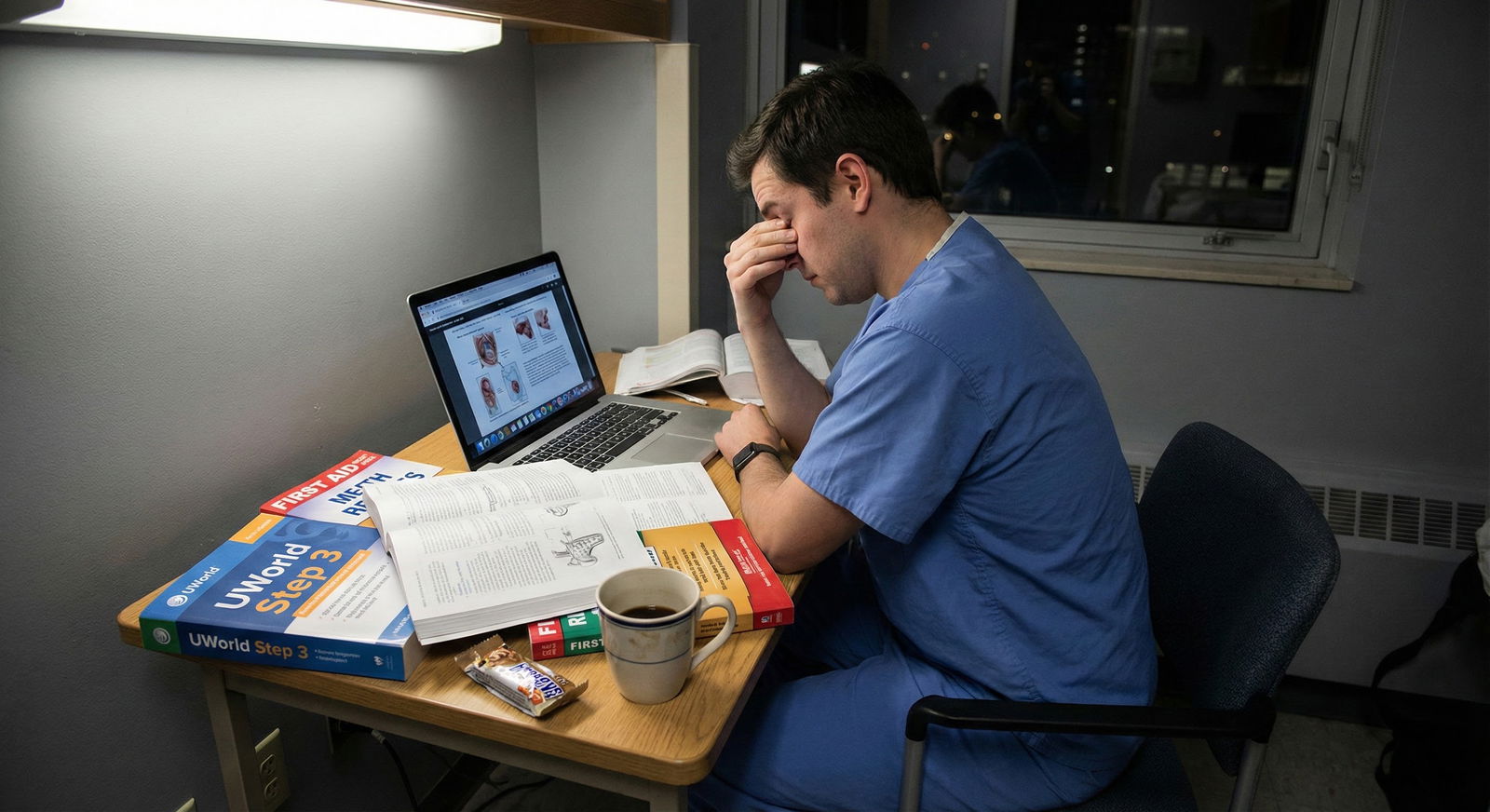
What works better is ugly consistency. A half-block before rounds. Ten incorrects after sign-out. One CCS case before bed. Not glamorous. Very effective.
Test-Day Survival and CCS: The Final 48 Hours and What Passing Looks Like
The last 48 hours are for tapering, not cramming. If you try to brute-force 300 random facts into your head at the end, you'll show up tired and frantic. That's how people underperform.
Use the final two days for:
- light review of your error log
- a few mixed questions to stay sharp
- CCS workflow refresh
- confirming logistics
- protecting sleep
For CCS, passing behavior is boring and systematic. That's good. Know your framework:
- stabilize first if needed
- focused history/physical
- appropriate initial orders
- reassess after results
- advance management logically
- don't forget disposition and counseling
Common CCS mistakes are not exotic. They're workflow errors:
- forgetting pregnancy test when relevant
- not reassessing after treatment
- ordering everything and thinking that counts as management
- missing location changes like ICU vs floor vs discharge
- not advancing the clock appropriately
On multiple-choice sections, pace matters more than ego. Hard question? Mark it, move. Don't bleed four minutes proving a point to yourself. Nobody cares if you felt "close." The exam rewards completed execution.
And if you miss a run of questions, so what? Keep moving. I've seen strong residents crater because they spiraled after one ugly block. That mental spiral costs more points than the actual questions did.
Passing Step 3 in this setup is not about mastery. It's about being organized, awake enough, and clinically steady.
If You're Behind Already: Emergency Rules for Salvaging the Week
If you're already 3-5 days behind, here's the rescue algorithm.
Step 1: Stop rebuilding the perfect plan. That's procrastination in scrubs.
Step 2: Protect the big rocks immediately.
- timed mixed questions
- CCS practice
- biostats/ethics review
- sleep
Step 3: Cut the fluff. Drop, in this order:
- extra resources
- long-form reading
- detailed note beautification
- niche content cleanup
Step 4: Compress intelligently.
- Do smaller question sets if full blocks aren't happening
- Review only incorrects and uncertain corrects
- Replace broad reading with targeted weakness review
- Do at least 1 CCS case daily
If your schedule got blown up by call, stress, or terrible sleep, do a final-day reset:
- sleep
- 20-40 mixed questions
- 1-2 CCS cases
- quick ethics/biostats sweep
- stop spiraling
That's a salvage plan. Panic studying is not.
A disciplined rescue beats a dramatic breakdown every single time.
The bottom line
If you only have 10 days and your schedule is a mess, build around questions, CCS, and sleep protection. That's the whole game. Not perfection. Not volume for the sake of volume. Not pretending you're a full-time test taker.
You are a resident. Your plan has to respect that.
Start with Day 0 triage tonight. Block your sleep. Pick your resources. Do your first timed set. Then keep showing up in short, repeatable blocks until test day.
That's how this gets done.