

The usual “academic vs private practice” advice is shallow. You’re not choosing between “teaching vs money.” You’re choosing a daily life and pressure profile that either matches your personality—or slowly grinds you down.
Let’s get specific about who actually thrives in each path and how to match it to your personality, not just your CV.
Step 1: Forget the Stereotypes (They’re Half Wrong)
Here’s the lazy version you’ve probably heard:
- Academic = teaching, research, prestige, less money
- Private practice = more money, less teaching, business headaches
Not completely wrong. But dangerously incomplete.
The real divide is about:
- How much autonomy you want
- How you handle uncertainty and risk
- Whether you like structure or flexibility
- How you feel about metrics, RVUs, and “productivity”
- What kind of recognition actually motivates you
If you don’t anchor this decision to your core personality traits, you can absolutely end up in a “good” job that feels terrible.
Step 2: Quick Personality Snapshot – Which Description Feels Like You?
Read these and circle (mentally) which sounds more like your default mode.
Profile A: The Academic-Fit Personality
You’re energized by ideas, systems, and “why we do it this way” questions. You:
- Naturally explain things to others, even when you’re not “on the clock”
- Get a weird satisfaction from crafting a good teaching moment on rounds
- Read articles and actually think, “We could do a QI project on this”
- Don’t mind some bureaucracy if it means structure, committees, and a clear ladder
- Like being around residents, fellows, conferences, and grand rounds
- Are okay with salary being more “stable but capped” than “sky’s the limit”
You care about legacy, not just your paycheck. Your ego likes being “Dr. X, the specialist in Y at Big Academic Center.”
Profile B: The Private Practice-Fit Personality
You’re energized by control, efficiency, and results you can feel immediately. You:
- Hate pointless meetings and academic politics with a passion
- Care way more about doing good work than presenting it at a conference
- Get satisfaction from a clean schedule, predictable days, and clear outcomes
- Like the idea of owning or co-owning something (practice, ASC, etc.)
- Are motivated by financial upside and negotiating leverage
- Want to shape your own workflow, staffing, and maybe your own brand
You don’t need a university logo on your badge to feel accomplished. Your ego likes being “the go-to doc” in your community, not “the associate professor.”
If neither fits perfectly, that’s normal. Most people are a mix. This is about dominant tendencies, not a BuzzFeed quiz.
Step 3: Core Tradeoffs – Money, Control, and Daily Life
Let’s put the big factors side-by-side.
| Factor | Academic Medicine | Private Practice |
|---|---|---|
| Income trajectory | Slower, more stable, capped-ish | Higher ceiling, more variable |
| Autonomy | Moderate, committee-driven | High (if partner/owner) |
| Teaching | Built-in, expected | Optional, usually minimal |
| Research | Possible/expected (varies) | Rare, usually unpaid/side |
| Admin burden | Committees, system politics | Business, HR, billing, contracts |
| Job security | Decent if productive | Depends on market and ownership |
| Prestige | Academic title, publications | Local reputation, financial success |
If you want a visual of how the tradeoffs often feel:
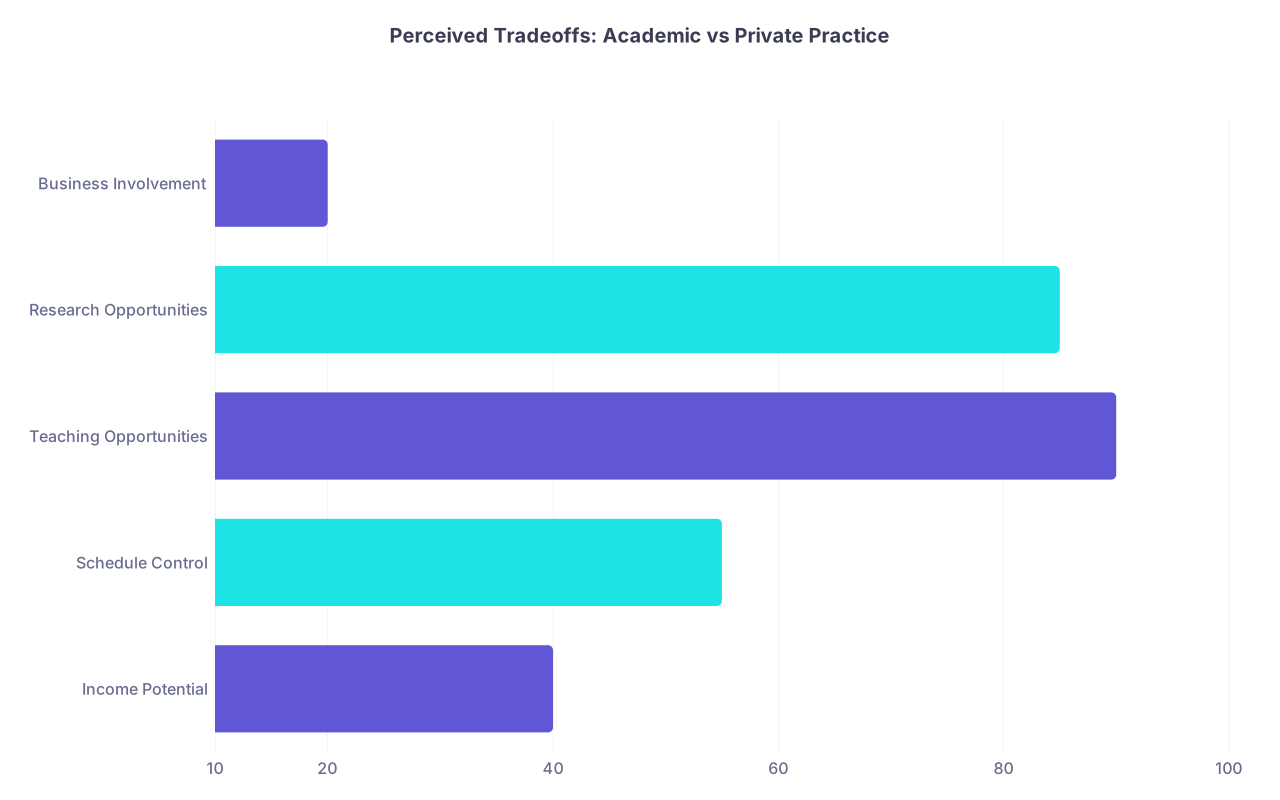
| Category | Value |
|---|---|
| Income Potential | 40 |
| Schedule Control | 55 |
| Teaching Opportunities | 90 |
| Research Opportunities | 85 |
| Business Involvement | 20 |
(Think of 100 as “max academic side” and 0 as “max private practice side” on each axis.)
Step 4: Match Specific Personality Traits to Each Path
Let’s get brutal and practical. Here’s what I’ve actually seen in residents and attendings over and over.
Trait 1: Your Relationship With Structure vs Freedom
If you like protocols, ladders, and defined roles → academia fits better.
You’ll tolerate the promotion criteria, mandatory trainings, M&M formats, etc.If you hate being told how to document, schedule, or “show face” → private practice gives you less oversight and more say in day-to-day operations.
Ask yourself: Do you get relief from someone else setting the framework, or do you feel caged?
Trait 2: Your Tolerance for Risk and Money Uncertainty
Academic: salary is negotiated but usually bounded. You won’t triple your income overnight, but you rarely go to zero.
Private: early years can be lean (especially if buy-in, ramp-up, or building a panel). Long-term, you can out-earn academics significantly, especially in procedure-heavy fields.
If the thought of fluctuating income keeps you up at night, private may still work—but as an employee, not an owner. That’s a different flavor of “private practice.”
Trait 3: How You Handle Politics and Power Dynamics
Academia has a very specific game:
- Promotions tied to publications, teaching evals, committee work
- “Invisible” rules about who gets what titles and leadership roles
- Departmental hierarchies that move slowly
Some people can play that game and even enjoy it. Others feel constantly blocked and resentful.
Private practice has politics too, just different:
- Partners vs associates
- Referral patterns and turf wars
- Revenue distribution models
Ask: Do you prefer a more formal ladder with clear ranks, or direct negotiation with fewer guardrails?
Trait 4: Your Need for Intellectual Stimulation vs Operational Control
Academics who thrive:
- Enjoy debating trial design, guidelines, edge cases
- Get a kick out of being “the person” for a certain niche topic
- Like leading journal club more than optimizing billing workflows
Private practice docs who thrive:
- Get satisfaction shaving 5 minutes off each visit without sacrificing care
- Enjoy optimizing staffing, schedules, and throughput
- Prefer learning efficient real-world tricks over theoretical arguments
You don’t become less smart in private practice. Your daily “brain work” just shifts from academic questions to operational and clinical efficiency questions.
Step 5: Specialties Where the Choice Really Matters (and Where It Doesn’t)
Some fields almost push you one way or the other.
| Specialty | Often Skews Toward | Why |
|---|---|---|
| Radiation Onc | Academic | Tech-heavy, trials, cancer centers |
| Neurosurgery | Academic | Tertiary referrals, complex cases |
| Dermatology | Private | Cosmetic, procedures, cash pay |
| Emergency Med | Mixed | Corporate groups vs academic EDs |
| Hospitalist IM | Mixed | Academic teams vs community shifts |
Don’t pick a specialty only to stay academic or private—that’s backwards. But be aware: in some fields, your options will naturally cluster.
Step 6: Lifestyle Reality Check – How Your Day Actually Feels
Here’s what a week might concretely feel like.
Academic Attending (Medicine, for example)
- Morning: Rounds with residents/students, teaching on the fly
- Midday: Family discussions, consults, plus answering student questions
- Afternoon: Clinic or more inpatient work, supervising notes, feedback
- 1–3 times/week: Grand rounds, division meetings, research meetings
- Nights/weekends: Some call; plus research/writing time often bleeds into evenings
You’re constantly in “teacher mode.” You’re evaluated not just on patient care but on documentation, teaching scores, and maybe scholarly output.
Private Practice Attending (Outpatient-heavy specialty)
- Morning: Back-to-back clinic, focused on efficiency
- Midday: Quick charting, maybe reviewing labs/imaging, business chat with manager
- Afternoon: Procedures / more clinic
- After hours: Notes, maybe helping with staffing or process changes
- Meetings: Mainly business/operations, not committees about curriculum
Your main metrics: patient volume, RVUs, satisfaction scores, financial health of the practice.
If you want a simple visual of what pulls how strongly in each environment:
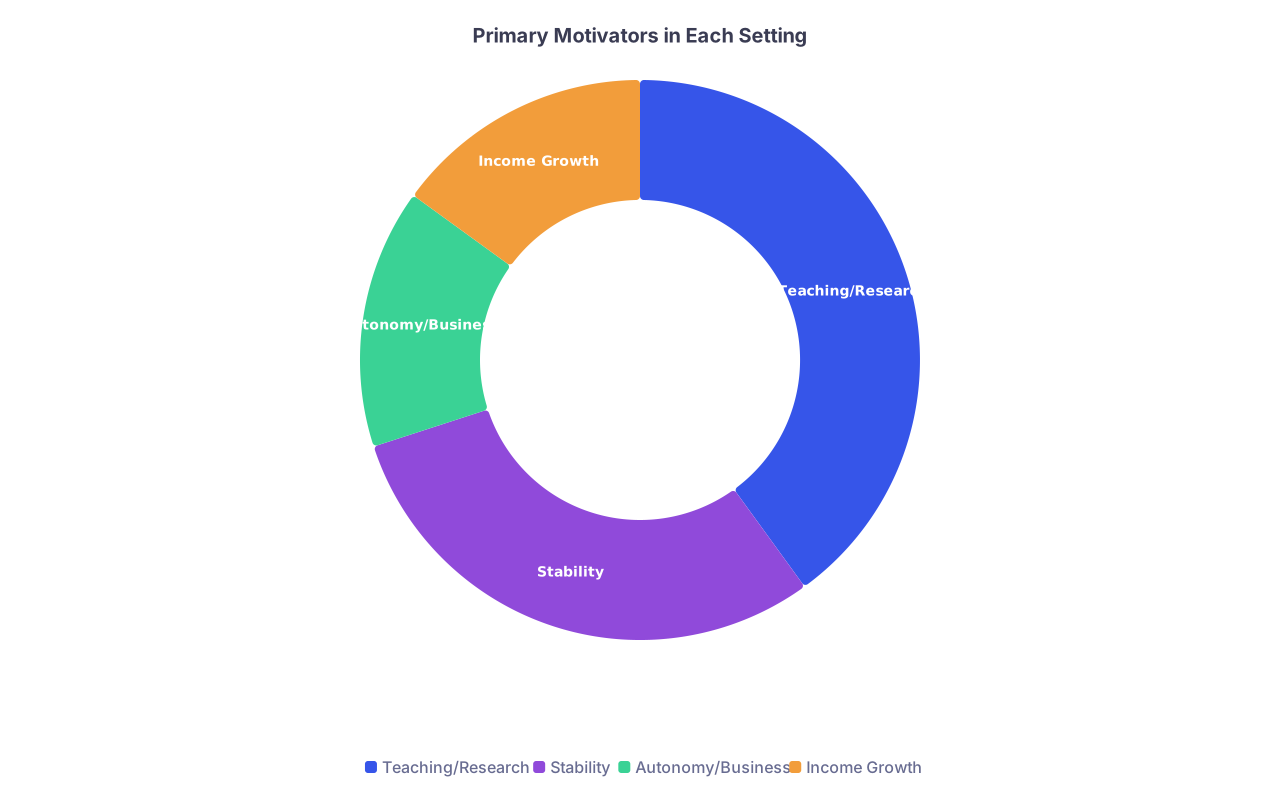
| Category | Value |
|---|---|
| Teaching/Research | 40 |
| Stability | 30 |
| Autonomy/Business | 15 |
| Income Growth | 15 |
(This roughly sketches an academic position. For private practice, that pie would swing hard toward autonomy/business and income growth.)
Step 7: Hybrid Options for the “In-Between” Personality
You’re not stuck picking one box forever. If you’re a mix, target hybrid setups that match that.
Examples:
Community hospital with a university affiliation
You teach residents but have less research pressure and more community-style practice.Private group with academic contracts
You staff residents on certain days and do pure private work on others.Employed by a health system, not classic “university faculty”
You may have lighter academic expectations but still attend conferences/teach.
Think of the spectrum:

| Step | Description |
|---|---|
| Step 1 | Pure Academic |
| Step 2 | Academic with heavy clinical |
| Step 3 | Community hospital with residents |
| Step 4 | Hospital employed private |
| Step 5 | Independent private group |
| Step 6 | Solo practice or niche boutique |
You can move along this spectrum over your career. Plenty of people start academic to build a name, then jump to private. Others do the reverse when they realize they miss teaching.
Step 8: How to Test-Fit Each Path Before You Sign a Contract
Here’s what you should actually do in residency/fellowship:
Rotate in both settings intentionally.
Don’t just “survive” that community month. Watch the attendings carefully:- Do they look burned out or content?
- How do they talk about their work?
- What frustrates them daily?
Ask attending-level questions, not resident-level ones.
Instead of “do you like it here?” ask:- “What parts of your job feel like a grind?”
- “If you could change one thing about your setup, what would it be?”
- “Would you choose academic/private again if you were PGY-3?”
Shadow the non-clinical time.
In academia: sit in on a division meeting, research meeting, promotions committee if you can.
In private: sit in on a business meeting, talk to the office manager about operations.Notice where you feel more like yourself.
When you’re in each environment, ask: am I more energized or more drained at the end of the day?
Step 9: Red Flags That You’re Aiming at the Wrong Path
You’re probably misaligned if:
You’re applying to academic jobs but:
- You hate writing, hate meetings, and secretly resent learners
- Your dream day is “just clinic, no teaching, no politics”
You’re applying to private practice but:
- You light up only when teaching or working with complex, tertiary-level cases
- You get bored with high throughput and standard problems
Be honest: some people chase “academic prestige” to impress parents/peers, then hate the reality. Others chase “private practice money,” then feel intellectually starved. Both are preventable.
Step 10: So…Which Path Fits Your Personality Type?
Here’s the blunt version.
You should lean academic if you:
- Get real joy from teaching and mentoring, not just tolerating it
- Like being in a big system with clear titles and ladders
- Are okay trading some income for stability and prestige
- Enjoy asking “why” and maybe doing projects, QI, or research
- Don’t mind slower decisions and committee processes
You should lean private practice if you:
- Crave autonomy in how you practice and structure your day
- Are motivated by income potential and are okay with some risk
- Don’t need formal academic recognition to feel successful
- Are interested (or at least not terrified) by business and operations
- Prefer direct, fast decision-making to committee consensus
And if you’re truly in the middle?
Target:
- Community teaching hospitals
- Hospital-employed groups with optional academic roles
- Private groups that partner with med schools for teaching days
Those can scratch both the teaching and autonomy itches without forcing you into the extremes.
Today’s actionable step:
Write down the three things you care about most in your career from this list—autonomy, income potential, teaching, research, stability, prestige, schedule predictability, business/ownership. Then, next to each, label it “non-negotiable” or “nice-to-have.” Once you see that on paper, you’ll know whether academic or private practice actually matches your personality, not someone else’s idea of success.


