

The belief that a hospital-employed position is “safer” and “better” for new attendings is oversold—and in some cases, flat-out wrong.
If you’re finishing residency or fellowship, everyone has an opinion about your first job. Program directors push stability. Senior attendings reminisce about private practice money. Recruiters promise “lifestyle” hospital jobs that magically fix everything. You’re trying to figure out if you should sign that hospital-employed offer or hold out for something more independent.
Let me cut through the noise: hospital employment is neither the default best choice nor a trap. It’s a tool. It’s good for some people, bad for others, and dangerous if you do not understand the tradeoffs.
Here’s how to think about it like an adult, not like a scared PGY-4 being sold security.
The Real Question: What Problem Are You Trying to Solve?
Before you worry about “hospital-employed vs private practice,” ask what you actually want your life to look like for the next 3–5 years.
Most new attendings are trying to solve one or more of these:
- “I do not want to deal with billing, collections, or running a business.”
- “I want predictable income and benefits while I pay off loans.”
- “I want to learn how to be an attending without also learning how to be an entrepreneur.”
- “I want control—over schedule, hiring, clinical decisions, and long-term career growth.”
- “I care more about upside income and autonomy than about bureaucratic stability.”
Hospital employment tends to help with the first three and hurt the last two. That’s the core tradeoff.
What “Hospital-Employed” Really Means (And Doesn’t)
Hospital-employed sounds simple: “I’m an employee of the hospital.” In reality, it’s code for a specific set of structures:
- You’re on a W-2, not 1099.
- The hospital controls your compensation model, staffing, and often your schedule.
- The hospital usually owns the technical and professional fees and then pays you a salary + some incentive.
- You get access to hospital benefit plans (health insurance, retirement, malpractice coverage).
What it doesn’t automatically mean:
- It does not guarantee job security.
- It does not guarantee better work-life balance.
- It does not guarantee fair compensation.
- It does not mean less work. Sometimes it’s more.
I’ve seen new attendings get crushed in hospital-employed roles because they assumed “employee = protected.” The hospital’s priority is not your career; it’s margin and coverage.
Key Pros of Hospital-Employed for New Attendings
There are real reasons a hospital-employed job can be a smart first step.
1. Simplicity and lower cognitive load
When you’re just learning how to be an attending, having someone else deal with:
- Billing and coding
- EHR templates and documentation rules
- Staffing (MAs, NPs/PAs, nurses)
- Clinic/OR infrastructure
- Credentialing
…can be a relief. You walk in, see patients, do notes, maybe some admin, and go home. No thinking about lease negotiations or marketing or hiring.
For many people, especially in the first 3–5 years, that’s worth a lot.
2. More predictable income and benefits
Your first job is when:
- Your loans are heavy.
- You may be buying a house.
- You might be starting a family.
- You don’t yet know your real productivity or local referral base.
That’s a bad time to gamble on a 100% eat-what-you-kill model unless you’re very risk-tolerant.
Hospital-employed offers often include:
- Guaranteed salary for 1–3 years
- RVU or quality bonuses on top
- Health insurance, disability, malpractice tail covered
- 401(k)/403(b), maybe a pension-style plan or match
Look at it as a “bridge job” to stabilize your life and finances while you figure out your long-term path.
3. Easier entry into competitive or desirable markets
In certain cities and subspecialties, independent groups are closed shops. Partnership spots are rare. But hospitals are still under pressure to recruit.
If you want to be in a specific city (where your partner works, where family lives), hospital employment may be the only realistic on-ramp.
4. Less immediate pressure to be a rainmaker
New attendings often underestimate how much of private practice success is not just clinical productivity, but:
- Building referral relationships
- Managing reputation
- Negotiating with payers
- Understanding local politics
A hospital-employed role can act as training wheels while you learn how the local ecosystem works.
The Hidden Downsides of Hospital Employment
This is where a lot of new attendings get burned. They see the base salary and miss the strings attached.
1. You’re trading autonomy for structure
You’re not just giving up ownership. You’re giving up control.
Hospital-employed usually means:
- Less control over your schedule structure (clinic versus OR versus call)
- Less control over who you work with (they can add NPs/PAs, fellows, or other attendings into “your” clinic)
- Less control over patient volume expectations
- Less control over adding or stopping certain services
You may be told in the interview, “We really value physician input.” But when census drops or budgets tighten, decisions get made in conference rooms you’re not invited to.
2. Compensation can quietly decay over time
The first contract often looks solid: nice base, reasonable RVU threshold, signing bonus.
Then year 2–3 comes:
- RVU thresholds go up “to align with market.”
- Compensation per RVU quietly drops to match some MGMA percentile.
- Fewer resources (less support staff) but same RVU expectations.
- Call gets heavier without proportional pay bump.
Hospitals share upside only when they have to. Once you’re locked into the system, leverage shifts.

| Category | Value |
|---|---|
| Hospital Salary+RVU | 350 |
| Private Practice Salary+Partnership | 400 |
| 1099 Locums | 450 |
(Values above are illustrative average annual potential in thousands after ramp-up.)
3. You’re easier to replace than you think
I’ve watched “secure” hospital-employed groups get:
- Merged into a larger system, with new compensation structures.
- Outsourced to a national staffing company.
- Restructured after a service line “realignment.”
If your name is not on the door and you do not own the contracts, your job can change on 90–180 days’ notice. Or disappear.
4. You’re inside the bureaucracy
You’ll be playing by:
- Hospital documentation rules
- Throughput metrics
- Quality dashboards
- Committee-driven decision making
Some people can tolerate this fine. Others feel like they went to school forever to become…a well-compensated cog.
If you’re wired for independence, this will grate on you quickly.
How Hospital-Employed Compares to Other Models
Let’s put hospital employment side by side with a couple of common alternatives for new attendings.
| Model | Stability | Autonomy | Income Upside | Complexity |
|---|---|---|---|---|
| Hospital-employed (W-2) | High | Low | Moderate | Low |
| Private practice, employee | Moderate | Moderate | Moderate-High | Moderate |
| Private practice, partner track | Moderate | High | High | High |
| 1099 locums/contractor | Variable | High | High | High |
Private practice employment / partner-track
- More autonomy than hospital-employed.
- Real ownership upside if partnership is legit.
- Usually less initial stability than a guaranteed hospital salary.
- You must do real homework: what’s the actual path to partnership, buy-in cost, and financials of the group?
1099 locums or contractor work
- Maximizes flexibility and short-term cash.
- No benefits, no job security, no built-in mentoring.
- Great if you’re unattached, want to see different systems, or aggressively pay down debt.
- Terrible if you need long-term stability and hate constant change.
When a Hospital-Employed Position Is the Better Choice
Let me be clear: sometimes hospital-employed really is the best move.
It’s probably the right answer for you if:
You want training wheels for the first 3–5 years
You’re not trying to figure out business models yet. You just want to grow clinically, learn how to run a clinic, handle complex cases, and build confidence. A straightforward hospital role can give you that reps without entrepreneurial stress.You have heavy personal or family obligations
Maybe your partner is in training. Maybe you have kids or eldercare responsibilities. Stability and predictable benefits matter more than squeezing out every last dollar of compensation.You’re in a field or market where independent practice is dying
In some specialties (e.g., hospitalist medicine, many ED groups with corporate medicine encroachment), “independent practice” is basically a label on top of a hospital- or corporate-dependent reality.You’re using it as a deliberate stepping stone
You go in with eyes open: “I’ll take this 3-year employed role in City X, learn the local ecosystem, save cash, then pivot to a partnership or start my own thing.” That’s a smart play if you actually follow through.
When Hospital-Employed Is Probably Not Better for You
On the flip side, hospital employment is a bad fit if:
You deeply value control
If words like independence, ownership, and decision-making get you excited, hospital employment will feel claustrophobic. You’ll be annoyed by:- Standardized clinic templates
- Productivity targets made by non-clinicians
- Administrative “priorities” that have nothing to do with patients
You’re financially aggressive and entrepreneurial
If your brain keeps spinning on “what if I built my own group,” you’ll leave money and fulfillment on the table by locking yourself into a restrictive employee model with noncompete clauses.You’re in a specialty with strong, stable private groups
Orthopedics, some surgical subspecialties, derm, certain radiology and anesthesia markets—great private groups still exist. In those environments, a hospital-employed role may literally be the worst financial play long-term.
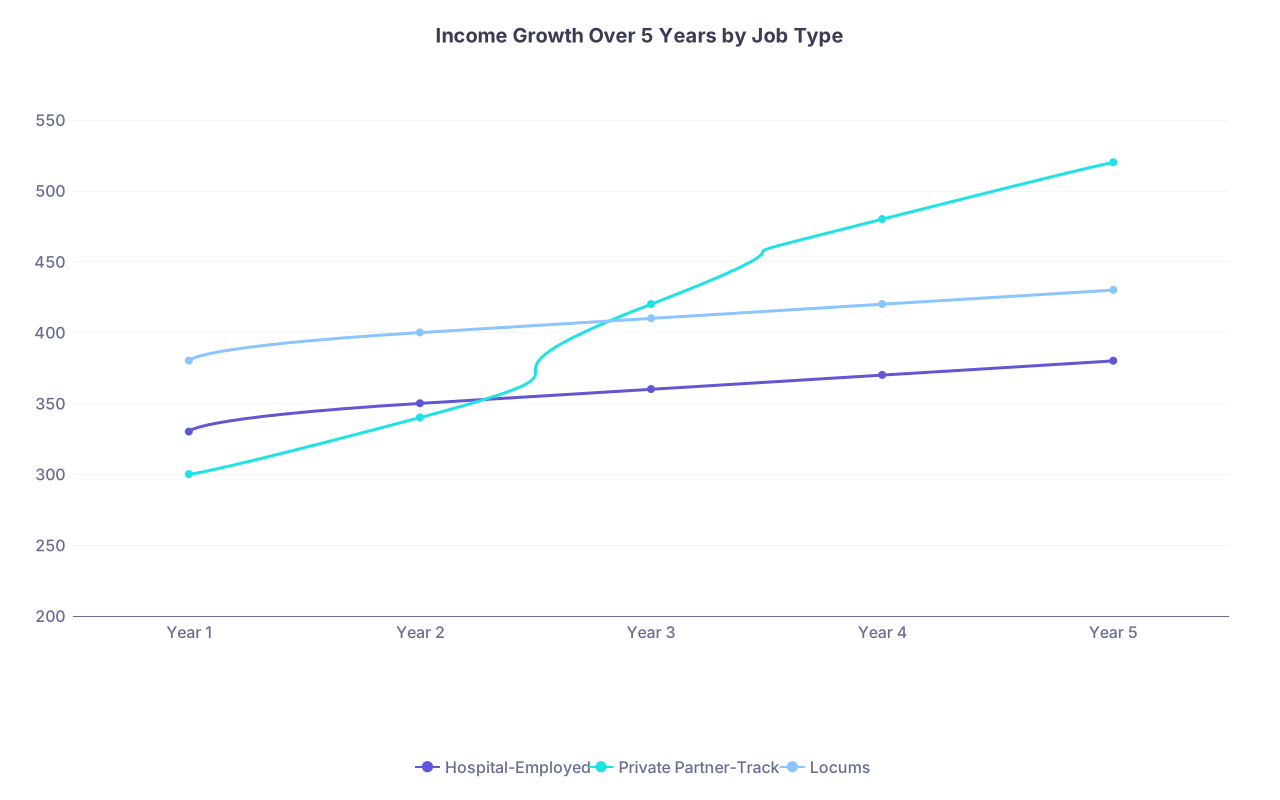
| Category | Hospital-Employed | Private Partner-Track | Locums |
|---|---|---|---|
| Year 1 | 330 | 300 | 380 |
| Year 2 | 350 | 340 | 400 |
| Year 3 | 360 | 420 | 410 |
| Year 4 | 370 | 480 | 420 |
| Year 5 | 380 | 520 | 430 |
Again, values are illustrative, but the pattern is real: hospital pay is smoother, partnership has a ramp then jumps, locums is high but flattish.
How to Evaluate a Specific Hospital-Employed Offer (Not Just the Idea)
Stop debating hospital vs private in the abstract. You’ll make smarter decisions looking at concrete offers.
Here’s a simple decision lens for a hospital-employed job:

| Step | Description |
|---|---|
| Step 1 | Hospital Offer |
| Step 2 | High risk - push for details or walk |
| Step 3 | Short term bridge only |
| Step 4 | Potential long term fit |
| Step 5 | Accept if lifestyle and pay fit |
| Step 6 | Clear compensation formula? |
| Step 7 | RVU/volume expectations realistic? |
| Step 8 | Noncompete limits future options? |
| Step 9 | Leadership and growth opportunities? |
Concrete things you must pin down before signing:
- Exact compensation structure
- Base salary
- RVU or productivity targets
- Bonus formula
- How often it’s recalculated
- Call expectations and compensation for call
- Noncompete radius and duration
- Who controls your clinic template and support staff
- Expectations for admin work (committees, meetings)
- How they handle underperformance and “right-sizing” clinics
Ask to see RVU or volume numbers of physicians currently in the role, not just what “could be achieved.”
A Pragmatic Strategy for Most New Attendings
You want a decision framework? Here’s the one I actually give to residents.
Pick location and specialty fit first.
A great job in a city you hate or far from your support system rarely feels great long-term. Decide your non-negotiables on geography and clinical scope.Within that, compare actual offers, not abstract models.
If your realistic choices are:- A hospital-employed job with solid pay and reasonable expectations, or
- A sketchy “partner-track” with no transparency and a long noncompete
The hospital job is better. Even if you “believe” in private practice.
Think in 3–5-year chunks, not forever.
Your first job is not your last job. A hospital-employed position can:- Buy you time
- Build your reputation
- Let you see how the local politics really work
Then, if you hate the bureaucracy, you pivot.
Do not sign anything with a suffocating noncompete unless you are genuinely okay staying in that system or leaving the region.
This is where new grads get trapped. A “safe” hospital job with a 50-mile noncompete can quietly lock you into a mediocre situation.Run the numbers like an adult.
Model:- Take-home pay after taxes and benefits
- Hours and call burden
- Realistic RVU or volume
- 3–5 year upside (raises, bonuses, partnership, etc.)
Then ask: “Does this trade of autonomy vs stability feel worth it to me right now?”
The Bottom Line: Is Hospital-Employed Really Better?
Sometimes. For some people. For some seasons of life.
Here’s the distilled answer you’re looking for:
- Hospital-employed positions are often better for new attendings who prioritize stability, benefits, and a lower administrative burden while they grow clinically and stabilize their lives.
- They are often worse for attendings who care deeply about autonomy, long-term income upside, and having real control over how they practice and grow.
- The right choice is not “hospital vs private” in theory—it’s which specific offer gives you the best mix of stability, autonomy, income, and future flexibility over the next 3–5 years.
Get clear on what you want your life to look like, then pick the structure that serves that—rather than defaulting to the supposedly “safe” hospital job because everyone around you is scared.


