

The worst financial decision many physicians make isn’t a bad stock pick. It’s a poorly evaluated partnership buy‑in.
Here’s the answer you’re looking for: partnership can absolutely be worth the buy‑in—but only if the numbers, control, and risk all line up in your favor. Most people over-focus on the prestige and under-analyze the math and governance.
Let’s fix that.
The Core Question: What Are You Actually Buying?
You’re not “buying partnership.” You’re buying a bundle of very specific things:
- A stream of future cash flow
- A share of control and decision-making
- A share of risk (legal, financial, reputational)
- Possibly, an eventual buy‑out when you retire or leave
If you can’t clearly define each of those four, you have no business signing anything.
At minimum, you should demand clear, written answers to:
- What exactly is the buy‑in amount and over what time period?
- What income do current partners make vs. non-partners, after all expenses and call differences?
- What is the practice worth today and how is that number calculated?
- How is the buy‑out calculated and funded when partners leave?
- Who controls major decisions (ownership %, voting rules, veto power)?
If the group gets vague, defensive, or annoyed when you press here, treat that as a loud warning siren.
Step 1: Run the Simple Payback Math
Start with the most basic question: how long until I earn back my buy‑in?
Let’s keep the model crude on purpose. You can refine later.
Say:
- Buy‑in: $300,000 (paid over 5 years = $60,000/year)
- Current employed comp: $350,000
- Projected partner comp: $500,000
Your annual pre-tax income bump is $150,000.
Simple payback period:
- $300,000 / $150,000 = 2 years to “break even” on the buy‑in
That’s actually pretty attractive—if the numbers are honest and stable.
Now look at a less pretty deal:
- Buy‑in: $500,000
- Employed: $400,000
- Partner: $475,000
Income bump: $75,000/year
Payback period: $500,000 / $75,000 ≈ 6.7 years
You’re tying up half a million dollars to (maybe) do better in 7 years. And that’s before job market shifts, reimbursement cuts, or hospital politics.
Use this as a first filter:
| Payback Time | Initial Reaction |
|---|---|
| ≤ 3 years | Worth serious consideration |
| 3–6 years | Depends heavily on risk & stability |
| > 6 years | Often not worth it |
Does this rule have exceptions? Sure. But if your payback is >6–7 years, the deal needs to be unusually safe and unusually well-structured to justify the risk.
Step 2: Compare “Partner Track” vs “Doctor With Options”
Too many physicians compare partnership to their current job only. That’s lazy thinking.
The real comparison is:
- Becoming a partner in this group
vs. - Staying employed or semi-employed elsewhere and investing your surplus income independently
That second path is more powerful than most people realize.
Example:
Option A – Partnership
- Buy‑in: $300,000 over 5 years
- Extra income vs employed: $150,000/year
- Net: You’re ahead financially in year 3 if income holds
Option B – Stay employed and invest
- No buy‑in
- You invest $100,000/year (the amount you could have used for buy‑in or taking more call, extra shifts, etc.) in a basic index fund
- Modest 6–7% annual return
After 10–15 years, Option B can absolutely compete, especially if partnership income is not dramatically higher—or if your group’s future is uncertain (hospital acquisition, declining volume, payor changes).
The point: “Partnership” isn’t the only route to wealth. It’s one route. You should compare it to alternatives, not just your current baseline.
Step 3: Dissect What Drives Partner Income
Partner income isn’t magic. It comes from somewhere: volume, payer mix, ancillary revenue, and leverage.
Ask specific, uncomfortable questions:
- What proportion of partner comp comes from pure clinical work vs. ancillaries (imaging center, surgery center, labs, real estate)?
- Are ancillaries already saturated, or are there growth opportunities?
- Who actually owns the ancillaries—physician group, separate LLC, or a mysterious “senior partner only” entity?
- How dependent is revenue on a single hospital, contract, or referrer?
If 40% of partner pay comes from a single hospital contract that’s up for renewal next year, your buy‑in is riskier than it looks.
Here’s how that risk often shows up in the real world:
- Hospital hires an employed group and drops your contract
- Private equity buys your practice and rewrites compensation
- DRG/fee schedule changes crush reimbursement for your bread-and-butter cases
If current partners dodge these questions or say “we’ve always been fine,” assume they haven’t truly stress-tested the model.
Step 4: Analyze Control, Governance, and Culture
Money isn’t enough. If you “own” 5% of a group run like a monarchy, you’re not really a partner. You’re a high-income employee with extra risk.
You want to see:
- Clear voting rules: majority, supermajority, items that require unanimous consent
- Transparent financials: regular P&L, balance sheet, partner distributions
- Defined authority: who negotiates contracts, hires/fires, sets compensation formulas?
- Fair path for new partners to gain meaningful influence over time
Watch out for:
- “Founding partners” with permanent extra votes or vetoes
- Opaque “executive committee” decisions that never get explained
- Culture where dissenters are quietly starved of referrals or OR time
I’ve watched talented physicians buy into groups where they had zero say in call distribution, hiring, or new project investments. They got the title and some income. They did not get real control.
That’s not partnership. That’s branding.
Step 5: Put the Risk on a Timeline
You’re not just asking, “Is this good now?” You’re asking, “What does this look like in 5, 10, 20 years?”
This is where a visual helps.
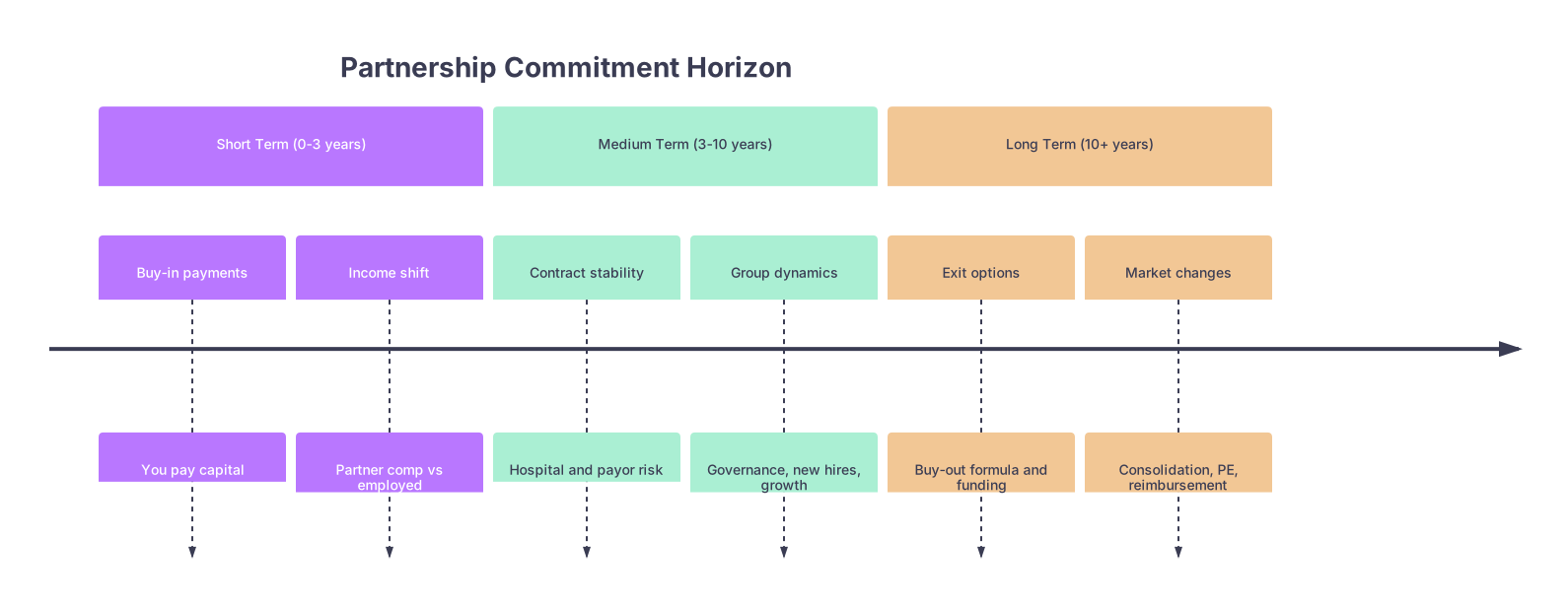
| Period | Event |
|---|---|
| Short Term (0-3 years) - Buy-in payments | You pay capital |
| Short Term (0-3 years) - Income shift | Partner comp vs employed |
| Medium Term (3-10 years) - Contract stability | Hospital and payor risk |
| Medium Term (3-10 years) - Group dynamics | Governance, new hires, growth |
| Long Term (10+ years) - Exit options | Buy-out formula and funding |
| Long Term (10+ years) - Market changes | Consolidation, PE, reimbursement |
Key questions by horizon:
Short term (0–3 years)
- Can you comfortably afford the buy‑in payments without wrecking your life?
- Are you taking on more call, admin, or headaches for this jump?
Medium term (3–10 years)
- How stable is your referral base and main hospital relationship?
- Is the group growing, stagnating, or shrinking?
- Are you bringing on more partners that will dilute income?
Long term (10+ years)
- How does the buy‑out work? Fixed formula? Tied to collections? Completely “to be determined”?
- Who actually funds your buy‑out—new partners, group savings, or no one (the “oops” model)?
- Are you building something that will exist when you’re ready to exit—or are you the last ones on the ship?
A great buy‑in with a garbage buy‑out is half a deal.
Step 6: Evaluate the Buy‑In Structure, Not Just the Amount
Two $300,000 buy‑ins can feel very different depending on structure.
You want clarity on:
- Amount: Fixed or adjustable? Tied to appraised value?
- Timing: Lump sum, payroll deduction, 3–7 year schedule?
- Interest: Is there interest on unpaid balance? At what rate?
- Source: Are you buying hard assets, AR, goodwill, shares in ancillaries?
- Security: What happens if you leave or get terminated halfway through?
Smart structures:
- Buy‑in tied to a reasonable multiple of earnings or a clear valuation formula
- Payments over a predictable period with modest interest (or none)
- Vesting schedules that aren’t punitive if something unexpected happens (e.g., spouse job move)
Stupid structures I’ve seen:
- Massive goodwill buy‑ins with no underlying assets, just “that’s what we’ve always charged”
- AR buy‑ins at face value when collections have been declining for years
- Partnership contingent on full buy‑in first, with no partial rights or protections
If you do not understand what each component of the buy‑in represents, slow down. Get someone to explain it until it’s boringly clear.
Step 7: Compare to Market Reality
Benchmarks matter. If your deal is wildly outside norms, you need a reason.
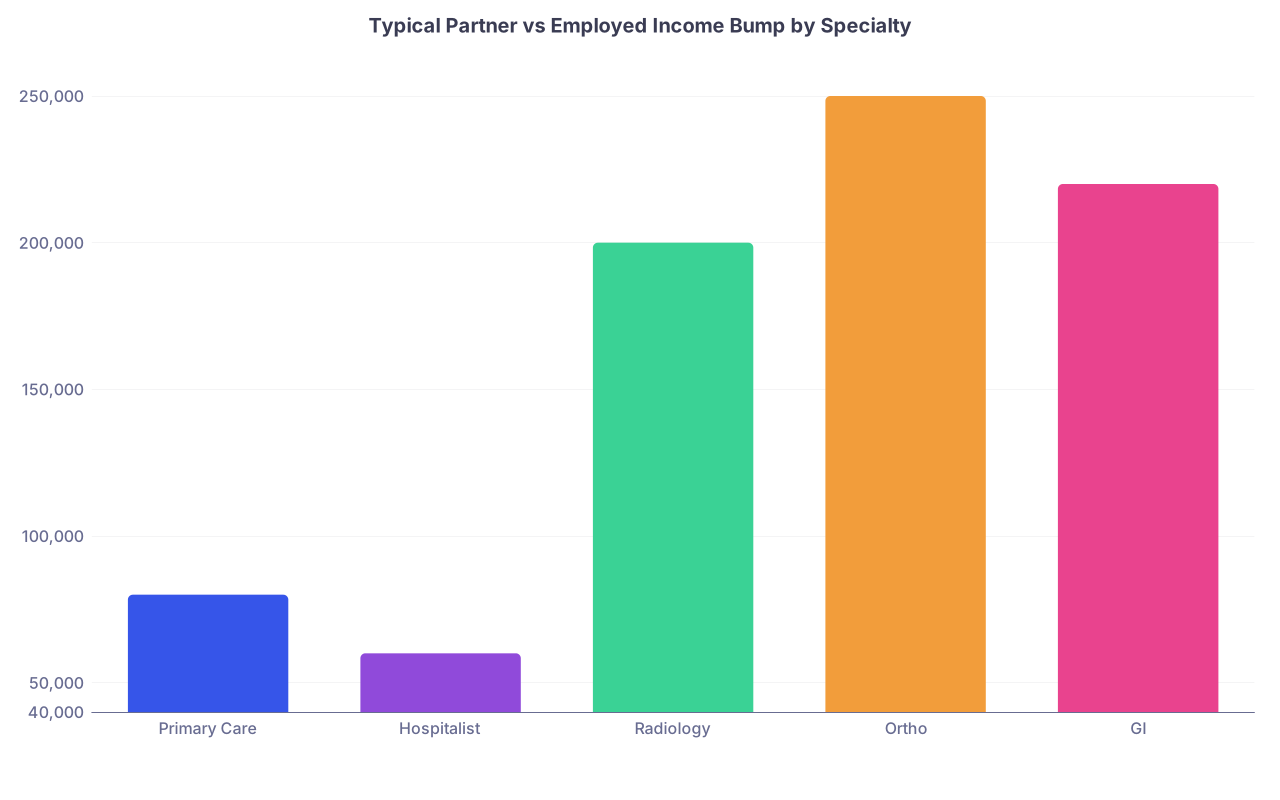
| Category | Value |
|---|---|
| Primary Care | 80000 |
| Hospitalist | 60000 |
| Radiology | 200000 |
| Ortho | 250000 |
| GI | 220000 |
Rough, common patterns:
- Primary care / outpatient IM: Small to moderate bump; partnership often more about control and ancillaries than huge comp swings
- Hospitalist: Sometimes minimal bump and more about scheduling/control; often not worth large buy‑ins
- Radiology / anesthesia: Historically big jumps, but increasingly consolidated and PE-influenced—details matter
- Procedural subspecialties (GI, ortho, cards): Can be huge upside, especially with ASC or imaging ownership—but also higher buy‑ins and more business risk
If your future partner income is only $20–30k higher than market employed comp, and the buy‑in is heavy, that’s a weak deal unless autonomy is your main priority.
Use MGMA, NERVES, AMGA, specialty society data, and frank conversations with peers in similar markets. You want to know:
- What do non-partner attending roles pay in your region?
- What do comparable group partners actually make—not their “best year ever” number?
- What’s happening to partnership models in your specialty overall (more consolidation, fewer true partnerships)?
Step 8: Use a Simple Decision Framework
Here’s the blunt framework I use when I walk people through this.
Partnership buy‑in is probably worth it if:
- Payback is ≤ 3–4 years using conservative income assumptions
- Governance is clear, fair, and gives you a real voice over time
- Revenue is diversified enough that one contract can’t destroy the group overnight
- Buy‑out is clearly defined and realistically fundable
- You actually want the non-financial parts of partnership: hiring decisions, culture work, strategic planning
It’s probably not worth it if:
- Payback is > 6–7 years and future earnings are uncertain
- Senior partners keep tight control and won’t share real numbers
- A single hospital or contract can pull the rug out at any moment
- The group talks a lot about “family” but refuses to put protections in writing
- You’re already burned out and the idea of more responsibility makes your stomach knot
And there’s a third option people ignore: delay.
Sometimes the smartest move is:
- Negotiate a 1–2 year “trial attending” period with full transparency of partner-level financials
- Get the books, understand the culture, see upcoming contract renewals
- Revisit buy‑in when you can make the decision with real data, not promises
FAQ: Partnership Buy‑In
1. How big is a “normal” partnership buy‑in for physicians?
Varies widely by specialty and market, but common ranges:
- Primary care: $50k–$150k
- Hospital-based (rad/anesthesia/path): $150k–$400k
- Procedural with ancillaries (GI, ortho, ophtho): $250k–$750k+
What matters more than the sticker price is the payback period and what you actually own (assets, ancillaries, goodwill, real estate).
2. Should I ever borrow to fund a partnership buy‑in?
Yes, you can—but only if:
- The after-tax increase in compensation clearly exceeds the loan payments with margin
- The deal still looks good under conservative assumptions (lower collections, fewer cases)
- You’re not already drowning in other high-interest debt
Think like an investor: would you borrow $300k for a business that someone else controls, with unclear future earnings? If the answer would be “absolutely not” outside of medicine, be careful.
3. What red flags should immediately make me rethink a buy‑in?
A few big ones:
- “We don’t share detailed numbers until after you’re a partner”
- No written buy‑out policy or it’s “case by case”
- Major hospital or payor contracts up for renewal with known tensions
- Founding partners with different, permanent economic rights
- Huge “goodwill” component with no logical valuation basis
You’re not being difficult by pushing on these. You’re being rational.
4. How much does autonomy matter versus money?
Enough that you should name it explicitly. Some physicians would happily take $50k less per year to control their schedule, hire their colleagues, and shape their practice culture. Others just want to see patients and go home. If you do not care about governance or business-building, an employed or hybrid model with good comp and less responsibility can be a better fit.
5. Who should review my partnership offer?
At minimum:
- A healthcare-savvy attorney (not just your neighbor who does divorces)
- A CPA or financial planner who understands medical groups and buy‑ins
- One or two trusted physicians not in your group who’ve been through partnership decisions
You’re about to commit hundreds of thousands of dollars and years of your life. Spending a few thousand on expert review is not optional; it’s cheap insurance.
Key takeaways: treat a partnership buy‑in as a business investment, not a rite of passage. Run the math on payback, stress-test the risks, and scrutinize governance and buy‑out terms. If the numbers, control, and risk profile all make sense—and you actually want the responsibility—partnership can be one of the best moves of your career. If not, walk away and build wealth on your own terms.


