
The standard myth that “real research only happens at big academic centers” is wrong. Dead wrong.
If you want to build a research career in a community practice setting, you absolutely can. But it will not look like the classic R01-funded, 80%-protected-time, lab-down-the-hall academic fairy tale. Different game, different rules, different metrics of success.
Let me walk you through what is actually possible, what’s fantasy, and how to build something real and sustainable.
The Short Answer: Yes, But You Must Redefine “Research Career”
You can build three broad types of research careers in community practice:
- Clinical / outcomes / pragmatic research rooted in real-world practice
- Quality improvement (QI) and implementation work that occasionally crosses into publishable science
- Industry-sponsored or network-based clinical trials
What you are very unlikely to do in a pure community practice:
- Run a basic science lab
- Hold major independent (R01-level) federal funding with big infrastructure
- Have 50–80% protected time purely for research on a community RVU contract
If your picture of “research career” is bench science and multiple large NIH grants, you’re fighting gravity. If your picture is: “I want to regularly ask good clinical questions, collect data, publish, present, and be known regionally or nationally for my work, while seeing patients in a community setting,” then you’re in business.
Step 1: Be Bluntly Clear About What You Want
Before you sign that first job contract, decide which of these you actually care about:
- I want to publish a few papers and present at meetings, mostly for intellectual satisfaction.
- I want research to be a core part of my identity—10–30% of my time, ongoing projects, maybe leadership roles.
- I want to be a regional or national leader in a niche, with grants, networks, and a reputation.
Those are very different goals.
Here is the reality in most community jobs:
| Path Type | Time Allocation | Funding Source | Feasibility Level |
|---|---|---|---|
| Small QI + case reports | 5–10% | Internal / unfunded | Very High |
| Multi-center trials | 5–20% | Industry / consortia | Moderate–High |
| Prospective cohort work | 10–30% | Internal + small grants | Moderate |
| R01-style independent lab | 50–80% | NIH/major agencies | Very Low |
If your answer is “I want 50% protected time and an R01 in a small community hospital with no research office,” that’s not ambition, it’s denial.
If your answer is “I want to build a strong track record of meaningful clinical research, maybe 10–30% of my time, while doing real-world medicine,” then we can build a practical plan.
Step 2: Know What Kind of Research Actually Works in Community Settings
The most successful community-based research careers focus on work that fits the environment and leverages what you have: patients, volume, real-world messiness, and clinical questions nobody at a tertiary center is asking.
Sweet spots for community-based research
Real-world outcomes and practice-based research
Examples:- Comparing outcomes before and after a new care pathway in your ED or clinic
- Studying adherence, no-show rates, or telehealth outcomes in underserved populations
- Looking at readmission rates after implementing a new discharge protocol
This is where large academic centers often fail because their populations are weirdly selected. Your “ordinary” clinic is their missing data.
Quality improvement efforts that are publishable
You’re already being pushed to do QI: sepsis bundles, diabetes metrics, readmissions, anticoagulation management. Most QI projects die in committee. A fraction become abstracts. Even fewer become papers.
If you learn to:- Start with a true question
- Use a simple but real design (pre–post, interrupted time series, cluster)
- Collect clean data and a few patient-centered outcomes
—you can turn routine QI into a publishable research stream.
Industry-sponsored trials and registries
Especially in oncology, cardiology, rheumatology, neurology, GI, and some surgical subspecialties.
Community sites are attractive to sponsors because:- You see “typical” patients
- You can enroll faster
- Patients may be more stable and local than tertiary referral populations
You can build a legit research identity as the “go-to” PI or high-enrolling site in multi-center trials.
Practice-based research networks (PBRNs)
Family medicine, primary care, pediatrics, and some specialty groups have networks specifically designed for community clinicians to participate in research.
Often, the network:- Supplies the protocol
- Provides data infrastructure
- Offers mentorship and co-authorship opportunities
If your work fits one of these lanes, you’re aligned with reality.
Step 3: Design Your Job for Research From the Start
The single biggest mistake: residents pick a job purely on salary/location, then six months later ask, “Can I get some protected time for research?” That’s backwards.
You negotiate research into the contract up front. Not as an afterthought.
What to push for, explicitly and in writing:
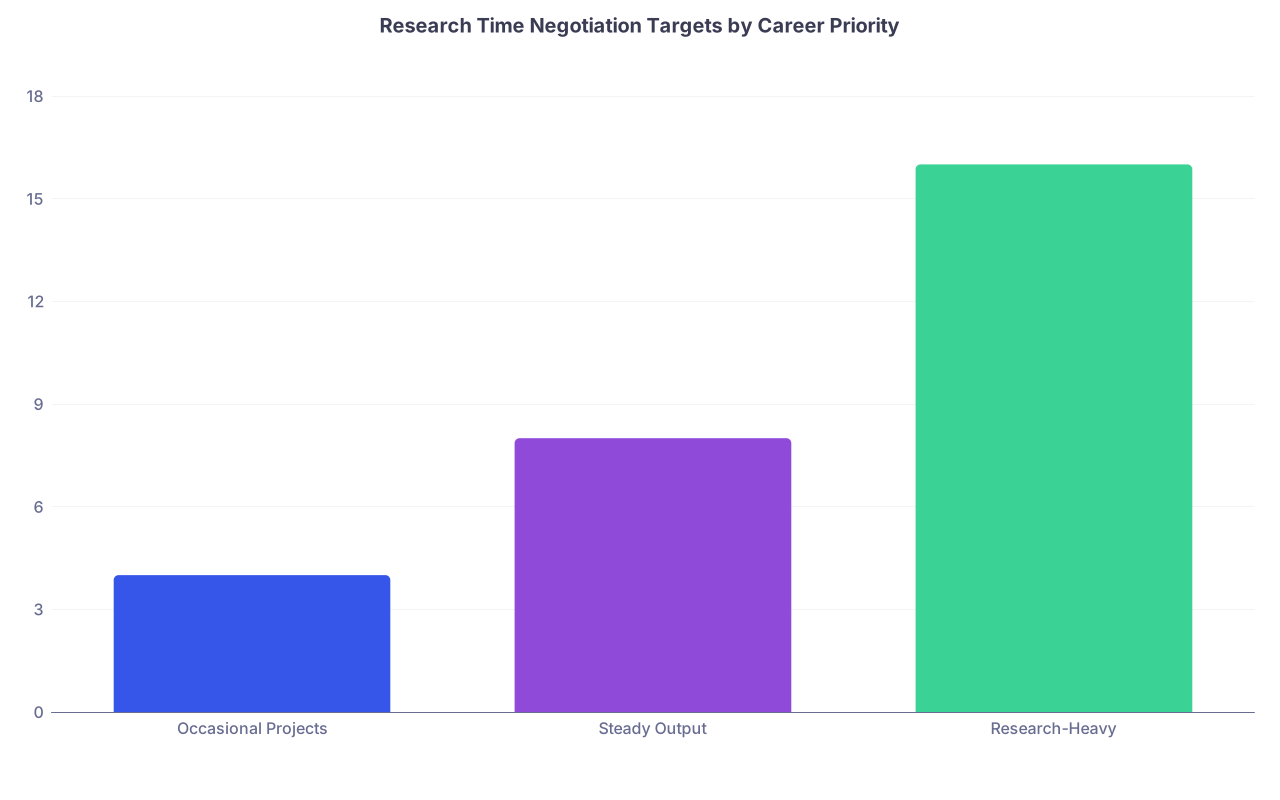
| Category | Value |
|---|---|
| Occasional Projects | 4 |
| Steady Output | 8 |
| Research-Heavy | 16 |
(Values are typical weekly protected-hours targets.)
Protected time
For “steady output,” ask for at least 0.1–0.2 FTE (half a day to a day per week) labeled as “research / scholarly activity.”
Don’t accept “you can do research on your own time.” That’s not a research career; that’s a hobby.Clear RVU expectations
Protected time must be excluded from RVU targets. Otherwise you’re just expected to hit full clinical numbers and do “research” anyway.Support infrastructure
Ask very specifically:- Is there a research office?
- Who handles IRB submissions?
- Is there a data analyst or can I access an EHR data pull?
- Who manages budgets and contracts for industry trials?
Money
You’re unlikely to get a big salary bump for “doing research” in community practice. The real currency is time, support staff, and reduced pressure on clinical metrics.
If you start in a group that has zero interest in research, no data access, and no appetite to change that, you can still publish—but you won’t build a research “career.” You’ll be moonlighting as a researcher.
Step 4: Make Collaboration Your Default Strategy
The smartest community researchers are “connectors,” not lone wolves.
You can plug into three main networks:
Academic partners
Keep your residency or fellowship connections alive. I’ve seen this pattern work very well:- You have the patient population and the clinical question.
- Academic partners provide expertise in design, stats, and grant writing.
- You’re site PI or co-PI, they’re methodologic lead.
You get publications and presentations without inventing an entire research ecosystem alone.
Regional or national consortia
Examples:- Oncology cooperative groups
- Cardiology device registries
- Primary care practice-based research networks
These come with a big advantage: infrastructure and pre-built protocols. You contribute patients and data; in return, you get authorship, leadership roles, and a track record.
Industry and device/pharma sponsors
Yes, industry research has baggage. It also has money, monitors, and CRA support.
If you:- Are selective about which trials you run
- Maintain clinical integrity
- Keep clear separation between clinical decisions and trial incentives
—industry trials can be a solid piece of a community research portfolio.

| Step | Description |
|---|---|
| Step 1 | Community Clinician |
| Step 2 | Academic Partner |
| Step 3 | Research Network |
| Step 4 | Industry Sponsor |
| Step 5 | Protocol Design |
| Step 6 | IRB and Startup |
| Step 7 | Patient Enrollment |
| Step 8 | Data Analysis |
| Step 9 | Manuscript and Presentation |
| Step 10 | Research Question |
Step 5: Start Small, Then Systematize
Your first couple of projects should be painfully simple:
- A high-quality case series.
- A pre–post study of a protocol change.
- Participating as a site in a straightforward industry trial.
The goal of the early phase is not to win awards. It’s to prove three things:
- You can enroll patients and collect data reliably.
- You can get an IRB application processed without losing your mind.
- You can get something—anything—accepted as an abstract or paper.
Once you’ve done that, then you start building systems:
- Standard templates for data collection
- Clinic workflows for screening and enrolling
- A relationship with the research office / IRB staff
- A list of go-to collaborators and statisticians
Over time, your “projects” become a program. Example of a realistic evolution in a community cardiology practice:
Year 1–2: Case series on a new device, one industry-sponsored trial site.
Year 3–5: Multiple device and drug trials, QI-based paper on readmissions, a registry contribution.
Year 5–8: Regional PI in a network, co-investigator on a grant led by an academic partner, 2–4 publications per year, talks at national meetings.
That’s a real research career. Nobody cares that your badge says “Community Hospital” instead of “Big Name University.” They care about your output and your contributions.
Step 6: Understand the Trade-offs and Limits
You do give up things in a community-based research career:
- Less proximity to students and residents (though some community hospitals have them).
- Less access to full-time statisticians, methodologists, and grant offices.
- Less institutional prestige when chasing large federal grants.
You gain other things:
- Access to “real” patients with fewer selection biases.
- More autonomy to define your niche.
- Often, more stable income and a more livable clinical schedule.
You’re also playing with different metrics of success:
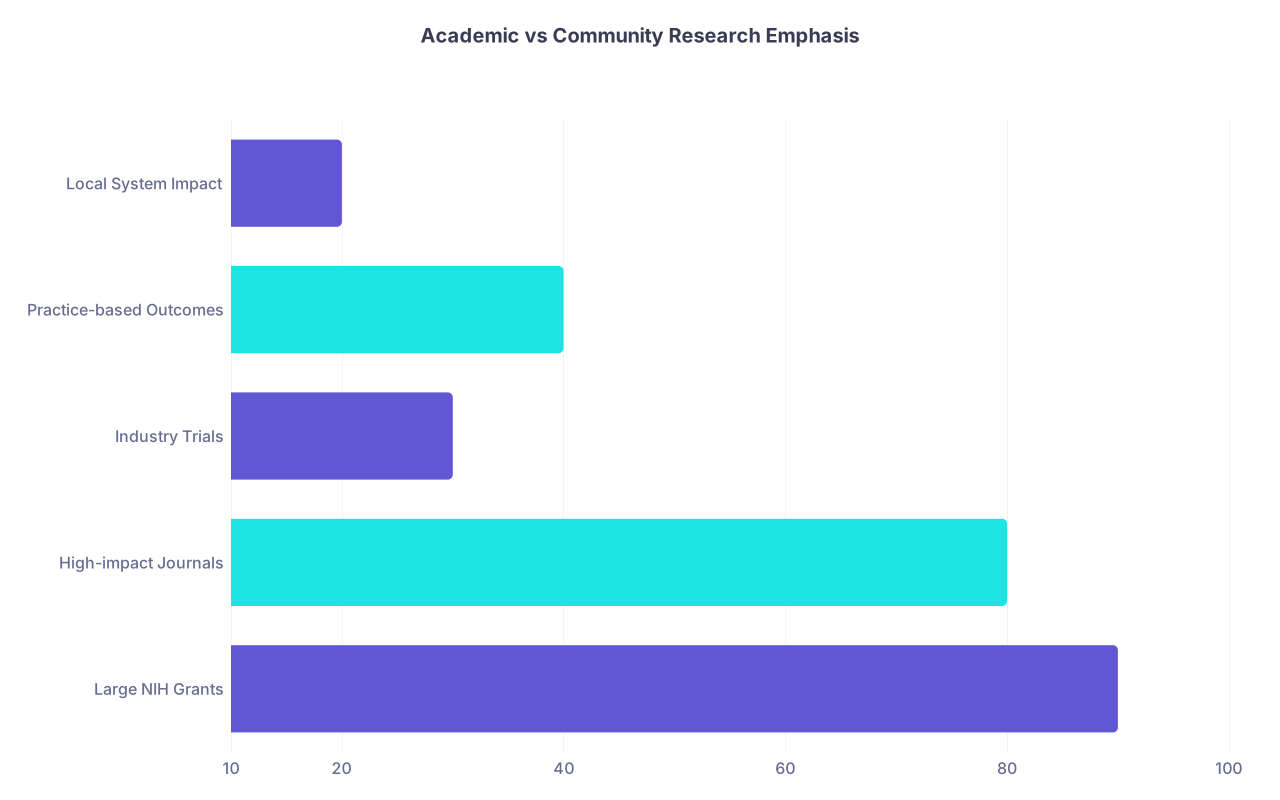
| Category | Value |
|---|---|
| Large NIH Grants | 90 |
| High-impact Journals | 80 |
| Industry Trials | 30 |
| Practice-based Outcomes | 40 |
| Local System Impact | 20 |
In an academic setting, the left side dominates. In a community setting, the right side does.
If your ego needs Nature and NEJM every few years, you’re making this harder. Can it happen from community practice? Rarely, yes, with the right collaborations. But your baseline should be solid specialty journals, high-quality implementation papers, and meaningful trial work.
Step 7: Guard Your Time Ruthlessly
Biggest risk: you become the “research person,” so everyone dumps random junk on you:
- “Can you just write this up for publication?”
- “We’re doing this new EHR template—maybe make it a paper?”
- “Admin wants another QI project for the dashboard.”
You say no. A lot.
You prioritize:
- Projects with clear methods, clear outcomes, and feasible data.
- Work that builds a coherent narrative in one or two topical areas.
- Collaborations where authorship and roles are explicit up front.
The people who flame out are the ones who scatter themselves across ten unrelated projects that never finish.
Use a simple screen before you say yes:
| Question | If Answer is Yes |
|---|---|
| Clear, focused research question? | Proceed to next filter |
| Access to needed data and patients? | Consider seriously |
| Named statistician/methods support? | Strong green flag |
| Authorship and role defined in writing? | Avoid future conflict |
| Fits your long-term niche? | Highest priority |
So, Can You Build a Research Career in Community Practice?
Yes. If you:
- Redefine “research career” toward clinical, outcomes, QI, and trials work.
- Negotiate time and support into your job from day one.
- Build tight collaborations with academic partners, networks, or industry.
- Start small, then turn one-off projects into a focused program.
- Ruthlessly protect your time and only pursue projects that move your niche forward.
Do that for 5–10 years, and you won’t be “the community doc who dabbles in research.” You’ll be the person people call when they want to actually test something in the real world.
FAQ (Exactly 5 Questions)
1. Is it realistic to get NIH or major federal grants in a community setting?
Rare, but not impossible. It usually happens in one of two ways:
- You’re a co-investigator or site PI on a multi-center grant led by an academic institution, or
- You’re part of a larger health system with a robust research arm, and your “community” site is functionally part of their infrastructure.
For a standalone community hospital or private practice with no research office, chasing big NIH grants as PI is usually not a good use of time early on. Build your track record first with smaller grants, industry work, and collaborations.
2. How much protected time do I actually need to make research a real part of my career?
For ongoing, meaningful research output, 0.1–0.2 FTE (half to one day per week) is the bare minimum. If that’s all you have, you must be selective and focused. If you want to lead multiple trials or manage a small program, 0.3 FTE is much more realistic. Anything under 0.1 FTE and you’re relying heavily on nights and weekends—it can work early on, but it’s not sustainable as a “career.”
3. Can private practices (not hospital-employed) realistically do research?
Yes, especially in subspecialties where industry trials are common. I’ve seen private oncology and cardiology groups run very efficient trial programs. The key is having at least one part-time research coordinator, clear financial arrangements for trial revenue, and a physician champion who is serious about quality and compliance. Solo or tiny practices can still produce case reports, small retrospective series, and participate in registries, but building a major research portfolio is harder without scale.
4. Will doing research in community practice hurt my income?
Short term, it can. Protected time usually means fewer clinic sessions or procedures. Long term, it can balance out or even help, depending on:
- Revenue from industry trials
- Promotion into leadership roles (medical director, research director)
- Opportunities such as speaking, consulting, or guideline work that come from your research profile
If your only goal is maximizing RVUs and take-home pay, deep research involvement will compete with that. If you want a blended career of clinical work + research impact, you accept some trade-off in raw clinical productivity.
5. If I eventually want to move back into academia, will community-based research help or hurt?
Done right, it helps. What academic departments want to see is:
- A coherent body of work in a defined area
- Evidence you can complete projects and publish
- Ability to collaborate and bring something unique (like a real-world patient population)
Community experience can be a selling point if you’ve generated solid clinical research, led multi-center trials, or developed respected QI programs. What hurts you is a long gap with no scholarly output, or a CV full of unfocused, unfinished projects. If you keep publishing and stay visible at meetings, you’ll remain competitive for hybrid academic-community roles later.


