

The worst career mistakes doctors make after residency are about priorities, not contracts.
You’re not actually choosing between “jobs.” You’re choosing between three levers—salary, location, and mentorship—and whichever one you overvalue will quietly run your life for years.
Let me be blunt: for your first attending job, mentorship should usually win. Salary is second. Location is third. And yes, there are exceptions—but fewer than people like to admit.
Let’s walk through this in a way that actually helps you decide.
The Real Tradeoff: Now Money vs Lifetime Trajectory
Your first attending job isn’t about your peak earning years. It’s about your learning curve and your reputation curve.
In your first 3–5 years, you’re:
- locking in your clinical style
- building your professional identity
- establishing your referral patterns and niche
- cementing habits (good and bad) that will be hard to change later
The job that gives you the highest short‑term income is very rarely the job that gives you the steepest growth curve.
Think of it this way:
- A $40–60k pay difference in your first job looks huge when you’re jumping from $70k to $300k.
- Over a 20–30 year career, that early difference is noise compared to:
- becoming the go‑to subspecialist who can command better offers later
- avoiding burnout that pushes you to cut back hours or leave clinical work
- avoiding practice patterns that get you on the radar of risk management
So the question isn’t “salary vs location vs mentorship?”
It’s: what combination of those three gives you the steepest long‑term trajectory with the lowest chance of hating your life?
How I’d Rank Them for Most New Attendings
Here’s my default ranking for your first job out of residency/fellowship:
- Mentorship and culture
- Scope of practice and workload (hidden fourth category, but critical)
- Salary
- Location
Does that mean location never matters? No. If your spouse’s job, your kids’ needs, or immigration issues hinge on geography, location moves up the list. But if you can be flexible, you’d be crazy not to use that flexibility to buy mentorship and a sane practice.
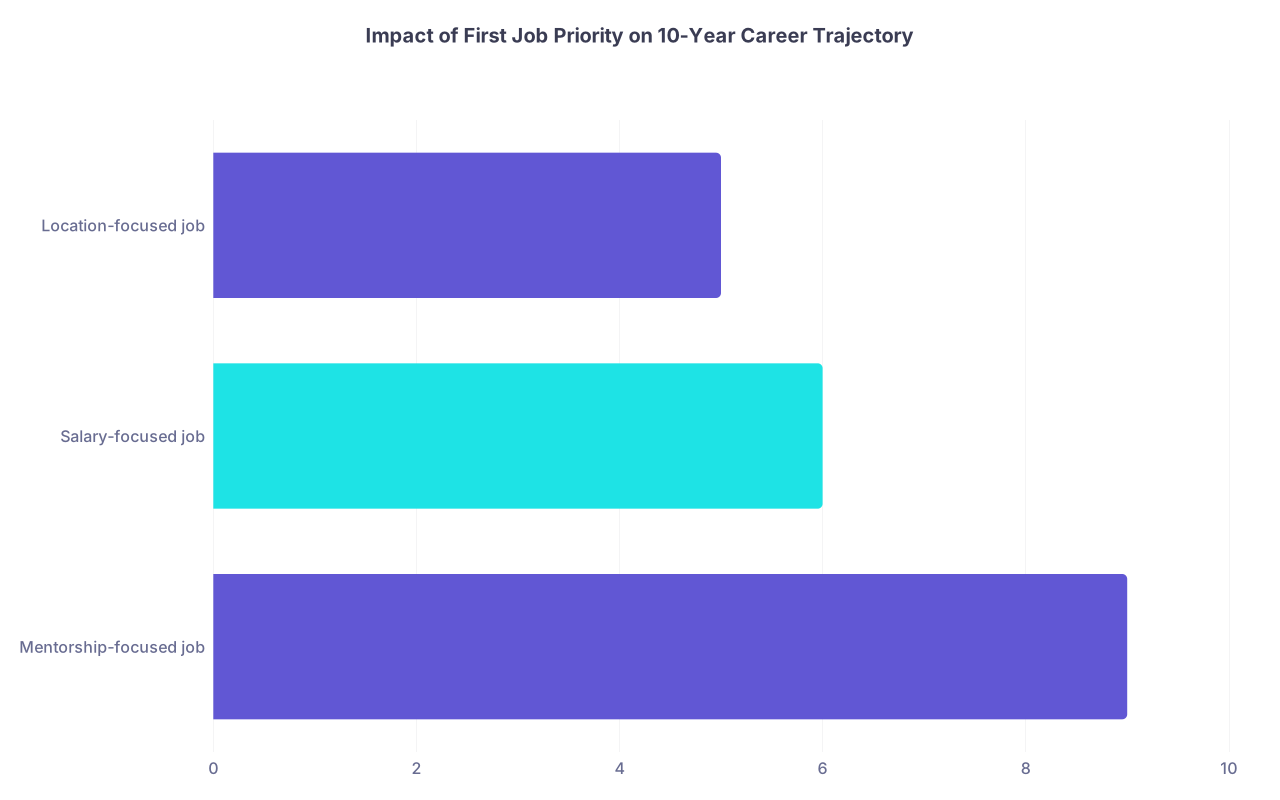
| Category | Value |
|---|---|
| Mentorship-focused job | 9 |
| Salary-focused job | 6 |
| Location-focused job | 5 |
(Scale of 1–10, where 10 = best long‑term career growth. Not scientific, but very consistent with what I’ve seen.)
How to Think About Salary (Without Getting Trapped)
Everyone focuses on the starting number. Almost no one looks at the shape of the earnings curve.
Key questions that actually matter:
- Is there a guaranteed base, or pure RVU/production from day one?
- How long is the guarantee? 1 year vs 3 years is a big deal.
- Does the compensation ramp with experience and volume, or is it capped and flat?
- Are they “buying down” bad call with money, or is the money actually fair?
- What’s the non-compete, and how handcuffed will you be if you hate it?
| Scenario | Short-Term Pay | Long-Term Upside |
|---|---|---|
| High base, weak mentorship | High | Moderate |
| Moderate pay, strong mentorship | Medium | Very high |
| Pure RVU, minimal support | Variable | Low–moderate |
| Academic, low pay, strong mentorship | Low | Moderate–high |
Where new grads get burned:
- They chase the top-line salary in a location they like, with no real support. Year 1 is “fine.” Year 2–3 they’re drowning, making errors, or burning out. Then the non-compete bites and they’re stuck.
- They underestimate how much inefficiency and chaos erode that shiny salary. Poor support staff, dysfunctional EMR, horrible OR efficiency—all of that turns “$450k” into “I will pay to get out of here.”
Reasonable rule of thumb for a first job:
If you’re within ~10–20% of regional market salary but getting excellent mentorship and a survivable workload, you’re not “underpaid.” You’re buying an education and a launchpad.
You can renegotiate or move after 2–3 years. You can’t easily undo the consequences of growing up professionally in a toxic or unsupported environment.
How to Think About Location (Without Romanticizing It)
Residents say this all the time:
“I really want to be near family.”
“I’ve always wanted to live in [big coastal city].”
“I could never live in [small town / midwest / rural].”
Sometimes that’s legit. Other times it’s just fear of the unknown dressed up as preference.
Location should jump to the top of the list if:
- Your partner’s career is geographically constrained
- You share custody or have family responsibilities that truly lock you in
- You’re on a visa and options are limited
- A specific city is non-negotiable for your mental health or identity
But here’s the catch: location can’t fix a bad job.
You’ll see this pattern:
- People who choose “dream city” but land in a malignant or unsupported job end up with:
- zero time to enjoy the city,
- resentment of the cost of living, and
- a compromised early career.
- People who choose a “meh” city but land in a supportive job with good mentorship:
- grow faster,
- often can negotiate remote/part-time/locums options later,
- and can then move to the dream city on their terms, not desperate terms.
Candid take: If you’re 2–3 years out, single or flexible, and not locked down by family obligations, treat location as a lever, not a destination. Use it to get leverage on salary and mentorship.
Why Mentorship Is the Real Multiplier
Here’s where most new attendings underestimate things.
A good mentor in your first job can:
- quietly protect you from dangerous patients, cases, or politics
- show you how to structure your clinic or OR day so you’re not buried
- coach you through your first bad outcome or complaint
- help you build a niche (procedural, academic, leadership) that boosts long-term income
- write real recommendation letters if you move jobs
- teach you what not to tolerate in future contracts
You don’t need a formal “assigned mentor.” You need:
- senior partners or attendings who like teaching and are actually present
- a culture where asking questions isn’t seen as weakness
- time and space in your schedule to learn, not just crank RVUs
- leadership that remembers you’re a new attending, not a plug-and-play RVU generator
Red flags that there is no real mentorship, no matter what they say:
- “You’ll be independent from day one, we trust our doctors.”
- “We all practice very autonomously here.” (But no one can tell you who you’d actually go to for help.)
- No structured onboarding, no shadowing period, no reduced schedule initially.
- You’re replacing three people who left in under two years.
If you find a job with:
- slightly lower salary
- less-than-perfect location
- but clear, accessible mentorship and a sane environment
You should give that job very serious consideration. That’s the launchpad.
A Simple Framework to Decide Between Real Offers
You’ve got 2–4 offers on the table. They all blur together after a while. Use this:
Rate each job from 1–5 in these categories:
- Mentorship & culture
- Scope of practice & workload
- Salary & benefits
- Location & personal life fit
Be brutally honest. Then look at the pattern.
| Factor | Job A | Job B | Job C |
|---|---|---|---|
| Mentorship & culture | 5 | 2 | 3 |
| Scope/workload | 4 | 2 | 4 |
| Salary & benefits | 3 | 5 | 4 |
| Location/personal fit | 2 | 5 | 3 |
In this example:
- Job B is the “dream city, big money, sink or swim” situation.
- Job A is “less ideal location, okay money, excellent mentorship and workload.”
- Job C is compromise across the board, but not outstanding anywhere.
If you’re optimizing for your whole career rather than the next 12 months, Job A is usually the smarter play.
To make this feel less abstract, sketch your 3-year and 10-year self:
- 3-year self: What skills, procedures, or roles do you want to be competent in?
- 10-year self: What kind of schedule, leadership, niche, or income bands do you want?
Then ask: which job makes it most likely that both of those versions of you exist?
Red Flags and Green Flags for Each Priority
Let’s be very concrete. You can use this on your next site visit.
If the job is selling hard on salary:
Red flags:
- “We’re way above MGMA percentiles.” (Why? Usually because no one stays.)
- Massive sign-on bonus but aggressive non-compete.
- Heavy call with vague promises that it “usually isn’t that bad.”
- No specifics on mentoring, onboarding, or protected time.
Green flags:
- Transparent productivity data from current partners.
- Stable group with low turnover.
- Clear plan to taper from base to RVU over 2–3 years, not 6 months.
If the job is selling hard on location:
Red flags:
- “People love it here!” with no actual data on physician turnover.
- Everyone you meet seems rushed, cynical, or vague.
- You’re told “you’ll grow into mentorship” but can’t meet any likely mentors.
Green flags:
- Colleagues actually like living there and can articulate why beyond “cheap” or “nice schools.”
- Multiple senior docs have been there >7–10 years and aren’t quietly screaming for help.
If the job is selling hard on mentorship:
Red flags:
- All the “mentors” are also drowning clinically.
- No structured time for teaching or review; it’s all theoretical.
- They can’t show you examples of how they’ve onboarded and developed prior hires.
Green flags:
- Reduced schedule or call during the first 3–6 months.
- Named attending(s) you’ll work closely with, who are present, not just on paper.
- Specific examples: “Our last hire started with X, now does Y, and here’s how we helped.”
How Your Priorities Should Shift After the First Job
This is “Post Residency and Job Market,” not “for the rest of your life.”
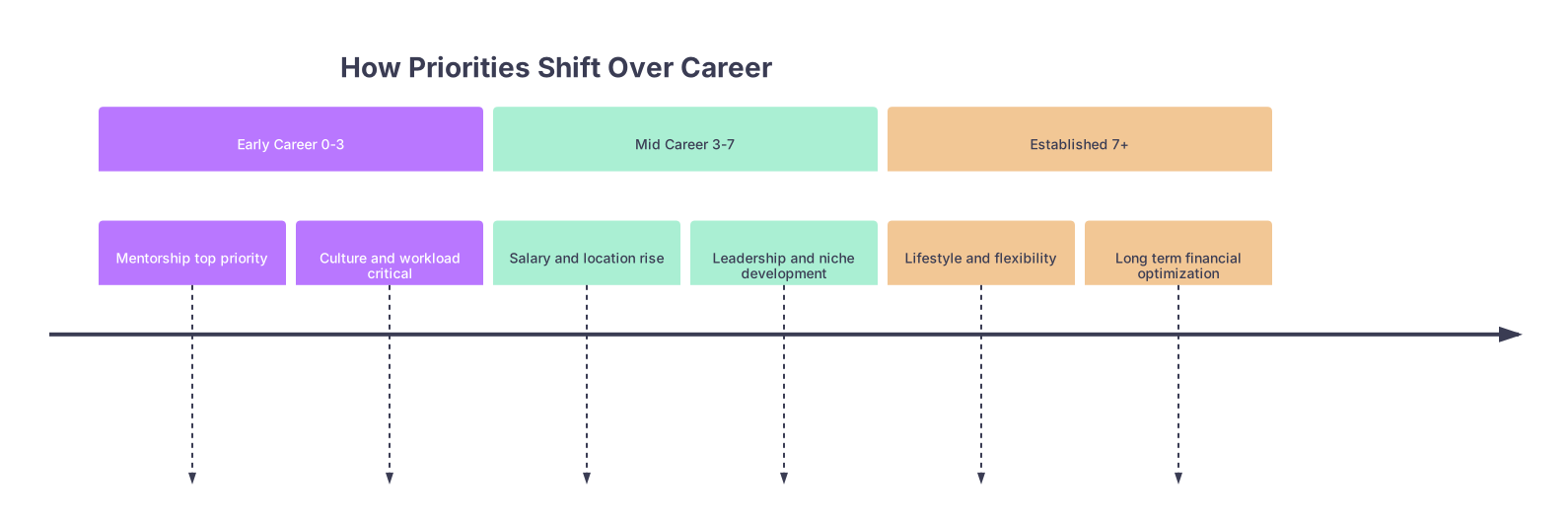
Here’s the general arc that actually works:
- First job (years 0–3): Overweight mentorship, culture, and good habits, with “good enough” pay and acceptable location.
- Second job (years 3–7): You now know your style, niche, and limits. Push harder on salary and location, but don’t abandon culture.
- Later moves (beyond ~7–10 years): You optimize around lifestyle and leverage. You have a reputation, skills, and options.
You don’t need the “perfect” first job. You need a first job that doesn’t damage your long‑term options.
And when you force yourself to choose, favor the boss/partners you trust over the city you fantasize about or the paycheck that makes your eyes light up.
FAQs
1. Is it ever smart to prioritize salary first in my first job?
Yes—but rarely. If you have massive high-interest debt, major family financial obligations, or a very strong internal compass clinically (for example, you’ve basically functioned as junior faculty during fellowship with strong mentors), then a high-paying, less-supported job can be a calculated short-term play. Even then, I’d limit that to 2–3 years and have an exit plan, because bad habits and burnout creep up fast.
2. What if my dream location only has mediocre jobs?
Then you decide what you’re willing to trade. One option: take a 2–3 year job with great mentorship elsewhere, build skills and a strong CV, then deliberately target that dream location later with more leverage. Another option: take the mediocre job but be ruthless about guarding your learning—seek external mentors, conferences, courses, and be ready to leave if the environment is corrosive.
3. How do I actually assess mentorship during an interview?
Ask concrete questions. “If I have a tricky case in my first six months, who do I call? Can I meet them today?” “What did onboarding look like for your last new hire?” “Can I see my schedule template for month 1, month 3, month 12?” Vague answers mean there is no real plan. Good programs love talking about how they develop people.
4. I’m scared of being ‘stuck’ if I choose wrong. How trapped will I be?
You’re less trapped than you think, unless you sign a brutal non-compete or buy-in contract without reading it. Most new attendings change jobs within 3–5 years. The main risks are reputational (if you burn bridges) and geographic (if your non-compete blocks your preferred city). Protect yourself contractually, leave professionally, and treat the first job as a training ground, not a life sentence.
5. What’s one concrete rule you’d give for choosing between two offers?
If one job has clearly better mentorship/culture and survivable pay, and the other has clearly better salary/location but weak support, pick the mentorship job almost every time. As long as you’re not putting your family in financial danger, the long-term return on strong mentorship and a healthy practice environment absolutely crushes the short-term win of a slightly bigger paycheck in a cooler city.
Key points, no fluff:
- For your first job, mentorship and culture usually matter more than salary or location.
- Use location and flexibility as leverage to buy mentorship, support, and a sane workload.
- Treat the first 2–3 years as your “attending fellowship”—optimize for your trajectory, not just your paycheck.


