

You’ve just finished training abroad. Maybe it was a full residency in the UK, fellowship in Canada, a surgical program in Germany, or time as a registrar in Australia because the US door was closed when you graduated. Now you’re back in the US (or about to be), and you’re staring at a mess of questions:
Will US systems recognize what you did?
Are you basically a new grad again?
How do you actually get a job—or back into training—without wasting another 3–5 years?
This is the playbook for that situation. No theory. Just what to do—and what not to do—if you’re re‑entering the US market after training abroad.
Step 1: Get brutally clear on your current status
Before you send a single email, you need to know where you actually stand in the US ecosystem. Not how things “should” translate. How they do translate.
There are really three big buckets:
- You already have US residency + board eligibility, and you did additional training abroad.
- You trained entirely abroad and are an IMG with ECFMG certification.
- You’re somewhere messy in between (research years abroad, partial training, non‑US MD degree, etc.).
Let me walk you through how each plays out.
| Scenario | US View of Your Training | Typical Next Step |
|---|---|---|
| US residency + foreign fellowship | Strong, often valued | Apply for US jobs directly |
| Full foreign residency, no US training | Variable, often not equivalent | Re-apply via Match or non-ACGME roles |
| Partial foreign training | Mostly ignored | Start over in US residency |
| US MD + years abroad, no residency | At-risk profile | Re-enter Match ASAP |
| Foreign research only | Neutral/positive add-on | Same as standard IMG/US grad |
If you’re in group 1 (US residency done, fellowship abroad): you’re in the best spot. You can usually market your foreign fellowship like any other subspecialty training or “value-add” skill set.
If you’re in group 2 or 3 (no US residency): the US system does not care how competent you are. If you’re not residency‑trained in an ACGME program, you’re not a fully recognized specialist here. That’s reality. I’ve seen consultants from the NHS end up doing internship-level work here because of this.
So step one:
– Pull your ECFMG status (if IMG).
– Confirm your USMLE score validity and state-specific requirements (some states have time limits, like 7–10 years from first Step attempt to full licensure).
– Make a one-page summary: degree, country, training abroad, current visa/citizenship status, US exams and dates.
You’ll use that summary constantly.
Step 2: Map the realistic paths back in (by profile)
Here’s where you stop fantasizing about “maybe a program will just recognize my experience” and pick an actual path.
If you already completed US residency before going abroad
You’re in strong shape.
You can generally:
– Apply for standard attending jobs (hospital-employed, groups, academic)
– Present your foreign training as a fellowship, niche skill, or academic angle
– Negotiate like any US‑trained attending
The two main constraints:
Board certification/eligibility clock.
Some boards give you a limited time (e.g., 7 years) post‑residency to take and pass boards. If you delayed to go abroad, you might be close to that edge. Fix this first. Register and schedule the exam.State licensure.
Your foreign training doesn’t usually hurt you. But some states want recent clinical activity and reference letters from the last 1–2 years. If all your recent work is abroad, you’ll need solid documentation and letters from overseas supervisors.
Action: While still abroad, get detailed letters that explicitly mention:
– Clinical workload
– Procedures performed
– Level of independence
– Quality/safety metrics if you have them
If you did full residency abroad (e.g., NHS consultant, Canadian FRCPC, Australian FACEM)
You’re the tricky group. You’re not a new grad, but the US treats you like one in many ways.
Hard truth: for most specialties and most states, you will still need US ACGME residency (at least in some form) to practice independently and be board‑eligible.
Your realistic paths:
Re‑enter via the Match as a “senior” candidate.
Yes, it feels insulting. But it’s the cleanest way to full US status.Find non‑ACGME clinical roles that leverage your skills while you position yourself. These include:
– Hospitalist roles in some systems that are willing to hire foreign‑trained physicians who are board‑eligible elsewhere (varies a lot; expect lower pay and narrower privilege sets).
– Staff physician roles with limited privileges.
– Telemedicine roles (if you can secure some state license, sometimes via alternative pathways).Academic / research-heavy positions that allow some clinical work under supervision, especially if you have strong publications.
If you think you might be the exception, talk to actual licensing boards, not internet forums. Call 2–3 state medical boards and ask:
– With my training (describe exactly), am I eligible for full license?
– If not, what pathway exists (if any) to recognize my foreign residency?
Usually the answer is: you must complete US residency.
Step 3: Understand what US hospitals and groups actually care about
They care less about your feelings of “I’ve already done this” and more about risk, credentialing, and reimbursement.
This is their mental checklist:
– Are you board-certified or clearly board-eligible in an ABMS board?
– Do you meet state medical board training requirements (often 2–3 years ACGME)?
– Do your malpractice and quality record look clean?
– Can they credential you quickly without endless exceptions?
– Will payers accept you in their networks without manual review?
That’s it. Your “Consultant” title from the UK? Impressive, but not decisive.
Translate your foreign experience into language they understand:
Instead of: “I was a consultant cardiologist.”
Say: “Equivalent to an attending cardiologist, independently running an acute cardiac unit, handling ~10–15 new admissions per day, plus cath lab days 2x/week.”
Instead of: “I rotated through multiple tertiary centers.”
Say: “Completed 5 years of structured post‑graduate training in internal medicine, including 18 months in ICU and 12 months in cardiology at tertiary centers.”
Make them see the US‑equivalent level.
Step 4: Fix the paperwork bottlenecks early
Licensing and documentation will slow you more than anything else. Start this before you board a plane if you can.
You need to deal with:
– State medical license eligibility
– ECFMG (if applicable)
– USMLE timelines / score validity
– Primary source verification of foreign credentials
– Visa status (if you’re not a citizen/green card holder)
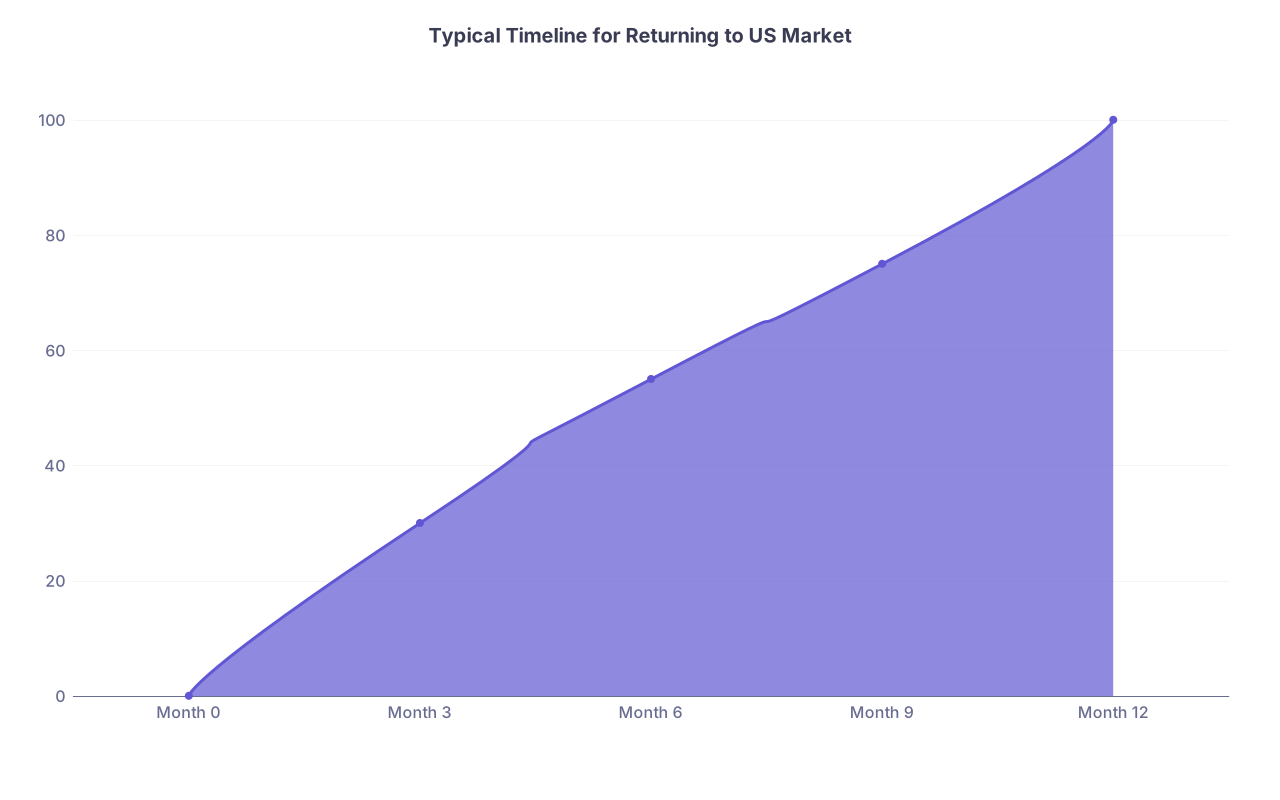
| Category | Value |
|---|---|
| Month 0 | 0 |
| Month 3 | 30 |
| Month 6 | 55 |
| Month 9 | 75 |
| Month 12 | 100 |
That line chart could just as easily be “percent of annoying paperwork completed” over time if you’re efficient.
Concrete steps:
Pick 2–3 target states you’d be willing to work in.
Go to their medical board websites and read the exact training requirements. Some are stricter. Some recognize a bit more foreign training. Don’t guess.Start verification requests from abroad.
Training certificates, letters, good standing documents—foreign hospitals drag their feet on these. Get them now, while you’re still on-site and can walk to HR or the medical director’s office.If IMG and your Step exams are older, check if any state has time limits you’d violate. Some will be off the table. Do not waste time on those.
Visa reality check.
If you’re returning on J‑1 waiver, H‑1B, O‑1, or still need sponsorship, you’ve got another layer of complexity. You’ll need employers who:– Are used to sponsoring visas
– Aren’t scared of nontraditional training backgrounds
– Have enough volume to wait through immigration delays
You’re not just looking for “a job.” You’re looking for “a job that can legally get me in the building.”
Step 5: Positioning your story so you’re not “the weird foreign CV”
You need a coherent narrative. If your CV looks like: US MD → 3 years gap → Saudi Arabia → NHS → random research → back to US… recruiters will assume baggage unless you tell a clean story.
You want a 2–3 sentence “why” that makes sense and doesn’t sound defensive.
Example frames that work:
– “I initially went to the UK for training because I was very interested in the NHS model and could not secure a US spot in my desired specialty at the time. Over the last X years I’ve built strong experience in [specific area]. Now I’m looking to bring that experience back to the US and commit to a long-term role in [state/region].”
– “I pursued fellowship and subsequent consultant work in Canada to gain high-volume exposure to [niche skill]. Now my goal is to settle in the US and contribute that subspecialty expertise within a US academic or hybrid practice.”
Avoid anything that sounds like: “I had no choice and now I’m crawling back.” Even if that’s partly true. You emphasize what you gained, then state clearly that you’re ready to settle in the US long-term.
Your CV itself should:
– Group foreign training under clear headings: “Postgraduate Training – UK (GMC registered, Internal Medicine, 2017–2022).”
– List procedures and scope of practice with numbers, not fluff.
– Put US connections (US exams, US clinical rotations, any US letters, US publications) prominently.
Step 6: Picking the right entry point: job vs more training
You need to choose between two main strategies:
- Fight for a direct attending‑type role that recognizes your experience.
- Bite the bullet and re‑enter formal US training (residency or fellowship).
Let me be direct:
– If you have no US residency and want a long career in the US, re‑entering the Match for ACGME residency is often the smartest play, even if it bruises your ego.
– If you already have US residency and did extra abroad, do not go back into more residency; go for attending jobs or properly structured fellowships.

| Step | Description |
|---|---|
| Step 1 | Foreign Training Completed |
| Step 2 | Apply for US Attending Jobs |
| Step 3 | Standard Job Search |
| Step 4 | Fix Board Status First |
| Step 5 | Consider Re-Entering Match |
| Step 6 | Complete Training Abroad or Shift Plan |
| Step 7 | Target Community Programs, Underserved Areas |
| Step 8 | US Residency Done? |
| Step 9 | Board Eligible? |
| Step 10 | Years of Foreign Residency |
If you choose direct job search (stronger CV, some US training, or US residency already done):
– Target community hospitals and private groups first. Academic centers are slower and more rigid on credentials.
– Look at states with physician shortages and more flexible attitudes (Midwest, South, rural West).
– Use recruiters, but do not rely only on them—many will ignore anything that looks nonstandard.
If you choose re-entering training:
– Be strategic about specialty choice. Some fields are basically closed to non‑traditional, foreign‑trained candidates (Derm, plastics, competitive surgical subspecialties).
– Programs that serve large immigrant or underserved populations may value your global experience more.
– Emphasize that you’ll hit the ground running because you’re not a 24‑year‑old intern. Sell maturity and experience without sounding arrogant.
Step 7: Tactically using your foreign experience as an asset, not a red flag
Foreign training can either scare US employers or impress them. You control which through how you package it.
Sell these angles:
– Systems perspective: “I’ve practiced in both NHS and insurance‑based systems; I understand efficiency and resource constraints intimately.”
– High-volume exposure: “In my last role, our ED saw 70,000 visits/year; I routinely managed 20–25 patients per shift independently.”
– Teaching experience: “I supervised junior doctors and students daily; I can contribute to resident education from day one.”
– Cultural and language skills: Huge plus in diverse US settings.
Do not:
– Trash the US system as “behind” the UK/Canada/Australia. That goes badly.
– Overplay prestige of foreign titles. A “consultant” label means little until you translate it into duties and outcomes.
– Act like you’re above residency or US training norms. Even if you are technically more experienced.
Step 8: Network like your career depends on it (because it kind of does)
If you just blast applications through hospital portals, your odds drop to near zero. You’re a nonstandard profile; nonstandard profiles need advocates.
What actually works:
– Reach out to US attendings from your med school or any prior US rotations. Even weak connections. Send a short, clear email: who you are, what you’ve been doing abroad, and exactly what you’re seeking.
– Attend US specialty conferences (ACP, ACEP, ASA, etc.) the year you plan to come back. Book 10–15 coffee chats with program directors, division chiefs, or group leaders.
– Use LinkedIn properly: not “Open to work” nonsense, but targeted messages to medical directors in your specialty in 2–3 target states.
Sample outreach script:
“Dr. X, I’m a US‑trained internist who completed residency at [Program] and have spent the last 4 years working as an attending in [Country] with a focus on [area]. I’m moving back to the US in [Month, Year] and looking for a hospitalist position in [State/Region]. I’d appreciate 15–20 minutes of your advice on how best to position my foreign experience in the current US market.”
You’re not asking for a job. You’re asking for advice. People respond to that more often.
Step 9: Expect and plan for a “reset” period
Even if you land a decent role, your first 6–12 months back will feel like you’re junior again. Because in some ways, you are.
Stuff that will hit you:
– Epic or Cerner documentation hell if you’ve been on simple or paper systems.
– US malpractice anxiety. People are more defensive here, for a reason.
– Coding, RVUs, metrics. If you’ve been on salary in the NHS, this will be a shock.
– Different thresholds for admission, imaging, and procedure use.
Plan for a reset:
– Take CME or short courses in US documentation and coding for your specialty.
– Ask explicitly for a structured onboarding and slower ramp‑up if possible.
– For the first 3–6 months, default to slightly more conservative medicine until you’re comfortable with local expectations and guidelines.

Step 10: Common mistakes that will cost you years (avoid these)
I’ve watched people waste 2–3 extra years because of these:
Waiting to start licensure until you’re physically back in the US.
Lost time. Start while you’re abroad.Insisting on matching your foreign seniority immediately.
“I was a consultant, I should be a senior attending here.” Maybe. But if that stubbornness keeps you from accepting a solid but slightly junior role that gets you in the system? Bad trade.Targeting only “dream” states or cities initially.
California, New York, Boston, big coastal cities—far more competitive, pickier about credentials. It’s often smarter to start in a more flexible state, build US experience, then move.Ignoring the board exam issue.
Letting eligibility windows lapse or delaying exams because you’re busy moving or working abroad. Fix this early.Leaving foreign employers on bad terms or without proper documentation.
Then, years later, you’re scrambling for training certificates and good‑standing letters from people who barely remember you.

Quick example paths (so you can see where you fit)
Example 1: US MD, no US residency, 5 years NHS internal medicine
– ECFMG-certified, Step exams done in 2014
– Worked as registrar, then consultant in NHS
– Now wants to return at age 35
Realistic plan:
– Ignore fantasy of “transferring” NHS registrar years into US.
– Re-enter the Match for Internal Medicine, targeting community programs, especially those with IMGs.
– Emphasize experience, maturity, readiness to supervise from PGY-2 onward.
– Accept that you may be an intern again, but with much easier clinical curve.
– Use UK experience to push later for hospitalist leadership roles.
Example 2: US IM residency, 3 years hospitalist in Canada, wants to come back
– Already ABIM-certified, left US after residency
– Practiced in Canada under FRCPC supervision
– Now wants job in Midwest
Plan:
– Reactivate ABIM & state licenses (or apply new) with strong Canadian reference letters.
– Apply directly for hospitalist jobs as attending.
– Sell Canadian experience as high‑volume practice, heavy responsibility, and comfort with acuity.
– Within 6–12 months, pursue leadership track if desired.
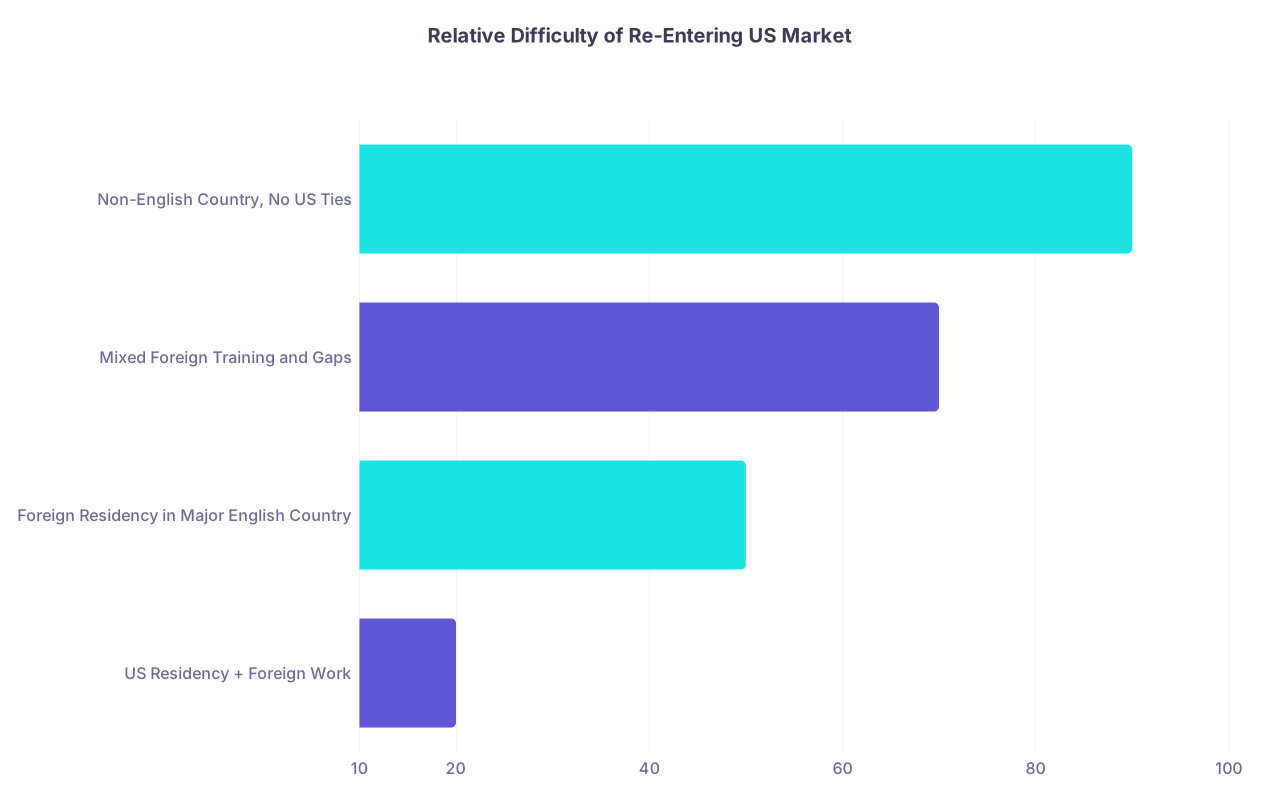
| Category | Value |
|---|---|
| US Residency + Foreign Work | 20 |
| Foreign Residency in Major English Country | 50 |
| Mixed Foreign Training and Gaps | 70 |
| Non-English Country, No US Ties | 90 |
(The higher the number, the harder it tends to be.)
FAQ (exactly 3 questions)
1. Can my foreign residency count toward US residency so I do not have to repeat all the years?
Usually no, or only partially. A few programs might grant you advanced standing (e.g., enter as PGY‑2 instead of PGY‑1) if your foreign training is very closely aligned and they’re motivated to take you. But from a licensing and board standpoint, most states and boards want a specific number of ACGME‑accredited years, not just “equivalent” time abroad. Assume you’ll need to repeat most, if not all, of formal residency and treat any credit as a bonus, not a plan.
2. Is it worth re-entering the Match if I’m already a senior doctor abroad?
If you want a long‑term US career with full independence, yes, it often is. The short-term hit to pride and income is real, but doing a US residency unlocks: clean licensing, ABMS board certification, easier job mobility, better pay over the next 20–30 years, and fewer headaches with credentialing. The alternative is often a patchwork of limited roles, constant exceptions, and being passed over for plum positions. For a 10–20 year horizon, residency usually wins.
3. Should I wait abroad until I land a perfect US offer, or move back first?
In most cases, start the process while abroad but plan to physically be in the US before or early in serious interviewing. Employers are nervous about people who seem hypothetical or far away. Being on the ground makes you more “real,” lets you visit hospitals, and signals commitment. Just do not move without a plan: have your licensing applications started, documents in hand, and at least some warm leads or networking conversations underway.
Key points to walk away with:
- The US system cares about ACGME training and ABMS boards, not titles you held abroad—align your path around that reality.
- Start the licensing, documentation, and narrative‑building work early, preferably before you leave your foreign post.
- Be willing to accept a short‑term ego and seniority reset to secure a clean, long‑term position in the US market.


