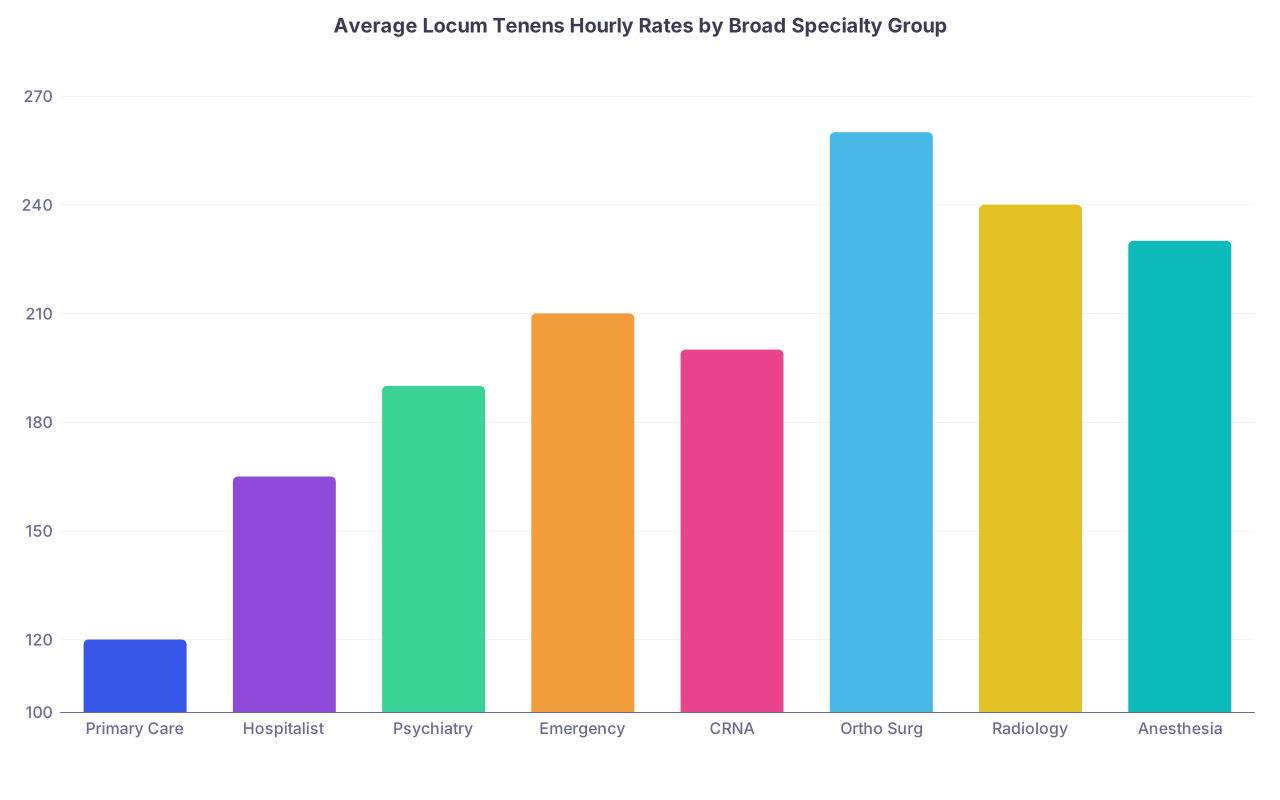
| Category | Value |
|---|---|
| Primary Care | 120 |
| Hospitalist | 165 |
| Psychiatry | 190 |
| Emergency | 210 |
| CRNA | 200 |
| Ortho Surg | 260 |
| Radiology | 240 |
| Anesthesia | 230 |
Locum tenens pay is not “mysterious” or “all over the place.” It follows patterns. Strong, quantifiable patterns. If you understand those patterns—by specialty and by region—you will outperform the average doctor on income from day one.
I am going to treat this the way I treat any market: as a set of price signals. Supply, demand, risk, and hassle get converted into hourly and daily rates. Your job is to read those signals correctly.
Below I will walk through:
- Typical rate ranges by specialty (with real numbers)
- How those numbers shift by region
- What actually moves the needle: schedule, setting, and contract terms
- How to decide if an offer is objectively good or weak
No fluff. Just the economics of your time.
1. The Big Picture: How Locum Pay Is Structured
Locum pay is essentially hazard pay plus flexibility premium. The data from major agencies, job boards, and physician-reported contracts converge on the same structure:
- The more urgent and hard-to-fill the shift → the higher the rate.
- The more rural/undesirable the location → the higher the rate.
- The more procedural and high-liability the work → the higher the rate.
- The more control you want (no call, specific days, part-time) → the lower the rate, all else equal.
When you strip the marketing away, you are selling three things:
- Your clinical skill set (specialty, procedures, board status)
- Your geographic flexibility (willingness to go where others do not)
- Your schedule flexibility (nights, weekends, holidays, call)
The pay is a straight function of those three levers.
2. Locum Pay by Specialty: What the Numbers Actually Look Like
These are typical 2024–2025 ranges I see repeatedly in contracts and agency postings across the U.S. I am not giving unicorn top-end outliers; I am giving realistic working ranges for physicians and advanced practitioners with clean records.
2.1 Broad Physician Specialty Comparison
Think in hourly terms, even if the contract is quoted as “per day” or “per shift.” That is how you compare apples to apples.
| Specialty | Common Structure | Typical Range (Hourly) | Typical Range (Daily) |
|---|---|---|---|
| Family / Internal Medicine | Outpatient, 8–10 hr | $110 – $140 | $900 – $1,400 |
| Hospitalist (Nocturnist max) | 12-hr shifts | $150 – $220 | $1,800 – $2,600 |
| Psychiatry (Outpatient/IP) | 8-hr days | $180 – $240 | $1,600 – $2,200 |
| Emergency Medicine | 8–12 hr shifts | $200 – $275 | $2,000 – $3,000 |
| Anesthesiology | 8-hr days + call | $200 – $275 | $1,800 – $3,200+ |
| Radiology | 8–10 hr days | $220 – $280 | $2,000 – $3,200 |
| General Surgery | 24-hr call models | $220 – $300 (eff.) | $2,500 – $4,000 |
| Orthopedic Surgery | OR + call | $250 – $350 (eff.) | $3,000 – $5,000 |
| OB/GYN | 24-hr L&D call | $200 – $275 (eff.) | $2,500 – $3,800 |
| Neurology | Inpatient consults | $180 – $240 | $1,800 – $2,400 |
“Effective hourly” for surgery/OB call assumes you are actually working 8–12 hours out of a 24‑hour call block on average. If you are slammed all 24, your true hourly drops; if you are quiet, it rises.
The relative ordering is consistent across markets:
Ortho / high-end procedural > Radiology / Anesthesia / EM > Psychiatry / Hospitalist > Primary Care.
3. Regional Differences: Where Geography Pays You Extra
The rate jumps are not random. They follow shortages and cost-of-living mismatches.
General pattern from the data:
- Rural Midwest / Great Plains / Mountain West: Highest effective rates, especially for physicians willing to take call and work in small hospitals.
- Deep South / non-coastal Southeast: Often high rates relative to cost of living. Some of the best net income.
- Coastal urban (CA, NY, MA, WA): Higher nominal pay but heavily offset by licensing friction, competition, and higher living costs. Effective net is often worse than a strong Midwest gig.
- Upper Midwest / New England rural: Quietly very competitive pay for hospital-based work, especially winter coverage.
Here is a simplified snapshot for one specialty—hospital medicine—across regions.
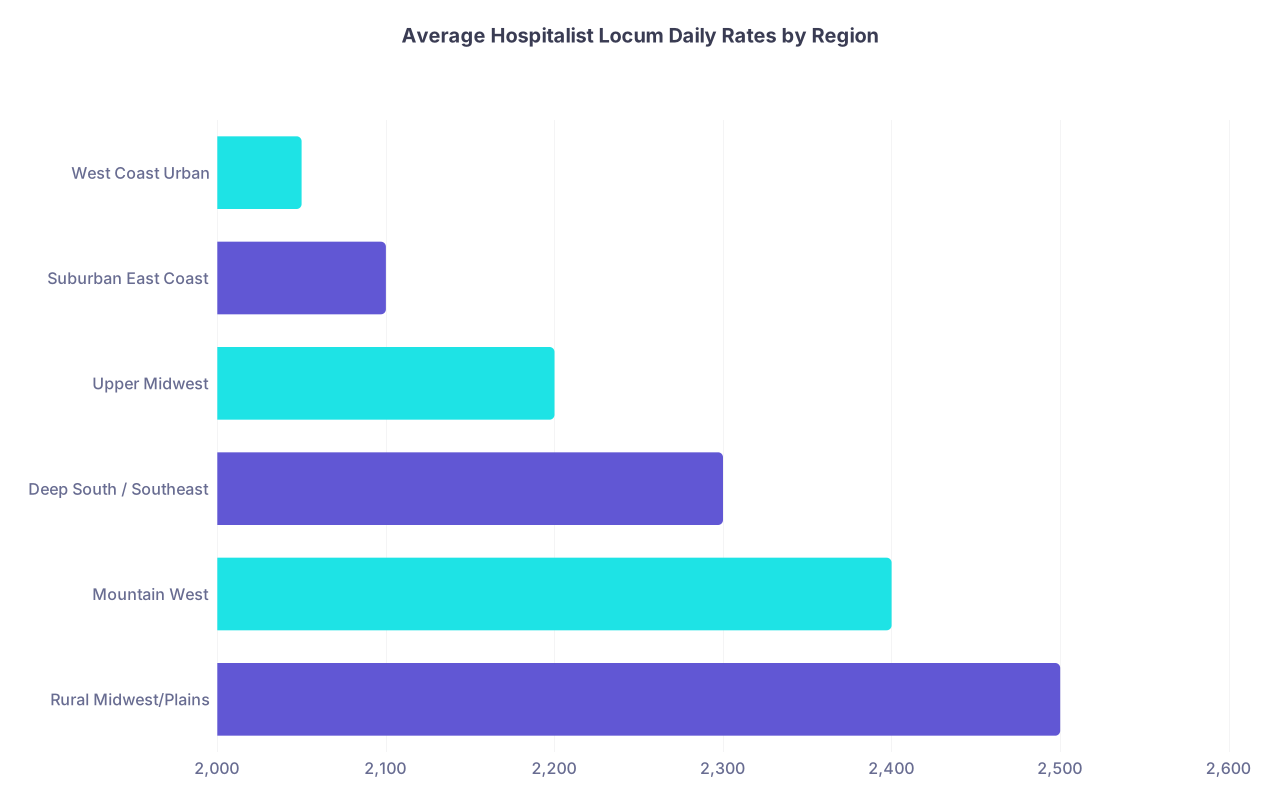
| Category | Value |
|---|---|
| Rural Midwest/Plains | 2500 |
| Mountain West | 2400 |
| Deep South / Southeast | 2300 |
| Upper Midwest | 2200 |
| Suburban East Coast | 2100 |
| West Coast Urban | 2050 |
Those numbers are realistic medians for reasonably busy 12-hour shifts. Yes, you will occasionally see $3,000+ for nights in extremely rural or crisis coverage scenarios.
3.1 Why Rural And Unpopular Locations Pay More
Look at it like a supply curve:
- There are fewer physicians licensed and willing to fly to a town of 15,000 people in January.
- Hospitals in those locations have very few back-up options when someone leaves.
- They cannot rely on “lifestyle” or “academic” appeal to fill positions.
So they use the one lever they have: pay. The data shows:
- 20–40% rate premium is common for true rural relative to nearby metro areas.
- Critical access hospitals frequently pay near the top of the range for their specialty, especially for:
- EM coverage
- General surgery and OB call
- Solo hospitalist coverage
If you want to maximize hourly income, rural + call is where the numbers spike.
4. Nurse Practitioner, PA, and CRNA Locum Rates
Advanced practitioners see similar patterns, just at different price points.
4.1 CRNAs: The Locum Powerhouse
CRNAs are essentially the “EM physicians” of the advanced practice world in terms of pay dynamics—high-demand, procedure-heavy, coverage-critical.
| Setting | Typical Range (Hourly) | Notes |
|---|---|---|
| Hospital OR, Midwest/South | $170 – $210 | Cardiac or high-acuity near top end |
| Hospital OR, West/East Coast | $160 – $190 | Competition + staffing models matter |
| Independent CRNA states, rural | $190 – $230+ | Call + leadership = highest rates |
| Surgery centers, predictable days | $150 – $180 | Lower acuity, more lifestyle-driven |
I have seen rural independent setups where experienced CRNAs effectively clear $2,200 – $2,800 / 24‑hr call day when you factor in call stipends plus cases.
4.2 NPs and PAs
Rates vary more because of wide role variation, but typical numbers:
- Primary care / urgent care NP or PA:
- $70 – $95 per hour
- Emergency medicine NP or PA:
- $85 – $120 per hour
- Hospitalist NP or PA:
- $80 – $110 per hour
The same geographic logic holds:
- Rural + nights/weekends = top of range or above.
- Big metro + cushy clinic hours = low to mid range.
5. What Actually Moves the Rate: The Real Levers
This is where most physicians leave money on the table. They look at the base day rate and ignore the structural variables that matter more.
5.1 Schedule and Shift Type
You can treat this like a multiplier on base rates:
- Nights vs days:
- Nights often pay 10–25% more than equivalent day shifts.
- Example: Hospitalist days $1,900, nights $2,300 in the same facility.
- Weekends/holidays:
- Holiday coverage commonly adds flat stipends: $500 – $1,500 extra for major holidays.
- 7-on/7-off vs sporadic coverage:
- Long blocks are more attractive to facilities and agencies; they may pay slightly less per shift but more efficiently when you factor travel and downtime.
One hospitalist example I saw last winter:
- Days: $1,900 per 12‑hr shift
- Nights: $2,400 per 12‑hr shift
- Same census, same documentation system, same location
That is a clear 26% premium purely for time-of-day.
5.2 Call Coverage and Intensity
Call is often where advertised numbers become misleading. Two contracts can both claim “$2,500 per 24 hours” and feel completely different.
- Model A: $2,500 for 24‑hr in-house OB call, busy L&D, 8–12 hours of real clinical work.
- Model B: $1,500 for 24‑hr pager call + $200 per case, mostly home sleep, perhaps 2–4 hours of work.
On paper, Model A “pays more.” Effective hourly, Model B might be better.
The only honest way to compare:
- Ask for actual historical workloads:
- Average admissions
- Average procedures
- Typical number of callbacks from home
- Convert to an effective hourly rate:
- Total pay / estimated actual working hours (not 24).
Once you do that across multiple offers, the “best paying” job often changes.
5.3 Setting and Complexity
- Academic centers:
- Lower rates on average, especially in popular cities. You are partially subsidizing teaching and prestige.
- Community hospitals:
- Mid to high range, depending on size and location.
- Critical access / low backup:
- High rates, but with more risk and responsibility. Solo coverage is priced in.
I have watched physicians consistently underestimate how much extra they should charge for being the only doc on site with minimal specialty backup. That is not the same job as working in a 600‑bed tertiary center with five colleagues and every consultant available.
6. Agency vs Direct Hospital Contracts: Follow the Money
Where your rate comes from matters as much as the number itself. Every dollar that goes to the agency is a dollar that does not land in your pocket.
Typical pattern:
- Hospital has an internal budget: say, $3,000 per 12‑hr EM shift.
- Agency offers you $2,300.
- Agency keeps $700 (plus potentially billing extra admin fees to the facility).
You see this again and again. People know it is happening but underestimate the magnitude.
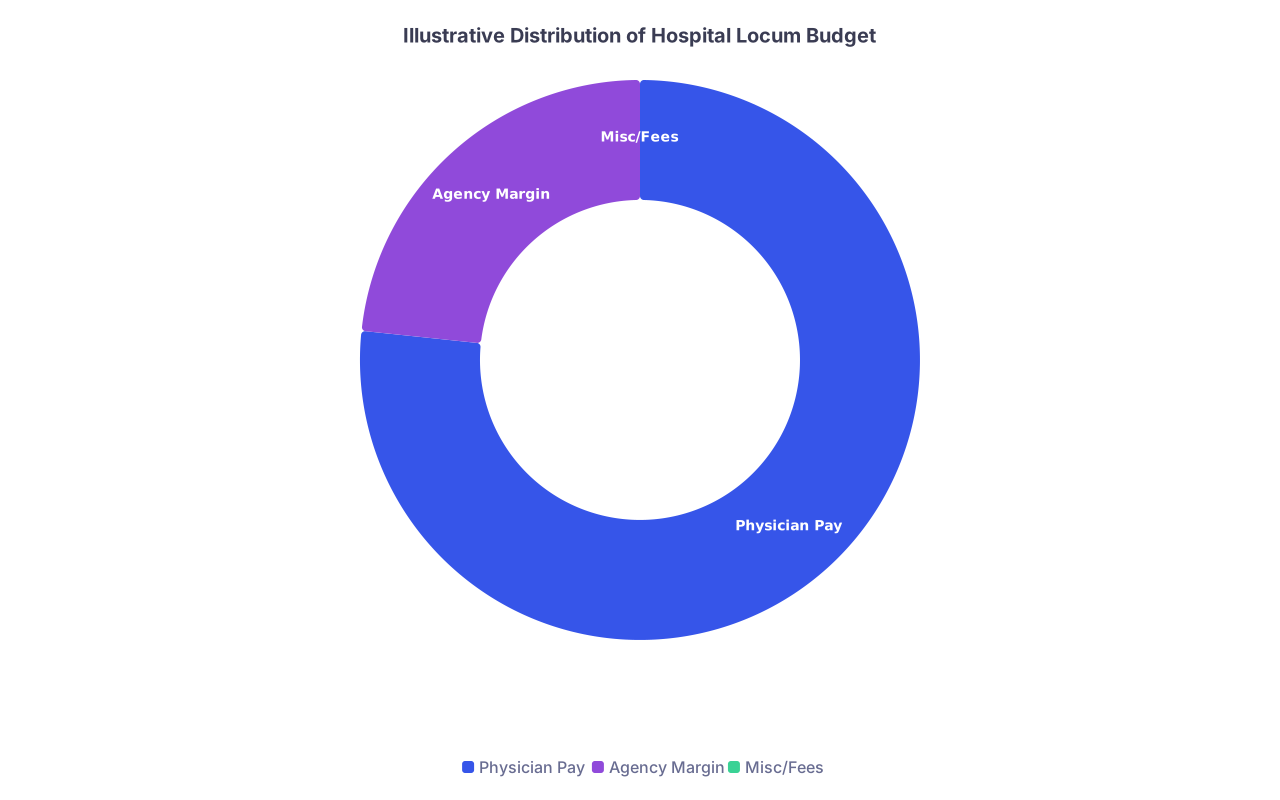
| Category | Value |
|---|---|
| Physician Pay | 2300 |
| Agency Margin | 700 |
| Misc/Fees | 0 |
That is a 23% haircut in this example.
What the data and real-world experience show:
- Agency contracts:
- Easier to find, less negotiation effort.
- More middlemen → lower physician rate.
- Some value for housing, travel coordination, malpractice.
- Direct contracts:
- Harder to land; require networking, cold outreach, or previous W‑2/partner relationships.
- 10–30% higher effective rates are common.
- More control over schedule and contract clauses.
For a full-time locum working 15 shifts/month, a 20% difference in pay can easily be $80,000 – $120,000 per year.
If you want to maximize earnings over multiple years, building a few direct relationships is not optional. It is a key part of the strategy.
7. Licensing, Region Stacking, and “Travel Arbitrage”
Another common blind spot: state licensing strategy.
You do not need 20 state licenses. You need a small, smart portfolio that opens high-rate regions with minimal friction.
High-yield locum states for rate + volume, historically:
- Midwest / Plains: ND, SD, IA, NE, KS, MO
- Mountain West: WY, MT, ID, CO (rural), UT (rural)
- South / Southeast: TX, LA, MS, AL, AR, GA, SC
- Upper Midwest: WI, MN, MI
Low-yield from pure pay perspective (but sometimes good for lifestyle/family reasons):
- CA, NY, MA, OR, WA metro areas
These are fine to work in, but rates are often suppressed by a higher local physician supply and facilities that know doctors want to be there anyway.
If you actually want to treat your career like an income-maximizing problem:
- Do 1–2 years building experience and references anywhere.
- Then stack licenses in 3–5 high-pay, compact-friendly states.
- Mix short high-rate rural stints with more “civilized” gigs to avoid burnout.
I have seen physicians double their locum annual income just by shifting from “where do I want to live” to “where are the best pay-to-hassle ratios,” then using travel to solve the lifestyle side.
8. Evaluating a Locum Offer: A Quantitative Checklist
When a recruiter says, “This is a very competitive rate,” that sentence is meaningless. You need a framework.
Here is a stripped-down evaluation process that works:
Convert everything to hourly
- Include:
- Base shift pay
- Call stipends
- Expected callback pay
- Estimate working hours realistically (not just scheduled hours).
- Include:
Benchmark against your specialty / region
- Compare to the ranges we walked through.
- If an EM midwestern offer is $210/hr but the going rate is $230–260/hr, that is not competitive no matter what the recruiter says.
Adjust for schedule and burden
- Nights, holidays, high census, solo coverage, trauma center status, procedures required.
- These should push your required rate up, not down.
Account for non-paid time and overhead
- Travel days that are not paid.
- Credentialing delays that lock up your license but do not pay.
- Housing arrangements: free vs stipend vs on you.
Estimate effective annual income
- Example: 12 EM shifts/month at $2,600/shift → ~$31,200/month → ~$374,000/year gross.
- Now apply reality:
- Weeks off for licensing, life events.
- Unpaid days for travel.
If you run this math for 3–4 opportunities side-by-side, the best choice is usually obvious. But most people never put the numbers in one place.
9. Common Myths That The Data Does Not Support
A few beliefs I hear repeatedly that do not hold up:
“Locums always pay way more than permanent jobs.”
Sometimes. But not always. In primary care, I see perm jobs with heavy RVU bonuses beat mediocre locum offers easily. The difference is flexibility, not guaranteed higher hourly.“Coastal states pay the best because they are expensive.”
False. Nominal pay may be somewhat higher, but on an after-tax, after-cost-of-living basis, a strong Southern or Midwestern locum beats almost any coastal city gig.“Agencies all pay about the same.”
Not true. I have seen a $400/day spread for the exact same shift at the same hospital between two agencies. One was willing to cut margin, the other was not.“Rates are fixed; you cannot negotiate.”
You can. Not every time and not infinitely, but 5–15% improvements are very common when you:- Have multiple offers.
- Are willing to walk.
- Back your request with concrete data (“I am currently at $X for similar work in Y region.”)
10. Strategy by Career Phase: When Locums Make The Most Sense
Given you are in the “post residency and job market” phase, the question is not just “what pays more right now” but “what position does this put me in two to five years from now?”
A few data-driven patterns I have seen play out:
1–3 years out of training:
- Locums can rapidly pay down loans and build a financial buffer.
- Coverage-heavy specialties (EM, anesthesia, hospitalist, psych) can realistically clear $350k–$500k+ if they work aggressively.
Mid-career:
- Some use locums to arbitrage:
- 6–8 months of high-intensity work
- 4–6 months of time off
- This is where rate optimization really matters. Small differences compound.
- Some use locums to arbitrage:
Late career / pre-retirement:
- Locums gives:
- Downshift in hours without politics.
- Ability to pick “easier” settings even at lower rates while still keeping control.
- Locums gives:
A blunt but accurate statement: Physicians who treat locums like a structured business—understanding their own hourly value, selecting high-yield regions, and avoiding lowball agency deals—end up with dramatically more financial flexibility than those who drift from assignment to assignment based on recruiter enthusiasm.
11. The Short Version: How To Use This Data
Three core points, no sugar-coating:
Specialty and geography set your baseline.
Ortho, EM, anesthesia, radiology, and psych carry the highest typical locum rates. Rural Midwest, Mountain West, and the South often pay more real money than coastal cities once you factor cost of living.Structure beats headline numbers.
Nights, call, solo coverage, rural placement, and agency margins move your actual hourly rate far more than most physicians realize. Always compute effective hourly after adjusting for real working hours and middleman cuts.A deliberate locum strategy compounds.
Stack a few high-yield licenses, use data to benchmark offers, and negotiate based on clear comparisons. Do that consistently for 3–5 years, and your financial position will look very different from the average doctor who “just takes whatever the recruiter sends.”
That is how you turn locum tenens from a stopgap into a powerful, data-driven career tool.