

It is July 5th. You just finished residency, you are on orientation week at a big academic hospital, and HR just slid a contract across the table labeled “Clinician-Educator Track.” Your friend across town just signed as “Clinician-Scholar.” Another co-resident went “Pure Clinician” at a community site and is already working 4 days a week and making more than both of you.
On paper, these three paths look like meaningless HR labels. In practice, they will decide:
- How many patients you see.
- How you are evaluated.
- Whether you ever get promoted.
- How burned out you feel in five years.
Let me break this down specifically.
1. The Big Picture: What These Labels Actually Mean
Forget the brochures. Here’s the functional definition used at most academic centers:
- Pure Clinician: Your job is patient care. Maybe some informal teaching. Little to no expectation for scholarship.
- Clinician-Educator: Your job is patient care plus education. Teaching, curriculum, maybe some educational leadership. Scholarship is “encouraged” but often not structurally supported.
- Clinician-Scholar: Your job is patient care plus scholarship. Research, grants, papers, presentations. Teaching happens, but promotion hinges on your scholarly output.
These are not moral categories. They are workload and incentive structures. They tell you:
- What the department will praise you for.
- What they will actually protect your time for.
- What gets you promoted.
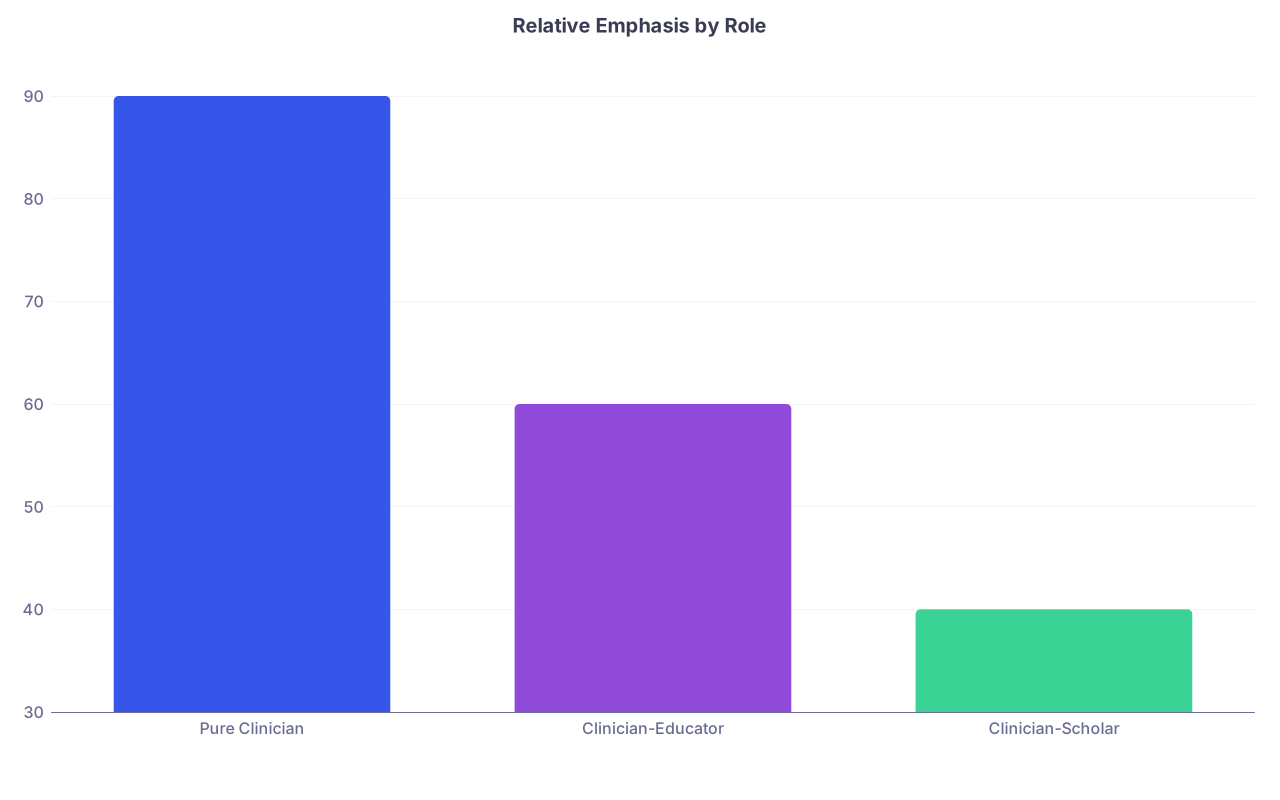
| Category | Value |
|---|---|
| Pure Clinician | 90 |
| Clinician-Educator | 60 |
| Clinician-Scholar | 40 |
That chart is crude but conceptually right: everyone sees patients. The question is what else you are obliged to do.
2. Pure Clinician: High Throughput, High Pay, Lower Academic Overhead
You are hired primarily to see patients. Often at:
- Large community hospitals
- Hybrid community–academic affiliates
- “Hospitalist service” arms of academic centers
- Private practice groups
What your week actually looks like
On a typical full-time inpatient pure clinician contract (hospitalist / ICU / ED style):
- 7 on / 7 off or 5 clinical days per week
- Clinical FTE = 1.0 (meaning nearly 100% of your salary tied to direct patient care)
- RVU or wRVU-based productivity expectations are clearly defined
- Very little protected nonclinical time (if any)
Outpatient pure clinicians:
- 8–10 half-day clinics per week
- Panel size expectations
- Limited “admin time” that quickly disappears into inboxes and notes
Teaching? You can precept residents, talk on rounds, give the occasional noon conference. But no one is building your career around it. You are filling a service need.
Advantages
Higher and more predictable pay.
You live off clinical revenue. No one expects you to find your own salary from grants. The comp is often substantially higher than academic tracks, especially once you are efficient.Clear metrics.
You know what success is: RVUs, length of stay, patient satisfaction, readmission rates. No handwaving about “impact” or “academic reputation.”Cleaner work-life boundaries (in some settings).
For 7-on/7-off hospitalist gigs, your “off” week can be genuinely off. No R01 deadlines creeping into your vacation.Less political academic nonsense.
Promotion committees, annual academic portfolios, teaching dossiers—these are minor or nonexistent worries.
Disadvantages
Limited promotion and academic recognition.
In many institutions, pure clinicians are “clinical track” with limited ceiling (sometimes no real tenure option). If you want to be Division Chief or Department Chair, this path can be a dead end.Monotony and burnout risk.
You live in the EMR. If you enjoy variety (teaching, projects, scholarship), this can get old by year 3–5.Less formal influence on training and policy.
You can be beloved by residents, but the big educational decisions often sit with clinician-educators or scholars. You may be treated like “workhorse faculty.”Less structural support for “side interests.”
You want to start a QI project or curriculum? You do it on your own time.
Who actually thrives as a pure clinician?
- People who genuinely enjoy clinical work and a fast pace
- Those who want higher early-career income (loans, family, location constraints)
- Those who do not care about titles like “Associate Professor”
- People who are fine with informal teaching but do not crave a scholarly identity
If you already feel tired just thinking about IRB paperwork, this path is not a failure. It is actually rational.
3. Clinician-Educator: You Live in the Gray Zone
The clinician-educator role gets marketed as: “You love teaching? Perfect fit.”
Reality is more complicated.
You are still heavily clinical. But you also:
- Run small groups
- Design curricula
- Serve on education committees
- Give lectures
- Possibly help with UME/GME leadership
The pitfall: many places talk about education but structurally reward RVUs.
Typical workload structure
A common bait-and-switch:
- Contract says: 0.8 clinical FTE, 0.2 “academic/educational” time
- Actual schedule: The 0.2 is not truly protected; you are still expected to hit the same RVU targets as 1.0 FTE colleagues.
Strong departments (there are some) do it right:
- Fewer clinics or shifts for clinician-educators
- Documentation: X hours/week dedicated to curriculum, mentoring, or program leadership
- Promotion criteria that include teaching excellence + educational scholarship
| Role | Patient Care Sessions | Protected Nonclinical Time | Typical Use of Nonclinical Time |
|---|---|---|---|
| Pure Clinician | 9–10 half-days | 0–0.5 days | Admin, inbox |
| Clinician-Educator | 6–8 half-days | 1–2 days | Teaching, curriculum, QI |
| Clinician-Scholar | 3–5 half-days | 2–3 days | Research, writing, grants |
What actually gets you promoted as a clinician-educator
This is where people get burned.
At promotion committee meetings I have sat through, “good teacher” is not enough. You need evidence of:
Educational scholarship
Examples:- Peer-reviewed education research
- Published curricula (MedEdPORTAL, journals)
- Invited workshops or national presentations on education
Educational leadership
- Clerkship Director
- Program Director / APD
- Course or thread director for the medical school
- Chair of curriculum committees
Measured teaching excellence
- Consistently strong evaluations (not just one year)
- Teaching awards help, but they are not mandatory
So the honest clinician-educator description:
You still see a lot of patients, you teach formally and informally, and if you want promotion beyond Assistant Professor you must treat education like its own scholarly niche. That means systematic work, not random lectures thrown together the night before.
Advantages
You get to shape doctors.
You are in the trenches with learners. Real influence on how they reason, what they value, how they practice.Intellectual variety.
Clinical work, yes, but also: designing learning experiences, thinking about assessment, engaging with education literature.Leadership opportunities.
Paths to PD, Clerkship Director, Vice Chair of Education, etc. Those roles are real power in academic medicine.More protected time than pure clinicians (in good systems).
Disadvantages
Chronic identity confusion.
Are you primarily a clinician? Educator? Pseudo-researcher? Many clinician-educators feel like they are never doing any one thing at the level they want.Under-resourced scholarship expectations.
Many departments demand “scholarly output” but do not give: statistician support, mentorship, or true protected time. This is how people stall at Assistant Professor.Pay gap compared to pure clinicians.
Less clinical time + non-RVU work often yields lower comp than your purely clinical colleagues.Administrative creep.
Curriculum committees expand. Documentation of competencies explodes. You slowly become an “education bureaucrat” if you are not careful.
Who thrives as a clinician-educator?
- People who genuinely enjoy teaching and get energy from learners
- Those who like designing systems (curriculum, assessment frameworks)
- People willing to invest in education scholarship (not just “giving talks”)
- Those okay with earning less than they could in private practice in exchange for impact and variety
If you light up when you walk into morning report, this may fit. But go in with open eyes about promotion and scholarship.
4. Clinician-Scholar: The Academic “Classic” Track
This is what most people picture when they say “academic medicine”: the grant-funded physician scientist or the outcomes researcher with a big lab or team.
There are variants (basic science, clinical trials, health services research, QI research, education research with heavier methods), but the anchor is the same:
Your career lives or dies on scholarly output.
Time structure and expectations
For a typical clinician-scholar at a solid academic center:
- Clinical FTE: 0.3–0.6
- Protected time: 0.4–0.7 for research, writing, grants, mentoring
- Promotion package: CV heavy with:
- First / senior author publications
- Grants (career development awards, R01s, foundation funding)
- National reputation (invited talks, committees, guideline groups)
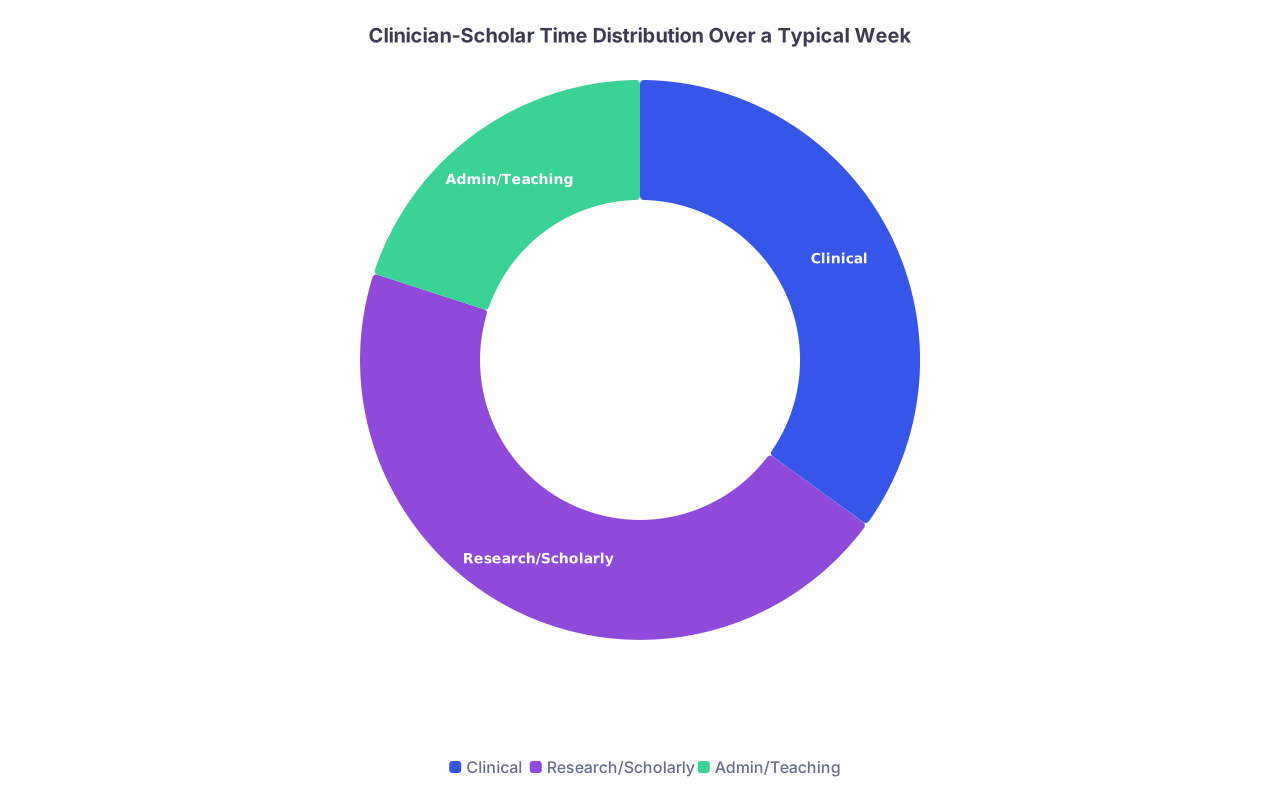
| Category | Value |
|---|---|
| Clinical | 35 |
| Research/Scholarly | 45 |
| Admin/Teaching | 20 |
You can call it “50% research.” In practice it bleeds into nights and weekends. Grant deadlines do not care about your off days.
What success looks like
By year 6–7 (promotion to Associate Professor) a clinician-scholar is typically expected to show:
- A coherent research niche (e.g., anticoagulation in AFib, ICU delirium, disparities in cancer screening)
- Independent funding or major role on funded projects
- A publication track record with increasing senior-authorship
- National presence: invited talks, panels, society committees
- Evidence of mentoring junior faculty or fellows
Teaching matters. Clinical excellence matters. But if your CV is light on data, committees will say it directly: “Not enough scholarship for this track.”
Advantages
Deep intellectual focus.
You get to ask and answer questions that shape guidelines, systems, or understanding of disease.Protected time (when real).
A true 50–70% research appointment is gold. You are not just sprinting from room to room all day.National and international reputation.
If you execute well, you will be invited to present, join writing groups, sit on influential panels.Long-term career flexibility.
With a strong scholarly portfolio, you can pivot to leadership (division chief, chair, dean) more easily.
Disadvantages
You are always chasing money.
Federal funding rates are brutal. K awards fail. R01s get triaged. You need resilience and a thick skin.Pressure and instability.
“Soft money” means parts of your salary depend on grants. Some institutions backstop you; some do not. I have seen mid-career faculty forced back to full-time clinical because funding dried up.Clinical skills at risk of stagnation.
If you are only 30% clinical, you must be intentional to stay sharp. Especially in procedural specialties.Pay gap relative to pure clinicians.
Early on, clinician-scholars usually earn less. Long-term, senior funded investigators can do quite well, but that is not guaranteed.
Who thrives as a clinician-scholar?
- People who genuinely like the process of research: hypotheses, methods, stats, writing
- Those who can stomach rejection and keep rewriting grants without spiraling
- Folks who want national/international impact and are comfortable with delayed reward
- Self-directed, organized people. No one forces you to write when you have 3 “free” days.
If your favorite part of fellowship was staying late to debug a dataset or draft a manuscript, this is your lane.
5. How These Roles Affect Promotion, Pay, and Burnout
You care about three things: career trajectory, money, and not hating your life by 40. Let us be blunt.
Promotion trajectories
| Role | Promotion Focus Priority (1 = highest) |
|---|---|
| Pure Clinician | 1 Clinical, 2 Service, 3 Teaching |
| Clinician-Educator | 1 Teaching/Education, 2 Scholarship, 3 Clinical |
| Clinician-Scholar | 1 Scholarship, 2 Funding, 3 Clinical |
- Pure clinicians can get promoted on clinical excellence and institutional service. Scholarship helps but is not essential.
- Clinician-educators stall if they rely only on good teaching evals. They need educational products that live beyond their own institution.
- Clinician-scholars do not get a pass on thin publication lists because they are “great teachers.” Fair or not, that is how committees read dossiers.
Compensation patterns
Very rough, but broadly true:
- Pure clinician: highest starting salary, fastest near-term income growth.
- Clinician-educator: mid-range, usually 10–30% below pure clinicians in same specialty in same market.
- Clinician-scholar: lower early salary; upside depends on grants, leadership roles, or negotiation.
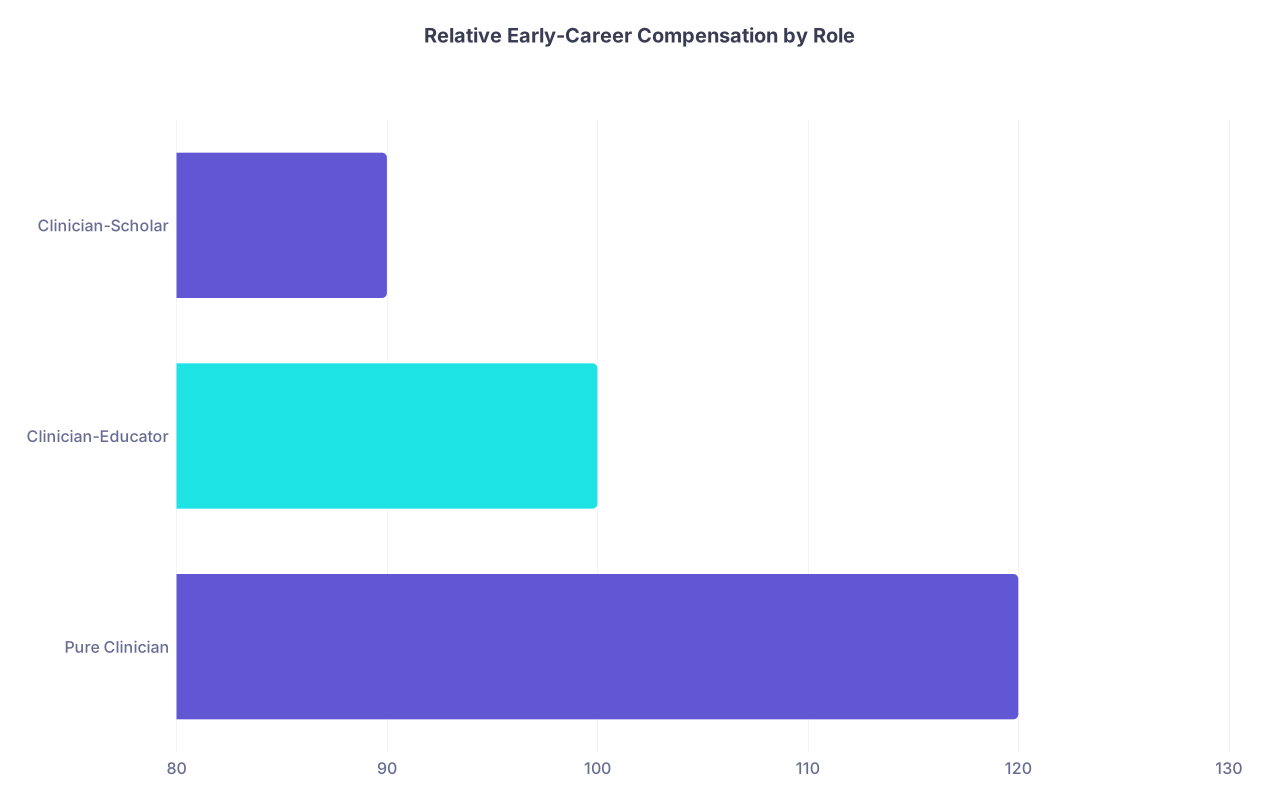
| Category | Value |
|---|---|
| Pure Clinician | 120 |
| Clinician-Educator | 100 |
| Clinician-Scholar | 90 |
Interpretation: if a pure clinician in your specialty in your market is at 1.2x baseline, clinician-educator might be at 1.0x and clinician-scholar about 0.9x, especially in the first 5 years.
Burnout risk and flavor
Pure clinician:
- Burnout flavor = volume + documentation + moral distress
- Risk is high when schedule is relentless with minimal team support.
- Mitigated by controllable schedule (e.g., 0.8 FTE) and supportive practice culture.
Clinician-educator:
- Burnout flavor = too many hats. Seeing patients, precepting, running a course, on 4 committees, writing “just enough” scholarship, often with insufficient protection.
- Very sensitive to local culture. Great if supported. Miserable if your “academic time” is quietly eaten by clinical or admin demands.
Clinician-scholar:
- Burnout flavor = chronic uncertainty + constant evaluation (grants, peer review, promotion, clinical metrics).
- Can be extremely satisfying with stable funding and good mentorship. Extremely demoralizing without those.
6. How to Choose: A Practical Decision Framework
Here is the algorithm I walk juniors through.

| Step | Description |
|---|---|
| Step 1 | Start |
| Step 2 | Clinician-Scholar most aligned |
| Step 3 | Consider extra research year or mentored position |
| Step 4 | Clinician-Educator likely fit |
| Step 5 | Pure Clinician or hybrid job |
| Step 6 | Commit to scholar track |
| Step 7 | Clinician-Educator with small research piece |
| Step 8 | Proceed but demand clear metrics |
| Step 9 | Negotiate or reconsider |
| Step 10 | Pure Clinician primary role |
| Step 11 | Do you enjoy research work itself |
| Step 12 | Have you produced first author work you are proud of |
| Step 13 | Do you love structured teaching and curriculum |
| Step 14 | Ok with lower early income and grant pressure |
| Step 15 | Is there real protected time in contract |
Key questions to ask yourself bluntly:
- Do you actually like doing research, or do you just like the idea of being “academic”?
- Do you derive energy from teaching? Or do you tolerate it because it is “part of the job”?
- How much income differential are you willing to accept, in real numbers, for nonclinical time?
- How risk-tolerant are you about soft money and promotion expectations?
If you cannot stand sitting with a dataset, do not pick clinician-scholar “for the prestige.” It will eat you alive.
7. Red Flags and Green Flags When You Interview
The title on the contract (clinician-educator vs clinician-scholar) means nothing if the local culture is off. When you interview, you need to interrogate the system.
For all roles: questions to ask
- “What does a typical week look like for someone in this role?”
- “What are the expectations for promotion on this track at 3, 6, and 10 years?”
- “Can I see the written promotion criteria for this track?”
If they cannot produce promotion criteria, that is a red flag.
Clinician-educator specific
Ask:
- “How many half-days of clinic per week for a typical clinician-educator at my rank?”
- “How much of that education time is really protected? Who controls my schedule?”
- “Can you show me recent successful promotion packets for clinician-educators here?”
Green flag: They immediately name 2–3 clinician-educators who were promoted recently and can describe their work concretely.
Red flag: “We value teaching so much that we don’t have hard metrics.” Translation: promotion will be arbitrary, and scholarship is probably under-valued but quietly expected.
Clinician-scholar specific
Ask:
- “What proportion of my salary will be guaranteed for how many years?”
- “How does the department support grant submissions? Biostats? Grants office?”
- “What happens if I do not have major funding by year 5?”
You want to hear a plan, not vague handwaving about “we always find a way.”
Pure clinician specific
Ask:
- “What are the RVU or encounter targets and what happens if I fall short?”
- “What is actual FTE for this role, and how many clinical days or shifts is that?”
- “Is there a path for promotion at my effort level, or is that essentially capped?”
Green flag: They admit the volume is high, show you transparent metrics, and discuss how they support documentation and efficiency.
8. Hybrid and Evolving Roles: You Are Not Locked In Forever
Reality: careers drift. You are not signing a blood oath.
I have watched the following transitions many times:
Clinician-educator → clinician-scholar
After doing solid education work, someone gets formal training (e.g., Masters in Education, clinical research methods), shifts into rigorous ed research, and eventually moves to scholar track.Clinician-scholar → pure clinician or heavy clinician-educator
Funding collapses, family needs shift, or they just burn out on grants. They shift to more clinical time and a simpler life.Pure clinician → clinician-educator
A beloved preceptor gradually takes on APD role or clerkship leadership, carves out protected teaching time, and gets reclassified.
But—and this matters—these transitions are easier at institutions that:
- Have clear written track structures
- Offer real mentorship
- Do not treat track changes as failures
Ask directly: “What is your process for changing tracks if interests or circumstances evolve?” If they look confused, assume it will be hard.
FAQ (exactly 6 questions)
1. Can I start as a pure clinician and later move into a clinician-educator or clinician-scholar role?
Yes, but it is much easier to move into clinician-educator than clinician-scholar. If you want scholar later, you must protect some time early to build skills: join projects, pursue a Master’s, publish. If you go 100% RVU for 5 years with no scholarship, pivoting into a protected scholar role is possible but uphill.
2. Do clinician-educators really need publications to be promoted?
At most serious academic centers, yes. The promotions committee will want to see some form of educational scholarship—curricula, assessment tools, or innovations that have been peer-reviewed, disseminated, or formally studied. A few invited talks and good student evaluations rarely carry you beyond Assistant Professor.
3. Is the clinician-scholar path realistic without an MD-PhD or heavy research background?
It can be, but you need intentional preparation: a strong research fellowship, methodologic mentors, and often formal training (Master’s in Clinical Research, Epidemiology, or Education). What matters most is evidence that you can generate rigorous work and secure funding, not the letters after your name.
4. How much of a pay cut should I expect for academic roles compared to community pure clinician jobs?
Ballpark: 10–40% early-career, depending on specialty and market. In some procedure-heavy fields, the gap is larger. You need to run actual numbers: cost of living, loans, partner’s income. Do not assume “it will even out later”; sometimes it does, often it does not.
5. If I am on a clinician-educator track, can I still do meaningful research?
Yes, but you must be ruthless about focus. Two or three well-designed projects with clear outputs beat ten scattered half-finished ideas. Partner with methodologic co-investigators, leverage existing data sources, and ensure your schedule truly includes research time, not just “educational admin.”
6. What is the single biggest mistake new faculty make choosing among these roles?
Picking a label for prestige rather than fit. I have watched people who hate research suffer as “clinician-scholars” and people who crave a quiet clinical life burn out in under-resourced educator jobs. Be brutally honest about what you enjoy doing on a random Tuesday at 3 p.m., not what looks good on a bio.
Key points:
- The titles “pure clinician,” “clinician-educator,” and “clinician-scholar” are really about what your institution will truly reward: RVUs, teaching/education leadership, or scholarship/funding.
- Your day-to-day life, pay, and burnout risk differ substantially by track; ask concrete questions and demand specifics about time, expectations, and promotion.
- You can change paths, but it is easier when you choose an initial role that matches your actual interests and get into a department that supports evolving careers instead of punishing them.


