

Last week, a hospitalist and a cardiology fellow sat in front of me with color‑coded spreadsheets and matching dark circles under their eyes. She had an academic offer at the big university hospital. He had two private practice groups courting him across town. Both jobs were “great opportunities.” Neither lined up cleanly. They had 18 days until her offer expired.
If that feels a little too familiar, keep reading. You are not dealing with a generic “career choice” problem. You’re dealing with a coordination problem: two timelines, two employers, one city, and a relationship you’d like to keep intact.
Let’s walk straight into the mess and make it manageable.
Step 1: Get Brutally Clear On What You Two Want First
Before you call a single recruiter back, you and your partner need a private, honest meeting that does not include anyone from HR, your parents, or your mentors.
You’re not ranking jobs yet. You’re building constraints.
Start with four buckets and write things down. Physically. Paper or shared doc.
City boundary and commute reality.
Not “we want to be in Boston.” Be concrete:- Max commute each of you is actually willing to tolerate (in minutes, during rush hour).
- Neighborhoods where you’d realistically live.
- Whether you’re car‑commute only, or willing to split car vs transit.
Career non‑negotiables for each of you.
- Academic partner: protected time %, promotion track, research resources, teaching expectations, call structure.
- Private partner: partnership track details, wRVU expectations, call burden, autonomy, income potential.
Life non‑negotiables.
- Kids now or soon? You need childcare logistics in the equation.
- Aging parents nearby?
- Religious/community needs, schooling preferences, etc.
-
- What do you absolutely need combined to service loans, live where you want, and not be miserable?
- What’s “we could walk away from this offer without panic” territory?
Do not skip this. If you let each employer define the problem for you, you’ll contort yourselves and still end up with something that doesn’t feel right.
Once you’ve done that, you can sanity‑check the city.
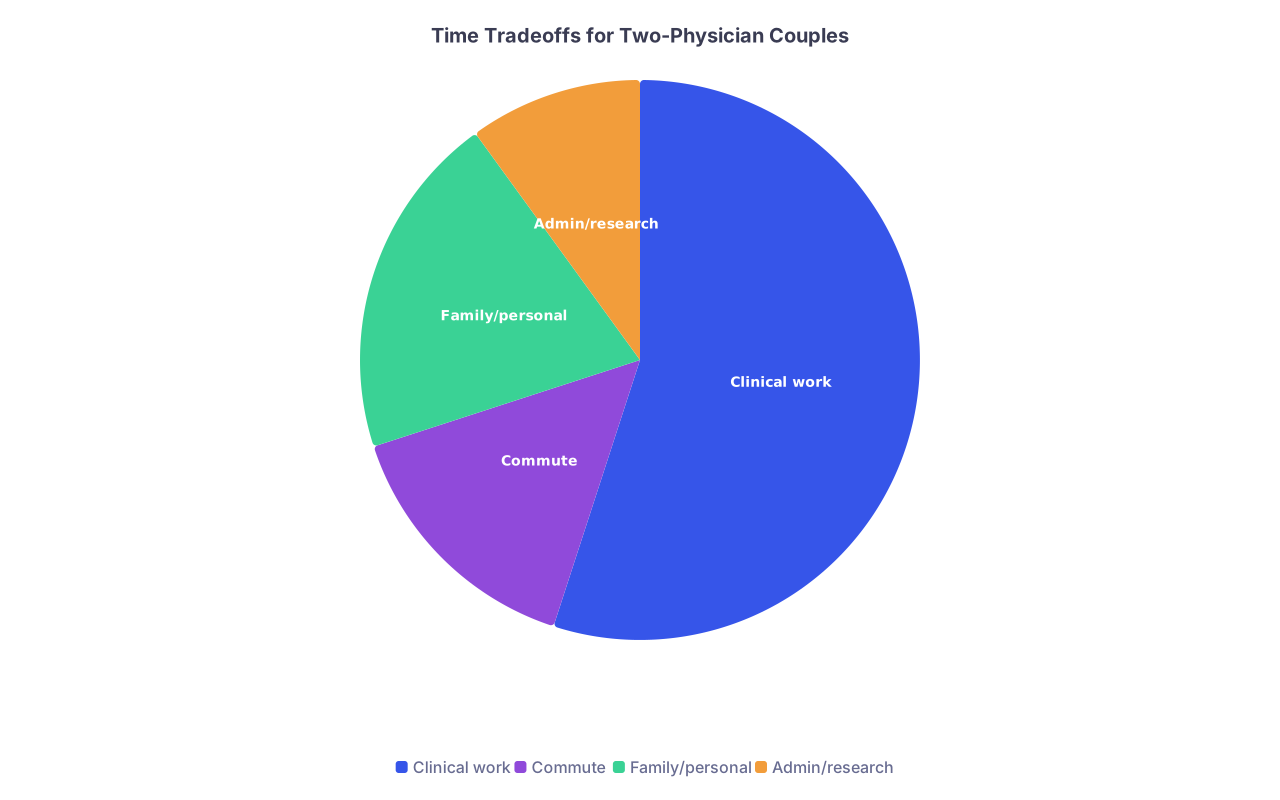
| Category | Value |
|---|---|
| Clinical work | 55 |
| Commute | 15 |
| Family/personal | 20 |
| Admin/research | 10 |
If your max tolerable commute is 25 minutes each, but the “one perfect academic job” is 50 minutes from both private groups, be honest: that’s not one city anymore. That’s a lifestyle choice.
Step 2: Map the Landscape – Not Just Offers, But Configurations
A two‑physician couple isn’t choosing between “Job A vs Job B vs Job C.” You’re choosing between configurations:
- Academic A + Private X
- Academic A + Private Y
- Academic B + Private X
- Academic B + Private Y
- One of you delays, does locums/bridge role, waits a cycle
Lay them out visually. I’ve watched couples literally find clarity the minute they see all combinations on one page.
| Combo | Commute Total (min both ways) | Combined Income (Year 3) | Call Intensity | Research Potential |
|---|---|---|---|---|
| Academic A + Group X | 70 | High | High | Strong |
| Academic A + Group Y | 40 | Medium | Medium | Strong |
| Academic B + Group X | 90 | Very High | Very High | Moderate |
| Academic B + Group Y | 50 | Medium | Low | Moderate |
You’re looking for 2–3 configurations that:
- Fit your commute and life constraints
- Hit your financial floor
- Give each of you at least one major career priority (not everything; that’s fantasy)
Those become the “target configurations” you carry into negotiations. Not “my spouse also needs a job somewhere” but “we’re trying to land Academic A + Group Y or Academic B + Group Y; here’s how you can help us get there.”
Step 3: Understand the Levers Academic vs Private Can Actually Pull
You cannot coordinate offers if you do not understand what each side can flex.
Academic side – levers they really have
Start date and bridge solutions.
They can:- Push your start date by 3–6 months.
- Offer part‑time or hospitalist moonlighting as an interim role.
- Adjust initial clinical load to ease a staggered family move.
Protected time and title.
You can:- Trade some starting salary for more protected time.
- Negotiate for Assistant Professor vs Instructor if that matters to you.
- Ask for concrete written expectations around RVUs vs academic output.
Spousal accommodation (sometimes).
They cannot magically create a tenure‑track line for your partner’s subspecialty. But they might:- Introduce your partner to local private groups.
- Facilitate courtesy interviews at affiliated hospitals.
- Offer your partner per‑diem work, hospitalist shifts, or clinic half‑days while a full‑time role materializes.
Private side – their real levers
Comp, call, and partnership track details.
- Base vs productivity mix.
- Call frequency (this affects your home life more than any mission statement).
- Buy‑in amount, timing, and what “partnership” actually means (voting vs profit only).
Site/location flexibility.
- Working primarily at the hospital closer to the academic center.
- Adjusting clinic sites to reduce double commutes.
- Hybrid schedules where one or two days are at a satellite near your shared home.
Start date and ramp‑up.
- They can align your start with your partner’s fellowship end.
- They can front‑load clinic vs procedures to match credentialing and home logistics.
If someone acts like nothing is negotiable, that’s already data about what it’ll be like to work there.
Step 4: Get Control of Timelines Before They Control You
This is where most two‑physician couples get burned: misaligned timelines.
You’ll see:
- Academic center: offers based on a committee meeting schedule, 14–21 day acceptance window.
- Private group: more informal, “We’d like an answer in 1–2 weeks, but we can be flexible.”
Here’s the move: you become obsessively explicit about timelines with everyone.
You tell each party something like:
“My spouse and I are both physicians, both trying to be in [City]. She has an offer with a decision deadline of [date]. I’m very interested here, but I need to understand your timeline for finalizing an offer so we can realistically coordinate.”
Do this early. Not after you receive your first contract.
Then you pin people down. Politely, but firmly.
- “When do you expect to have a formal written offer to me?”
- “Once extended, how long is the offer open?”
- “Could that window be extended if we’re close but waiting on my spouse’s contract?”

| Step | Description |
|---|---|
| Step 1 | Identify target city |
| Step 2 | Clarify couple priorities |
| Step 3 | Academic interviews |
| Step 4 | Private practice interviews |
| Step 5 | Academic verbal offer |
| Step 6 | Private verbal offer |
| Step 7 | Request written contract and timeline |
| Step 8 | Request written contract and timeline |
| Step 9 | Request extension from earlier offer |
| Step 10 | Review both contracts in parallel |
| Step 11 | Decide on aligned configuration |
| Step 12 | Timelines misaligned |
If an academic center won’t budge from a 7‑day deadline and your partner’s private group is “thinking about” making an offer “in a few weeks,” you treat that as a real problem, not a minor annoyance. You either:
- Press the private group to accelerate, or
- Push the academic HR for an extension before you’re at day 6.
You want these windows to overlap even briefly so you can see both contracts at once.
Step 5: How to Talk About “We Come as a Pair” Without Sounding Needy
There’s a right way and a wrong way to bring your partner into the conversation.
Wrong way:
“I can only come if you find something for my husband.”
That reads as a demand, and more importantly, it makes you sound like you have no agency over your own career.
Better framing:
“My spouse is a [specialty] finishing at [institution/year]. We are committed to being in [metro area] together long term. I’m very interested in this role. For this to be realistic, we’ll need supportive connections so my spouse can also build a sustainable practice here. Is there someone on your team who usually helps with spousal connections or introductions?”
You’re not begging. You’re describing a constraint and asking for help navigating the local network.
On the private side, be equally direct:
“My wife is joining [University Hospital] as a [subspecialty] faculty. I’d like to be sure my practice sites and call structure are compatible with her schedule and our childcare plans long term. Can we talk about which hospitals and clinics I’d primarily cover and how much flexibility there is there?”
People take couples more seriously when they present as organized adults with a plan—rather than as two residents in panic mode.
Step 6: Use Geography and Commute Time Like Hard Currency
If you ignore geography, you’ll pay for it every single day for years.
Do this exercise:
- Pull up a map of your target city.
- Drop pins:
- Academic center(s) looking at you.
- Each private hospital/clinic site for your partner.
- Neighborhoods you’d actually live in.
Now compute:
- Commute during rush hour (not midnight fantasy driving).
- Call obligations relative to where you’ll be.
You want your final configuration to hit something like:
- Each person ≤ 30–35 minutes one way, or
- One partner with a short commute (≤ 15 minutes) and the other ≤ 45 minutes, but with lower call burden
If you find all realistic configs give one of you 60–75 minutes each way, recognize what that does to your life:
- Less time with kids or each other
- Less energy for research
- More burnout risk
- Zero flexibility when one of you is stuck in the OR and the daycare closes at 6
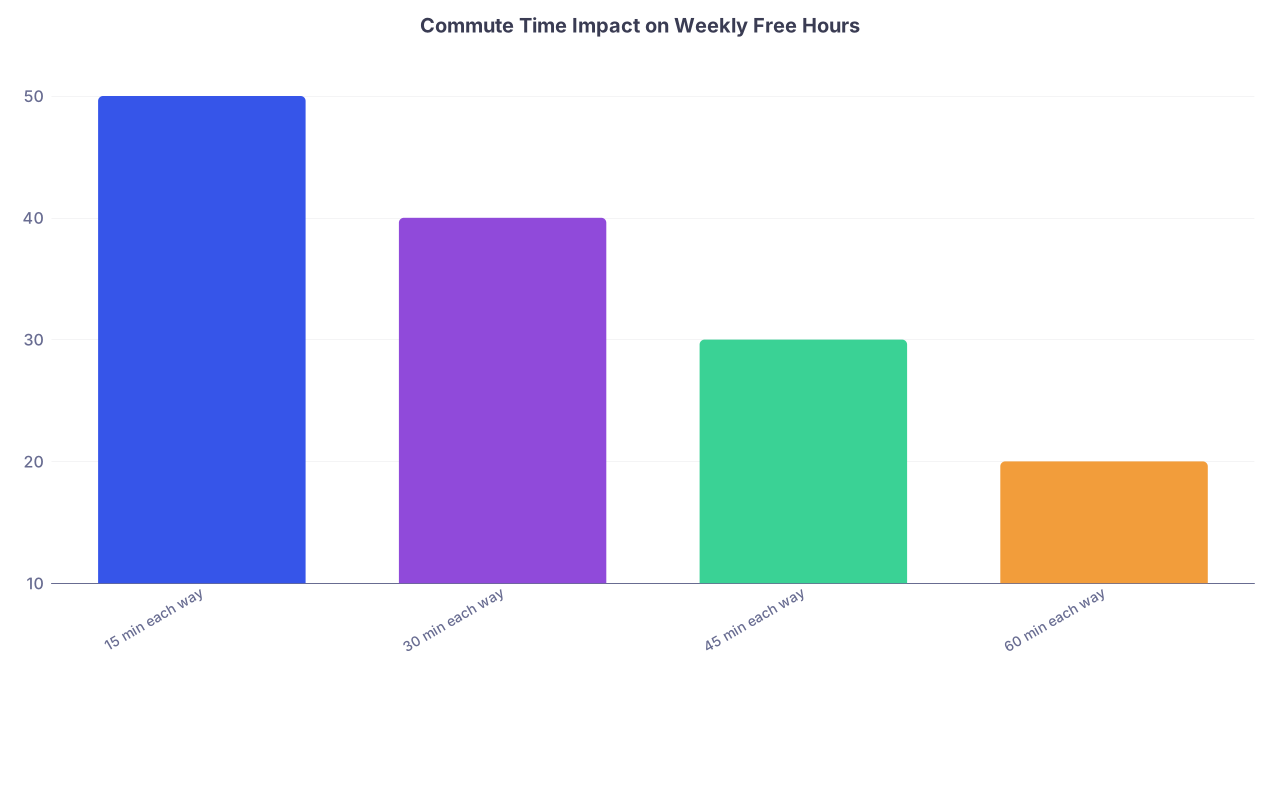
| Category | Value |
|---|---|
| 15 min each way | 50 |
| 30 min each way | 40 |
| 45 min each way | 30 |
| 60 min each way | 20 |
I’ve watched marriages strain not from a bad job, but from a brutal commute that seemed “temporary” and never changed.
You are allowed to walk away from a shiny academic job that puts you both in traffic hell.
Step 7: Stress‑Test Schedules and Call Before You Sign
The academic/private split often creates a trap: one of you has rigid OR/clinic days and heavy call; the other has “flexible” academic time that gets cannibalized by the chaos.
Don’t just ask, “What’s the call schedule?” Ask:
Academic side:
- How many evenings per week are you in clinic?
- How many weekends per month are you on service or call?
- Is call from home or in‑house? How often does it actually bring people in?
- How predictable is the schedule? Do you know your service weeks months in advance?
Private side:
- Home call vs in‑house vs “home but basically in the hospital.”
- Post‑call days truly off or just “lighter”?
- Average number of nights out of the house per week/month.
- Does anyone in the group have a spouse who’s also a physician? Talk to them.
Then, sit together and sketch one hypothetical month with real numbers:
- Week 1: She’s on academic inpatient, Q4 home call. He’s on private call that covers 3 hospitals.
- Who gets kids if daycare calls at 3 pm?
- Who can attend parent‑teacher conferences? Who can get groceries on a weekday?
- When is your one reliable evening together?
You’re trying to see if there’s any world where both of you are on heavy service/call at the same time every month. If yes, that’s a major red flag without robust backup (family, nanny, night nurse, etc.).

Step 8: Decide Who Optimizes for Career vs Stability (At Least For Now)
This part isn’t romantic, but it’s reality.
Usually:
- One partner’s job is optimized for long‑term career growth (research, leadership track, procedural volume).
- The other’s job is optimized for schedule stability, income, and geography.
That doesn’t mean one career is more “important.” It means you stagger your big swings so both of you are not in maximal chaos at the same time.
Typical patterns I’ve seen work:
- Academic job optimized now; private partner takes highly predictable, maybe less glamorous role with better schedule. After 3–5 years, you reassess and maybe rebalance.
- Private partner takes the heavy‑earning but intense first job; academic partner chooses a saner, more teaching‑heavy role with fewer grant pressures until loans are crushed.
Have an unfiltered conversation:
- Whose job is more geographically constrained?
- Whose subspecialty has fewer local options?
- Who cares more about prestige vs pay vs schedule right now?
You’re not signing a blood oath. But you are agreeing: “For this first 3–5 years out, we’re going to prioritize X for you and Y for me.”
Step 9: Handling the Scenario Where Offers Don’t Line Up
Sometimes the clean “both in one city, both starting August 1” outcome just doesn’t materialize.
Common ugly scenarios:
- One of you gets a strong academic offer; the other has only weak or no private offers in that city.
- The private offers are great in a nearby city, but the academic department there is lukewarm or absent.
- Timelines misalign, and someone wants an answer weeks before the other side moves.
Here are realistic options:
One of you accepts; the other plans a 1–2 year bridge.
- Locums in the region.
- Hospitalist/urgent care/per‑diem work while looking for a longer‑term fit.
- Telemedicine from the same home base.
This works better when:
- Loans aren’t crushing, or the accepting partner has a strong salary.
- The bridging partner has a generalist or flexible subspecialty.
You choose the “second‑best city” where both can have solid (but not perfect) roles.
The classic: you both pass on your individual “dream jobs” and pick a midsized city where you each are 7/10 happy. Long term, this is often less miserable than one person 10/10 and the other 3/10.Staggered long‑distance year with a hard end date.
I’m not a fan of long‑distance as a default, but:- If one role is clearly career‑defining and time‑limited (e.g., a top fellowship, 1‑year advanced training), you can do 12–18 months apart with strict rules:
- Biweekly in‑person visits.
- Financial plan to support the extra travel/rent.
- Pre‑agreed move‑in date and city.
- If one role is clearly career‑defining and time‑limited (e.g., a top fellowship, 1‑year advanced training), you can do 12–18 months apart with strict rules:
If you go long‑distance with no hard time limit and no concrete exit plan? I’ve seen that go badly more often than not.

Step 10: Pulling the Trigger Without Regretting It For 5 Years
At some point, you stop analyzing and sign.
Run one last pass with three lenses:
Worst‑week test. Picture it: both of you on call, sick kid, EMR meltdown, bad outcome debrief.
- In that week, are your jobs survivable?
- Does at least one of you have enough schedule slack or admin support to keep the house from burning down?
Three‑year test. If you stay in this configuration for 3 years:
- Are you each more employable, or stuck?
- Is your CV better, lateral, or worse?
- Are loans shrinking at a decent rate?
Resentment test. Be blunt:
- Will either of you secretly resent the other for “dragging” you to this city or job?
- Did you both have real veto power in this decision?
If you can honestly say:
- “This is not perfect, but it’s coherent,” and
- “We chose this together, eyes open,”
…then you sign, you stop second‑guessing, and you build a life there.
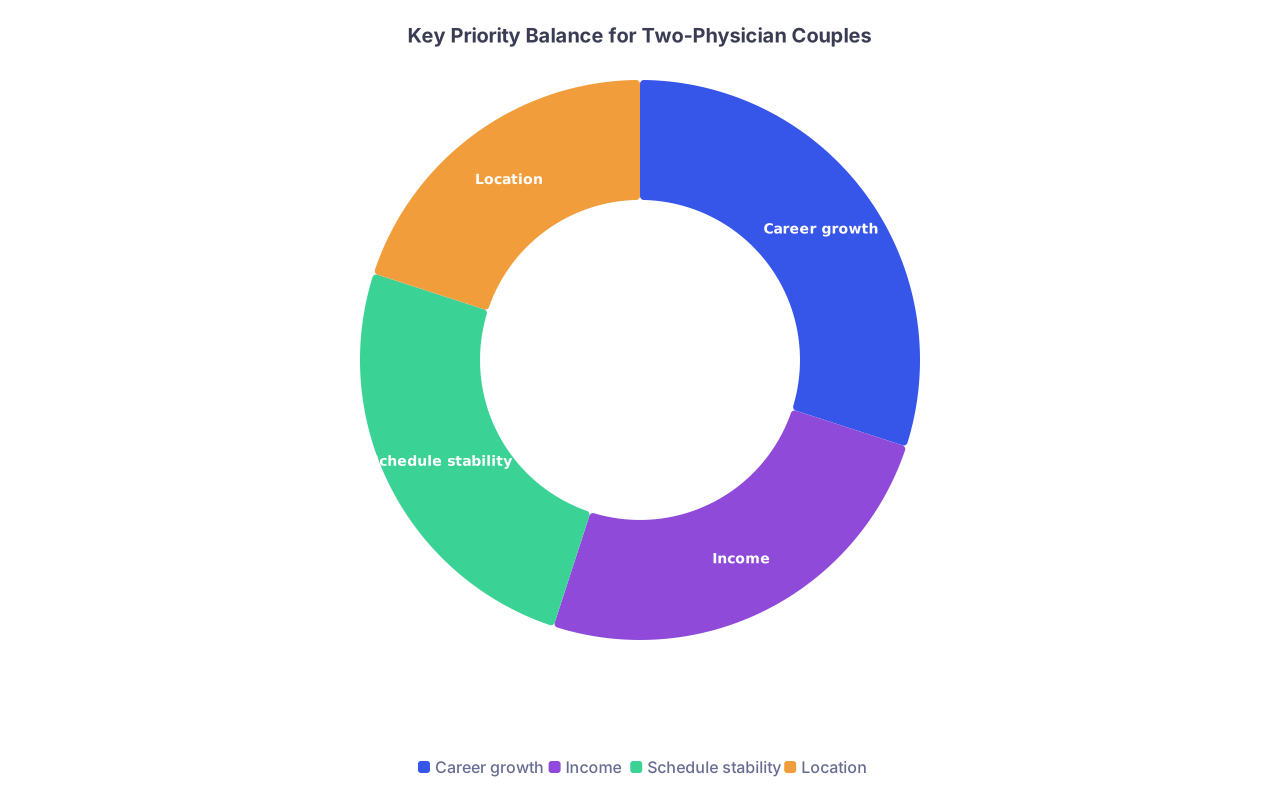
| Category | Value |
|---|---|
| Career growth | 30 |
| Income | 25 |
| Schedule stability | 25 |
| Location | 20 |
Final Practical Moves You Can Take Today
Do not just nod and go back to doom‑scrolling job boards. Do three concrete things now:
Schedule a 60‑minute meeting with your partner.
No phones. Open a shared doc. Write down:- Your city/commute limits.
- Each person’s top 3 non‑negotiables.
- Your combined financial floor. That document becomes your anchor when shiny offers start clouding your judgment.
Build a simple configuration table.
Even if you only have one offer and two “strong interest” leads, sketch possible combos. Seeing Academic X + Private Y side‑by‑side with Academic Z + Private W will clarify what you should push for.Email each recruiter/department contact and ask directly about timelines.
One sentence works:“Because my spouse is also a physician job‑seeking in [City], could you share your expected timeline for offers and decision windows so we can plan realistically?”
Start there. Then open your inbox and your calendar and move one step closer to a configuration that serves both of your careers—and your life outside the hospital.


