

The classic “academic vs RVU” advice completely ignores your loans and your kids.
Let me fix that.
You’re not choosing between “ivory tower” and “private workhorse.” You’re choosing between:
- How fast you get out from under $300k+ of debt
- How much of your kids’ childhood you miss
- How fried your brain and body will be at 40
If you’ve got massive student debt and a family, you do not have the luxury of pretending this is a purely “passion” decision. You need a plan. With numbers. With trade‑offs you actually understand.
This is the playbook I wish more people had before they signed that first attending contract.
1. Start with the actual problem, not the job labels
Your real problem is not “academic vs RVU.”
Your real problem is some version of:
- “I owe $350k at 6–8% interest.”
- “We have (or want) 2–3 kids.”
- “My partner’s income is limited / unstable / not enough to carry us.”
- “I’m exhausted from residency and I’m afraid an RVU job will break me.”
- “But I’m also afraid an academic salary means we’re broke forever.”
You solve that by defining three things concretely:
- How fast you must get out of dangerous debt territory
- How much home/family time you need to actually stay married and sane
- How much you care about teaching/research/title vs raw income
Do this before you even look at contracts.
The minimum numbers you must know
Grab a pen. No, really.
Write down:
- Total student loan balance
- Average interest rate
- Current or expected daycare/child expenses per month
- Partner income (realistic, not fantasy)
- Minimum monthly payment that actually moves the needle on loans (10‑year payoff, for example)
Now you’re going to sanity-check what different job types can realistically support.
2. What academic vs RVU actually looks like in real life
Forget the glossy brochure language. Here’s what you’re really choosing between in typical hospital-employed jobs.
| Factor | Academic Job | High-RVU Job |
|---|---|---|
| Base salary (non-surgical, HCOL city) | $200–260k | $280–450k |
| Control of schedule | Medium | Low–Medium |
| Nights/weekends | Moderate, often more call | Often heavier but paid more |
| Teaching/research | Built in | Usually minimal |
| Admin/meetings | High | Low–Medium |
| Job security | Generally higher | Depends on volume/payer mix |
Does this vary by specialty and region? Of course. But if your offers are nowhere near those ballparks, that’s already data.
The most common mistake I see: residents assume “academic = lifestyle, RVU = burnout.” Often wrong. A malignant academic department will chew through you harder than a high-RVU but well-run private group.
So you evaluate the specific offer. Not the category.
3. Model your life on each path (with kids and loans)
Stop thinking in vibes. Think in years.
Let’s build two simple 5‑year scenarios for a medium-paid specialty (IM, peds, hospitalist, psych — not ortho or derm; those are a different universe).
Scenario A: Academic hospitalist, moderate COL city
- Base: $230k
- Occasional bonus: $10k
- 7-on/7-off or similar inpatient schedule
- Federal loans on PAYE/REPAYE or SAVE, planning PSLF? Maybe.
Annual take-home (rough ballpark after tax, retirement, benefits): $140–160k.
With a family:
- Mortgage or rent: $2–3k/month
- Childcare (2 kids): $1.5–2.5k/month
- Loans (if aggressive, not PSLF): $3–4k/month
- Normal life expenses: $3–4k/month
You are not saving a lot. Aggressive debt payoff + decent home + kids = very tight on an academic salary unless:
- Your partner earns solid money
- You’re geographically flexible and choose LCOL
- You’re truly doing PSLF and keeping payments low
Now 5 years later: debt might be modestly reduced or forgiven (if PSLF track is clean), but you haven’t built much wealth beyond maybe a retirement account and small emergency fund.
Scenario B: RVU-heavy employed job, same city
- Base: $250k
- RVU bonus: realistic total comp $350–450k if you work hard but not insanely
- 12–15 shifts/month or 4–5 long clinic days/week
Annual take-home: $220–280k.
Same family expenses:
- Mortgage: $2.5–3k
- Childcare: $1.5–2.5k
- Loans: You can throw $6–8k/month if you choose
- Life expenses: $3–4k
Now you can:
- Pay off $300–400k of loans in 4–6 years
- Build a real emergency fund and taxable savings
- Still max retirement accounts
The price: more intensity, less slack, more pressure to produce.
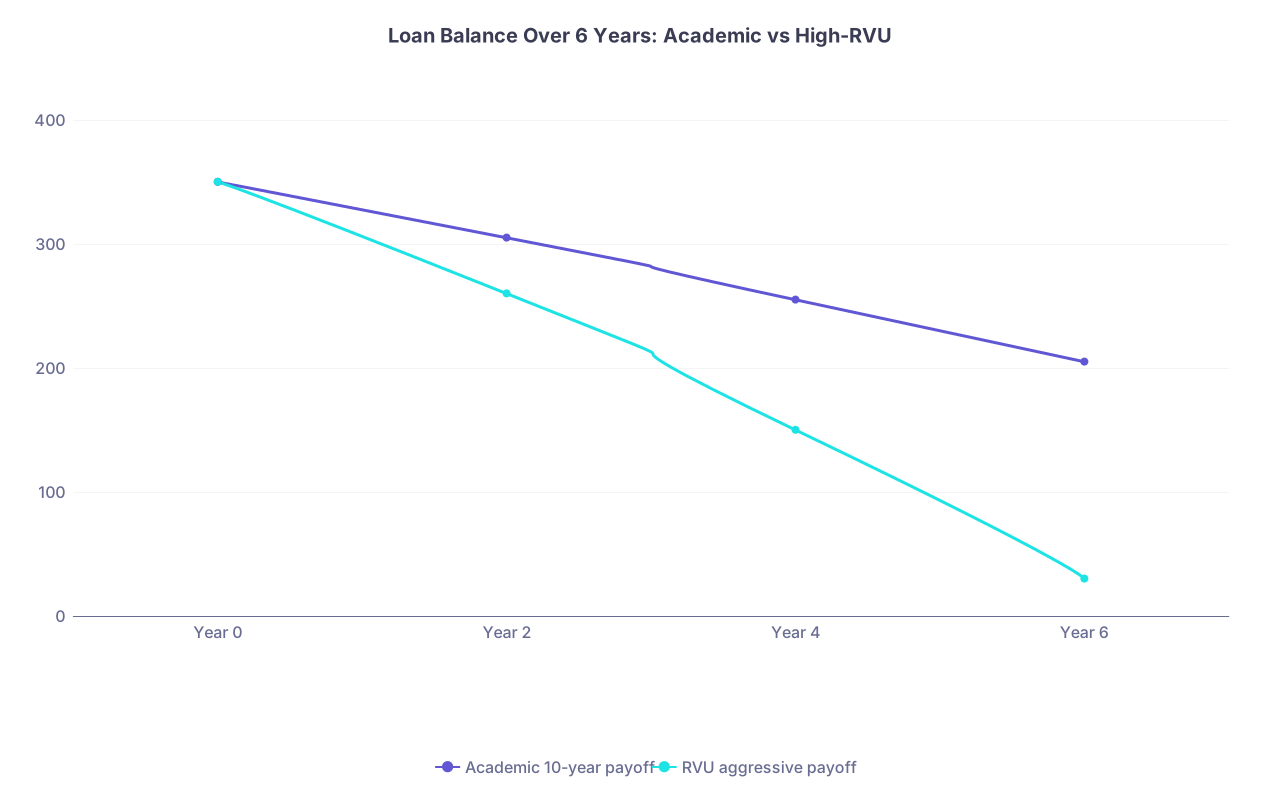
To visualize the payoff gap:
| Category | Academic 10-year payoff | RVU aggressive payoff |
|---|---|---|
| Year 0 | 350 | 350 |
| Year 2 | 305 | 260 |
| Year 4 | 255 | 150 |
| Year 6 | 205 | 30 |
Numbers are illustrative, but the shape is real: RVU grind can get you debt-free much faster if you use the income correctly.
4. The crucial question: PSLF or not?
If you have monstrous federal loans and a family, PSLF (Public Service Loan Forgiveness) is not just an “option.” It can completely change your job choice.
When academic + PSLF actually wins
Academic or nonprofit hospital employment is usually PSLF‑eligible. Private RVU gigs often are not.
You lean toward academic/PSLF when:
- Federal loans > $300k
- You’re sure the employer is a 501(c)(3) or qualifying nonprofit
- You’re willing to ride 10 years of qualifying payments
- Your income in academics keeps your monthly payments relatively manageable
Over 10 years you might:
- Pay less total out of pocket than full private payoff
- Get the rest forgiven tax‑free
- Make the lower academic salary workable because you’re not shoveling $7–8k/month at loans
Big warning: PSLF only works if you treat it like a project. Clean employer status, correct repayment plan, no gaps, forms signed yearly. I’ve watched people coast on assumptions and lose years.
When PSLF is a trap
You skip PSLF and lean RVU if:
- You secretly want to switch to private practice or industry in a few years
- You hate academia and know you won’t last 10 years
- You are in a very high-paying specialty where fast payoff is realistic
- Your spouse’s income + your potential RVU income makes 5‑year payoff comfortable
What kills people is trying to “kind of” do PSLF while also not committing to staying employed in qualifying jobs. That in‑between is miserable: high stress, slow payoff, and you still might not qualify.
5. Use a “bridge strategy” instead of a permanent identity
You do not need to decide who you will be for the rest of your life right now.
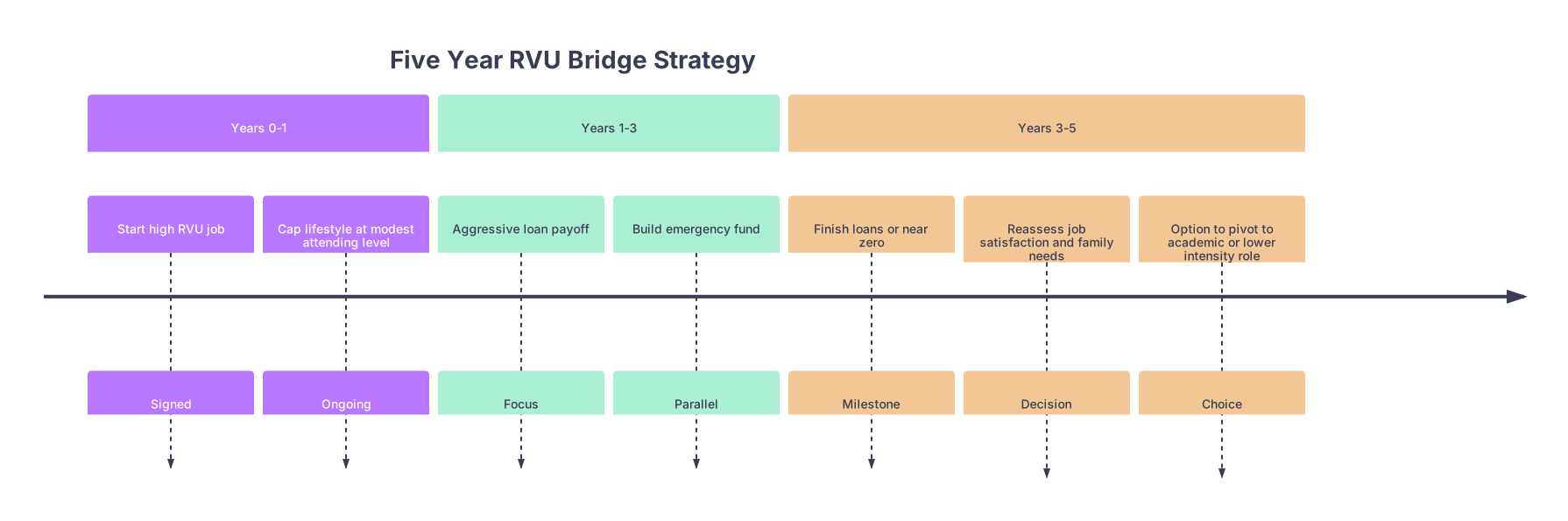
A powerful move for debt‑heavy docs with families is the 3–5 year bridge strategy.
Version 1: RVU now, academic later
Years 0–5 (post-residency):
- Take a high-paying RVU job
- Live like a late resident / modest attending (this is the discipline test)
- Crush loans + build a solid savings buffer
- Keep a toe in academics: moonlight teaching, small research collaborations, guest lectures
Years 5+:
- Pivot into academic role once your debt is manageable or gone
- Accept lower salary because your required monthly nut is much smaller
- Enjoy teaching, research, more predictable schedule with far less financial anxiety
Version 2: Academic now (PSLF), optional RVU later
Years 0–10:
- Take qualifying academic/nonprofit job
- Commit hard to PSLF: annual forms, correct repayment plan, confirm employer status
- Keep lifestyle modest despite “stable” job
- At 10 years, forgiveness hits → massive psychological and financial relief
Years 10+:
- Either stay academic because you like it
- Or jump to RVU/private with no loan anchor, using extra income for true wealth-building instead of back debt
This is how you stop feeling boxed in by “academic person” vs “RVU person.” You’re not picking an identity. You’re picking phases.
6. How family dynamics change the equation
If you’re single, you can survive almost anything for 3–5 years.
With a spouse and kids? Different game.
Pay attention to these friction points
- Call frequency and unpredictability. A “light” academic call schedule can still destroy your partner’s bandwidth with bedtime, illness, and logistics.
- Commute. Academic centers are often downtown. A 45–60 minute commute each way compresses family time more than one extra clinic session.
- True schedule control. RVU jobs sometimes allow compressed work weeks (4 long days) or block schedules. That can actually be better for family than scattered academic clinics, meetings, and random evening talks.
- Childcare backup. Who covers when daycare calls at 2 pm? RVU environments may be less forgiving, but some group practices understand parents far better than rigid academic departments.
Do not trust abstract descriptions. On every offer, ask specific questions:
- “How many nights per month will I actually work on average?”
- “How many weekends?”
- “Over the last year, how often did attendings stay late past scheduled end?”
- “What proportion of people have young kids here, and how do they manage?”
- “If my kid is sick, what’s the honest culture about calling out or leaving early?”
The answers are in the eye roll and the 2‑second hesitation, not the words.
7. The burnout reality: where it actually hits harder
Everyone’s scared of RVU burnout. Fair. But I’ve watched plenty of colleagues get cooked in academic jobs too.
Common academic burnout drivers
- Death by meetings and bureaucracy
- Service time disguised as “teaching” with no protected time
- Comp committee pressure to publish when you have zero bandwidth
- Lower pay while doing essentially full‑time clinical work plus extra
Common RVU burnout drivers
- Constant pressure to see “just a few more”
- Moral injury from high volume / low time per patient
- Compensation tied to metrics you don’t fully control (no‑shows, insurance nonsense)
- Toxic groups that punish boundary setting
The real differentiators aren’t the labels; they’re:
- Leadership quality
- Culture around saying “no”
- How they treat colleagues who have kids or family needs
- Turnover over the last 3 years
You must ask about turnover. If multiple physicians with families have left in the last few years, that’s a red flag, regardless of RVU vs academic.
8. Concrete steps: how to choose when you have actual offers
Here’s how I’d walk you through it if we were at your kitchen table with two contracts.

| Step | Description |
|---|---|
| Step 1 | List Offers |
| Step 2 | Check PSLF Eligibility |
| Step 3 | Model 10 year PSLF plan |
| Step 4 | Model 5 year payoff plan |
| Step 5 | Compare family schedule realities |
| Step 6 | Estimate monthly surplus each job |
| Step 7 | Expand search or negotiate |
| Step 8 | Choose that job |
| Step 9 | Pick based on culture and future goals |
| Step 10 | PSLF Path Attractive? |
| Step 11 | Can job meet debt + family needs? |
Step 1: PSLF vs non-PSLF
Is one job clearly PSLF‑eligible and the other not?
- If yes, run a 10‑year PSLF projection vs 5–7 year private payoff at RVU job
- If the PSLF saves you six figures and you can tolerate academia, that’s strong justification
Step 2: Build actual 5‑ and 10‑year budgets
For each job:
- Estimate post-tax income realistically
- Subtract: housing, childcare, life, realistic loan payment plan
- What’s left? That “what’s left” is your margin of safety and opportunity.
| Category | Value |
|---|---|
| Academic Job | 1000 |
| High-RVU Job | 4000 |
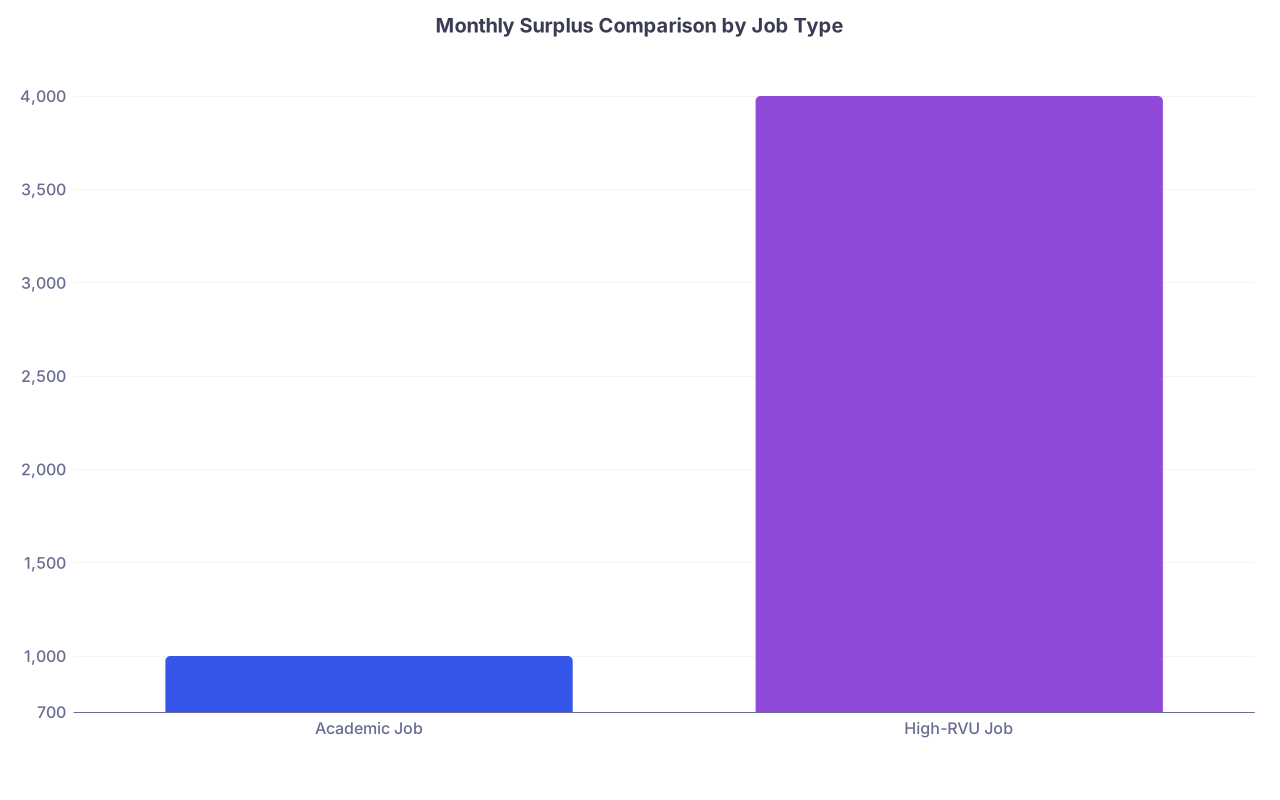
If that surplus is $1k vs $4k, over 5 years that’s a $180k difference. You can feel that difference in every part of your life.
Step 3: Put lifestyle detail to paper
For each job, write down:
- Number of nights per month
- Number of weekends per month
- Average end time for the workday, honestly
- Commute time
- Backup coverage flexibility
Then sit with your partner and ask: “What does a bad week look like on this job? What does a good week look like?” Be brutally specific.
9. Negotiation: you probably have more leverage than you think
You can often tweak a job into something that works much better for a young family with debt.
Things you can realistically ask for:
- Slightly higher base salary or guaranteed minimum for 1–2 years
- Reduced call or more predictable call schedule in exchange for slightly lower RVU target
- Signing bonus timed to hit before first big loan payments
- Relocation assistance structured to reduce out-of-pocket moving and housing overlap
- Protected time that is actually protected (in writing) if you’re going academic
In academic jobs you can often negotiate:
- Clear expectations around clinic FTE and non-clinical time
- Specific written commitments for teaching/leadership roles that might lead to promotion (and sometimes salary bumps)
In RVU jobs:
- Clarify and, if possible, cap panel size or daily encounter expectations
- Make sure the RVU threshold for bonuses is realistic based on current physicians
- Get examples of last year’s total comp for similar attending FTEs
And yes, ask to talk to a young doc there with kids. Off the record. That conversation is usually worth more than any recruiter PDF.
10. How to avoid the two worst mistakes
I see two predictable disasters.
Disaster 1: Taking low-paid academia without PSLF plan
You go academic because it “feels safer” and “more balanced,” but:
- You’re not at a qualifying PSLF employer or never file the forms
- You don’t aggressively limit lifestyle creep
- You end up barely scratching principal while interest eats you
Result: 8–10 years in, you are mid-career, still heavily indebted, with limited savings and no quick escape path.
Disaster 2: Taking high-RVU and inflating lifestyle instantly
You go big RVU, tell yourself you’ll “just do it for a few years,” and then:
- Buy the expensive house
- Two cars with payments
- Private school
- No budget, just vibes because “I earn plenty”
Result: 5 years later, you made $1.5–2M gross and your net worth is… basically zero. Loans maybe reduced but not gone. You’re exhausted and trapped because your lifestyle now demands the high RVU pace.
Both are avoidable if you treat the first 5–10 years post‑residency as a deliberate phase, not a permanent identity.
11. A quick reality check by specialty
Your leverage and options vary a lot by field.
| Specialty Group | Typical Academic Pay vs RVU Gap | PSLF Attractiveness |
|---|---|---|
| Primary Care (IM/FM/Peds) | Large gap | High |
| Hospitalist | Medium gap | High |
| Psych | Medium–large gap | High |
| EM | Variable, depends on market | Medium |
| Surgical subs | Sometimes smaller gap at big centers | Medium |
| Derm/Ortho/Anes/Rad | Huge RVU potential | PSLF less critical |
If you’re in primary care with $400k loans and two kids, PSLF or a planned RVU bridge strategy is almost mandatory unless your spouse is a high earner.
If you’re ortho with $400k loans, a reasonably-paid RVU job can erase that in under 5 years if you don’t act like an NBA rookie with your spending.
12. Put it together: your decision framework
Here’s the stripped-down version I’d force you to answer:
- Are you willing and able to commit 10 years to PSLF-qualifying work?
- If yes, heavily consider academic/nonprofit with a clean PSLF plan.
- If not, can you tolerate 3–5 years of higher-intensity RVU work to nuke your loans?
- If yes, do a bridge: RVU grind, strict lifestyle, then reassess.
- For each concrete offer, ask:
- Does this job let us:
a) cover life + kids and
b) either aggressively pay loans OR credibly pursue PSLF?
- Does this job let us:
- If the answer is “no” for both offers:
- You do not pick the “less bad.” You keep looking, expand geography, and negotiate harder.
And through all of this, your spouse (if you have one) is not an accessory. They’re a co‑architect. If they’re silently resentful of a high-RVU grind or silently terrified of your low academic paycheck, you will feel that in year 2, hard.


| Category | Value |
|---|---|
| Clinical | 50 |
| Admin/Meetings | 20 |
| Teaching/Research | 10 |
| Family/Personal (remaining) | 20 |

| Period | Event |
|---|---|
| Years 0-1 - Start high RVU job | Signed |
| Years 0-1 - Cap lifestyle at modest attending level | Ongoing |
| Years 1-3 - Aggressive loan payoff | Focus |
| Years 1-3 - Build emergency fund | Parallel |
| Years 3-5 - Finish loans or near zero | Milestone |
| Years 3-5 - Reassess job satisfaction and family needs | Decision |
| Years 3-5 - Option to pivot to academic or lower intensity role | Choice |
Bottom line
Three things to walk away with:
- Stop treating “academic vs RVU” like identity labels. They’re tools. Use them in phases to solve your real problems: debt, family time, long‑term flexibility.
- Make the decision with hard numbers and real schedules, not vibes. Build 5‑ and 10‑year projections, including PSLF vs private payoff, and look at what your life actually feels like in each.
- Whatever you pick, commit to the phase: either go all‑in on PSLF with clean paperwork and modest lifestyle, or go all‑in on a 3–5 year RVU bridge with strict loan payoff and spending discipline. Your future self – and your kids – will feel the difference.


