
The fantasy that physicians can work “anywhere” is wildly overstated.
If your spouse’s career locks you to a city or region, your job search is a different game entirely—and you need to stop playing by advice written for people who can “just be flexible.”
This is the situation: your spouse has a career that isn’t portable—big law associate in a major market, tenure-track faculty, specialized engineer tied to one company, kids anchored to a specific school system, or immigration constraints that make moving a legal mess. You, as a post-residency or early-career doctor, are effectively doing a constrained job search in a small radius.
Let’s walk through how to handle that. Not in theory. In actual moves you can make this quarter.
Step 1: Get Brutally Clear on Your True Geographic Box
“Somewhere in the metro area” is not a plan. You need a hard box with numbers.
Start with what your spouse’s job really allows, not what you wish it allowed.
You need answers to questions like:
- How far can they realistically commute without blowing up their life? 30 minutes? 60?
- Are there real satellite locations for their employer, or is that HR fiction?
- Does their promotion track depend on being in a particular office or lab?
- Are kids locked into a specific school district or can you cross a boundary line?
- Any immigration / visa issues that tie you to an employer or state?
Be specific and write it down. For example:
- “We must be within 40 minutes of downtown Chicago by train or car.”
- “We cannot live more than 30 minutes from Hospital X because of childcare logistics.”
- “Visa tied to Employer Y in Austin; we have to stay in Austin metro for at least 3 years.”
Now overlay your specialty onto a map. Literally.
Pull up Google Maps and search:
- “hospital near [city]”
- “[specialty] clinic near [city]”
- “[health system name] [specialty]”
- Telemedicine-friendly employers (if that’s on the table)
Create a shortlist of every potential employer inside your actual geographic box. Don’t filter yet by prestige or vibe. Just find the bodies.
This is your market. It might be 4 hospitals and 8 groups. That’s fine. It’s reality. You’ll work with that.
Step 2: Decide What You’re Willing to Sacrifice—and What You’re Not
You’re not going to get everything. You need to choose your trade-offs on purpose, not by default.
Think about:
- Academic vs community
- Ideal niche vs broader generalist work
- Title vs schedule vs pay
- Call burden vs location convenience
- Brand-name institution vs sane work environment
When geography is fixed, one or more of these is going to give. If you pretend otherwise, you’ll end up resentful and boxed in.
Do this exercise:
Make three columns on a piece of paper:
- Non‑negotiable
- Strong preference
- Nice‑to‑have
Force yourself to put only 3–5 items in “Non‑negotiable.” Examples:
- “No >1:3 call.”
- “No full-time nights.”
- “Must be at least 0.8 FTE for benefits.”
- “No more than 2 locations I regularly commute between.”
Everything else goes into the other two columns.
Keep this list visible while you talk to recruiters and chiefs. It will stop you from saying yes to a shiny but toxic role because you’re scared there won’t be others.
Step 3: Go Direct, Not Just Through Job Boards
Constrained geography means you can’t sit back and wait for posted jobs. By the time something hits a job board in your narrow region, 3 internal candidates and the chief’s friend from fellowship may already be in line.
You’re going to use three channels simultaneously:
- Cold-but-smart outreach
- Networks (even weak ones)
- Recruiters—but controlled
3.1 Cold Outreach That Doesn’t Sound Desperate
You’re going to email chiefs and practice leaders directly. Short, precise, and obviously tailored.
Subject lines that work:
- “Board-eligible [specialty] completing residency at [program] – interest in [Hospital/Group]”
- “[Specialty] physician relocating to [city] – exploring opportunities at [system]”
- “[Subspecialty] with [unique skill] – local candidate”
Core elements of the email:
- Who you are (training, year, specialty)
- Why this location (and that you’re committed to staying)
- Why them specifically (show you know something about their group)
- What kind of role/FTE you’re open to
- CV attached
Example line:
“I’m relocating permanently to the Boston area due to my spouse’s position at MIT and am seeking a long-term role in outpatient general neurology within 30 minutes of Cambridge.”
That tells them:
- You’re local (or will be)
- You’re stable (not a 1-year flight risk)
- You understand geography
You’d be surprised how often the reply is: “We’re not actively advertising, but let’s talk.”
3.2 Use the Network You Already Have (Even If It Feels Thin)
You’re not asking for favors. You’re surfacing information.
Tell people exactly what you’re looking for:
- “We’re locked to Houston because of my spouse’s job. Do you know anyone at [Hospital A/B/C] or large private groups in [specialty]?”
- “I have to be within 30 minutes of downtown Seattle; any sense of which systems treat their [specialty] people decently?”
Hit:
- Former attendings and fellowship directors
- Co-residents who left for that city
- Medical school classmates
- Subspecialty listservs and society Facebook/Slack groups
Most people won’t outright get you the job. But they’ll give you:
- Enough intel to avoid toxic groups
- The name of the real decision-maker
- A warm intro that moves you ahead of anonymous applicants
3.3 Recruiters: Useful, But Don’t Let Them Spray Your CV
In a tight geography, recruiter misuse can burn options.
Ground rules:
- You tell them exactly which hospitals/systems/groups they may contact.
- You keep a spreadsheet: who has your CV, who contacted whom, and when.
- You ask them to confirm before sending your CV anywhere new.
You never want a chief to hear about you first from a random recruiter you barely remember talking to, especially if you also reach out directly. You look disorganized, or worse, desperate.
Step 4: Expand How You Define “Local”
Sometimes the problem isn’t that there are no jobs. It’s that you’re defining “commute” too narrowly or all-or-nothing.
Get creative without torching your spouse’s career or your sanity.
Options I’ve seen work:
1–2 “long commute” days per week
Live close to your spouse’s work. You take 1–2 days where you commute 60–90 minutes to a higher-paying or better-fitting role, with 2–3 days at a closer satellite clinic. Many groups will flex this if they want you.Hybrid telemedicine + 1–2 in-person clinic days
Especially in psych, derm, endo, sleep, rheum, some primary care setups. You anchor your life where your spouse needs to be. You drive in a couple days; the rest is from home.Short-term grind to reposition later
Year 1: tolerate a commute or less‑than‑perfect setup while your spouse solidifies role/promotion/green card. Year 3+: renegotiate, shift jobs, or move slightly within the metro once you have more leverage.
Use these only intentionally, with time limits. “I’ll do a 75-minute commute three days a week indefinitely” is how people burn out and start resenting everyone.

| Category | Value |
|---|---|
| Commute | 8 |
| Clinic | 32 |
| Admin | 6 |
| Family | 40 |
| Sleep | 42 |
Step 5: Structure the Conversation With Your Spouse Like an Adult, Not a Victim
This is where many physicians screw it up. They stew silently, then explode with: “Well you’re the reason I can’t take that academic job!” That’s a fast track to mutual resentment.
You’re a team making one career system out of two people.
Here’s the conversation that actually works:
You come in with:
- A clear geographic box
- Rough understanding of your local job market
- Your non‑negotiables and flex areas
You say something like:
“If we stay in [City] for your career, my options look like [X]. That probably means [trade-off A] and [trade-off B] for me. I can live with those if [condition]. What can shift on your side, if anything?”You ask specific questions:
- “Are we definitely committed to this company/campus for 5+ years?”
- “Is there a realistic path to a more flexible role for you here later?”
- “If a truly toxic job is my only option in this radius, what’s Plan B?”
Make sure both of you say out loud what you’re choosing:
- “We are choosing to prioritize your BigLaw partnership track over my ideal academic niche, for at least 5 years, and we both understand that means I may be in a less perfect but stable role.”
Spoken choices are easier to own than unspoken sacrifices.
Step 6: Negotiate From Your Constraints, Don’t Hide Them
You might be tempted to hide your geographic lock in negotiations, thinking it weakens your leverage. Bad move. Smart chiefs can smell it anyway.
Use it strategically.
What you actually have:
- Stability: You’re not leaving for a random job across the country next year.
- Motivation: You need this to work; you’re likely to invest in the team.
- Predictability: They know you won’t show up halfway through the year saying, “We’re relocating for my spouse’s fellowship.”
So you say:
- “We’re anchored in this area for the long term due to my spouse’s career. That’s actually a positive for you: I’m committed to building something sustainable here. To make that realistic, I’d need [X schedule / Y FTE / Z flex].”
Examples of what to ask for in exchange for being “the local long‑term hire”:
- Fewer sites to float between
- A sane, predictable schedule (especially if your spouse travels)
- Specific clinic days that align with childcare
- Protected administrative time if you’re doing nonclinical work
You’re not begging. You’re trading. Long-term stability for them, reasonable structure for you.
Step 7: Have a Plan If All the Local Options Suck
Sometimes every large group in your box has a reputation: terrible leadership, RVU sweatshop, constant turnover. I’ve seen cities where every resident whispers, “Whatever you do, don’t sign with Group X.”
If that’s your city and you’re stuck there because your spouse’s job is truly immovable, you cannot just shrug and take the least awful option and hope.
You need an exit‑within‑the‑city strategy.
Possible moves:
Short, tactical contract
Push hard for a 1- or 2-year contract with:- Clear, written expectations
- Minimal restrictive covenants (or geographically tiny ones) Then, while you’re working, you:
- Quietly build relationships at other local hospitals
- Explore side clinical work (urgent care, telehealth, per diem) that could grow
Part-time + multiple small roles
Instead of one 1.0 FTE job at a toxic system:- Take a 0.6–0.8 at the least-bad local employer
- Add 0.2–0.4 telemedicine, locums (within state), or niche cash practice More complexity, yes. But more control.
Nontraditional role anchored locally
Think:- Industry (med device, pharma) with local or remote HQ
- Clinical informatics with mostly remote work
- Health tech enterprise physician roles These may not be your “forever identity” as a doctor, but they can be excellent bridges while your spouse completes a key career phase.
Step 8: Contract Red Flags Matter More When You’re Geographically Trapped
When you can’t easily leave the region, your contract risk is higher. You cannot sign the same way your co-resident headed to a big national market does.
Watch for three specific traps:
Noncompetes with huge geography
“50 miles from any practice site.”
In a constrained search, this might mean: “If we fire you, you can’t work anywhere your spouse can commute.”You push back hard:
- Shrink miles
- Limit to specific addresses
- Shorter duration Or, if they won’t budge and they’re the only job in town, you at least do this with your eyes open and Plan B clarified.
Heavy, opaque RVU expectations
If there are only 3 other groups in town and you burn out at this one, you’re in trouble.Demand:
- Clear written benchmarks
- Actual physician productivity data (not just recruiter vibes)
- A ramp-up period that’s realistic for the local market
Call arrangements that wreck your spouse’s schedule
You cannot both have “black box” careers with brutal unpredictability if you have small kids, limited family support, and fixed geography.You must ask:
- How often am I first call vs backup?
- How far away can I live?
- Is there a realistic path to reduced call later?
If a contract is especially ugly and you’re especially trapped by location, this is where you pay an attorney who actually reads physician contracts for a living. Not your cousin who “does some corporate law.”
Step 9: Use Time to Your Advantage, Not as a Stress Weapon
The most common mistake: starting the search late, panicking, and signing something awful because “we have to stay here.”
You don’t have the luxury of procrastination.
Rough timeline if you’re still in residency/fellowship:
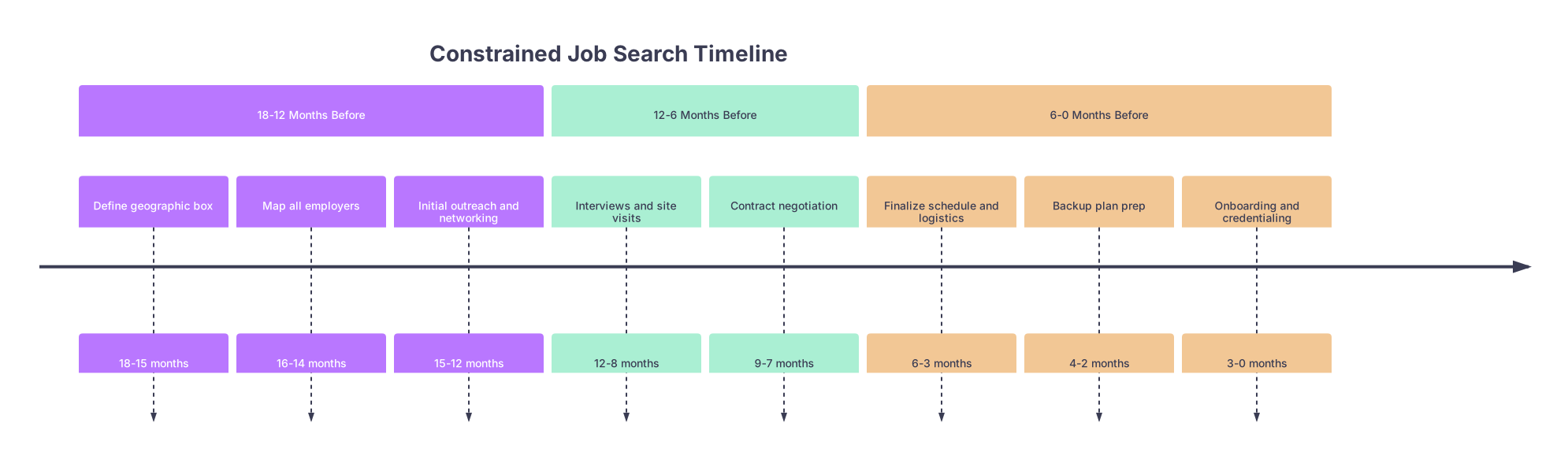
| Period | Event |
|---|---|
| 18-12 Months Before - Define geographic box | 18-15 months |
| 18-12 Months Before - Map all employers | 16-14 months |
| 18-12 Months Before - Initial outreach and networking | 15-12 months |
| 12-6 Months Before - Interviews and site visits | 12-8 months |
| 12-6 Months Before - Contract negotiation | 9-7 months |
| 6-0 Months Before - Finalize schedule and logistics | 6-3 months |
| 6-0 Months Before - Backup plan prep | 4-2 months |
| 6-0 Months Before - Onboarding and credentialing | 3-0 months |
If you’re already in practice and stuck:
- Give yourself a 6–12 month runway to change jobs.
- Commit to one major job-search action every single week (email, networking call, CV adjustment, recruiter conversation).
- Don’t let “I’m busy” become code for “I’m quietly giving up and staying in this miserable role forever.”
Step 10: Protect the Marriage While You Protect the Career
Last piece, and it matters: constrained geography due to a spouse’s career can slowly poison a relationship if you handle it poorly. You’ll both be tempted to keep score.
A few ground rules that help:
No “you owe me” language
“I stayed in this city for you, so you have to put up with…” is a guaranteed resentment generator, even if it’s technically true.Shared narrative
Get to a point where you can say: “We decided together to prioritize X and accept Y trade-off for now.” Not “you made me.”Time-bound sacrifices
“We’re agreeing to this setup for 3 years, then we reassess.” Put that in your calendar as a real check-in, not a vague hope.Outside perspective
Couples counseling or even a one-time session with a career counselor who understands dual-career families can reset you both. You are not weak for needing that; you’re smart.

A Quick Reality Check
Here’s the blunt truth: A constrained job search because of your spouse’s career doesn’t ruin your career. But it does change how you have to operate.
You:
- Plan earlier.
- Network harder.
- Negotiate more openly.
- Accept certain trade-offs deliberately, not by accident.
I’ve seen physicians stuck in tiny markets build excellent, stable, satisfying careers because they treated the constraint like a design parameter, not a punishment.
And I’ve seen others in huge open markets end up miserable because they assumed “I can always just move” and made impulsive, short-sighted choices.
Your box is smaller. So you play smarter.
Key Takeaways
- Define your actual geographic box with your spouse, map every plausible employer inside it, and accept that this is your real market—not the whole country.
- Use targeted outreach, networks, and controlled recruiter use to surface unposted or informal opportunities, then negotiate from your position as a long-term, locally anchored hire.
- If all local options are bad, treat your first role as tactical: minimize noncompetes, structure time-bound sacrifices with your spouse, and build pathways (side work, alternative roles, better connections) to a more sustainable job within the same constrained geography.