
Handling a Non-Compete Clause When You Need to Stay Local
What do you do when your contract says you cannot practice within 20 miles… and your kids’ schools, your partner’s job, and your entire support system are all inside that circle?
This is where a lot of people get burned. Not because they’re lazy or careless, but because they sign stuff during fellowship or early attending life without understanding how hard a non‑compete can hit when you finally want out.
Let’s walk through how to handle this when staying local is non‑negotiable.
Step 1: Get Extremely Clear on What Your Non‑Compete Actually Says
Most physicians I talk to don’t fully understand their own non‑compete. They remember “2 years, 15 miles” and that’s about it. That’s not enough.
Pull the contract. Not the offer letter. The actual signed employment agreement.
You’re looking for the “Restrictive Covenants,” “Non‑Competition,” or “Post‑Employment Restrictions” section. Then answer these questions in writing:
What activities are restricted?
Is it:- Any practice of medicine?
- Just your specialty?
- Just doing certain procedures?
- Working with competing groups/hospitals?
Big difference between “cannot practice medicine” and “cannot practice cardiology with a competing group.”
What is the time period?
Six months, one year, two years? Longer than two years is usually excessive and often harder to enforce, but you need the exact number.What’s the geographic scope—precisely?
Miles from what? Common variants:- Primary clinic location only
- Any office where you see patients
- Any hospital where you have privileges
- Any facility owned by the employer system
I’ve seen contracts that say “25 miles from any location owned or operated by Employer.” In a big hospital system, that can basically mean the whole metro area.
Is it “point to point” or “radius around each site”?
Ask a lawyer if you’re unsure. A 10‑mile radius around 1 clinic is very different from 10 miles around 6 clinics.When does the clock start?
- Last day of employment?
- Last day you practice within their system?
- Only if you resign vs. if you’re terminated?
Are there any carve‑outs or exceptions?
Sometimes buried in the language:- If they terminate you without cause, non‑compete is reduced or void
- Certain hospitals or rural areas are exempt
- Moonlighting or telemedicine excluded under defined conditions
If you cannot answer all six questions in clear, normal language, you don’t understand the clause yet.
At this point, do not guess. Do not assume your friend’s contract is the same. And do not take HR’s word as gospel. HR works for the employer, not for you.
Step 2: Map Your Reality vs. The Restricted Zone
You need to see the problem on a map, not just in your head.
Do this literally:
- Mark each restricted location on a map
- Draw the radius for each (5, 10, 25 miles, whatever the contract says)
- Shade the blocked areas
Now overlay your life:
- Where you live
- School/daycare locations
- Partner’s job
- Closest family support
- Where you’d realistically want to practice (competing hospital, private groups, FQHCs, etc.)
Most physicians are shocked how much is actually included when they see the circles. Especially with multi‑site systems.
This exercise clarifies your options:
- Can you work on the edge of the metro area and still be reasonably local?
- Is telemedicine viable from home if the restriction is about physical sites?
- Are neighboring counties actually outside the radius?
You’re building a tactical picture. Like planning where you can safely land without getting shot at.
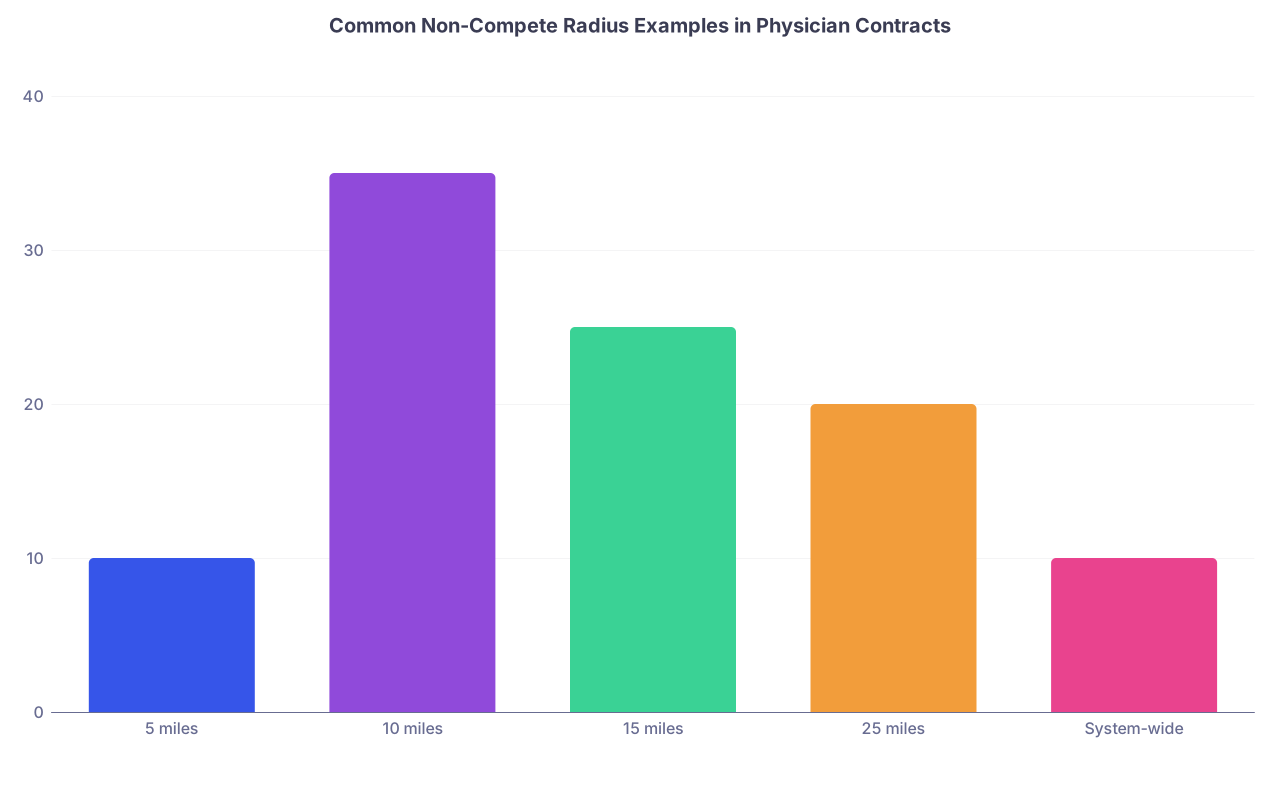
| Category | Value |
|---|---|
| 5 miles | 10 |
| 10 miles | 35 |
| 15 miles | 25 |
| 25 miles | 20 |
| System-wide | 10 |
(Those percentages are roughly what I’ve seen in real physician contracts: 10% tiny radius, 35% 10 miles, etc. System‑wide is the nightmare one.)
Step 3: Before You Panic—Figure Out How Enforceable This Really Is
Non‑compete enforceability is extremely state‑specific and changing fast.
Some states basically hate physician non‑competes (California, North Dakota, Oklahoma). Others limit them (like prohibiting them for employed physicians in certain settings or making them void if the employer fires you without cause). Some big health systems are backing away from them under pressure. And there’s a federal fight over them too.
Do not assume yours is ironclad just because it’s in writing.
Here’s what you actually do:
Find a local healthcare/physician contract lawyer
Not your cousin who does real estate. Someone who negotiates physician contracts in your state. They’ll know the local court climate and which employers are aggressive.Ask them three blunt questions:
- How often do you see non‑competes like this enforced around here?
- How enforceable is this clause, realistically, if I go to [specific employer] nearby?
- What are my real‑world risks if I stay local but push the boundaries?
Be honest about your risk tolerance
Some people will accept a 20% chance of a nasty letter and possible court drama. Others won’t sleep at night unless the risk is almost zero.
I’ve seen:
- Hospital systems send scary cease‑and‑desist letters and then… do nothing more.
- Groups sue aggressively as a “message” to others, even when their legal case is weak.
- Employers quietly waive or narrow non‑competes during physician shortages.
Do not decide based on Reddit threads or “my attending said.” Decide based on an attorney who knows your geography, your employers, your courts.
Step 4: Leverage Every Weakness in the Clause
Most non‑competes are drafted broad. Sometimes too broad. Courts often look for “reasonableness” in:
- Scope of activity
- Geography
- Duration
Your lawyer should be hunting for attack points:
- Is the radius absurd given the market density?
- Is the time period longer than your state usually allows?
- Does it try to block you from any clinical work, even very different from your current role?
- Does it punish you even if they breach first (e.g., stop paying you properly, change your schedule drastically)?
Even before a lawsuit, these weaknesses give you leverage to negotiate a softer landing.
You want to know: If this went to court, what might a judge realistically trim this to? Courts often “blue pencil” non‑competes, making them smaller. That potential future reality is bargaining power today.
Step 5: Try to Negotiate Your Way Out (Quietly and Strategically)
If staying local is crucial, your primary mission is to reduce or neutralize the non‑compete before you jump ship.
This is where many people screw up: they announce they’re leaving, accept a new job across town, and only then bring up the non‑compete. That’s backwards.
You want to:
- Know your legal position (after talking to an attorney).
- Have an alternate job path in mind.
- Then open a conversation about amending or waiving the restriction.
How to approach your current employer:
- Do not lead with threats
- Do not say “my lawyer said this is unenforceable” (that just makes them defensive)
- Do not email anything you wouldn’t want read in court
Try something like:
“I really value being able to stay in this community long‑term for family reasons. The current non‑compete makes that very difficult. I’m hoping we can find some middle ground—either by narrowing the radius, shortening the duration, or tying it to specific sites rather than system‑wide. Is that something you’d be open to discussing?”
You may have more leverage if:
- They’re short‑staffed and desperately need you to stay for a transition
- Your subspecialty is hard to replace
- You’re willing to help recruit and onboard your replacement
- You’re not running to their direct arch‑nemesis across the street
Some employers will offer:
- Reduced radius
- Shorter time (e.g., 3–6 months instead of a year)
- Waiver if you agree not to solicit their patients or staff
- Waiver for specific jobs (FQHCs, VA, academic programs)
| Concession Type | Typical Example |
|---|---|
| Shortened duration | 24 months → 6–12 months |
| Reduced radius | 20 miles → 5–10 miles |
| Site-specific limit | Only main clinic, not all sites |
| Role-based carve-out | Hospitalist but not clinic work |
| Conditional waiver | Waive if you avoid key rivals |
If they refuse everything, good. Now you know exactly what you’re up against and can plan accordingly.
Step 6: Design a “Stay Local Without Getting Sued” Strategy
This is the heart of it. Let’s be concrete.
Scenario A: Full Clinical, Same Specialty, Same Metro
You’re a general cardiologist in a mid‑size city. Your non‑compete is 1 year, 15‑mile radius from all practice sites. Your whole life is in this city and you cannot move.
Real options:
Find an employer just outside the radius
- Maybe a competing hospital in a neighboring town 18 miles from your main clinic
- Accept a longer commute for a year
- Plan to move back closer once the year is up
Change practice focus temporarily
If the non‑compete is specifically about outpatient clinic in a competing group, you could maybe:- Work as a hospitalist or intensivist
- Do inpatient‑only consults
- Take a temporary academic or research role
But only if the language allows it. This is where that “what activities are restricted?” step matters.
Mix telemedicine + per diem work outside the radius
- Telemedicine from your house might be okay if the patients are out of state or the “location” is legally considered where the patient is, not you
- Per diem shifts in a hospital beyond the radius
A lot of people underestimate how viable a 6–12 month telemed + locums hybrid can be as a bridge.
Scenario B: They Fired You / Reduced Your Hours / Breached
Different leverage.
If they:
- Cut your salary unilaterally
- Drastically reduced hours or closed your clinic
- Terminated you “without cause”
The argument that they now get to control where you practice for 1–2 years gets weaker. Sometimes much weaker.
This is where an attorney might say: “Given these facts, I’m comfortable with you taking that nearby job. Worst case we respond strongly to a cease‑and‑desist.”
Translation: You accept some legal sabre‑rattling as the cost of staying local.
Scenario C: You’re in a State Hostile to Physician Non‑Competes
If you’re in California or another state that limits/enforces against these heavily, stop acting scared of a clause that may already be dead on arrival.
You still:
- Get a legal opinion
- Don’t rub it in the employer’s face
- Expect possibly a threatening letter
But the legal risk may be more bark than bite. Your lawyer can tell you whether the right move is to:
- Ignore the clause and proceed
- Send a pre‑emptive “this clause is void under state law” letter
- Or quietly move and respond only if challenged
Step 7: Use Time Deliberately—Not Passively
If your non‑compete is 6–12 months and very likely enforceable, that’s annoying but survivable. You can often bridge that gap intentionally.
Options:
- Negotiate a delayed start with your new local employer that lines up with the end of the restriction
- Do locums in a neighboring city or state for 6–12 months
- Do telemedicine, research, or non‑clinical work while the clock runs out
- Work part‑time outside the radius and part‑time in non‑clinical roles locally (education, admin, consulting)
Do not just “take a year off.” That makes future credentialing and career questions trickier. Put something on your CV that looks intentional and defensible:
“2026–2027: Telemedicine primary care + locum tenens internal medicine, [Region]”
You’re buying your geographic freedom back with one transitional year. It can absolutely be worth it.

| Step | Description |
|---|---|
| Step 1 | Review Contract |
| Step 2 | Consult Lawyer |
| Step 3 | Consider Ignoring or Minimal Change |
| Step 4 | Negotiate Modification |
| Step 5 | Plan Around Radius |
| Step 6 | Shorten Duration or Radius |
| Step 7 | Work Outside Radius |
| Step 8 | Change Role or Telemed |
| Step 9 | Accept Local Job |
| Step 10 | Enforceable? |
Step 8: Protect Yourself in the Next Contract (Do Not Repeat This)
Once you’ve been burned by a bad non‑compete, you stop treating contract review as optional. Or you should.
Non‑competes are 100% negotiable early on. Once you sign, your leverage drops to near zero.
When you’re looking for your next local job:
Start the non‑compete conversation early
Don’t wait until after the offer is “final.”Ask plainly:
- “Do you require a non‑compete?”
- “What is the radius and duration?”
- “Is there any flexibility there?”
Aim for one of these:
- No non‑compete at all (ideal)
- Very short duration (3–6 months)
- Narrow radius (5–10 miles from primary site only)
- Only for voluntary resignation—not for termination without cause
- Only binding if they retain you full time and don’t materially cut pay/hours
Have your lawyer mark up the contract before you sign
Pay the few hundred dollars. It will be the best ROI of your career.
If an employer says, “Our contract is standard, everybody signs it, we don’t change it,” that’s code for: “We like having maximum power and we’ll use your desperation against you.”
You decide how badly you want to work for people like that.
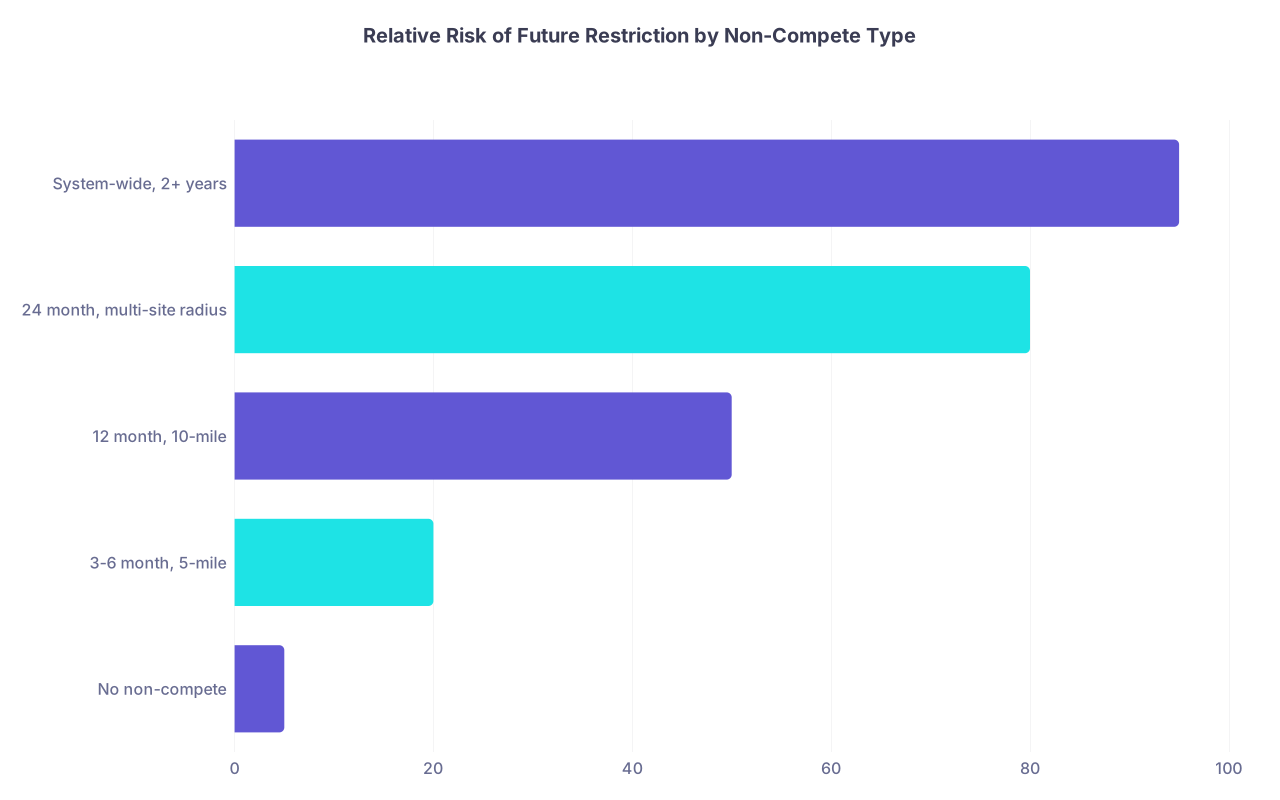
| Category | Value |
|---|---|
| No non-compete | 5 |
| 3-6 month, 5-mile | 20 |
| 12 month, 10-mile | 50 |
| 24 month, multi-site radius | 80 |
| System-wide, 2+ years | 95 |
Step 9: Be Smart About Communications and Optics
Last piece, often ignored.
If you’re planning to stay local and push or work around a non‑compete:
- Don’t talk about it openly with colleagues who might repeat it to admin
- Don’t put “Starting at Competitor X on [date]!” on LinkedIn before you’ve sorted the legal side
- Don’t email yourself large patient lists or referral patterns—the fastest way to invite legal trouble is to improperly take data
If things get tense:
- Let your lawyer respond to any cease‑and‑desist letters
- Don’t argue law with your former employer
- Keep your tone professional and boring in all written communication
One more thing: do not trash your former employer to patients or on social media. It’s emotionally satisfying and legally dumb.
FAQ (Exactly 5 Questions)
1. Can I just ignore my non‑compete if I think it’s unfair?
You can do whatever you want. The question is: what risk are you taking on? Ignoring a non‑compete can mean nothing happens… or it can mean a cease‑and‑desist letter, an injunction, and expensive legal fights. You need a local healthcare attorney to tell you how aggressive your former employer is and how your state’s courts tend to rule. Acting blindly because the clause “seems unfair” is how you end up in real trouble.
2. If my employer fires me, does that automatically void my non‑compete?
No, not automatically. Some states or specific contracts say non‑competes are void if you’re terminated without cause, but many do not. I’ve seen doctors assume, “They let me go, so I’m free,” and then get hammered with enforcement efforts when they pop up across town. You need to read the specific contract language and have a lawyer assess it in the context of your state law.
3. Are hospital-employed physicians treated differently than private practice docs for non‑competes?
Sometimes. A few states have rules specifically addressing hospital‑employed physicians or physicians in certain specialties. Also, big hospital systems may have more money to enforce non‑competes, but they also have more PR exposure and may not love headline‑worthy lawsuits against local doctors. Private practices sometimes enforce aggressively because they feel personally “betrayed.” The bottom line is not the label on your employer; it’s your contract + your state’s law + the employer’s track record.
4. What if my new employer says, “Don’t worry, we’ll handle your old non‑compete”?
Be very careful. That usually means: “We’re willing to take some risk, and you’ll be in the legal crossfire with us if this goes badly.” They might help pay for lawyers or negotiate with your old group, which is nice. But if a court issues an injunction, it’s your license and ability to work locally that’s on the line. Get your own lawyer. Do not rely solely on the new employer’s assurances.
5. Is paying to “buy out” a non‑compete ever a good idea?
Sometimes, yes. If the buyout is clearly defined, reasonably priced, and gets you exactly what you need (freedom to work locally, now), it can be a clean solution. But many contracts don’t spell out a buyout. Then you’re just negotiating a ransom number in the dark. Before you write a big check, have your lawyer assess whether the clause is even enforceable. You do not want to pay $50k to “solve” a problem that the law would have solved for free.
Key points:
- Don’t guess about your non‑compete—get the exact language analyzed by a local healthcare attorney.
- Design an intentional plan: negotiate, narrow, work around the radius, or bridge the time—don’t stumble into a lawsuit.
- Protect your future self: in your next job, attack the non‑compete before you sign, or walk away from employers who insist on handcuffs.