

The way doctors talk about urban vs rural careers is mostly wrong.
Urban is supposedly where the “real medicine” and high salaries are. Rural is framed as noble but financially and professionally second-tier. That story is popular. It is also lazy, dated, and increasingly disconnected from actual market data.
Let me be blunt: if you are choosing city vs rural based on what your co-residents think about pay, prestige, lifestyle, or “autonomy,” you’re probably optimizing for the wrong decade.
This is one of those topics where anecdotes (“my cousin’s friend in a small town makes a killing” or “everyone in big cities burns out”) get recycled as fact. So let’s drag this into the light and line it up against real numbers.
The Myth Map: What Everyone Repeats vs What’s Real
Here are the greatest hits I hear on rounds and in workrooms:
- “Urban physicians make more. Cost of living is higher, so salaries are higher.”
- “Rural work is less competitive because it’s less desirable.”
- “You’ll lose your skills in rural medicine.”
- “Rural means insane call, no coverage, and no life.”
- “Urban jobs are secure. Rural jobs are risky and unstable.”
- “Urban is better for a spouse’s career and kids’ education. Rural is career suicide for partners.”
Some of these are half-true. Some flat-out backwards. Let’s sort them.
Pay and Incentives: The Money Story Is Not What You Think
The biggest myth: “Big city, big paycheck.” No. In most specialties, it’s the opposite.
Look at almost any credible compensation survey—MGMA, Medscape, Doximity. The pattern repeats: when you adjust for region, rural and non-metro physicians often earn more cash than their metro peers, especially in bread-and-butter specialties (FM, IM, EM, psych, general surgery, anesthesia).
Why? Basic economics. Urban markets have:
- More physicians per population
- Academic centers willing to pay prestige, not top dollar
- Residents and fellows who want to stay for lifestyle reasons
Rural and semi-rural markets have:
- Fewer physicians
- Higher marginal value per additional doc recruited
- Desperate hospitals and systems offering aggressive packages
So you see deals like:
- Rural IM hospitalist: base $320–380k + sign-on + loan repayment + housing help.
- Large coastal city IM hospitalist: $250–300k, high census, no real loan support, $3,000+ rent for a modest apartment.
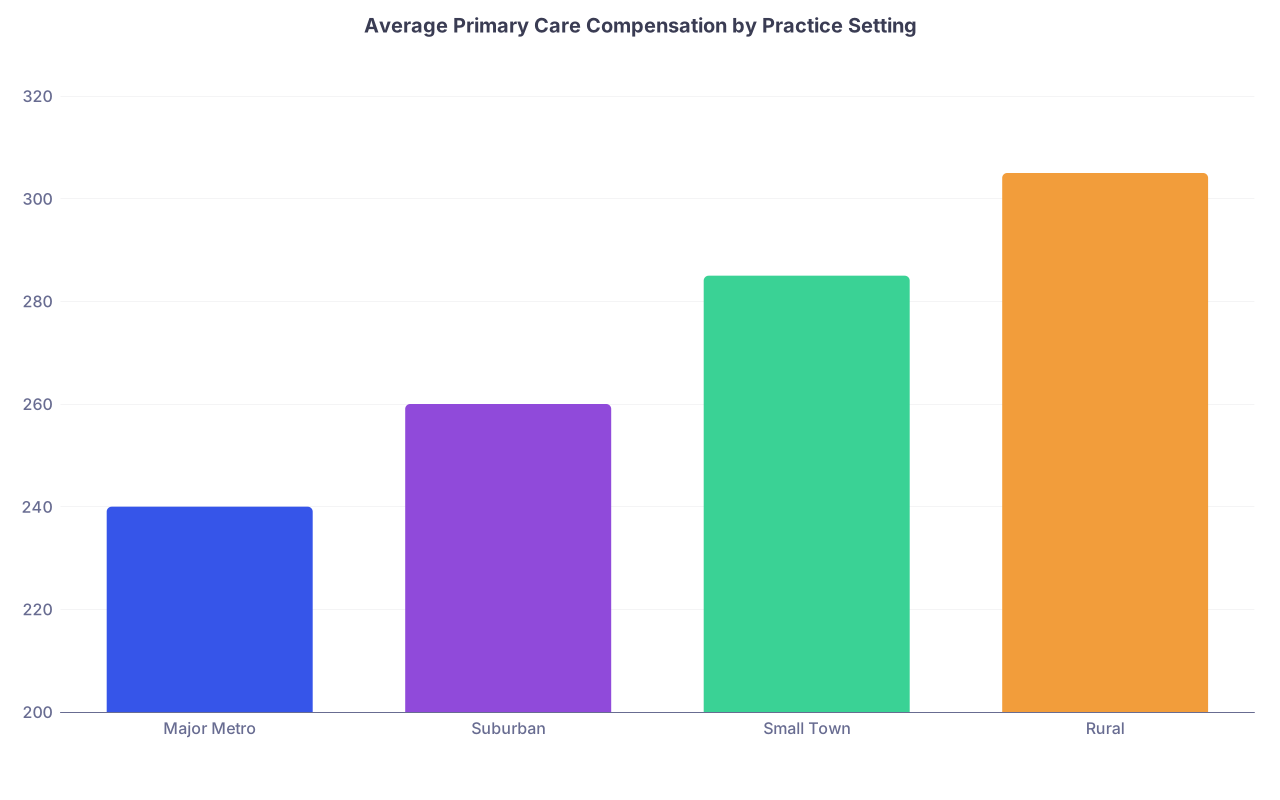
| Category | Value |
|---|---|
| Major Metro | 240 |
| Suburban | 260 |
| Small Town | 285 |
| Rural | 305 |
These are illustrative but directionally accurate against current survey data: pay tends to increase as population density drops. And that’s before you factor cost of living.
A $300k salary in a Midwestern town where a 4-bedroom house is $350k is not the same life as $300k in Boston, Seattle, or San Francisco where that barely covers a condo with HOA fees and parking.
So what’s the real takeaway?
Urban vs rural is not “high pay vs low pay.” It’s often “lower nominal pay with worse cost of living vs higher nominal pay with much better cost of living.”
If money and financial freedom matter to you—and for most physicians buried in loans, they should—you ignore this at your own risk.
Prestige vs Practice: “Real Medicine” Happens in Cities? Not Anymore.
Another popular fantasy: “If you go rural, you’ll do less complex medicine and fall behind.”
That used to be more true. It’s fading fast.
Three things are changing this:
Telemedicine and remote subspecialty support
A rural FP or IM doc with a cardiology e-consult, teleradiology reads, and rapid transfers to a tertiary center is not “practicing outdated medicine.” They’re the front line of a pretty sophisticated network. I’ve seen small-town EDs with tele-stroke systems that move faster than giant urban hospitals where neurology is swamped.Procedural breadth
In many rural settings, you expand your skills, not shrink them. Rural FM docs placing lines, doing scopes, running OB, or handling minor ortho. Rural hospitalists doing procedures their city counterparts never touch because there’s always a fellow or specialist around. You want to feel clinically indispensable? A rural environment will test that quickly.Referral patterns
Urban academic centers push complexity up. Community and rural hospitals keep a surprising amount of mid-complexity pathology in-house now because the financial pressure is to avoid transfer when safe.
The urban advantage today is less “real medicine” and more “exposure to rare zebras and cutting-edge research.” If you’re gunning for a subspecialty academic track, sure, stay near centers of gravity. But for a long-term practice career? Clinical richness is absolutely not exclusive to big cities.
The prestige piece is mostly social. Your co-residents might quietly judge a small-town move because “everyone from this program goes to the city.” That’s not market reality. That’s peer pressure.
Lifestyle: The Call, Coverage, and Burnout Myth
Now the fear story: “Rural means you’re always on call, you cover everything, you never sleep.”
Sometimes true. Often exaggerated. And increasingly negotiable.
Here’s the honest pattern I see when I talk to attendings in both settings:
Urban academic physicians:
Crushed by RVU targets or academic expectations, EMR madness, committee work, and traffic. Call might be lighter, but the daily grind is heavier and more bureaucratic. Burnout rates are not low.Urban private practice:
Better pay, but saturated markets, more competition, and increasingly predatory contracts from private equity or mega-systems. Autonomy often shrinking.Rural and small town:
Coverage is a real issue in some areas—especially certain surgical subspecialties, anesthesia, OB. You can absolutely get stuck in a place where you’re “the only one,” and that can be brutal. But the market knows this, which is why call stipends, schedule flexibility, and creative coverage models are being thrown around aggressively.
The key nuance: rural and small-town jobs have a much wider spread. Some are incredible: 7-on/7-off, generous locums backup, strong midlevel support, admin that actually listens because losing you would cripple them. Some are nightmares: 1:2 call, no backup, politics, under-resourced facilities.
Urban jobs also have a spread. But it’s narrower. There’s more standardization, which sounds safe, but also means less leverage for you.
What most residents do wrong is assume “urban = balanced lifestyle” and “rural = martyrdom.” The real question you should ask is: how many FTEs currently in that department? Actual call schedule? Recruitment history? Physician turnover in the last 3–5 years?
If a rural job is paying 30–40% above market with a massive sign-on and they’ve been perpetually recruiting… that is not always a hidden gem. Sometimes it’s hazard pay for dysfunction.
Job Security and Market Power: Who Actually Has Leverage?
Here’s the contrarian truth people dodge: the further you get from dense urban centers, the more bargaining power an individual physician usually has.
Urban markets:
- Oversupply in many core specialties
- Hospitals and groups can replace you more easily
- If you push too hard on contract terms, they shrug and move to the next CV in the stack
Rural and small-town markets:
- Chronic shortages in multiple specialties
- High patient demand
- Losing a single doc can shut down a service line
This shows up in:
- Sign-on bonuses that are meaningfully higher for rural
- More retention bonuses after 2–3 years
- Loan repayment that actually moves the needle
- Willingness to customize schedule, call, and clinic templates
| Incentive Type | Major Metro | Small Town / Rural |
|---|---|---|
| Sign-on Bonus | $10k–$25k | $30k–$100k+ |
| Loan Repayment | Rare / modest | Common, substantial |
| Housing Assistance | Occasionally | Frequently |
| Visa Sponsorship | Competitive slots | Often more flexible |
Is rural automatically “more secure”? Not necessarily. A single-hospital town with shaky finances can implode. But giant urban systems merge, close service lines, and cut physicians all the time. The risk just looks different.
The real advantage in rural or semi-rural isn’t magical stability. It’s that your absence hurts them more than theirs hurts you. That changes negotiations.
Family, Spouse, and Kids: The One Myth That’s Tricky
Let’s talk about the hardest piece and where the myths are only half-wrong: family.
The caricature is:
- Urban: infinite jobs for spouses, elite schools, culture, diversity.
- Rural: no jobs for spouses, weak schools, nothing to do, socially isolating.
Reality is more granular:
For a spouse in tech, certain corporate fields, or academia, yes—major metros are typically better. But remote work has blown a hole in that narrative. I’ve seen multiple physicians move to smaller markets precisely because their partner now works from home and they wanted cheaper housing and less chaos.
Schools: the idea that only big-city schools are “good” is largely a parental anxiety story. Many small-town districts are solid or excellent, with smaller class sizes and less competition mania. There are also rural districts that are absolutely under-resourced. You cannot generalize. You have to look school by school.
Social life and culture: some physicians truly wither without restaurants, museums, and anonymity. Others find being a known and trusted figure in a small community deeply satisfying. I’ve heard both versions from people I respect.
So I won’t sugarcoat this: the family question is the one domain where urban often does have a clearer edge—especially if your partner’s career is geographically constrained. But even here, the simplistic “rural = bad for family” doesn’t hold up cleanly anymore.
One smart tactic I’ve seen: people split the difference with “micropolitan” areas—cities of 50–250k with a regional hospital, some suburbs, and enough infrastructure that you’re not isolated, but still benefit from non-metro compensation and cost of living.
How to Actually Evaluate Urban vs Rural Offers (Instead of Guessing)
Forget the folklore. Here’s how to approach it like an adult who reads data.
For every offer—urban or rural—you should know:
- Base compensation vs national benchmarks for your specialty and region (MGMA, Doximity, etc.). Not what they say is “competitive.”
- True cost of living: housing, taxes, childcare. Not just “median rent” but what you would actually choose to live in.
- Call burden broken down: weekdays, weekends, holidays, backup expectations. How many docs share it.
- Turnover history over 3–5 years: how many physicians have left and why.
- Recruitment status: are they always recruiting? How long has your position been posted?
- Scope of practice: procedures, autonomy, transfer patterns, backup availability.

| Step | Description |
|---|---|
| Step 1 | Job Offer Received |
| Step 2 | Check Compensation vs Benchmarks |
| Step 3 | Assess Cost of Living |
| Step 4 | Review Call and Coverage |
| Step 5 | Ask About Turnover and Recruitment |
| Step 6 | Clarify Scope of Practice |
| Step 7 | Negotiate or Walk Away |
| Step 8 | Consider Personal and Family Fit |
| Step 9 | Accept or Keep Looking |
| Step 10 | Red Flags? |
Then, overlay your personal priorities like a weighting function:
- If you care most about academic identity, research, and prestige → urban/academic.
- If you care most about financial independence, autonomy, and leverage → small town / rural / micropolitan.
- If you care most about your partner’s local career options → probably urban or at least mid-size city, unless they’re remote.
The mistake is pretending one of these settings “wins” universally. They don’t. But the market is favoring rural and semi-rural right now on pay, leverage, and negotiating room. That’s not opinion, that’s what the offers look like.
The Quiet Trend: Why More Young Docs Are Sneaking Out of Big Cities
Here’s something people aren’t talking about loudly in residency lounges: a noticeable number of new attendings do a few years in urban jobs, burn out on cost of living and chaos, and then quietly move to smaller markets.
You see CVs where someone went:
- Residency in big coastal city
- First job at academic or large private group in same city
- Second job: regional center or small city 3–6 hours away
- Third job: either they stay put, or they push a bit more rural with a killer package
They don’t brag about it on social media because it feels like “leaving the cool kids table.” But when you talk to them privately, the themes repeat:
- “I didn’t realize how much of my paycheck was just going to rent and daycare.”
- “I was killing myself for prestige that didn’t pay my loans.”
- “I have more time with my kids now. And ironically, I do more interesting medicine.”
That trend is driven by math and quality of life, not by romance about country living.
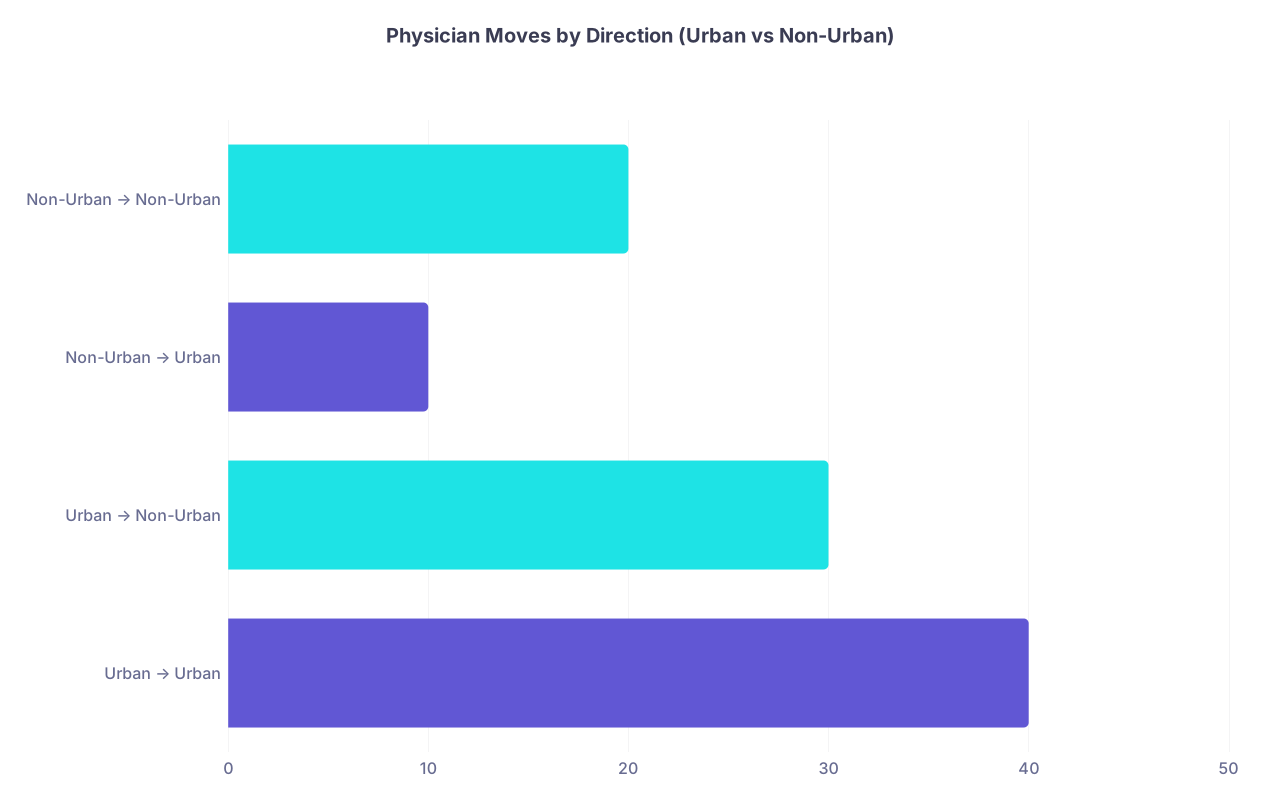
| Category | Value |
|---|---|
| Urban → Urban | 40 |
| Urban → Non-Urban | 30 |
| Non-Urban → Urban | 10 |
| Non-Urban → Non-Urban | 20 |
Again, illustrative, but survey after survey shows a steady pull toward smaller markets once people feel the real costs of big-city life.
FAQs
1. Is it career-limiting to start in a rural job right out of residency?
Not inherently. If you want a pure academic, NIH-grant-heavy future, then yes, disappearing to a small town for 5–10 years will make that track harder. But for community practice, leadership roles, or even later transitions back to urban centers, a rural stint doesn’t hurt you. In some cases it helps, because you can demonstrate broad practice, systems thinking, and “I can handle anything that walks through the door” credibility. The key is keeping your skills current, engaging in CME, and not letting yourself become clinically isolated.
2. Do rural jobs really offer that much more money, or is that recruiter hype?
There is definitely recruiter spin, but the general pattern is real. Rural and small-town offers often sit at or above the 75th percentile for compensation in multiple specialties, once you factor in bonuses and loan repayment. The trap is when a high salary masks a toxic call burden or a failing hospital. So yes, the money difference is often meaningful—but you have to analyze what you’re trading for it.
3. Will I be stuck if I move my family to a rural area and then want to leave?
You’re more “stuck” by your contract than by geography. Read the non-compete (if enforceable in your state), repayment clauses for sign-on/loan bonuses, and term length. From a pure market standpoint, you can often move from rural → suburban/urban more easily than the reverse, because you’ll now be a practicing attending with real experience. The main friction is your own family logistics and willingness to uproot, not the job market.
4. How do I tell if a rural job is a hidden gem or a disaster in disguise?
Ask hard questions and verify them. Talk to multiple current physicians there, not just the handpicked champions. Ask who left in the last 3–5 years and why. Look at call schedules in writing. Ask about hospital financials, recent service line closures, and plans for growth. Probe on support staff, midlevels, and backup for high-risk cases. If answers are vague, inconsistent, or defensive, assume the worst. Great rural groups are usually eager to be transparent because they know they’re selling against stereotypes.
The Bottom Line
Urban vs rural physician careers are not “glamour vs sacrifice.” They’re different trade-off bundles.
Three things to remember:
- The money and leverage are often better outside major metros, especially once you factor in cost of living.
- Clinical depth and autonomy do not belong exclusively to large academic centers; rural and small-town practice can sharpen you in ways big cities never will.
- Ignore the residency gossip. Read contracts, study market data, and choose the setting that matches your actual priorities, not your peers’ insecurities.


