

The unspoken truth: partnership promises get broken all the time.
Not “occasionally.” Not “rarely.” A lot. And nobody really warns you about it in training.
You’re post-residency, maybe in your first or second attending job, and someone has dangled that magic phrase in front of you: “2-year partnership track,” “path to equity,” “you’ll be a partner by X date.” On paper, it sounds like security. Status. A finish line.
But in the back of your mind there’s that sick feeling:
What if partnership never happens?
What if they change their mind?
What if I built my whole life around a promise that never turns real?
Let’s say it bluntly: you are not crazy for worrying about this. You are smart. Because the worst trap for young physicians is assuming the people who employ you will naturally “do the right thing” when the time comes.
They might.
They also might not.
This is about having a contingency plan before you get blindsided.
The ugly reality of “partnership tracks”
You know what I’ve heard more than once from older attendings in break rooms?
“Oh yeah, everyone here is ‘on the partnership track.’”
Translation: the track is mostly vibes and hope, not enforceable reality.
Partnership promises are often vague by design. Something like: “Typically after 2–3 years, we offer partnership to strong performers.” That sounds reassuring until you realize:
- “Typically” means nothing.
- “Strong performer” has no definition.
- “We offer” isn’t “we guarantee.”
And then year 2.5 rolls around and suddenly you’re hearing:
“Reimbursement’s been tight.”
“We’re restructuring the group.”
“We’d like to extend your associate period another year.”
Or worse: “We’ve decided to pause partnership offers for now.”
Here’s the part nobody wants to say out loud: sometimes the whole “partnership track” is basically a retention strategy. A carrot to keep you grinding, covering nights, taking call, being “flexible” with your vacation days, while they keep all the equity and control.
That’s why you have to assume from day one that partnership might never happen. Not in a cynical “everyone’s out to get me” way. In a clear-eyed, “I will protect myself and my future” way.
Step one: translate vague promises into hard terms
You can’t contingency plan if you don’t even know what you’re supposedly being promised.
If you already signed a job with a partnership track, pull out that contract. Actually read the partnership clause. For real. Sit with the discomfort.
Ask yourself:
- Is there a specific timeframe? Like “eligible after 24 months of employment” – or is it mush like “usually considered around the 2-year mark”?
- Are there defined criteria? RVUs, quality metrics, citizenship items? Or just “subject to partner vote” and “satisfactory performance”?
- Does it define buy-in terms? Ballpark number? Payment structure? Or is it “to be determined at time of offer” (giant orange flag)?
- Is there any guarantee of being considered, or only “may be invited” language?
If you’re still negotiating a contract, this is when you push harder. Not for a unicorn guarantee (most groups won’t do that) but for clarity.
You want things like:
- A clear eligibility timeline (“eligible after 2 full years of employment”)
- Objective criteria written down (RVU thresholds, committee participation, call coverage)
- Buy-in structure (range + payment options, not some mystery number that appears later and guts your savings)
- Governance rules – how many votes needed to approve a new partner, how often partnership is reviewed
Will every group give you all of this? No. Some will push back. But their reaction tells you a lot about whether partnership is real or aspirational.
Step two: build a parallel life that doesn’t depend on partnership
This is the part that calms the late-night panic. You stop treating partnership as your safety net and start building your own.
Think in two buckets: financial and professional.
Financial: assume you never get equity
Plan your money like you will never get a partnership offer, a buy-out, or a big equity windfall. If you do? Great, bonus. If you don’t? You’re still okay.
That means:
Live like your salary might plateau. Don’t mentally spend future partner income. I’ve seen people buy the doctor house and luxury car “because I’ll be partner soon,” then get stuck in a job they hate because they literally can’t afford to leave.
Save aggressively. Especially in those first few years. Max your retirement accounts if you can, build a brutal “I can walk away” fund (6–12 months of expenses minimum), and avoid anchoring your lifestyle to your current pay.
Because if partnership falls through and you need to jump ship, the question will be: can you afford to take a temporary pay cut, move, or switch to a different practice model?

| Category | Value |
|---|---|
| Low (5%) | 5000 |
| Moderate (15%) | 15000 |
| Aggressive (25%) | 25000 |
| Very Aggressive (35%) | 35000 |
That chart isn’t about being perfect with numbers; it’s about realizing you have way more control if you aim for the higher bars now, not “after I make partner.”
Professional: don’t let your identity shrink to one group
Emotionally, this is harder. Once you’re in a group, it’s easy to let your professional world get tiny. Same hallways, same faces, same politics. Suddenly, the idea of leaving feels like jumping off a cliff blindfolded.
So you quietly, steadily build optionality:
- Keep your CV updated with specific accomplishments, not just “did my job.”
- Maintain relationships with former attendings, residency friends, mentors, people who moved to other systems or groups.
- Go to a conference once in a while. Present something if you can. Get your name out there even minimally.
- Look at job boards before you’re miserable. Just to know what’s out there and what people are paying.
You’re not cheating on your current job by doing this. You’re refusing to let your entire fate be determined by a small group of partners sitting in a conference room one Tuesday night.
Step three: reality-check the group’s behavior now, not later
Your future as a partner is already being written. Not on paper. In how they treat you today.
Here are the patterns I’ve seen matter:
- Do they actually explain the business side to you, or keep everything opaque? Real partners-in-training get looped into numbers at least a little.
- Have they made recent partners? Name them. When? If nobody “new” has made partner in 5–7 years, believe that pattern.
- How do they talk about former associates? Lots of “wasn’t a good fit” or “they just couldn’t hack it”? That might be partially true… but if everyone mysteriously “wasn’t the right fit,” that’s suspicious.
- Are they open when you ask about partnership, or defensive and vague?

If you’re already getting brushed off now with “oh don’t worry about it, you’re doing great, we’ll talk when it’s closer,” that’s not automatically bad. But if that’s the only answer you ever get? Red flag.
Your anxiety here is a data point. Don’t ignore it. But also don’t catastrophize off zero information. Start collecting real evidence.
Step four: Plan out specific “if this, then that” moves
You need more than a vague, “If they screw me, I’ll just leave.” You won’t. Not if you have no idea what leaving looks like.
So sketch out actual contingencies. You can do this on a notes app or a random Google Doc. Call it something like “Plan B – Career” so it doesn’t terrify you every time you see it.
Break it down by scenarios:
Scenario 1: They delay partnership by 1–2 years
Maybe reimbursements dropped. Maybe they’re growing. Maybe it’s legitimate, maybe it’s stalling.
Your options might be:
- Stay, but renegotiate compensation (higher base, more bonus) in writing in exchange for delayed partnership.
- Ask for clear written criteria and timeline going forward: “What exactly needs to happen between now and X date for partnership to be on the table?”
- Quietly start networking and exploring external options while you see if they follow through on the “delay” story.
Scenario 2: They tell you “you’re not partner material”
This is the nightmare phrase. It might be about your numbers, your personality, your “fit.” Realistically, it could be partially true, completely unfair, or just politics.
What then?
You decide whether you can and want to fix the concerns and whether these are people you still trust enough to build your future with. A group that deems you non-partner material once is very unlikely to suddenly flip later.
Concrete moves:
- Ask for specific reasons, not generalities. “You’re just not a good fit” is code for “we don’t want to tell you the real reasons” or “we don’t have any structured criteria.”
- Get feedback in writing if you can. At least write down what they said, with dates, for yourself. It helps later when the gaslighting creeps in.
- Begin an active job search, not a passive fantasizing one.
Scenario 3: They ghost the topic indefinitely
No clear no. No clear yes. Just “we’re still deciding,” “next quarter,” “you’re on our radar.”
This is where people lose 3–5 years of their life stuck in limbo. Feeling too guilty to leave because “it might still happen,” but too resentful to feel loyal.
Your move:
Set a private deadline. For example:
“If by [Month, Year] I don’t have a concrete partnership offer, including terms, I will start interviewing elsewhere.”
Not threaten them with it. Just hold yourself to it.
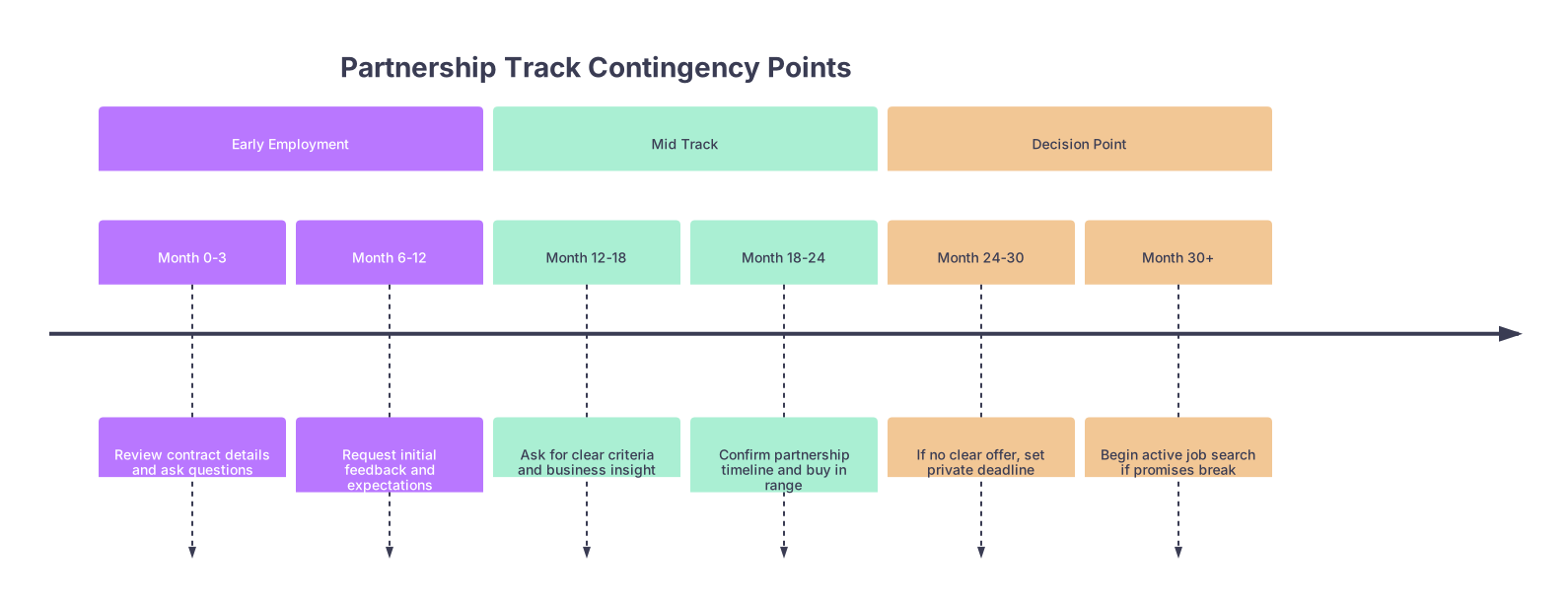
| Period | Event |
|---|---|
| Early Employment - Month 0-3 | Review contract details and ask questions |
| Early Employment - Month 6-12 | Request initial feedback and expectations |
| Mid Track - Month 12-18 | Ask for clear criteria and business insight |
| Mid Track - Month 18-24 | Confirm partnership timeline and buy in range |
| Decision Point - Month 24-30 | If no clear offer, set private deadline |
| Decision Point - Month 30+ | Begin active job search if promises break |
Private deadlines are powerful because they cut off the endless “maybe next year” self-delusion.
Step five: Know your other career pathways if partnership dies
The fear underneath all this is usually: “If I don’t make partner, my career is over / I’ll be stuck in some awful job forever.”
That’s just not true. Painful, yes. Final, no.
Here are real options attendings take when partnership plans blow up:
| Path | Main Tradeoff |
|---|---|
| Another private group | Better fit vs. starting over |
| Hospital-employed model | Less control, more stability |
| Academic position | Lower pay, more teaching/research |
| Locums / per diem | Flexibility, income variability |
| Telemedicine / hybrid | Remote work, narrower scope |
You don’t need to love all of these. You just need to accept that you are not boxed into a single destiny.
You might find a group that actually honors partnership. You might decide hospital-employment sanity beats chasing equity. You might stack locums and telemedicine and buy yourself time and money to decide your next step without panic.
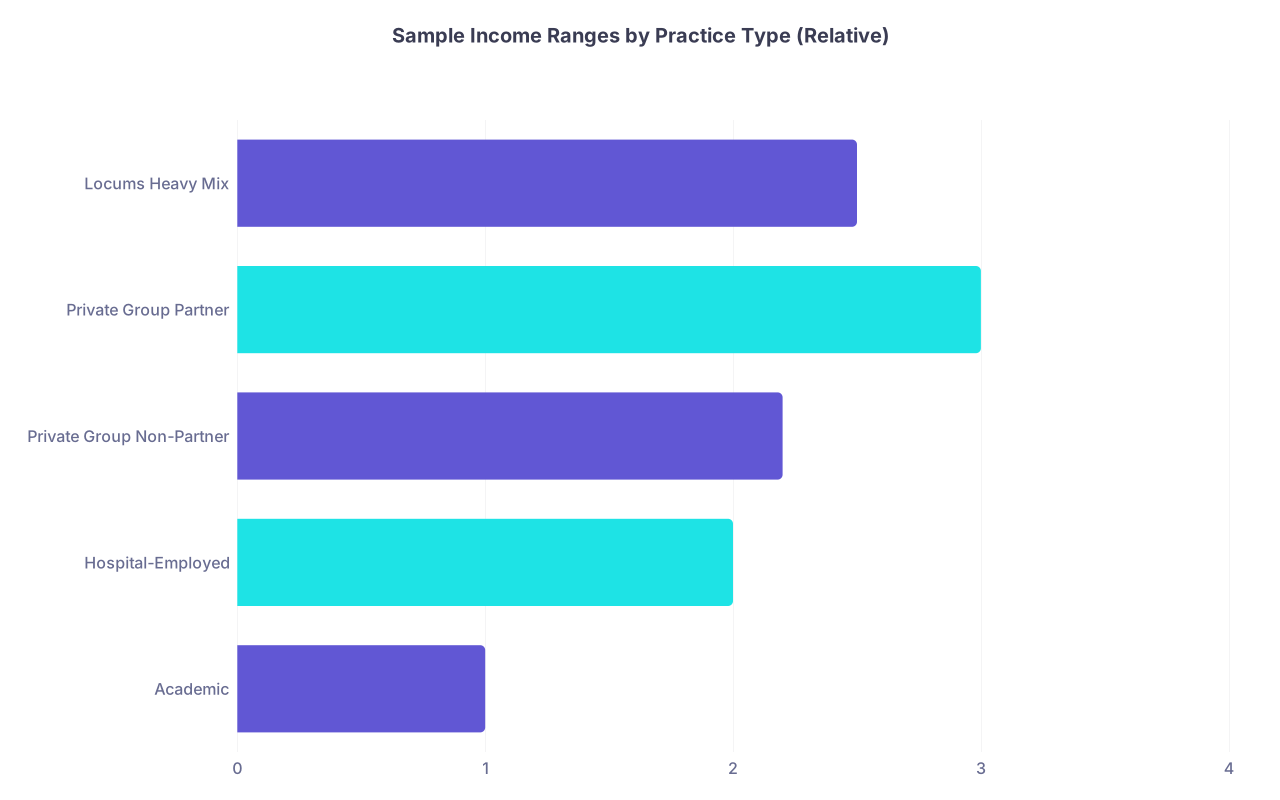
| Category | Value |
|---|---|
| Academic | 1 |
| Hospital-Employed | 2 |
| Private Group Non-Partner | 2.2 |
| Private Group Partner | 3 |
| Locums Heavy Mix | 2.5 |
That chart isn’t literal dollars, just the relative pattern I’ve seen: yes, partnership can be the most lucrative. But it’s not the only way to have a solid financial life. And a miserable “almost partner” who never gets in will often earn and keep less long-term because they stay underpaid and overworked out of fear.
Emotional fallout: grieving the promise
Let’s not pretend this is just spreadsheets and job boards. When partnership doesn’t happen, it feels like a betrayal. It’s not just: “I lost a job opportunity.” It’s: “I spent years of my life for people who never really saw me as one of them.”
You might feel stupid. Used. Angry. Ashamed.
You’re none of those things.
You’re a physician who trusted people who benefited from your trust. That’s not a moral failing. It’s normal.
What is in your control is how long you let that betrayal freeze you.
The danger is turning one group’s decision into a global story: “I’m not partner material,” “no one will want me,” “I blew my only chance.”
You didn’t. There are other groups, other models, entirely different ways of being a doctor.
And also: a lot of groups that didn’t make their first or second associate partner later realized they made a mistake when that person went somewhere else and flourished. You don’t need their retroactive validation. But it happens.

Talk to people outside your current bubble. Old co-residents. A mentor at another institution. Even a physician coach if you have the bandwidth. You need voices that remind you there’s a whole world beyond this one practice.
How to talk to your group without blowing yourself up
You’re probably thinking: “If I ask these questions directly, they’ll label me difficult and kill my chances.” That fear is real. But silence has a cost too.
There’s a middle ground.
Instead of marching in with “So am I getting partner or what?” you can frame it as:
“I’m really invested in the long-term success of the group and want to understand how I can grow here. Could we sit down sometime this month to talk specifically about what partnership looks like – timeline, expectations, and how I’m tracking so far?”
Then in that meeting:
- Ask what concrete things you can do in the next 6–12 months to be on track.
- Ask when you should expect a formal decision/offer by, in approximate time, not “sometime.”
- Ask whether there are any concerns now, so you’re not surprised later.
If they dodge even that gentle, professional version of the conversation? That tells you a lot. You file that data, keep doing a solid job (don’t give them ammo), and quietly start prepping your exit plan.

| Step | Description |
|---|---|
| Step 1 | Request meeting about growth |
| Step 2 | Discuss expectations |
| Step 3 | Clarify timeline and criteria |
| Step 4 | Note red flags |
| Step 5 | Reassess in 6-12 months |
| Step 6 | Begin quiet job exploration |
| Step 7 | Clear answers? |
You’re not being disloyal by preparing. You’re being an adult in a system that does not automatically protect you.
FAQ – Your 3 a.m. partnership panic questions
1. If partnership isn’t guaranteed, should I even consider private practice?
Yes, but with eyes wide open. Private practice can be incredible if you join a group with a real track record of making partners and sharing governance, not just cash. The mistake isn’t choosing private practice; it’s assuming “partnership track” means the same thing everywhere. Ask hard questions. Talk to former associates, not just the people giving you the tour.
2. How soon is too soon to ask about partnership details after starting?
You don’t need to bring it up day one, but you also don’t need to wait until “right before” you’re supposed to be eligible. Around 6–12 months in is reasonable to ask for expectations, feedback, and how the track typically works. Frame it as wanting to grow with the group, not demanding a guarantee.
3. What if leaving hurts my reputation and they badmouth me?
Some groups will absolutely gossip. That’s real. But your reputation is built over years with many people, not just one set of partners. If you leave professionally – give appropriate notice, don’t trash them publicly, keep working hard until your last day – most future employers will judge you on their experience of you, not secondhand drama. And honestly, a group that trashes ex-associates says more about themselves than about you.
4. Is it dumb to stay if they delay partnership but promise “soon”?
Not automatically. Sometimes the delay is legit. The key is whether they’re transparent, whether they share numbers, whether they give you something in return (comp changes, clearer timeline), and whether you actually trust them. What’s dumb is staying indefinitely on vague assurances without any movement or written clarity, while your resentment builds and your market value stagnates.
5. Can I negotiate my way into a more solid partnership guarantee?
You probably won’t get a hard “you must be made partner” clause, but you can negotiate clearer eligibility language, defined criteria, and more transparency around buy-in and compensation. You can also negotiate review checkpoints: “At 18 months we’ll review your progress toward partnership and identify any gaps.” If they act offended that you even ask? That’s a sign you should walk away before you start.
6. What if I’m just not “partner personality” and should accept that?
Some people truly don’t want ownership headaches, HR issues, or business meetings. That’s fine. But that’s different from internalizing one group’s judgment as a permanent label. You might not fit their idea of a partner. That doesn’t mean you couldn’t thrive in a more collaborative group, an academic role, or a hospital-employed leadership position. Don’t shrink your entire future to match one room of people.
Open whatever contract or offer email you have right now and search for the word “partnership.” Read that paragraph slowly. Ask yourself: do I actually understand what this promises versus what it implies? Then, write down one concrete action you’ll take this week—ask a question, call a mentor, update your CV, run your budget—as if partnership might never happen and you’re going to be okay anyway.


