

The myth that only hyper-academic superstars get faculty jobs is quietly wrecking a lot of perfectly good careers.
Let me say it bluntly: most people hired into faculty roles are not research unicorns with 50 papers, R01 funding, and a Nobel Prize in their Amazon cart.
You’re freaking out because:
- You don’t have a PhD.
- Your PubMed page fits on one screen (barely).
- You kind of like clinical work and teaching more than pipetting cells at 2 a.m.
And you’re thinking: “There’s no way I’m ‘academic’ enough for a faculty job. I’ll get laughed out of the applicant pool.”
Let’s reality-check that. Hard.
The Dirty Secret: Most Faculty Jobs Are Not NIH-Superstar Jobs
First thing you have to understand: “faculty job” is not one thing. It’s not all Harvard basic science PIs who live in labs and speak only in impact factors.
There are at least three very different flavors:
| Role Type | Typical Focus | Research Expectation |
|---|---|---|
| Clinician-Educator | Clinical + Teaching | Minimal to Moderate |
| Clinical Track | Mostly Clinical | Optional/Light |
| Tenure/Research | Research-Heavy | High/Required |
The problem is you’re comparing yourself to the wrong bucket.
If you’re looking at a tenure-track, research-heavy posting at UCSF/Stanford/Harvard that literally says “candidates must show evidence of sustained extramural funding potential” and your research is a case report and a QI poster… yeah, that’s a mismatch.
But that’s not most jobs.
Most academic centers are quietly desperate for:
- Solid clinicians who show up,
- People who can teach residents without scaring them away from the field,
- Folks who will help with QI, curricular stuff, maybe some basic scholarship.
They slap “Assistant Professor” on the contract, your mom cries, LinkedIn gets updated, and nobody is asking where your R01 is.
So no, “not academic enough” is usually code for “I don’t actually understand what track I’m applying for.”
What Programs Actually Mean by “Academic Potential”
This phrase haunts postings: “Candidates should demonstrate academic potential.”
You read that as:
“If you don’t have 20+ first-author papers and a K award, don’t even think about emailing us.”
That’s not what it means for most clinician-educator or clinical faculty roles.
They’re often looking for evidence that you can do some of the following:
- Teach effectively (residents, med students, APPs)
- Participate in QI or systems projects
- Write up a case, small series, or education paper
- Present at regional/national meetings
- Maybe help build a program or curriculum
Notice: none of that requires you to be a hardcore research machine.
I’ve literally heard division chiefs say:
“We can’t teach someone to be reliable and decent with learners. We can teach them how to write a paper.”
So if your CV looks like:
- A few case reports or small projects
- Some posters at specialty conferences
- A teaching award or good evaluations
- Committee work or leadership in residency
You’re already more “academic” than you think.
The Stuff You’re Minimizing That Actually Counts
You’re probably dismissing half your experience as “not real research” or “not academic enough.”
Let’s go through the usual pile of things people downplay.
- QI projects on length of stay, readmissions, throughput
- Clinical pathway development (e.g., chest pain pathway, sepsis protocol)
- Resident didactic sessions you created from scratch
- Curriculum design (bootcamps, simulation, OSCEs)
- Case reports/series or clinical vignettes
- Local or regional conference presentations
- Leadership roles: chief resident, committee work, resident rep
You’re telling yourself: “Yeah but everyone does that, it doesn’t count.”
No. Everyone starts there. Then they learn to package it as scholarship.
Example: A residency noon conference series you designed? That can turn into:
- A MedEd conference abstract
- A short paper on curriculum design
- An invited workshop later
- A line of “education scholarship”
You see “just teaching.” Hiring committees see: “Oh, I can slot this person into resident education and they’ll actually do it.”
Where Being “Not That Academic” Does Actually Hurt You
I’m not going to gaslight you. There are real situations where your anxiety is valid.
You will be at a disadvantage if:
- You’re applying to a research-heavy department and your CV is almost all clinical.
- The job ad explicitly emphasizes “investigator,” “extramural funding,” “independent research program,” and you have zero trajectory in that direction.
- You want tenure-track and your “research” is a single M3 poster.
Here’s the harsh piece:
If you want a research-tenure track role at a top academic center, you do need a strong, focused research record — multiple multi-year projects, mentorship, a clear niche, ideally some grant experience.
If that’s the track you’re dreaming about and you didn’t build that foundation in residency/fellowship?
You might need:
- A research fellowship
- A postdoc
- Or to recalibrate toward a clinician-educator or clinical track start and build from there
That doesn’t mean you’re out of academia. It means you’re on a different on-ramp.
Understanding Tracks So You Don’t Self-Reject
A lot of the “I’m not academic enough” panic comes from lumping all faculty under one expectation.
Here’s a rough reality snapshot:
| Track Type | Typical Papers Needed to Be Competitive | Grant Pressure |
|---|---|---|
| Clinician-Educator | 0–5 total, any role | Low |
| Clinical Faculty | 0–3, usually QI/case-based | Very Low |
| Tenure/Research | 8–15+, multiple first-author, focused | High |
Yes, departments vary. Some clinician-educator tracks in big-name places are stiffer. Some smaller programs are thrilled if you’ve ever opened REDCap.
But if you’re panicking about your 3–4 modest publications being “nothing,” you’re probably misjudging how much is enough for non-research tracks.
The Red Flags You’re Imagining vs The Ones They Actually Care About
You’re worried they’ll see your CV and think:
- “Where are the Cell/Nature/NEJM papers?”
- “Why didn’t this person do a postdoc?”
- “Only three publications? Embarrassing.”
What they’re more realistically worried about for most non-tenure roles:
- Will this person show up, take call, and not implode?
- Are they relatively normal with learners?
- Are they vaguely interested in improving something over time (education, QI, clinical ops)?
- Do they play well with others or are they a walking HR ticket?
You’re dissecting your H-index; they’re asking, “Is this someone I’m okay sharing 2 a.m. admissions with?”
How To Tell If You’re “Enough” Right Now
Let me give you a painfully honest checklist. If you’re aiming at clinician-educator or clinical faculty roles and you can honestly say “yes” to most of these, you’re in the game:
- You have at least 1–2 presentations (local/regional/national).
- You’ve been involved in a QI, research, or education project beyond just “I consented patients.”
- Someone in your residency/fellowship could plausibly write, “They’re excellent with learners” in a letter.
- You’re willing to keep doing some academic stuff: teaching, QI, small studies, curriculum work.
- You can talk about an area you want to grow in: med ed, QI, a clinical niche, etc.
If you’re 0/5 on that?
Then yeah — you’re not ready yet. But that’s a fixable problem, not a permanent identity.
Concrete Steps If You’re Behind and Freaking Out
If your brain is screaming “I’m screwed,” here’s what actually moves the needle in 6–18 months.
Find one project you can see through
Not six. One.- QI: Reduce unnecessary labs, improve discharge summaries, streamline a pathway
- Ed: Build a workshop, simulation, or mini-curriculum
- Clinical: Case series, chart review on something your program cares about
The goal: abstract + poster + maybe a short paper. Not a magnum opus.
Get your name on something soon
Ask a faculty member:
“I’m interested in a faculty role eventually and worried my CV is light. Is there a project I can help push over the finish line — abstract, manuscript, anything?”People are always sitting on half-written stuff.
Teach and document it
- Volunteer to give a didactic series
- Run a small-group session
- Help with simulations or OSCEs
- Ask for written feedback or a teaching letter
Fix the story, not just the CV
Programs care about trajectory. Be able to say in an interview:- “During residency I realized I liked X (teaching/QI/clinical niche). I did A, B, C. Going forward, I want to develop Y program or study Z problem.”
Even if A, B, C are small, the coherence matters.
The Mental Trap: Comparing Yourself to the Wrong People
You’re probably doing this:
- You see Twitter threads from MD/PhDs with 40 publications and a K award
- You hear about a co-resident with an R21
- Your attending casually mentions their Scopus ID and a CV longer than your lease
And you assume: “Those are the people I’m competing with.”
No.
You’re competing with:
- Other residents who did a couple of projects
- Fellows who have 3–6 publications, maybe one solid first-author
- People who are just decent clinicians, okay teachers, and not impossible to work with
Stop comparing your “clinician-educator track” reality to someone who’s been groomed for basic science tenure since undergrad.
Different game. Different scoreboard.
Yes, Bias Exists. But It’s Not Always Against You.
Here’s the uncomfortable thing:
Some institutions do favor people with strong research profiles even into non-research roles.
Some specialties (derm, rad onc, neurosurg) are just more insane about CVs.
But also:
- Some departments are starved for workhorse clinicians.
- Some programs are desperate for people who like teaching.
- Some places are tired of hiring “academic stars” who don’t want to cover nights or do actual clinical work.
Your “not academic enough” profile can be exactly what a clinically heavy division wants — if you target those jobs instead of self-rejecting from all of them.
How To Read Job Ads Without Spiraling
Let’s decode some language so you can stop assuming everything means “Nobel Prize or bust.”

Phrases that usually mean research-optional / clinician-educator friendly:
- “Clinician-educator track”
- “Primary emphasis on clinical care and teaching”
- “Participation in quality improvement and educational activities expected”
- “Opportunities for scholarly work encouraged but not required”
Phrases that usually mean research-heavy / be careful:
- “Tenure-track investigator”
- “Evidence of independent research program”
- “Expectation of extramural funding”
- “Protected time for research with startup package”
If you apply to the first group and you’re still thinking “I’m not academic enough,” that’s anxiety talking, not reality.
How To Talk About a Thin CV Without Sounding Defensive
You’re terrified they’ll say, “Your research is light. Why?”
You can’t freeze there.
Better answer than panicking:
- “Most of my focus in residency was on becoming a strong clinician and teacher. In my later years, I started working on X project and Y presentation, which showed me I really enjoy Z area. Now I’m looking for a role where I can keep building in that direction while contributing clinically.”
A terrible answer:
- “Yeah, I know, I should have done more research. I just didn’t have opportunities. Our program wasn’t very academic.”
The trick is acknowledging reality without apologizing for existing.
Quick Reality Check Before You Spiral Again
If you’re:
- Finishing residency/fellowship
- Have a few modest academic things (projects, posters, teaching)
- Genuinely interested in doing some academic work going forward
Then you are absolutely competitive for lots of clinician-educator and clinical faculty roles, especially:
- Community-affiliated medical schools
- State schools
- Mid-tier academic centers
- Newer programs building their education/research infrastructure
The stuff you think disqualifies you usually just means you shouldn’t pretend you’re a pure research hire. That’s all.
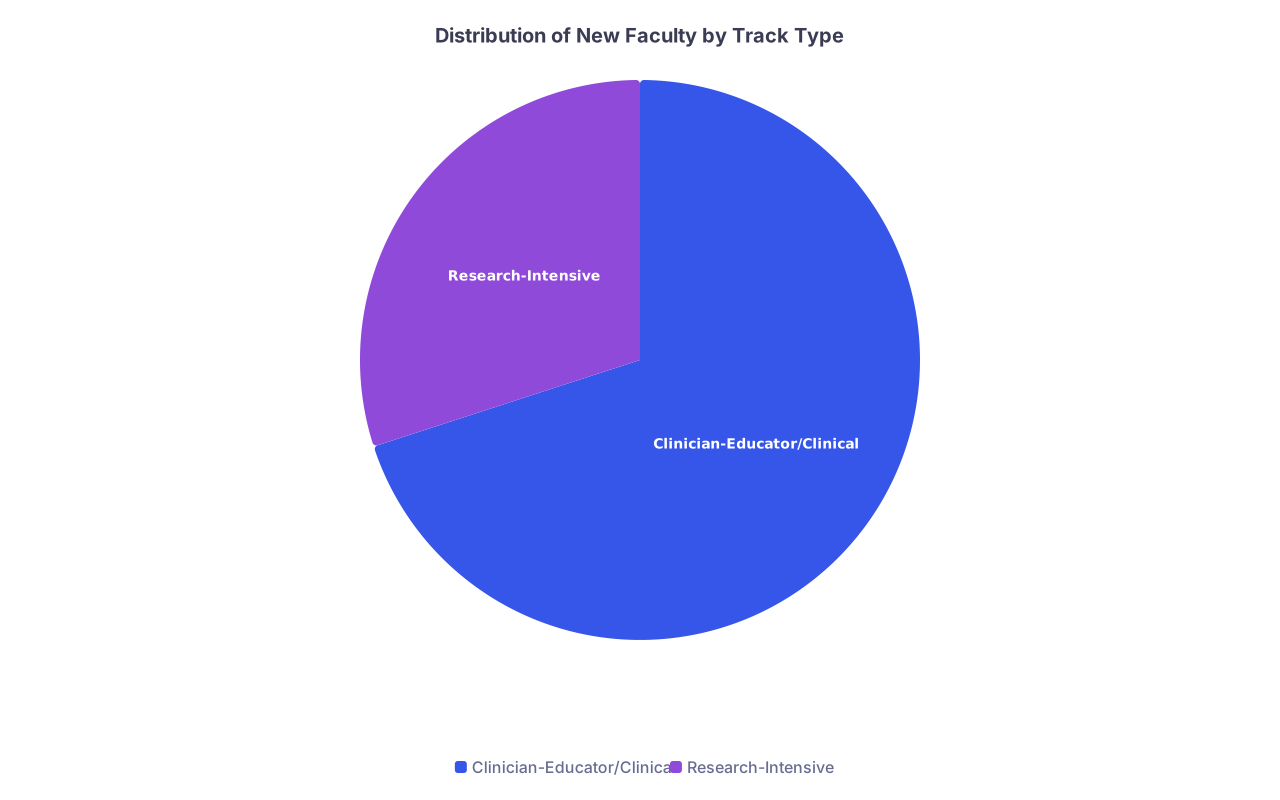
| Category | Value |
|---|---|
| Clinician-Educator/Clinical | 70 |
| Research-Intensive | 30 |
Numbers vary by specialty and institution, but the big picture holds: most new hires are not pure research people.
You’re imagining a world where 90% of faculty are hardcore scientists and you’re the lost, clinical outlier. Reality is almost the opposite.
FAQs – The Questions You’re Too Embarrassed To Ask Out Loud
1. Is it “too late” in PGY-3/fellowship year to become academic if I haven’t done much?
No. It is too late to magically become a competitive R01-track superstar. But it is absolutely not too late to become a solid clinician-educator candidate. One or two focused projects + visible teaching + good letters in the next 6–12 months can move you from “nothing” to “decently competitive” for many places.
2. Do I need a certain number of publications to get any faculty job?
There’s no universal cutoff. I’ve seen people hired to clinical faculty with zero publications but strong teaching/clinical reputations. For clinician-educator roles, 1–5 small things (posters, case reports, QI papers) often puts you in the comfortable range, especially outside the top 10 brand-name places.
3. Will places judge me for having mostly QI and case reports instead of big trials or basic science?
For clinician-educator and clinical tracks? Usually no. That’s normal. They care more that you can finish projects, present them, and that your work aligns with something they value (patient safety, education, throughput, etc.). Save the self-loathing for journals that only publish randomized trials, not faculty searches that just need a reliable colleague.
4. Should I do an extra fellowship or research year just to look more academic?
Only if you genuinely want the skills and plan to use them long-term. Doing a random extra year just to “bulk up the CV” is a miserable way to delay your life for unclear benefit. For most clinician-educator paths, you’re better off building projects where you are and getting mentorship than tacking on extra years of training you resent.
5. What if I apply and get rejected everywhere – does that mean I’m not cut out for academia?
No. It usually means one of three things: you targeted the wrong track (applied to research-heavy jobs with a light CV), you aimed only at ultra-competitive institutions, or your story/letters didn’t match what they needed right then. People reapply, redirect to a different type of institution, or build one more year of real projects and get in the next cycle all the time. A rough cycle is feedback, not a lifelong sentence.
Key takeaways:
- Most faculty jobs are not built only for hardcore researchers; clinician-educator and clinical roles are very real and very common.
- Your small projects, QI work, and teaching actually count — stop writing them off as “not real academia.”
- You’re probably not “not academic enough”; you just need to aim at the right track, build a coherent story, and stop comparing yourself to the tiny slice of people chasing R01s on day one.


