

What If I Regret My Academic Job? Options When You Choose “Wrong” First
It’s 9:47 pm. You’re still in your office. The hallway is quiet except for the hum of the ventilation and someone’s footsteps way down the corridor. Your inbox is a graveyard of committee emails, “quick” student issues, and three reminders about a grant deadline you know you’re not going to meet.
You scroll through yet another Doodle poll for a meeting that should’ve been an email and your stomach drops:
“I think I picked the wrong first job.”
And then your brain goes straight to hell:
Did I ruin my career? Am I stuck here? Did I just destroy my chances at ever getting another position because I’m going to look “uncommitted” or “a flight risk”? Do people actually leave academic medicine without blowing everything up?
Let me be blunt: you absolutely can “choose wrong” on your first academic job and still end up with a career that makes sense and doesn’t wreck your sanity. I’ve watched people do it. I’ve watched people stay way too long, too. The second group regrets it more.
You’re not the first person to realize your academic dream job feels… nothing like the dream.
First: Are You Actually In The Wrong Job, Or Just In The Worst Phase?
This part sucks, but you have to face it honestly.
There’s a huge difference between:
- “I hate the transition”
vs. - “I hate the actual job and its core expectations.”
The first one sometimes gets better. The second one almost never does.
Think about your day in ugly detail. Not the fantasy version you told yourself when you signed the contract.
Ask yourself some ruthless questions
When you strip away the institutional nonsense, what parts of your job do you actually like doing?
Teaching? Clinics? Inpatient? Curriculum work? Mentoring? None of it?What parts fill you with dread the night before?
Not general “I’m tired” dread. Specific dread. That’s data.If your department magically became supportive and functional tomorrow, would you want to stay in this type of role?
Same percent research/teaching/clinical, similar expectations, just with less chaos.
If the answer to #3 is “honestly… no,” then yeah, this is probably the wrong job type, not just the wrong institution.
If the answer is “I might actually like this if people weren’t insane about RVUs / committee work / grants,” then your problem is likely the department and culture, not the entire academic track.
You’re not trying to make a philosophical decision here. You’re trying to separate “first-year misery” from “fundamental mismatch.”
The Quiet Truth: People Leave Academic Jobs All. The. Time.
You know what institutions are great at? Pretending everyone is happy and perfectly aligned with the mission.
You know what they’re terrible at? Admitting how many junior faculty:
- Leave after 1–3 years
- Quiet quit and do the bare minimum
- Jump to community jobs, hybrid positions, or totally different systems
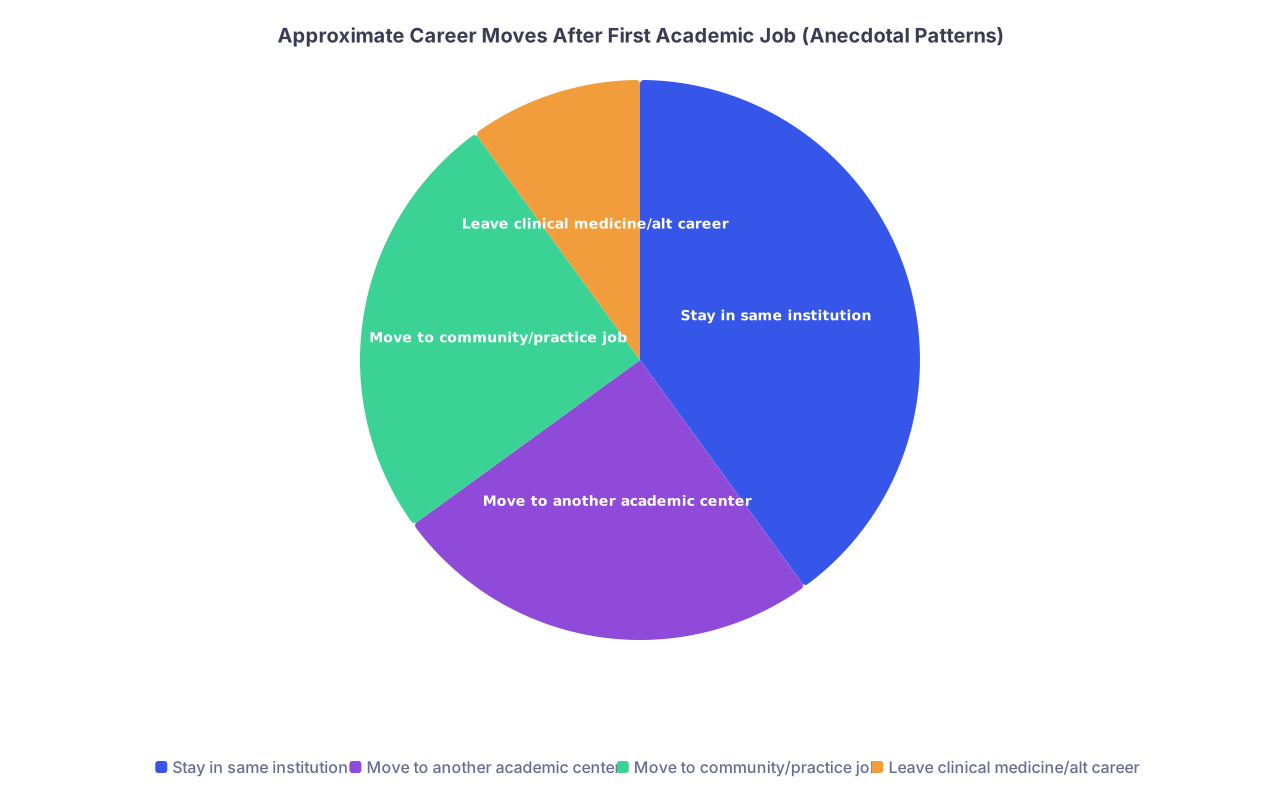
| Category | Value |
|---|---|
| Stay in same institution | 40 |
| Move to another academic center | 25 |
| Move to community/practice job | 25 |
| Leave clinical medicine/alt career | 10 |
Those numbers aren’t from some official database; they’re from watching cohorts of junior faculty over and over. The point is: you are not weird or broken for feeling like this isn’t it.
What programs actually care about when you apply somewhere else:
- Are you professionally reasonable?
- Can people work with you?
- Did you do something with your time there (taught, published a bit, did decent clinical work, didn’t set the place on fire)?
Nobody expects you to chain yourself to your first academic job out of “loyalty.” That’s a story places tell to keep you functioning while they burn you out.
Your Real Options (You Have More Than Two)
Your brain probably keeps flipping between two extremes:
- Stay and be miserable forever
- Blow everything up and quit tomorrow with no plan
You actually have more levers than that.
Option 1: Try to Fix the Job Before You Flee
Not because you “owe it” to the place. Because if you do leave, it’s good to know you weren’t just running on panic.
Look at your FTE and workload like a contract (because it is). Where is the mismatch?
Maybe you were hired 60/20/20 “clinical/teaching/research” and in reality you’re 80% clinic, 20% everything else, plus nights and weekends of unpaid admin. That’s not a “you problem.” That’s a bait-and-switch problem.
You can do a few things:
- Track your time for 2–4 weeks brutally honestly.
- Compare it to your contract and “expected” breakdown.
- Request a meeting with your division chief or chair with actual numbers in front of you.
Sometimes this leads to small but meaningful gains: dropping one clinic session, getting protected time for a project, saying no to another committee without guilt because your numbers back you up.
Sometimes they brush you off or gaslight you. That’s data too. If they show you who they are, believe them.
Option 2: Change the Track or Role Inside the Same Institution
A lot of people don’t realize how fluid tracks can be early on.
You might be:
- On a clinician–educator track but secretly hate curriculum meetings and love just seeing patients and teaching at the bedside
- On a tenure track with a grant requirement that’s comically unrealistic for your division
- Technically “research faculty” but covering 10 clinics a week because “we’re short”
Ask about:
- Switching to a more clinical track with less research expectation
- Moving into a dedicated educator track if that’s where your joy is
- Reducing FTE or negotiating a different balance (e.g., 0.8 with a side gig)
This is where people panic: “If I switch tracks, I’ll look weak and unemployable later.”
Reality: what kills careers isn’t one track change. It’s years of doing unfocused, burnt-out work that leaves you with no coherent story of who you are professionally.
Option 3: Lateral Move to Another Academic Center
Sometimes the problem isn’t academia. It’s this place.
Different institutions have totally different cultures. I’ve seen people move from one academic hospital where they were drowning to another where the expectations were clear, promotions were actually possible, and they weren’t on 9 committees “because you’re so good at this.”
Moving looks like:
- Updating CV and getting it in good shape (no, you are not “too early” to revise it)
- Quietly reaching out to mentors at other institutions, old attendings, fellowship contacts
- Applying for posted positions but also letting people know you’re open to being recruited
You can absolutely leave after 1–2 years. You don’t have to “stick it out for 5 years” to be taken seriously. What matters is how you frame it:
“I realized I’m really passionate about X, and the opportunity here lets me focus my efforts more directly in that area,” not “my last department was a dumpster fire and I hated everyone.”
Option 4: Move to a Community or Hybrid Job
This is the one a lot of people are secretly curious about and also terrified of.
The fear script goes like this:
“If I leave academia, I can never come back. I’ll be seen as ‘just a community doc.’ I’ll lose all my teaching and research cred.”
Reality is more nuanced:
- Some people go to community and stay because… they’re actually happier
- Some find hybrid roles: community job with teaching appointments, part-time academic affiliations, or niche programs (hospitalist with teaching responsibilities, for example)
- A smaller group do later move back to academia, usually if they keep some scholarly activity going or maintain connections
Let’s be honest: many community jobs pay more, are more straightforward, and don’t drag you through endless committees. The trade-off is less formal structure around teaching/research and sometimes less prestige. Depends how much you actually care about that versus being able to sleep.
| Factor | Academic Center | Community / Private Practice |
|---|---|---|
| Salary (early) | Lower–moderate | Usually higher |
| Non-clinical work | Teaching, research, admin | Limited, often optional |
| Committees | Many, often unpaid | Few, more operational |
| Prestige clout | Higher | Variable |
| Schedule control | Less | Often more |
Timing: How Long Is “Too Soon” To Leave?
This is the part that keeps people stuck. You’re scared of looking flaky.
There’s no magic number, but here’s the pattern I’ve seen:
- Under 6–9 months: looks like you either had a major mismatch or red flag. If you leave this fast, have a very clear, calm, professional reason.
- 1–3 years: very common departure window. People don’t blink at this. You tried it. You learned. Now you’re refining.
- 4–5+ years: now you’ve built some capital and might get asked, “What changed?” Still fine, but people will assume there’s a bigger shift in priorities.
The bigger risk is staying so long that you get sucked into responsibilities you don’t want and then feel “too entrenched” to move. I’ve watched that. It’s not pretty.
If you already know, in your gut, “this is not sustainable and not what I want long term,” you don’t get bonus points for suffering an extra 2–3 years.
How To Leave Without Burning Everything Down
Here’s the nasty little secret: you don’t actually need everyone to like you. You need a few key people who respect you enough to say, “Yes, I’d hire this person again” or “They did good work here.”
Focus on:
- Doing your job reasonably well until you leave (don’t mentally check out to zero)
- Not trash-talking your institution in writing or in public
- Keeping one or two allies/mentors in your corner who know the real story
When you interview elsewhere, your story is not “I hated my job.” Your story is:
- “I gained X skills,”
- “I realized I most enjoy Y,”
- “I’m now looking for a role that allows me to focus on Y with Z kind of support/structure.”
That’s it. Clean. Grown-up. No drama.

| Step | Description |
|---|---|
| Step 1 | Hate current job |
| Step 2 | Consider track/role change or lateral move |
| Step 3 | Explore community or hybrid roles |
| Step 4 | Update CV and reach out to contacts |
| Step 5 | Apply and interview |
| Step 6 | Leave professionally |
| Step 7 | Reassess current options |
| Step 8 | Problem is job type or place |
| Step 9 | Accept new offer |
What About Regretting The Regret?
Here’s the meta-fear:
“What if I leave and then regret leaving, and now I’ve double-ruined my life?”
You’re trying to find a zero-risk path. It doesn’t exist. Staying is a risk. Leaving is a risk. Doing nothing is also a decision with consequences.
So the question becomes: which regret can you live with more?
- Regretting that you tried something else and maybe had to adjust again
vs. - Regretting that you knew this job was wrong and stayed for 5–10 years because you were scared to move.
When I look back at people five years later, the ones who are bitter are almost always the ones who stayed in situations they clearly outgrew or clearly hated. The ones who left sometimes say, “Yeah, my next job wasn’t perfect either,” but they rarely say, “I wish I’d stayed at that first miserable job.”
You don’t need a perfect choice. You need a less wrong next step.
Okay, But What Do I Do Right Now?
Today is not about fixing your whole life. It’s about getting out of your head and onto paper.
Here’s a simple, low-drama move you can make tonight:
- Print your contract or pull it up on your screen.
- On a blank page, write your actual weekly breakdown last week: hours in clinic, teaching, research, admin, random crap. Be brutally honest.
- Compare the two. Circle the top 2–3 biggest mismatches or pain points.
- Write a one-sentence version of what you wish your job actually looked like in 2–3 years.
That’s it. No big career move yet. Just truth on paper. Once you see it clearly, you can start deciding:
- Do I try to fix this here?
- Or do I quietly start building an exit plan?
You’re not trapped. You’re just early. Early is fixable.
FAQ (Exactly 4 Questions)
1. Will leaving my first academic job ruin my chances of ever getting another academic position?
No. What ruins your chances more is doing nothing of substance because you’re so burned out and resentful you barely function. If you leave with a coherent narrative, some teaching/clinical/research output, and at least a couple of people willing to vouch for you, you’ll be fine. People in hiring committees have seen this countless times. Your situation feels dramatic to you; to them, it’s Tuesday.
2. How honest should I be in interviews about why I’m leaving?
Filtered honest. Not raw, unedited honest. You don’t say, “My chair is toxic and this place is a disaster.” You say things like, “I’ve learned I’m at my best when I can focus on X and I’m looking for a role where that’s a clearer priority,” or, “The position evolved in a direction that was more Y-heavy than we originally anticipated, and I’m hoping for a role more aligned with Z.” If someone pushes for dirt, that’s a red flag about them, not you.
3. What if I have almost no publications or scholarly output yet—am I stuck?
You’re not stuck, but your options shift. Another research-heavy tenure track might be harder. A clinician–educator or more clinical track may still be realistic, especially if you’ve taught a lot or taken on educational roles. Community and hybrid jobs may actually fit better. You can also use the next 6–12 months to complete one or two small, doable projects where you are—case reports, educational initiatives, QI projects—so you’re not leaving totally empty-handed.
4. How do I know if it’s “just burnout” versus a truly bad fit?
Burnout usually feels like exhaustion with flashes of, “I’d like this if it were less insane.” Bad fit feels like, “Even if they paid me more, took away half my workload, and fixed the call schedule, I still wouldn’t want to be doing this version of work.” Picture the “best realistic” version of your current role. If that still makes you feel trapped or heavy, it’s not just burnout. It’s misalignment.
Open a blank document or notebook right now and write that one sentence:
“In 3 years, my ideal job looks like: ________.”
Don’t make it pretty. Make it honest. That’s your starting point out of this.


