
If you ignore salary when choosing a residency, you’re making a mistake. If you choose only based on salary, you’re making a bigger one.
Here’s the actual answer: salary should matter, but in a structured, realistic way—not as the headline decision-maker, and not as an afterthought. You need a framework, not vibes.
Let’s build that.
1. The Reality: Residency Salary Is More Similar Than You Think
First, kill the fantasy that one program’s going to pay you like a tech PM and another like a barista.
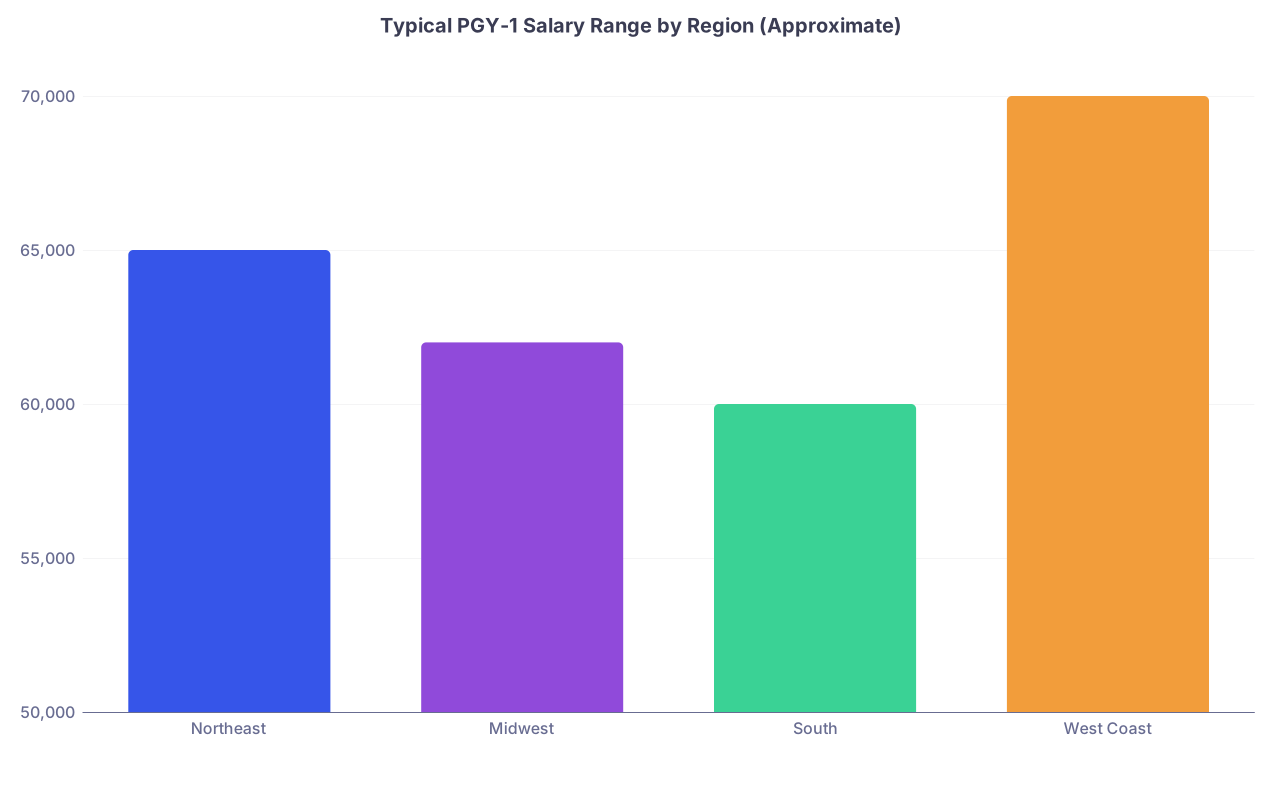
Across most US programs, base PGY-1 salaries cluster pretty tightly. They’re not identical, but they’re not wildly different either.
| Category | Value |
|---|---|
| Northeast | 65000 |
| Midwest | 62000 |
| South | 60000 |
| West Coast | 70000 |
Most residents are in the roughly $60k–$75k PGY-1 range (before taxes). The real spread in lifestyle impact comes from:
- Cost of living (rent, taxes, childcare, transportation)
- Local support (family nearby, partner income)
- Benefits (meal money, parking, call pay, moonlighting)
So the question isn’t “Which program pays the most?”
It’s “Given the salary and cost of living, can I live without constant financial panic—and is this program worth any tradeoff?”
2. A Simple Framework: How Much Should Salary Matter?
Use this as a rough weighting system when ranking programs. Don’t obsess over the exact percentages—this is about order of importance.
| Factor | Suggested Weight |
|---|---|
| Training Quality & Fit | 40–50% |
| Location & Support System | 20–25% |
| Salary & Cost of Living | 15–20% |
| Program Culture & Wellness | 15–20% |
Here’s the rule I’d use:
- Salary and cost of living combined: important, but not top tier
- They should break ties, not override huge differences in training quality or fit
- If salary/cost of living makes your life financially unsafe or unmanageable, it jumps from “tie-breaker” to “dealbreaker”
Where salary absolutely shouldn’t sit: as your #1 decision driver. A slightly higher paycheck won’t fix a malignant culture, weak training, or a location that makes you miserable.
3. Step-by-Step: How to Evaluate Salary & Cost of Living Rationally
Let’s get concrete. Here’s exactly how to factor money into your rank list.
Step 1: Get Real Numbers, Not Vibes
Don’t guess. Ask or look up:
- PGY-1, PGY-2, PGY-3 (and beyond) base salaries
- Meal stipends (annual or per call)
- Parking costs (free, subsidized, or painful)
- Health insurance premiums and coverage details
- Disability insurance (short- and long-term)
- Retirement match (if any)
- Call pay (rare but nice when it exists)
- Moonlighting policies and rates (and when you’re eligible)
Many of these are on program or GME websites. For the rest, you ask directly:
“Could you share the current salary and benefits breakdown for residents (including meal money, parking, call pay, and moonlighting opportunities)?”
If someone dodges that, that’s a flag.
Step 2: Adjust for Cost of Living
This is where people mess up. A $70K salary in San Francisco is not better than $62K in the Midwest. It might actually be worse.
Use any cost-of-living calculator (NerdWallet, Numbeo, etc.) and compare.
Example you’ll actually see:
- Program A
- Location: Major coastal city
- PGY-1: $72K
- Average 1BR rent: $2,500
- Program B
- Location: Mid-sized Midwest city
- PGY-1: $64K
- Average 1BR rent: $1,200
Do the fast-and-dirty math:
- Program A: $72K – ($2,500 × 12) = $42K left pre-tax
- Program B: $64K – ($1,200 × 12) = $49.6K left pre-tax
So even though A “pays more,” B gives you more breathing room. That’s the number you actually feel.
Step 3: Run a 5-Minute Monthly Budget
Don’t get fancy. Do a quick monthly estimate:
- Take-home pay:
- Assume ~60–70% of gross after taxes/benefits (varies by state and dependents)
- Subtract:
- Rent/mortgage
- Utilities + internet
- Food (groceries + realistic eating out)
- Car payment / public transit / gas / insurance
- Minimum loan payments
- Phone
- Required insurance not covered
- Childcare (if applicable)
Ask one question:
Do I have at least $300–500/month left over most months?
If the answer is no, that program’s financial setup is risky. You will live on credit cards. You will be anxious. Burnout isn’t just hours and personalities—it’s also bills.
This is where salary and location jump from “tie-breaker” to “potential dealbreaker.”
Step 4: Factor in Loans and Future Specialty Income
You’re not picking a lifetime salary here. Residency is a weird, underpaid, overworked 3–7-year tunnel. Your attending income will dwarf your residency paycheck.
So ask yourself:
- Are my loans federal with income-driven repayment? Then a slightly lower resident salary might drop your payments a bit.
- Am I entering a higher-paying specialty (ortho, derm, gas, EM, etc.)? Long-term, a $4–5K resident salary difference is noise.
- Am I going into primary care, peds, psych, or academic medicine and planning PSLF? Then stable payments and not wrecking your finances during residency actually matter more.
Bottom line: Don’t pretend a slightly higher resident salary will “solve” $300K of loans. But do respect that being totally financially underwater for 3–7 years breaks people.
Step 5: See Salary in the Context of Burnout and Wellness
Here’s what I’ve seen over and over:
- Programs that underpay and nickel-and-dime residents on parking, meals, exam fees, and conferences? Their residents are often angrier and more burned out.
- Programs that may not be the absolute top salary, but:
- Cover parking
- Provide real meal money
- Pay for Step 3
- Offer annual educational funds and time
- Have reasonable moonlighting…
Those places feel very different day to day.
Money is not just the check. It’s how often you feel disrespected or supported.
4. When Should You Upgrade or Downgrade a Program Because of Money?
Here’s the practical call:
Situations where salary/cost-of-living should seriously move a program up your list
- You have significant family responsibilities (kids, dependents, single-income household)
- You’re choosing between two programs with similar training quality and culture
- One program is in a very high cost-of-living area and the numbers just don’t work
- One program offers:
- Strong moonlighting in PGY-2+
- Good benefits that meaningfully offset costs (e.g., childcare, housing support)
Situations where salary should NOT outweigh everything else
- The “better-paying” program:
- Has a malignant or clearly toxic reputation
- Is weak in your specialty interests (fellowships, case volume, research)
- Is in a location where you or your partner will be miserable
- The difference is a few thousand dollars in gross salary with:
- Comparable cost of living
- No big difference in benefits
Would I take a clearly weaker training program to make $3–5K more per year? No. That trade makes zero sense long term.
5. Red Flags and Green Flags in How Programs Talk About Money
You’ll pick up a lot from how programs discuss salary and benefits.
Green flags
- They voluntarily share salary, benefits, and moonlighting information in detail
- Chiefs and residents can clearly explain:
- “Most of us live in X neighborhoods.”
- “Typical rent is around $Y.”
- “Here’s roughly what people’s budgets look like.”
- They acknowledge cost-of-living challenges honestly and describe what they’ve done to help (e.g., increased salary, parking changes, better food, childcare negotiations)
Red flags
- Hand-waving: “You’ll be fine, everyone makes it work” with no specifics
- Residents clearly dodging or looking uncomfortable when you ask about finances
- Parking is insanely expensive, meals are nonexistent, and they brush it off as “part of training”
- Vague or restrictive moonlighting rules—“We technically allow it, but almost nobody does” is code for “the workload makes it impossible”
If they can’t talk like adults about money, assume the support structure is weak.
6. A Quick Decision Tool: Where Does Salary Rank For You?
People love generic advice. You don’t need generic. You need a quick self-check.
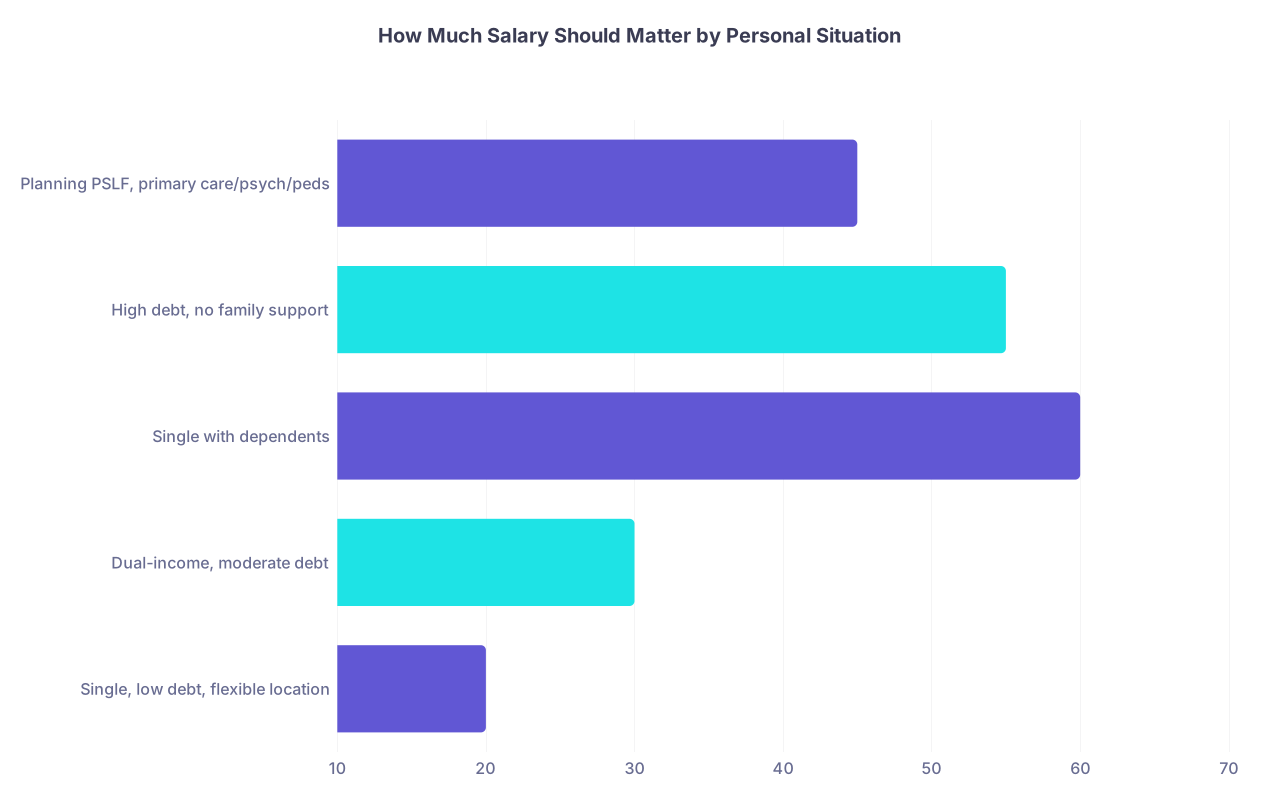
Look at these profiles and see where you land:
| Category | Value |
|---|---|
| Single, low debt, flexible location | 20 |
| Dual-income, moderate debt | 30 |
| Single with dependents | 60 |
| High debt, no family support | 55 |
| Planning PSLF, primary care/psych/peds | 45 |
(This “value” is how strongly I’d let money influence your rank list out of 100.)
If you’re:
Single, low debt, flexible
Money’s a factor, but I’d put training quality and location far ahead. A $3–4K difference is noise over your career.Single with dependents or high debt and zero family support
You can’t treat money like an afterthought. Programs that make your budget unworkable are bad choices—even if their name sounds fancy at dinner parties.Planning PSLF or long-term academic/primary care
You must protect your financial and emotional runway. Salary + cost of living should be strongly considered, but still not above training quality.
7. How to Ask Smart Salary Questions on Interview Day
Don’t ask, “So how’s the salary?” That’s useless. Ask questions that reveal the lived experience:
- “Where do most interns live, and what’s typical rent for a studio or 1BR?”
- “Do people feel like the salary and meal money are enough to not stress constantly about food and rent?”
- “How many residents usually moonlight, and from what year?”
- “Does the program pay for Step 3, licensing, or board review materials?”
- “What are the biggest out-of-pocket expenses residents complain about?”
And the most honest one:
“If you could change one thing about the salary or benefits here, what would it be?”
That answer tells you more than the number itself.
FAQ (Exactly 5 Questions)
1. Should I ever rank a program lower only because of salary?
Yes—if the salary and cost-of-living combination makes your budget genuinely unsafe. If you can’t cover basic expenses without debt spiraling, that’s a valid reason to rank a program lower, even if the training is strong. You’re not a robot. Financial distress bleeds into performance, wellness, and patient care.
2. Is a big-name program in a high-cost city “worth it” despite low effective salary?
Sometimes. If that program clearly advances your long-term goals—competitive fellowships, academic careers, niche subspecialties—it may be worth tighter finances for a few years. But you should run the numbers honestly and ask: “Can I survive this without wrecking my mental health or taking on insane credit card debt?” Prestige doesn’t pay interest.
3. How much more should a high-cost city pay to be “equivalent”?
Roughly: I’d want at least $8–10K more per year in a very high-cost city compared to a low- or mid-cost city, and even that may not fully balance things. More important than the raw difference: What’s your leftover monthly cash after rent and basics? If that number is tiny or negative, the bigger salary is irrelevant.
4. Does moonlighting actually make a big difference?
It can. I’ve seen residents add $10–30K per year with good moonlighting setups, especially in EM, IM, anesthesia, and sometimes psych. But it depends on:
- When you’re allowed to start (PGY-2 vs PGY-3)
- How heavy your base workload is
- The local rates and number of shifts available
Moonlighting can’t be your entire financial plan, but in a solid program, it absolutely changes the math.
5. Bottom line: how should I actually use salary when making my rank list?
Here’s the quick version:
- First, rank programs by training quality + fit + culture.
- Then, overlay location, support system, and family needs.
- Finally, use salary + cost of living + benefits to:
- Eliminate truly unworkable situations
- Break ties between roughly similar programs
Don’t chase the highest number. Don’t pretend money doesn’t matter. Use it as a sharp, rational filter—inside a bigger, smarter decision.
Key Takeaways:
- Salary matters, but only when you factor in cost of living, benefits, and your personal situation—never as a standalone number.
- Use money to eliminate financially unsafe options and break ties between comparable programs, not to justify weak training or toxic cultures.
- If your realistic budget doesn’t work on a program’s salary, that’s not you “failing at adulting.” That’s a valid reason to move it down your list.