
The usual advice about “just follow the best program name” is garbage if it ignores your real life and your family. Proximity to family can absolutely make or break your residency experience—but not in the same way for everyone.
Here’s the real answer: proximity to family is as important as the specific trade‑offs you’re willing to live with every single day for 3–7 years. For some people, that’s a top‑3 factor. For others, it’s a nice bonus. If you don’t decide which group you’re in before you submit your rank list, you’re gambling with your happiness.
Let’s break this down in a way that actually helps you rank programs.
The Core Question: Where Does Family Fit in Your Top 3 Priorities?
You only get three true “non‑negotiables” before you start lying to yourself:
- Training quality / career goals
- Geography (city type, region, cost of living)
- Support / relationships (family, partner, kids)
Proximity to family sits in that third bucket. The right way to think about it is not “Is family important?” Of course it is. The question is:
Is being physically near family more important than:
- A stronger program?
- A safer city or better cost of living?
- Your partner’s job or kids’ school?
- Your own mental health in a specific environment (e.g., you hate snow, or big cities drain you)?
If being near family is in your top 3 priorities, it should directly change your rank list. If it’s not, then it’s a tiebreaker—not the main driver.
Here’s a simple framework that works:

| Step | Description |
|---|---|
| Step 1 | Start Rank List |
| Step 2 | Define max distance radius |
| Step 3 | Use family as tiebreaker |
| Step 4 | Group programs inside radius |
| Step 5 | Group programs outside radius |
| Step 6 | Rank by training then fit |
| Step 7 | Rank by training then fit |
| Step 8 | Rank by training and fit |
| Step 9 | Use family to sort similar programs |
| Step 10 | Family top 3 priority |
If “Yes” at that decision point, family proximity becomes a structural part of your list. If “No,” you still care, but it’s not the driver.
The Real Effects of Being Close vs Far from Family
Let’s be concrete. Here’s what I’ve seen over and over with residents.
Benefits of being close to family
Being near family can help a lot when:
- You have kids or plan to during residency
- You or a close family member has health issues
- You come from a culture where family involvement is heavy and expected
- You know you lean on your family emotionally and practically
What “help” actually looks like:
- Someone drops off food when you’re on nights.
- Your kid gets picked up from daycare when your attending keeps you late.
- You crash at your parents’ house post‑call instead of driving 45 minutes home.
- You can attend a sibling’s wedding or a parent’s biopsy without flying across the country.
This isn’t theoretical. I’ve watched residents survive brutal ICU months because their mom stocked their freezer. I’ve also watched people with zero support burn out on a schedule that their co‑residents were handling reasonably well.
Downsides of being close to family
Nobody talks about this enough.
Being near family can also add:
- Pressure to attend every birthday, holiday, and random Sunday dinner
- Guilt if you miss events because of call
- Constant questions about “When are you done with residency?” from people who don’t get 80‑hour weeks
- Expectations that you’ll be emotionally available when you’re barely holding it together
If your family is:
- High‑conflict
- Emotionally demanding
- Poor at boundaries
then being across the country might honestly be protective.
Benefits of being far from family
Being away can give you:
- Space to focus on training without constant obligations
- A chance to build an independent support system with co‑residents
- More freedom to structure your limited off time the way you want
- Room to grow as an adult without everyone weighing in
Some residents tell me, “I love my parents, but I needed 3 years of not having them drop by unannounced.”
Downsides of being far from family
Obvious but real:
- You miss big events (weddings, funerals, births), or pay a lot and burn all your PTO to attend
- Nobody is there to help with practical stuff when life implodes
- If something serious happens (parent diagnosed with cancer), you’re suddenly on planes during your “vacations”
This isn’t just emotional. It’s logistical and financial.
How Much Does Family Proximity Matter for Different Situations?
Use this section brutally honestly. Don’t answer with who you wish you were. Answer with who you actually are at 2 a.m. post‑call.
| Situation | Typical Importance of Proximity |
|---|---|
| Single, no kids, no major family illness | Low–Moderate |
| In serious relationship, partner movable | Moderate |
| Partner has fixed job/location | High |
| Have kids or planning in next 3–4 years | High–Very High |
| Parent/sibling with major health issue | Very High |
| High‑conflict / boundary‑poor family | Low or actively negative |
This is not absolute. But if you see yourself in the “High” or “Very High” rows and then push family proximity to the bottom of your decision list “because prestige,” don’t act surprised if you’re miserable later.
Comparing Two Programs: Prestige vs Proximity
Let’s say you’re IM‑bound and have two realistic choices:
- Program A: Top‑tier academic, 3 hours flight from family
- Program B: Solid mid‑tier community, 45 minutes from your parents and siblings
Here’s how to think through it.
Career goals
- Want cards GI, hem/onc at a big academic center? Program A probably opens more doors.
- Happy with hospitalist work in your home region? Program B is likely enough.
Your actual stress tolerance
- Are you the person who recharges by being alone, or by being around your family?
- When you’re sick, exhausted, or overwhelmed, do you instinctively text your mom/sibling/partner or your friends?
Your existing support system
- Do you already have a strong partner + friend network who’ll be with you at Program A?
- Or will you be totally starting from zero in a brand‑new city?
How replaceable each benefit is
- You can sometimes recreate community far from family (co‑residents, church, gym, hobbies).
- You can’t recreate aging parents or young nieces/nephews.
If your identity is heavily tied to high‑level subspecialty fellowship and research, it might be worth being far from family for the right program. If your identity is tied to being a present child/parent/sibling and staying in your home region long term, proximity should weigh more.
Put Numbers on It: A Quick Scoring Exercise
Rank your own priorities on a 1–5 scale for each program.
| Factor | Weight (1–5) | Program X Score (1–5) | Program Y Score (1–5) |
|---|---|---|---|
| Training strength | |||
| Fellowship prospects | |||
| Proximity to family | |||
| Partner/job situation | |||
| Cost of living | |||
| City / lifestyle fit |
Steps:
- Assign weights based on what matters most to you (not your classmates, not Reddit). Total doesn’t have to be 100.
- Score each program 1–5 on each factor.
- Multiply weight × score, add up totals.
If you’re honest with the weights, you’ll see quickly whether proximity is a minor factor or a major one. If “proximity to family” ends up with a 4 or 5 weight, stop pretending it’s just a tiebreaker.
How Family Proximity Interacts with Burnout and Well‑Being
This isn’t touchy‑feely fluff. Burnout is a real outcome variable here.
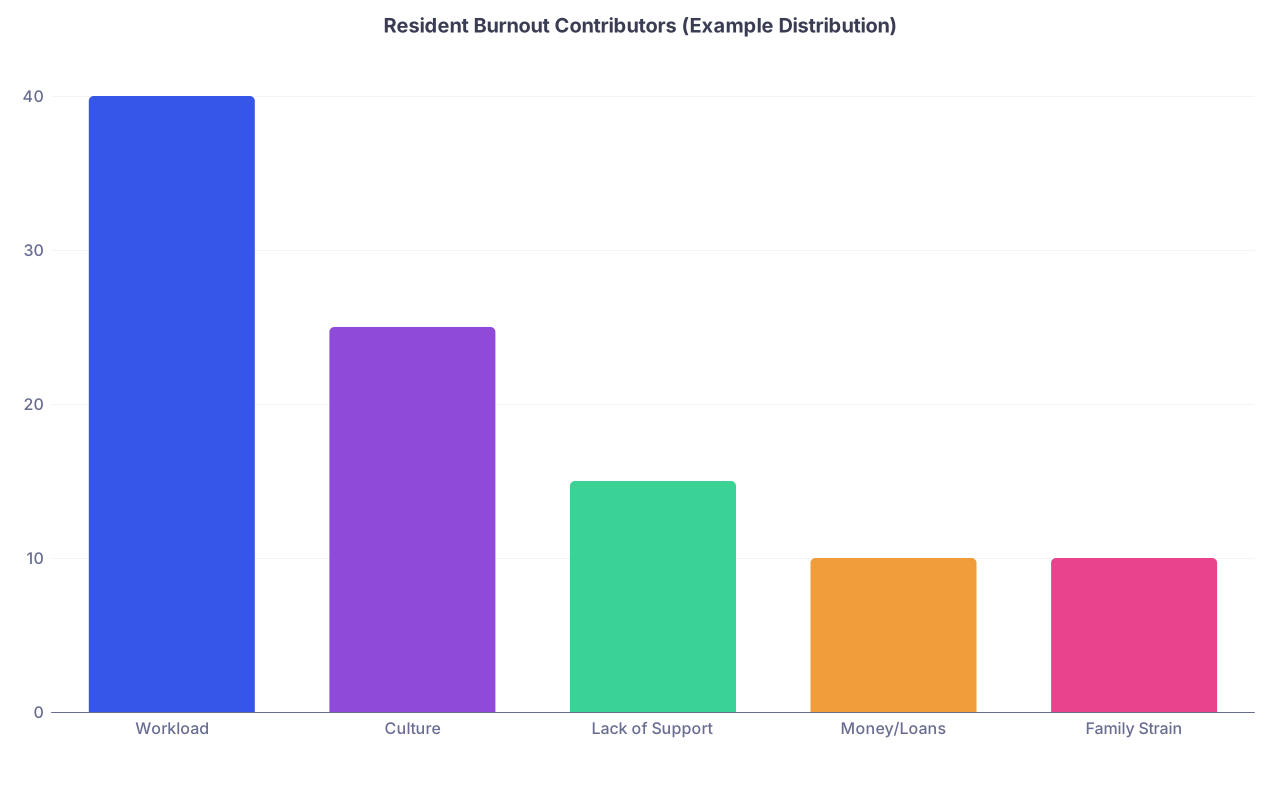
| Category | Value |
|---|---|
| Workload | 40 |
| Culture | 25 |
| Lack of Support | 15 |
| Money/Loans | 10 |
| Family Strain | 10 |
“Lack of Support” and “Family Strain” together can be 25% of why people crack during residency.
What I’ve seen:
- Residents near healthy, supportive families bounce back faster from rough stretches.
- Residents far from everyone who also never built local support spiral more quickly.
- Residents near toxic families are often more exhausted after a “day off” than after a ward shift.
So proximity amplifies whatever your family dynamic already is. Good support gets better. Chaos gets louder.
If your family is your anchor: distance has a cost. If your family is a consistent source of stress: distance is sometimes an investment.
How to Actually Talk to Your Family About This
Most families say, “We just want what’s best for you,” then five minutes later, “But can’t you just rank something closer?”
You need to:
- Be honest about residency life: 80‑hour weeks, nights, q4 call. They will not really get it unless you spell it out.
- Explain your priorities clearly: “If I match here, I’m more likely to get the fellowship I’ve been working toward for 8 years.” Or, “If I’m near you, I think I’ll be mentally healthier and actually able to show up as a good doctor and a good daughter/son.”
- Set expectations: “Even if I’m in the same city, I may go weeks without seeing you except for quick dinners.”
If you decide to prioritize distance from family (for your own sanity), say so in adult language:
- “I work better with some space. I love you, but I need to build my own life for a few years.”
You don’t need their full emotional approval. You do need clarity.
When You Should Absolutely Prioritize Proximity
I’ll be blunt. I think you should put proximity to family in your top 2 factors and let it heavily shape your rank list if:
- You’re the primary or backup caregiver for an aging or seriously ill parent
- You’re a single parent or in a fragile co‑parenting situation
- You have a partner whose career can’t easily move and whose income you rely on
- You’ve had serious mental health struggles and your support system is largely family‑based
- You already know yourself as someone who falls apart without face‑to‑face support
In those cases, ranking a distant “fancier” program over a closer “solid but not stellar” program is often a bad trade. You might still do it. But be very honest about the risk.
When You Can Safely Treat Proximity as a Tiebreaker
On the flip side, you can probably treat family distance as a secondary factor if:
- You’re single, no kids, no major family illness
- You’re genuinely excited about building a new life in a new place
- You and your partner are both mobile and on the same page
- Your family is supportive but not intensely involved in your day‑to‑day life
- You’re very career‑driven and aiming for competitive subspecialties where program strength really matters
Then your order of operations looks like:
- Rank by training quality + culture fit
- Use geography and proximity to family as tiebreakers between roughly similar programs
That’s totally valid. Just make sure it’s a conscious choice.
Practical Next Step: Build Three Rank Lists
Here’s a simple exercise that forces clarity:
List A – Pure training list
Rank programs only by training quality, fellowship prospects, and resident culture. Pretend family proximity doesn’t exist.List B – Pure proximity list
Rank programs only by distance to family and “life outside hospital” factors (partner job, cost of living, kids’ schools, etc.).List C – Final list
Now layer them. Starting from List A, one program at a time, ask:
“Would I rather be here than one step down the training ladder but significantly closer to my support system?”
When the answer flips from “yes” to “no,” that’s your real priority line.
Your goal by the end: You can point to your #1 and say one specific sentence:
“I ranked this program first because I’m choosing [training / proximity / partner / X] over [prestige / distance / cost / Y], and I’m okay with that trade.”
If you can’t fill in those blanks, you’re not done.
FAQ: Proximity to Family and Residency Rankings
1. Should I ever rank a weaker program higher just because it’s near my family?
Yes—if your life circumstances make proximity a top priority. If you have caregiving responsibilities, kids, a partner rooted in that area, or limited emotional reserves, a “weaker but decent” program near strong support is usually a better real‑world choice than a “stronger” program where you’re isolated and drowning. Just be sure the local program will still reasonably get you to your career goal (e.g., hospitalist, general peds, community EM).
2. How far is “too far” from family during residency?
There’s no magic mileage, but these cutoffs change your reality:
- Driving distance (≤4–5 hours): You can realistically visit on golden weekends.
- Short flight (1–3 hours, multiple daily options): You can go for emergencies but not casually.
- Cross‑country / international: You’ll see them a few times a year at most.
Decide what bucket you’re okay with. If someone’s health is fragile, I’d push hard to stay in driving distance if possible.
3. What if my family really wants me close, but my best programs are far away?
Then you have to decide whose priority wins: yours or theirs. Lay out your reasoning clearly: “These programs give me better chances at X career, and I’ve worked toward that for years,” or, conversely, “I’m choosing to stay close because I value being present here more than that extra prestige.” You’re an adult; you get to choose. Their disappointment is real but not decisive.
4. Does being near family actually help with burnout, or is that just something people say?
It helps if your family is actually supportive and low‑drama. Practical help (meals, childcare, rides) and emotional support shorten your “recovery time” after hard stretches. But if your family is exhausting, critical, or boundary‑poor, proximity can worsen burnout. Proximity amplifies whatever dynamic is already there—it doesn’t magically fix it.
5. I have kids. Does that change how much I should value proximity?
Usually yes, a lot. Grandparents or nearby relatives who can reliably help with emergencies, school pickups, occasional overnights—that’s gold. It can be the difference between constantly scrambling for childcare and having a realistic, sustainable system. In that case, I’d put proximity near the top of your priority list unless the local programs are truly unsafe or won’t support your core career goals.
6. What’s one concrete thing I can do today to decide how much family proximity should matter for me?
Open a blank page and write two short paragraphs:
- “If I match far from family, the hardest parts for me will be…”
- “If I match close to family, the hardest parts for me will be…”
Force yourself to be brutally specific. Then read both out loud. Whichever one genuinely scares you more—that’s your answer about how heavily to weigh proximity.
Now, today, sketch those three rank lists—training‑only, proximity‑only, and your blended “real life” list—and see where family actually lands for you.