
The number of residency interviews you need is lower than the anxiety in your group chat suggests.
You don’t need “as many as possible.” You need enough for your specialty, with your profile, to hit a safe match probability—and then you stop hoarding and start choosing.
Let’s walk through what “enough” actually looks like, specialty by specialty, and how to know when you can confidently rank programs instead of panic-adding more.
The Real Answer: Use Probabilities, Not Vibes
The NRMP data is clear: past a certain point, more interviews barely change your match odds.
The key ideas:
- The match is driven by your rank list length, not how many interviews you could have gone to.
- For most applicants, 8–12 solid interviews is where match probability jumps into “reasonably safe” territory.
- After that, you’re not improving safety much. You’re mostly upgrading preference.
Here’s a rough rule-of-thumb based on NRMP Charting Outcomes and Program Director data + what I’ve seen play out year after year:
| Applicant / Specialty Type | Safer Interview Range |
|---|---|
| Very competitive specialties (Derm, Ortho, Plastics, ENT, Urology, Neurosurg) | 12–18 |
| Mid-competitive (EM, Anesthesia, Gen Surg, OB/Gyn, Rad, PM&R) | 10–14 |
| Less competitive (IM, Peds, FM, Psych, Path) | 8–12 |
| Couples Matching (add this on top of above) | +3–5 each |
If you want a single sentence:
Most US MD/DO applicants in non-ultra-competitive fields should sleep pretty well with 10–12 interviews.
If you’re gunning for Derm/Ortho/etc., or you know your application has issues? Push higher within your band.
What the NRMP Data Actually Shows (Without the Spin)
Let’s anchor this in numbers instead of Reddit horror stories.
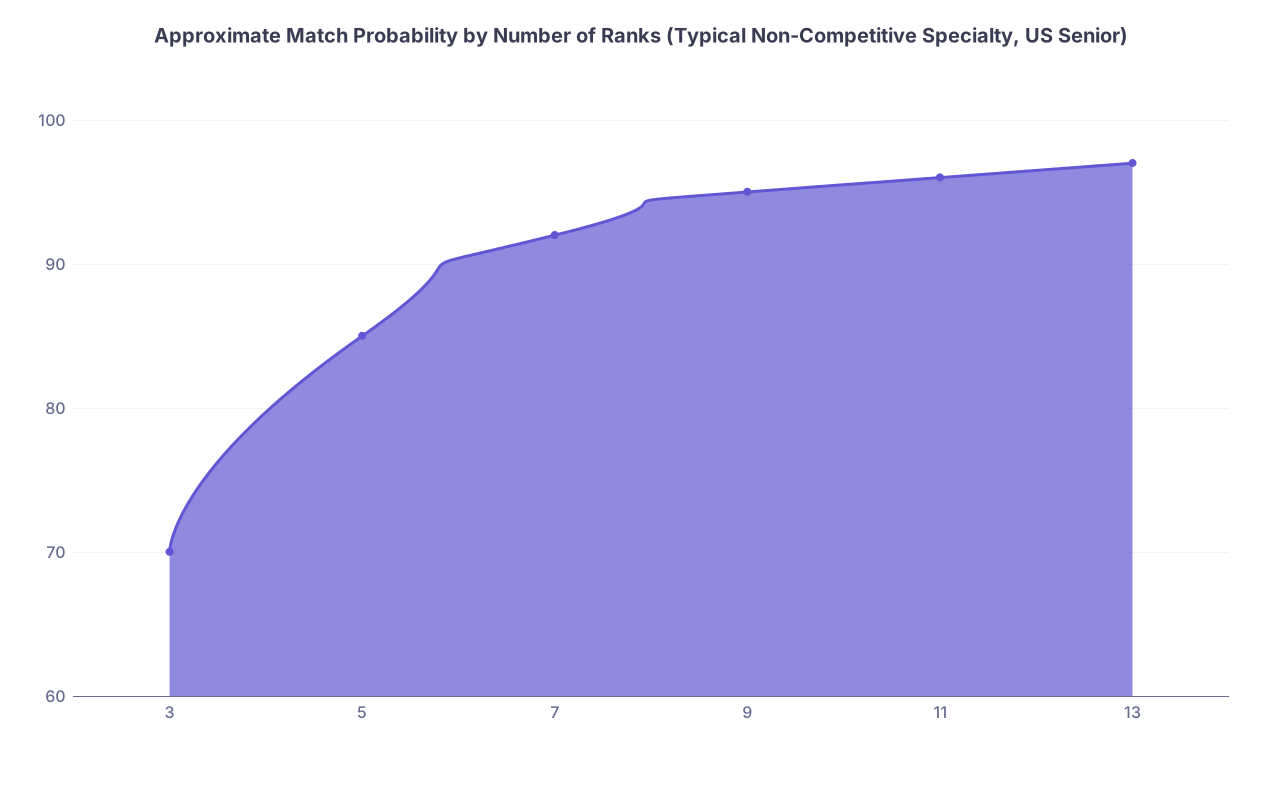
The NRMP publishes data showing match probability vs. number of contiguous ranks (i.e., number of programs you actually rank in one specialty). Interviews ≈ ranks for most people.
| Category | Value |
|---|---|
| 3 | 70 |
| 5 | 85 |
| 7 | 92 |
| 9 | 95 |
| 11 | 96 |
| 13 | 97 |
Interpretation for a typical US senior in IM/FM/Peds/Psych:
- 3 ranks → about 70% chance
- 5 ranks → about 85% chance
- 7 ranks → low 90s
- 10–12 ranks → mid-to-high 90s
You see the pattern: big jump from 3 to 7–8, then flattening.
For more competitive fields, the curve shifts right:
- You might need 10–14 ranks to get into the 90%+ zone.
- For ultra-competitive (Derm, Plastics, ENT, etc.), 12+ is where it starts feeling reasonably safe if you’re an average matched applicant in that field.
So if your question is: “Can I stop at 8?” the honest answer is: it depends where you live on that curve.
Step 1: Know Which Bucket You’re In
You can’t use someone else’s “safe number” without looking at your own profile and specialty.
Bucket 1: Less Competitive Fields (IM, FM, Peds, Psych, Path)
If you’re a typical US MD/DO senior without major red flags:
- 8–10 interviews → usually enough to feel reasonably secure.
- 10–12+ interviews → you’re in “I should match somewhere” territory unless there are big issues.
US-IMGs and non-US IMGs in these fields usually need more:
- Think 12–15+ interviews to feel comfortable.
- If you’re at 8–10 as an IMG, you’re not doomed, but I wouldn’t cancel lightly.
Bucket 2: Mid-Competitive (EM, Anesthesia, Gen Surg, OB/Gyn, Radiology, PM&R)
Here, the safe range goes up a bit:
- US MD: 10–14 interviews
- US DO / IMGs: 12–16 interviews if you can get them
You’ll see plenty of matched residents in these specialties who only had 8–10 interviews. It happens all the time. But if you want to plan for safety, aim a bit higher than that.
Bucket 3: The Spicy Ones (Derm, Ortho, Plastics, ENT, Urology, Neurosurg)
If you’re playing in this arena, you already know: the margin for error is smaller.
If you’re an average matched applicant for your field:
- 12–18 interviews is the range where people start to relax.
- Below 10 interviews in these specialties is possible but nerve-racking.
Here’s the trick though: if you’re in this group and you’re only getting 5–6 interviews, you usually know why (late interest, weaker scores, limited research). At that point, the right move might be thinking about a backup specialty, not just chasing more interviews.
Step 2: Match Your Number to Your Risk Tolerance
Two applicants can have 10 interviews and feel very different:
- One has 10 mid-to-strong fits and was a solid candidate on paper.
- One has 10 mostly low-tier programs and multiple red flags.
So you adjust.
Use this mental framework:
- Strong applicant for your field (good scores, no fails, solid letters, good home support):
You’re safe on the lower end of the ranges above. - Average applicant:
Aim for the middle. - Weaker / red flags (fails, leaves, major course repeats, SOAP history):
Push toward the upper end—and don’t cancel decent interviews lightly.
If you’re couples matching, bump your personal target by about 3–5 interviews each, because now you’re trying to align two match processes simultaneously.
How to Know When to STOP Accepting New Interviews
People burn out because they don’t know when to stop. There is a stopping rule.
Use these three questions:
Do I have enough total interviews within my target range for my specialty + risk?
Are at least half of my interviews at programs I’d realistically rank in the top 2/3 of my list?
Would adding another interview:
- Actually change my rank list meaningfully?
- Or just add travel, fatigue, and more “meh” options I’ll put at the bottom?
If your answer to #1 and #2 is yes, and #3 is “no, it probably won’t change much,” you’re allowed to politely decline further interviews without sabotaging your match.
Typical scenario:
- IM applicant, US MD, no red flags
- 11 interviews total
- 5–6 programs you’d be quite happy at, the rest “fine but not exciting”
You get another invite from a far-away, mid-tier program very similar to ones you already have. For most applicants in that situation? You can safely say no.
When You Should NOT Cancel Interviews (Yet)
I’ve watched people cancel too aggressively because they got overconfident early. Then December got quiet. Then panic.
Don’t cancel if:
- You’re below the safe range for your specialty/risk group.
- You have a fragile mix (e.g., 8 interviews but 3 are prelim-only or categorical+prelim combos).
- You’re banking everything on a “good feeling” about 2–3 favorite places.
Also, be cautious if:
- You haven’t had that many interviews yet and you don’t know how you’re actually coming across.
- A lot of your programs are in one geographic area that might be more competitive.
General rule:
If you’re under 8 total interviews in any specialty and you’re not in a clearly low-competitiveness group with a strong app, it’s too early to start canceling just for convenience.
What If My Number Is Low?
Let’s say you’re staring at the calendar and you’ve only got 4–6 interviews lined up.
You’re not done. You still have levers:
- Keep your schedule open – last-minute invites do happen, especially as others cancel.
- Signal interest professionally – a short, specific email to your realistic programs:
- Identify your connection (geography, prior contact, mentor, research).
- State genuine interest in training there.
- Don’t beg. Don’t attach a novel.
- Talk to your mentors / chair – explicit advocacy still matters more than people admit.
- Firm up a backup – if you’re in a very competitive specialty with very few interviews, it might be time to build a parallel plan (SOAP/back-up specialty, prelim + reapply, etc.).
I’ve seen applicants go from 5 to 9 interviews in January/February simply because people with 18 interviews finally started canceling.
Don’t assume you’re done getting invites just because it’s late.
How Many Programs Should You Rank?
Interviews → rank list → match probability. The final lever is how long your list actually is.
Rough guidance:
- Rank every program where you’d rather train than go unmatched.
This isn’t “where you’d love to be.” This is “where you can tolerate being for 3–7 years.” - If you’re single-specialty (all categorical spots):
- Aim for 8–12+ ranks at minimum in less competitive fields.
- 10–15+ for mid-competitive.
- 12–18+ for the very competitive ones, if you have them.
- Don’t play games like “I’ll only rank my top 5 because I’d rather SOAP than go there.”
SOAP is not a guaranteed upgrade. It’s a scramble.

| Step | Description |
|---|---|
| Step 1 | Total Interviews |
| Step 2 | Accept new invites |
| Step 3 | Schedule and attend |
| Step 4 | Politely decline |
| Step 5 | Finalize rank list |
| Step 6 | Within safe range? |
| Step 7 | New invite better than bottom ranks? |
The only programs you leave off your list are those where you truly would rather not match at all. That bar should be high.
What People Get Wrong About “More Interviews”
A few myths that waste people’s time and money:
Myth: More interviews always = safer.
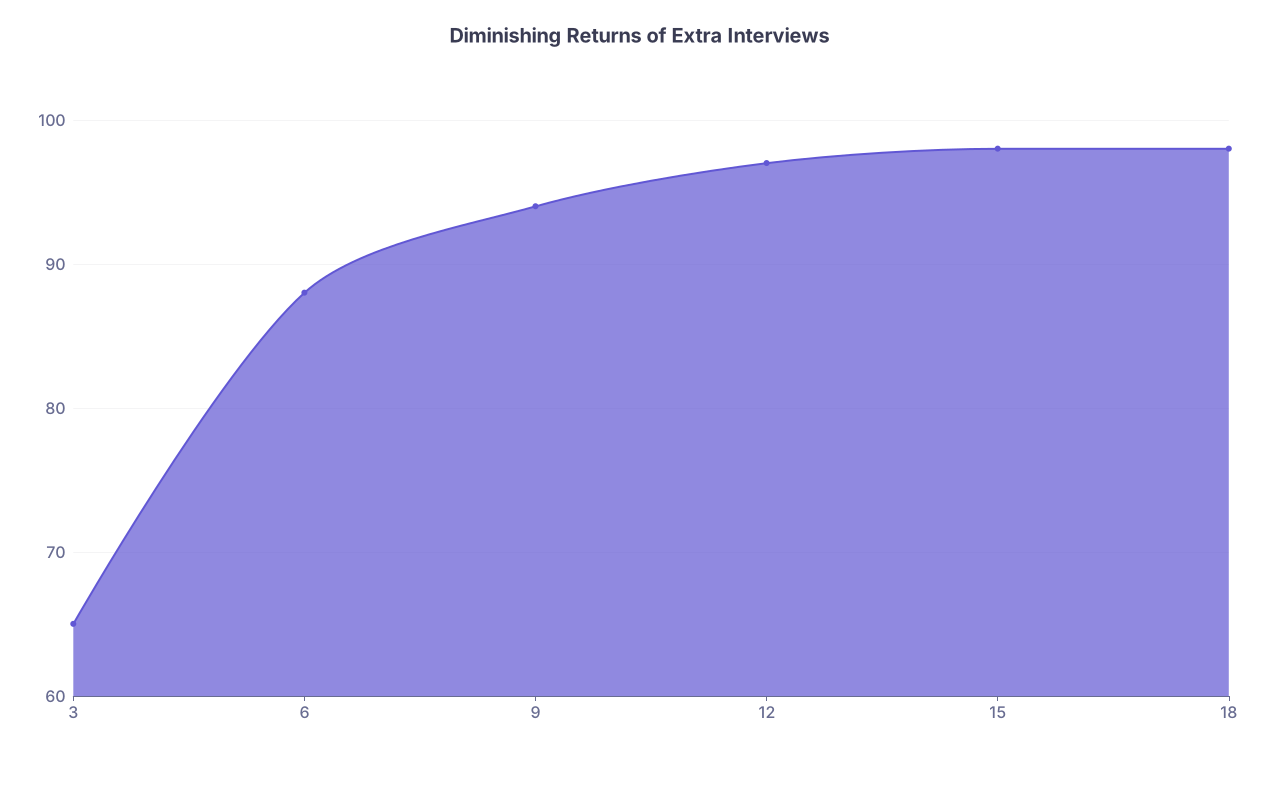
Reality: Going from 4 to 8 is huge. 10 to 16? Diminishing returns.Myth: You should go on every interview you get.
Reality: Once you’re solidly above your safe range and the new invite is clearly below programs you already have, you’re allowed to say no.Myth: I can game the algorithm with a short list of only top programs.
Reality: The algorithm favors applicant preferences, but it can’t match you to a program you didn’t rank. Short lists just increase your chance of going unmatched.
| Category | Value |
|---|---|
| 3 | 65 |
| 6 | 88 |
| 9 | 94 |
| 12 | 97 |
| 15 | 98 |
| 18 | 98 |
Look at that curve. The cliff is early. After your first ~8–12 ranks, you’re in fine-tuning mode, not survival mode.
How to Use This While You’re Actually Scheduling
Here’s how I’d approach it if I were you, in real time:
Set a target number today based on:
- Your specialty bucket
- Your honest self-assessment (strong / average / weaker)
- Whether you’re couples matching or IMG
Accept everything until you’re at least close to that target.
No over-thinking in the beginning.Once you hit the bottom of your safe range, start asking:
- Is this new invite:
- In a city/region I prefer?
- At a clearly better program than my current bottom third?
- If yes → accept. If no → lean toward declining.
- Is this new invite:
Guard your energy.
A well-rested, present version of you at 11 interviews beats a burned-out, bitter version of you at 17.Near rank deadline:
- Rank every program that clears your minimum acceptable bar.
- Don’t leave safety options off because of ego.

Quick Specialty Snapshot
These are ballpark comfort zones for US seniors (bump up if DO/IMG, red flags, or couples):
| Specialty Group | Comfortable Interview Range |
|---|---|
| IM, FM, Peds, Psych, Path | 8–12 |
| EM, Anesthesia, Gen Surg, OB/Gyn, Radiology, PM&R | 10–14 |
| Derm, Ortho, Plastics, ENT, Urology, Neurosurg | 12–18 |
If your goal is: “I want to rank confidently, not just desperately,” you aim for the middle of those ranges, not the extreme end.

Bottom Line: How Many Is “Enough”?
Strip away the anxiety and it comes down to this:
- Most US MD/DO applicants in less or mid-competitive fields are in good shape with 10–12 interviews, assuming no major red flags and a reasonably broad list.
- For highly competitive specialties, 12–18 is a more realistic comfort range if you’re an average matched applicant for that field.
- After you hit your target range, stop chasing volume and start protecting your energy and preferences—rank every program where you’d rather train than go unmatched, and let the algorithm do its job.
That’s how you move from “Do I have enough?” to “Where do I actually want to be?”