
The biggest mistake applicants make is believing the brochure instead of the track record.
If you want a specific fellowship, you do not ask, “Will you support my goals?” You ask, “Show me your receipts.”
Here’s how to figure out—before you rank them—whether a residency program will actually support your fellowship goals or just smile and nod during interviews.
Step 1: Get Clinical Reality Straight First
Before you obsess over research and “mentorship culture,” you need one thing: a program that will make you a strong, independent clinician in that specialty.
Fellowship directors care about three things a lot more than “we support fellowships”:
- Are you clinically solid?
- Do your letters say you’re excellent?
- Do your numbers and experiences match their usual fellows?
So first filter: is this a place where you’ll actually grow, not just survive?
Ask yourself:
- Do they have enough volume and complexity in your field of interest?
- Are residents confident and not terrified on rounds?
- Do seniors seem competent, not constantly scrambling or clueless?
If a program can’t train you well clinically, all the “fellowship support” talk is decoration.
Then—and only then—evaluate fellowship support.
Step 2: Look at Where Graduates Actually Match
This is the single strongest indicator. Not promises. Outcomes.
You want recent, concrete data, not “we’ve sent people to top programs” with no details.
Look for:
- A list of fellowships matched in the last 3–5 years
- Names of institutions and specific subspecialties
- How often people match vs. just “apply and see”
If the program does not publish this, you email the coordinator or PD and ask.
Here’s how to interpret what you find.
| Pattern You See | What It Usually Means |
|---|---|
| Multiple matches in your target field every year | Strong track record and culture of support |
| 1 match every few years in your field | Possible but not built-in; you’ll hustle more |
| Matches only to their own in-house fellowship | May be fine, but less national visibility |
| No data / vague statements | Either disorganized or weak results |
Pay attention to names:
- For cards: are they matching at places like Cleveland Clinic, Mayo, Duke, or only small, local community programs?
- For heme/onc: NCI-designated centers or mostly small private practices?
You don’t need all “top 10” placements. You need consistent, credible matches into your type of fellowship.
If you have a narrow target (e.g., interventional pulm, advanced heart failure), find out:
- Do they even have graduates in that niche?
- If not, have they ever supported someone going that route?
If the answer is essentially “we’ve never had anyone do that,” consider that a yellow flag. Not an automatic no, but you’re blazing a trail.
Step 3: Compare Your Goals to Their Usual Outcomes
Your goals don’t have to be fully defined, but you should be able to answer:
- Academic vs community-based career?
- Highly competitive fellowship vs more open (e.g., GI vs nephrology)?
- Geographic flexibility vs “I must stay in this city”?
Now compare your goals to their output.
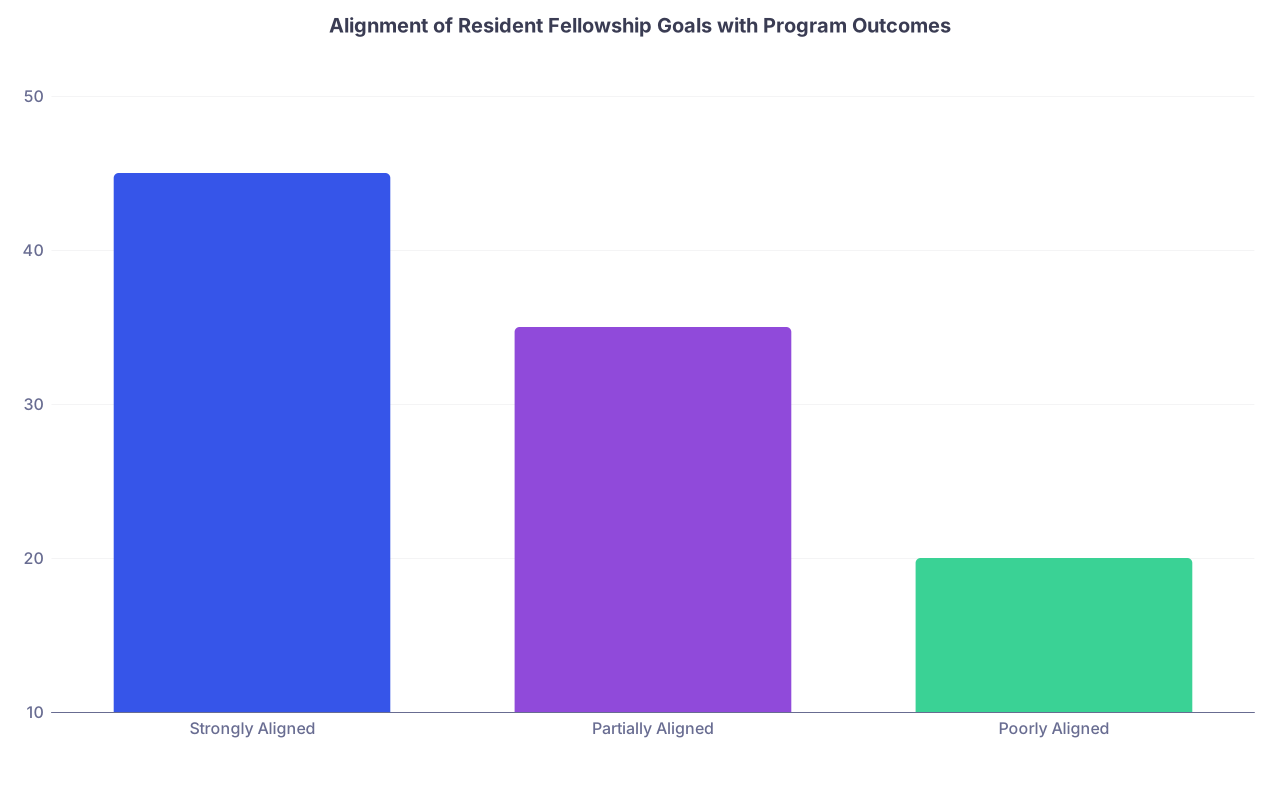
| Category | Value |
|---|---|
| Strongly Aligned | 45 |
| Partially Aligned | 35 |
| Poorly Aligned | 20 |
If a program:
- Routinely sends people into your desired fellowship type
- At programs in the kind of setting you want (academic vs community)
- With residents who have similar profiles to you
…then you’re aligned.
If you want top-tier, research-heavy cards and the program usually sends people to local community cards fellowships (or mostly into hospitalist jobs), you’re swimming upstream.
Does that mean impossible? No. But you’ll need:
- Strong research
- Strong letters
- A clear plan
And ideally, a program that wants to help you close that gap.
Step 4: Study Their Research and Scholarly Culture
For many fellowships—cards, GI, heme/onc, pulm/crit, academic EM, peds subspecialties—research and scholarship matter. A lot.
You want to know:
- Are residents regularly publishing, presenting at national meetings?
- Is there a research infrastructure (IRB help, statisticians, mentors)?
- Do they actually protect time, or is it “sure, you can do research… after sign-out at 7 p.m.”?
Red flags I’ve seen:
- “We support research” but zero posters with resident names at recent national conferences
- A “research requirement” that is literally a case report PowerPoint for noon conference
- Faculty say, “Yeah, we should get more residents involved” instead of, “We have X, Y, Z projects going now”
Ask directly:
- “How many residents in the last year presented at a national conference?”
- “Are there ongoing projects in [your interest] that residents can join?”
- “Do you have research tracks, QI pathways, or scholarly time?”
You’re not chasing prestige for its own sake. You’re looking for proof that residents can get the kind of CV that fellowship PDs expect.
Step 5: Evaluate Mentorship Quality, Not Just “Mentorship Programs”
A lot of places throw around “mentorship” like confetti. The question is: does it function in real life?
You want:
- At least a few faculty in your area of interest with:
- Reliable reputations
- Some academic output
- A history of getting residents into fellowships
- A structure that makes it easy to connect early (PGY-1 or early PGY-2)
Strong signals:
- “Dr. X is our go-to person for pulm fellowships—she meets with interested residents early.”
- Residents easily rattle off names of mentors.
- There are standing “fellowship prep” meetings or workshops.
Weak signals:
- “We’re a small program; you can just work with anyone.”
- Residents pause and then say, “I guess you could talk to Dr. ___, maybe?”
- No one seems to know who to approach for letters or career advice.
On interview day, ask residents:
- “Who would you go to here if you were applying to [your fellowship]?”
- “Does that person actually help with strategy, or just write letters?”
If they struggle to answer, you already have your answer.
Step 6: Look at Culture Around Fellowship vs. Hospitalist Life
You want a place that respects both paths. But you also want a place that knows how to launch fellowship applicants.
Here’s the reality: some programs are hospitalist factories. They might “support” your fellowship goals the way a university “supports” entrepreneurship—by letting you use the library while you figure it out alone.
You want to see:
- A mix of graduates: some hospitalist, some fellowship, some academic
- No subtle shaming of “people who just want to do fellowship”
- Chiefs or faculty who are fellowship-trained and still engaged in your field
Ask current residents:
- “What percentage of your class is applying to fellowship?”
- “How does the program respond when someone says they want a competitive fellowship?”
- “Did you feel guided in the timing and number of applications, or did you guess?”
If you hear: “Honestly, we kind of figured it out ourselves from friends at other programs,” that’s not support. That’s survival.
Step 7: Assess Structural Support: Time, Electives, Letters
Fellowship applications are not just about ambition. They are about logistics.
Look for:
- Elective time in your field of interest, before you apply
- Home specialty services that let you act like a fellow-lite: endoscopy, cath lab, advanced ICU time, etc.
- Space to do away/audition electives if those matter in your specialty
Typical questions I advise applicants to ask:
- “How much elective time do you get in PGY-2 and early PGY-3?”
- “Is there dedicated fellowship advising, or is it informal?”
- “When do people usually ask for letters, and who helps strategize that?”
And then there’s scheduling support:
- Are you on nights or ICU during prime interview season?
- Do they help with time off for interviews, or is it a fight every time?
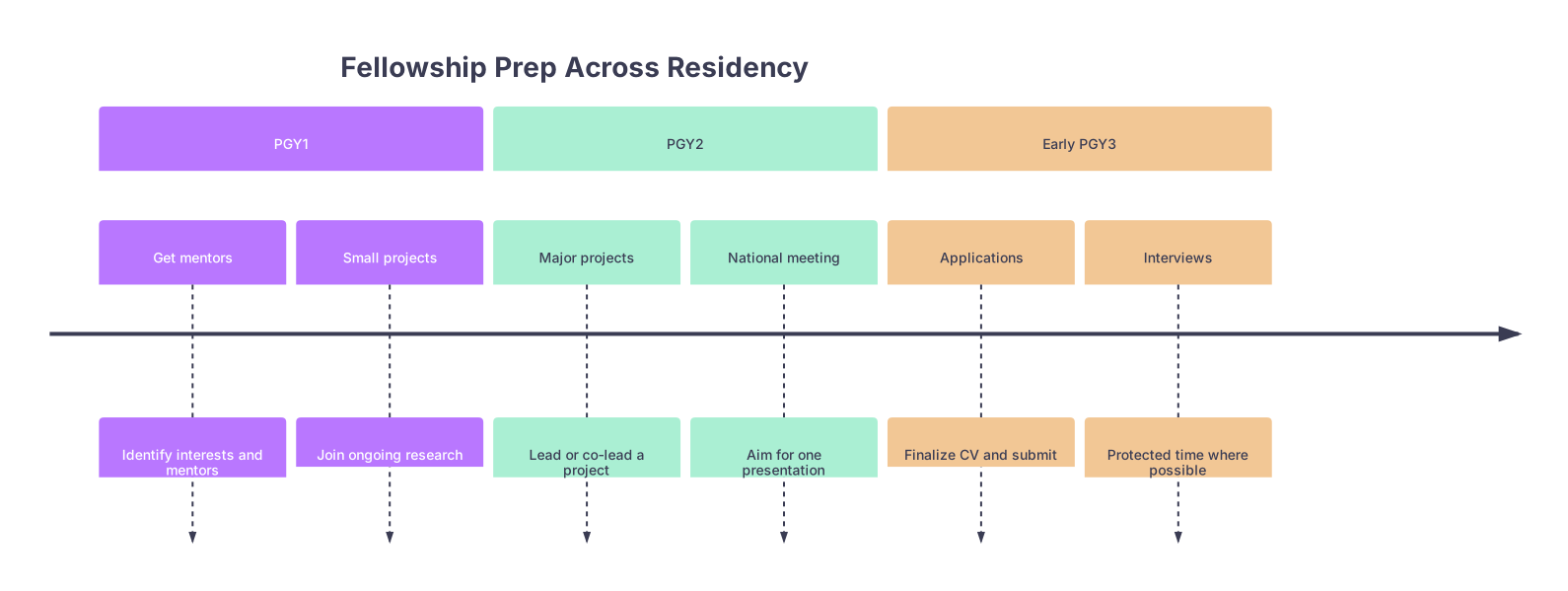
| Period | Event |
|---|---|
| PGY1 - Get mentors | Identify interests and mentors |
| PGY1 - Small projects | Join ongoing research |
| PGY2 - Major projects | Lead or co-lead a project |
| PGY2 - National meeting | Aim for one presentation |
| Early PGY3 - Applications | Finalize CV and submit |
| Early PGY3 - Interviews | Protected time where possible |
You want a program that actually respects that timeline.
Step 8: Decode the Interview Day Answers
On interview day, everyone sounds supportive. Your job is to ask questions in a way that forces specifics.
Bad question:
- “Do you support residents who want to do fellowship?”
Better questions:
- “In the past 2–3 years, where have residents matched for [your fellowship]?”
- “If I told you on day one that I wanted [subspecialty], what specific steps would you recommend in PGY-1 and PGY-2?”
- “Who here would you say is the ‘point person’ for residents applying in [field]?”
- “How do you help a resident who aims for a very competitive program but might need to strengthen their application?”
Listen for:
- Specific names, numbers, and examples
- Mention of real processes (meetings, timelines, specific rotations)
- Confidence vs vague reassurance
Then cross-check with residents privately:
- “Did that actually happen for your class?”
Discrepancy between PD story and resident reality is a major red flag.
Step 9: Use a Simple Framework to Compare Programs
You don’t need a 20-column spreadsheet. A simple scorecard works.
Rate each program 1–5 on these:
- Track record in your desired fellowship
- Research/scholarly opportunities in your interest
- Mentorship quality in your field
- Structural support (electives, scheduling, advising)
- Resident culture around fellowship vs hospitalist paths
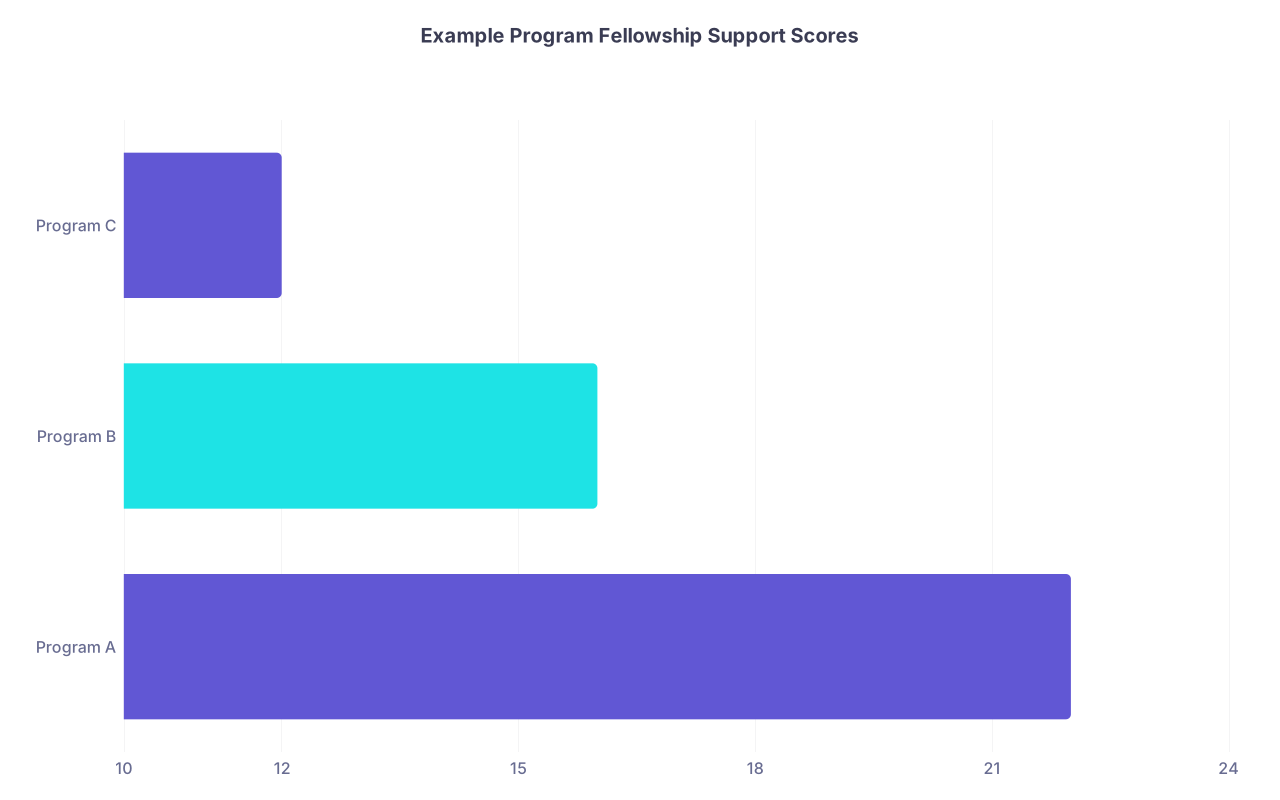
| Category | Value |
|---|---|
| Program A | 22 |
| Program B | 16 |
| Program C | 12 |
If a program is:
- 4–5 across the board → High-support environment
- Strong clinically but 2–3 in support → Possible, but you’ll need to be self-directed
- Weak clinically and weak in support → Hard pass if you are serious about fellowship
Do not get hypnotized by name alone. I’ve seen residents at “big-name” places flounder into mediocre outcomes because the program was chaotic and no one actually mentored them. I’ve also seen people from solid-but-not-famous programs land incredible fellowships because the system around them was tight.
Step 10: Balance Fit, Geography, and Fellowship Ambition
Here’s the uncomfortable truth: you can absolutely over-optimize for fellowship.
Choosing a malignant program because “they send people to top fellowships” is a good way to burn out or become the resident who no one wants to write a strong letter for.
You want the intersection of:
- Safe, sustainable training environment
- Solid clinical exposure
- Reasonable, proven fellowship support
- A city/life situation you can tolerate for 3+ years

If you’re torn between:
- Program A: Slightly weaker fellowship track record, great culture, strong clinical training
- Program B: Stronger fellowship record, toxic culture, always short-staffed
I will say this plainly: A is usually the better long-term bet. A thriving resident with decent support beats a miserable one at a “brand name” almost every time.
Specialty-Specific Nuances (Quick Hits)
Different fellowships care about different things:
Cards / GI / Heme-Onc / Pulm-Crit
Research, strong letters, often academic home program. You want clear research and mentorship lanes.Most surgical fellowships
Case logs + operative autonomy + letters from big names. You need high-volume attendings in your subspecialty.Peds subspecialties
Scholarly work and strong peds subspecialty divisions. Look at children’s hospital affiliation.Non-procedural IM fellowships (endo, rheum, ID, nephro)
Still benefit from research, but clinical reputation and letters weigh heavily. Support matters, but you can succeed from many places.
Make sure the program is aligned with your field’s expectations, not just generically “supportive.”
How to Test This Today
Don’t just nod and close the tab.
Right now, pick 3 residency programs you’re considering and:
- Go to their website and search: “fellowship match list” or “graduate outcomes.”
- If you can’t find it in 5 minutes, email the program coordinator asking for the last 3 years of fellowship placements.
- For each program, write down:
- How many residents matched into your target fellowship
- Where they went
- Any pattern (academic vs community, local vs national)
Then ask yourself: Does this look like the kind of path I want to walk?
If the answer is “not really,” adjust your rank list before you convince yourself you’ll be the exception.