
The usual advice about choosing a “big name” residency at all costs is lazy and often wrong.
If you’re asking whether it’s better to be the top resident at a mid-tier program or an average resident at a powerhouse, here’s the blunt answer:
For most people, it’s better to be in a place where you can be in the top 10–20% and get real responsibility, mentorship, and support — even if the name is mid-tier — than to be invisible and mediocre at a big-name powerhouse.
But. There are exceptions, and they matter.
Let’s break this down properly so you can make a clear decision instead of agonizing over “brand name vs. role.”
Step 1: Understand What Actually Matters For Your Future
Residency is not college. The name on your badge helps, but it does not carry you forever. What shapes your career more than “tier” is this combination:
- Strength of mentorship and sponsorship
- Clinical competence and confidence coming out of training
- Scholarly output (if you care about academics)
- Letters of recommendation and reputation within your field
- Your trajectory within the program (top vs. forgettable)
Being “top” vs. “average” affects almost all of these.
At a mid-tier where you’re a standout, you’re more likely to:
- Get chief resident
- Get the best letters (“top 1–5% of trainees in 10 years” type)
- Get pushed for fellowships/jobs by people who actually know you well
- Get leadership roles (committees, QI, education, curriculum)
- Be trusted with autonomy earlier
At a powerhouse where you’re “fine but not special,” you risk:
- Being on long lists of “very good, solid residents” but not the person faculty advocate for
- Being overshadowed by hyper-productive co-residents
- Leaving with decent but generic letters
- Being less likely to be chief, less visible, less remembered
So the real question isn’t “mid-tier vs. powerhouse.”
The real question is:
At which program are you more likely to become a known, trusted, heavily supported resident with a strong upward trajectory?
That’s the program that wins.
Step 2: Factor in Your Career Goals (This Changes the Answer)
This is where nuance comes in. Your goals matter a lot.

Goal A: Competitive Fellowship at Top Institutions
Think cards at Cleveland Clinic, GI at Mass General, ortho at HSS, derm anywhere elite, neurosurgery, IR, etc.
Here, the powerhouse brand plus strong performance is gold. But “average at powerhouse” vs. “top at mid-tier” is a closer fight than most people admit.
Top mid-tier resident can absolutely beat an average big-name resident if:
- You have high-quality research with strong mentors
- Your letters are glowing and specific
- You’ve done away rotations or networked well
- Your Step/board scores are strong
Big-name “average” helps especially when:
- You still have decent research output
- You have letters from nationally known people (even if they’re not “this is my best resident ever” level)
- The fellowship PDs know and trust your home program strongly
If you’re aiming only at the top 5–10 fellowships in the country, and you’re realistically confident you’ll be at least upper-middle at the powerhouse, I’d lean powerhouse.
But if there’s a decent chance you’ll truly be middle of the pack or burned out and just surviving? I’d lean toward a strong mid-tier where you can become a star.
Goal B: Academics, Education, and Leadership (But Not Hyper-Competitive Procedures)
Think hospitalist with academic appointment, clinician-educator, program leadership, quality officer, med ed focus, etc.
Here, being top at a mid-tier is often better than being average at a powerhouse.
Why? Because you need:
- Leadership roles (chief, curriculum work, committee involvement)
- Strong narrative: “This resident changed our program for the better.”
- Mentors who will pick up the phone for you
You can get that at both, but it’s easier if you’re one of a few standout people at a mid-tier than resident #19 out of 30 very strong people at a national brand.
Goal C: Community or Non-Academic Practice
If you want to be a solid clinician in a good community job and you’re not chasing fellowship prestige?
Then the answer is simple: pick the place where you’ll become the best clinician and have the healthiest life. That’s usually:
- Strong volume
- High autonomy
- Decent supervision
- Reasonable work culture
In that scenario, “top at mid-tier” is usually far better than “stressed and average at powerhouse.”
Step 3: What Being “Top” Actually Buys You (vs. The Name)
Let’s get concrete. Here’s what top at a mid-tier vs. average at a powerhouse often looks like in real life:
| Factor | Top at Mid-Tier | Average at Powerhouse |
|---|---|---|
| Letters of Rec | “Top 1–5% of residents” | “Excellent, solid resident” |
| Leadership Roles | Chief, committees, projects | Maybe committee, usually not chief |
| Mentorship Access | Close, regular, personal | Good but more diluted |
| Research Opportunity | Moderate, but you’re prioritized | High, but you compete for attention |
| Visibility to PD/Fellowship | Very high | Moderate |
If your letters say “best resident we’ve trained in years” from a mid-tier, that carries a surprising amount of weight. People in your specialty know which “mid-tier” programs are actually very strong and which faculty are respected.
On the flip side, a letter from a national giant that says “hard-working, reliable, above-average resident” is fine, but it doesn’t open doors by itself.
Step 4: When the Powerhouse Clearly Wins
There are specific situations where I’d tell you to suck it up and go to the powerhouse, even if you won’t be the absolute top.
Hyper-competitive surgical subspecialties
Ortho, neurosurgery, plastics, ENT, some competitive surgical fellowships.
These fields can be brutally pedigree-conscious. Being at a powerhouse with name-brand mentors and built-in research infrastructure can be the difference between matching and not.You already know you perform well in competitive environments
If you crushed at a top med school surrounded by killers, kept your mental health intact, and still landed in the top third or better? You’ve shown you thrive under that pressure.The powerhouse in question is the leader in the exact niche you want
If you want transplant ID and you can go to the absolute top transplant ID center, that’s hard to pass up. Same with places that literally define guidelines in your area.You’re dead-set on an academic career at the R1/major academic center level
And you’re willing to grind: research, grants, national committees. The networks you build at those places can pay off for decades.
Even then, the key isn’t “be okay with being average forever.”
The key is: can you still carve out a lane where you’re excellent at something there?
That might be research productivity, teaching, QI, or clinical niche.
Step 5: A Practical Framework to Decide Between Two Actual Programs
Stop arguing about hypotheticals and run this decision tree on the real options in front of you.

| Step | Description |
|---|---|
| Step 1 | List Your Top 2-3 Programs |
| Step 2 | Prioritize fit and growth |
| Step 3 | Lean powerhouse |
| Step 4 | Lean strong mid tier |
| Step 5 | Choose program where you can stand out |
| Step 6 | Goal needs elite fellowship or pedigree? |
| Step 7 | Powerhouse available? |
| Step 8 | Confident you will be upper half there? |
Then, get specific. Ask yourself for each program:
- At which place am I more likely to be in the top 10–20% of residents?
- Where do I feel safe enough to take risks (research, leadership, extra projects) instead of just surviving?
- Where did I meet attendings/PDs who actually seemed to like me and see my potential?
- Where will I get the best combination of:
- Clinical exposure/volume
- Autonomy with backup
- Time/space for scholarly work or leadership
If the mid-tier wins 3–4 of those, and the only thing the powerhouse has is “brand,” I’d pick the mid-tier.
Step 6: Signs You’re Overvaluing “Powerhouse” Branding
If any of these sound like you, you’re at risk of making a bad, prestige-driven decision:
- You say things like “I’ll be miserable, but it’s only three years and it’s [Big Name].”
- You’re terrified of the idea of not being one of the best residents.
- You keep saying “I should pick X” but your gut wants Y.
- You can’t actually articulate what the powerhouse gives you besides reputation.
Residency is not a short, fun inconvenience. It’s years of your life where you form habits, identity, networks, and confidence.
Selling three to seven years for name-only prestige is a bad trade.
Step 7: Don’t Forget Lifestyle and Burnout Risk
Here’s the part people hand-wave away and then regret: your mental health and energy level will determine how well you perform.
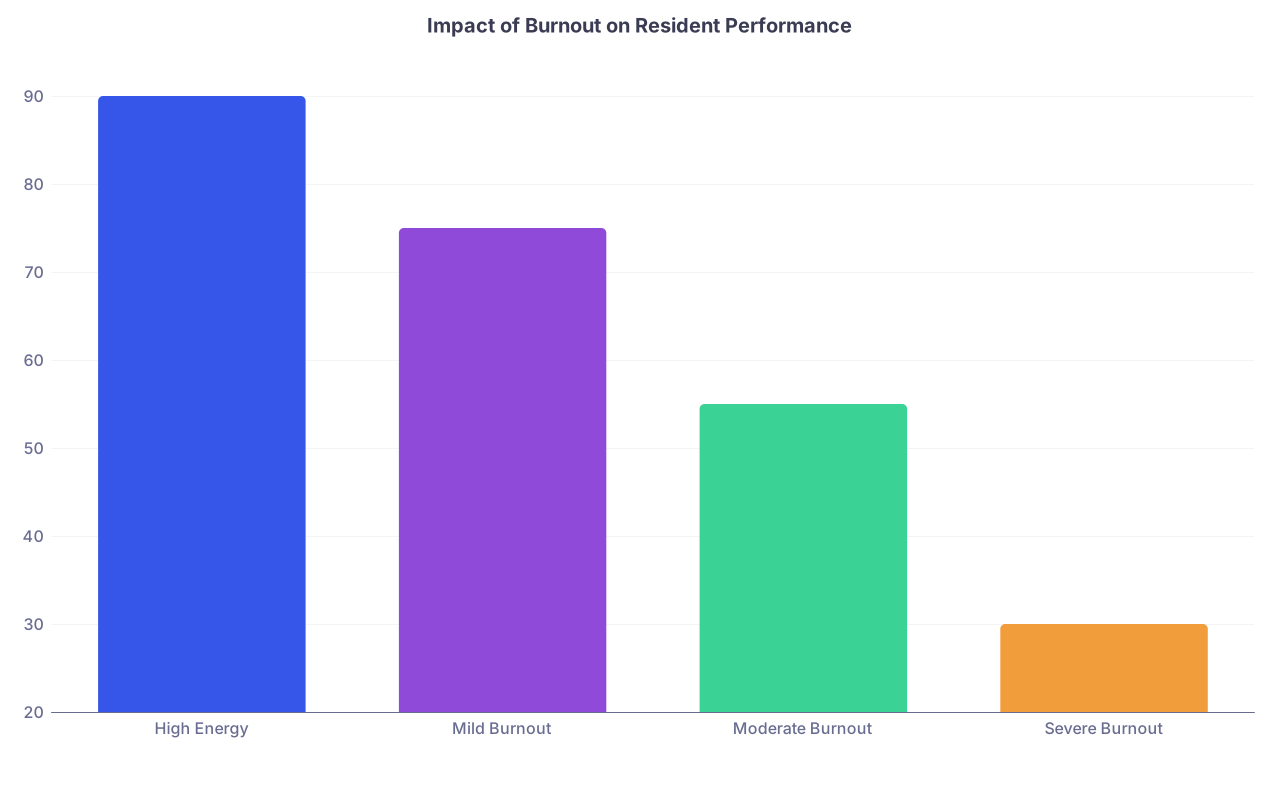
| Category | Value |
|---|---|
| High Energy | 90 |
| Mild Burnout | 75 |
| Moderate Burnout | 55 |
| Severe Burnout | 30 |
(Think of the numbers as “percent of your potential you’re actually able to show.”)
If the powerhouse is notorious for:
- Toxic culture
- 80+ hour weeks that are really 90, chronically
- No schedule flexibility
- Constant resident turnover
You won’t be “average at a powerhouse.” You might end up underperforming your actual ability, which kills the whole advantage.
At a healthier mid-tier program, you might:
- Sleep more
- Think more clearly
- Have capacity for research/leadership
- Show people your real ceiling
And that’s what matters. People judge your career potential based on what you actually show them during residency, not what your Step score theoretically hinted you could be in a perfect universe.
Step 8: How to Pressure-Test Your Choice
Do this two ways: with data and with your gut.
](https://cdn.residencyadvisor.com/images/articles_svg/chart-residency-decision-weighting-example-3602.svg "Residency Decision Weighting Example")
| Category | Value |
|---|---|
| Clinical Training | 30 |
| Fellowship Prospects | 25 |
| Mentorship | 20 |
| Location/Life | 15 |
| [Program Culture](https://residencyadvisor.com/resources/choosing-residency-program/how-do-i-judge-if-a-program-is-truly-committed-to-resident-wellness) | 10 |
- Create a rough weighting for what matters to you (like the chart above).
- Score each program 1–10 on each dimension.
- Multiply, sum, see what actually comes out on top.
Then, gut check:
- Imagine you choose the powerhouse, and three months in you’re clearly bottom half. How does that feel?
- Imagine you choose the mid-tier, and you’re quickly seen as one of the strongest juniors. How does that feel?
If the idea of being forgettable in a famous place makes you quietly sick, believe that. Same if the thought of passing on the powerhouse haunts you.
A Quick Example Scenario
You’re choosing Internal Medicine between:
- Program A: Big-name university hospital, top 10 nationally, heavy research, malignant reputation, 28 residents per class.
- Program B: Strong but mid-tier university-affiliated program, great teaching reputation, 14 residents per class, PD knows every resident well.
You want GI or cards, you like research, and your app so far is “good but not insane”: Step 1 pass / 250+ Step 2, a couple of posters, no first-author original research yet.
If I look at that, I’d ask:
- At Program A, will you realistically stand out among the insanely driven, early-research crowd? Or will you be middle of the pack, with some posters, decent but not glowing letters?
- At Program B, can you get first-author work with easier access to mentors, be chief, and graduate with letters that call you their best?
If you think you can be top quartile or better at Program A, and you can handle the culture, I’d lean A.
If not, I’d lean B and focus on being the absolute best resident they’ve seen in years.
Extra: What Fellowship PDs Actually Notice
From talking to program and fellowship directors, here’s what actually gets noticed:

- Letters that say:
- “Top 1–5% of residents I’ve trained in 10–20 years”
- “I trust this person with my family”
- Real, sustained research/productivity with coherent focus
(not just “was third author on 5 random abstracts”) - Evidence of leadership and reliability:
- Chief roles
- Major QI project that actually changed something
- Education awards
- Clear, specific comments on clinical judgment and work ethic
Notice what’s not on that list: “Name recognition alone.”
Brand matters. But it’s not a substitute for being excellent somewhere.
Key Takeaways
- Being top or near-top at a strong mid-tier is usually more powerful for your long-term trajectory than being forgettable at a powerhouse, unless you’re chasing the most competitive niches.
- If you can confidently be upper-tier at a powerhouse and your goals are heavily academic or hyper-competitive, that can absolutely be the right call.
- Choose the program where you’re most likely to become excellent, visible, and well-supported — not just the one where the logo looks best on paper.
FAQ (Exactly 5 Questions)
1. Will I regret not picking the biggest brand name if I choose a mid-tier program?
You will not regret it if you become a top resident, get strong letters, and hit your goals. I’ve seen people from “no-name” IM programs match GI, cards, and heme/onc at major centers because they were the star back home. You’re more likely to regret three miserable years spent being average at a place that never really invested in you.
2. Is it true fellowship programs filter by residency program name?
Some do rough filtering by program reputation, especially in very competitive fields. But inside your specialty, PDs know which “mid-tier” programs are actually excellent. A star from a respected regional program often beats a forgettable resident from a fancy address. The people writing your letters and vouching for you matter more than the tier label.
3. How do I tell if I’m likely to be top vs. average at a program?
Look at your track record in similar environments. If you’ve always been top when surrounded by very strong peers and high expectations, you might do fine at a powerhouse. If you tended to thrive in smaller, more supportive settings and fade a bit in very cutthroat ones, you’ll probably do better — and look better — in a high-support mid-tier program.
4. What if my dream is academic medicine but I hate research?
Then you need a program where you can lean into teaching, clinical excellence, and leadership in education or quality improvement. That usually means a place where you can stand out and get leadership roles — which is more accessible at many mid-tier programs than at ultra-competitive powerhouses. You can still get an academic job if your letters and reputation as a clinician-educator are strong.
5. Should I talk to current residents about being “top” vs. “average”?
Yes. Ask current seniors and chiefs (privately) who’s considered top-tier in their class and why. Ask how chiefs are chosen, who gets fellowships, and what the PD values. Their answers will tell you whether the program truly supports growth or just praises whoever publishes the most. Use that intel to judge where you’re more likely to thrive and be recognized.