The Great DO/MD Debate Ignores What Matters: Outcomes
You've probably heard the whispers in the premed library. "If you don't get into an MD school, just go DO." It's an applicant anxiety artifact. A status symbol. Students fixate on the two letters after a doctor's name as if they are a magical shield against patient mortality. They aren't.
I've seen too many bright students agonize over this false hierarchy. They treat osteopathic medical schools as a backup plan, assuming the clinical reality mirrors the admissions tier list. It doesn't. Here's what the data actually shows. When you look at large Medicare databases and hospitalist studies, there are no clinically meaningful differences in mortality, readmissions, or complications between DO and MD physicians.
None.
Patients don't care about your MCAT score or your medical school's ranking. They care if they survive, if they get better, and if they have to come back to the hospital next week. By those metrics, a DO and an MD are statistically indistinguishable. The whole debate is a massive distraction. While applicants lose sleep over prestige, the actual clinical data proves that the degree itself doesn't move the needle on patient survival. It's time we stopped treating "DO" as a consolation prize and started looking at what actually happens when the doctor walks into the room.
Data Doesn't Lie: Mortality and Readmission Are Essentially Identical
Let's look at the hard numbers. Over the past decade, several massive retrospective studies have tracked outcomes for hospitalized patients treated by DOs versus MDs. The results? A dead heat.
When researchers crunch the Medicare data for 30-day mortality and readmission rates, the differences are so small they lack clinical significance. We're talking about a mortality difference of 0.1% and a readmission difference of 0.1%. You can't build a hierarchy on that. It's statistical noise.
The surgical field tells the exact same story. If you go under the knife, does it matter if your surgeon has a DO or an MD? The complication rates say no. DO and MD surgeons post comparable outcomes in everything from general surgery to specialized procedures.
People often argue that MDs handle the "harder" cases, so their numbers might look worse. But when you adjust for patient case mix and hospital setting, meaning you compare a DO treating a sick, elderly patient in a rural community hospital to an MD treating a similar patient in a similar setting, the apparent differences shrink to zero. Sometimes the DO edges out the MD. Sometimes it's the reverse. But it never favors one degree consistently enough to matter.
If you're a premed student choosing your path based on which degree yields better clinical outcomes, you're asking the wrong question. The data demands you stop worrying about the letters and start worrying about your training.
The Hidden Confounder: Residency Selection, Not Medical Degree
If the outcomes are identical, why do people still assume MDs are "better"? Because they don't understand selection bias.
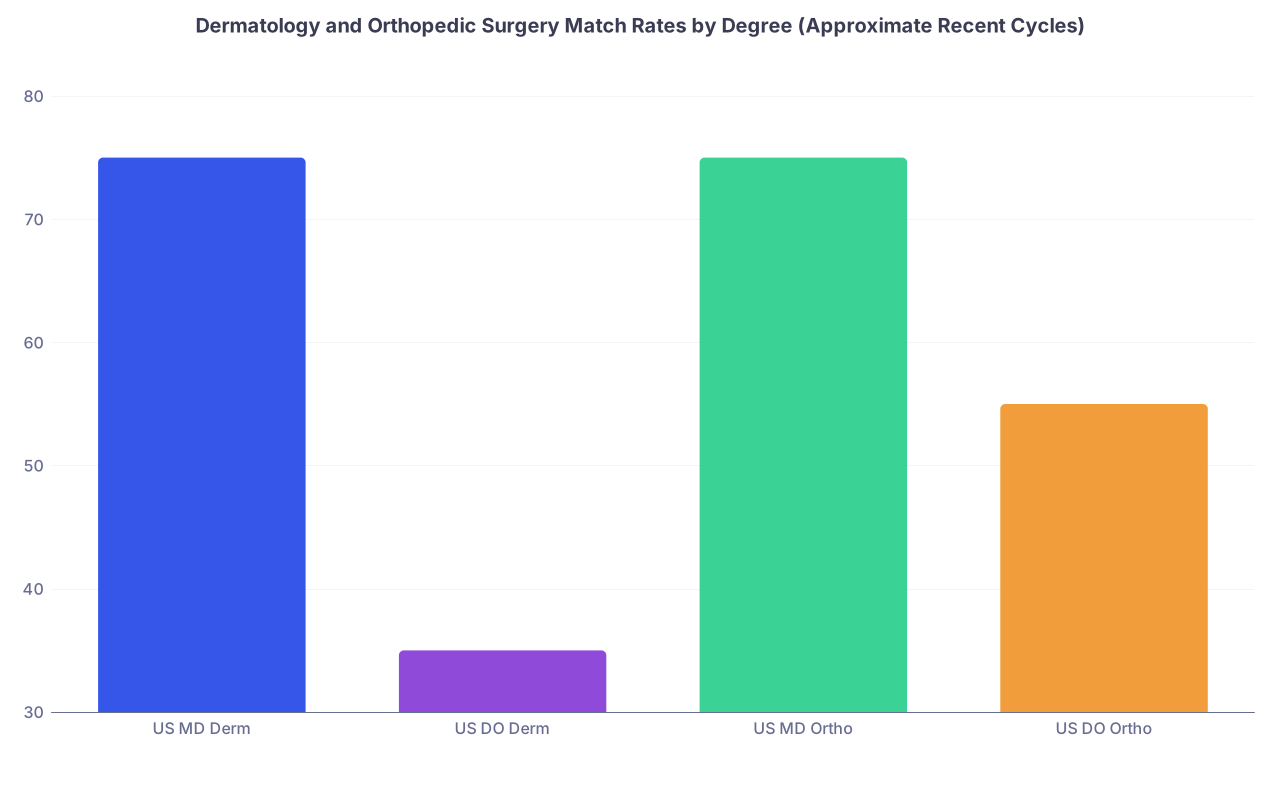
Attending physicians aren't randomly assigned to patients. And doctors aren't randomly assigned to specialties. DOs disproportionately enter primary care, family medicine, and rural practice. MDs cluster in procedure-heavy specialties like dermatology, orthopedic surgery, and plastic surgery, often in academic tertiary care centers.
When you compare a rural family medicine DO treating chronic diabetes in an underserved community to an academic neurosurgical MD, you aren't comparing degrees. You're comparing specialties, patient populations, and hospital resources. That's a confounding nightmare.
If you don't understand selection bias, you shouldn't be analyzing medical data. The residency match process filters applicants into vastly different career trajectories. Once you control for specialty, practice setting, and patient acuity, the gap between DO and MD gets even closer to absolute zero. The "MD superiority" myth survives only because people look at raw, unadjusted numbers and draw lazy conclusions. A rural primary care doc is going to have a different patient mortality profile than a subspecialist at Mayo Clinic. That doesn't make them a worse doctor. It makes them a different doctor.
Where DOs and MDs Actually Differ: Education and Practice Patterns
Let's be clear. DOs and MDs are not identical. Their training differs from day one. DO curricula include osteopathic manipulative treatment (OMT) and explicitly lean into a whole-person philosophy. MD programs typically emphasize a research-university model, heavily integrating bench science and algorithmic disease management.
These educational differences create real, measurable differences in practice patterns. DOs are far more likely to practice primary care.
But here's the kicker. These distribution differences don't translate into outcome deficits. A DO handling primary care delivers comparable preventive care metrics. They often spend more time addressing musculoskeletal concerns directly, a direct result of their OMT training.
MDs might publish more research or pursue highly competitive surgical fellowships, but that doesn't make them inherently better at keeping a patient alive during a hospital admission. The education differs. The career paths differ. The patient populations differ. But the quality of care delivered, when measured by hard clinical endpoints, remains a tie. If you want a doctor who spends an extra ten minutes palpating your spine and talking about lifestyle modifications, you might actually prefer a DO.
The Patient Experience: When 'Different' Doesn't Mean 'Worse'
The medical establishment loves to equate "different" with "worse." It's a tired, elitist trope. When we look at patient satisfaction data, there is no MD advantage. None.

DO training tends to emphasize preventive medicine, patient time, and hands-on musculoskeletal care. That translates directly to the patient experience. On several communication and preventive care measures, DOs actually lead. Patients report feeling heard. They report better discussions about lifestyle and structural pain.
Does an MD program teach you to be a bad communicator? Of course not. But the systemic focus of osteopathic education on the holistic, structural, and preventive aspects of the human body often produces doctors who practice a very specific, highly effective type of primary care.
The most important variable for patient outcomes is the system they enter. A good hospital with strong nursing, rapid response teams, and solid protocols will produce good outcomes regardless of whether the attending physician is a DO or an MD. The two letters after the name are the least predictive variable in the entire equation.
The Bottom Line for Patients and Applicants: Stop Chasing Letters, Start Weighing Evidence
Here's the reality. From mortality to readmissions to patient satisfaction, the data shows no clinically meaningful degree-based hierarchy. None. The debate is stale, and the evidence has settled it.
If you're a premed student, stop treating DO programs as a backup plan. Assess your residency fit. Look at the faculty. Evaluate the culture. Find the clinical opportunities that align with how you want to practice medicine. Don't turn down a great osteopathic school because you're worried a patient will judge your badge. They won't. They just want to get better.
If you're a patient, stop vetting your doctors based on their degree. Choose your physicians based on board certification, clinical experience, and how comfortable you feel with them in the room. Those factors actually matter. The letters DO and MD are just different roads to the exact same destination: competent, licensed medical practice.
Key Takeaways
- Outcomes are identical: Mortality, readmission, and complication rates are statistically indistinguishable between DO and MD physicians in risk-adjusted comparisons.
- Confounders drive the myth: Apparent outcome differences stem from specialty selection, practice setting, and patient acuity, not the medical degree itself.
- For patients: Board certification, communication, and personal fit matter far more than whether a doctor holds a DO or an MD.
- For applicants: Don't treat DO programs as inferior. Look for the best residency and training culture for your specific career goals.