

Last July, I watched two graduating residents—married, both with strong offers—nearly blow up their first year out of training. She had a dream academic hospitalist job in City A. He had a high-paying private practice position in City B, three hours away. Both tried to “make it work” without a plan. By November they were living apart, exhausted, and scrambling to renegotiate contracts they’d already signed.
You do not want to be them. Coordinating two first attending jobs is absolutely doable, but you cannot wing it. The market will happily pull you in opposite directions if you let it.
Let’s walk through how to handle this like adults who want careers and a life, not just two W-2s.
Step 1: Get Brutally Clear on Your Priorities (Before Talking to Anyone)
If you start emailing recruiters before you and your partner are aligned, you’re already behind.
Sit down—no phones—and answer these questions separately first, then together:
- Where do we refuse to live?
- Where would we be genuinely happy living for 3–5 years?
- Who is the “location driver” and who is more flexible?
- Are we trying to:
- Maximize income?
- Get specific training/experience (academics, niche fellowship, procedures)?
- Get lighter hours to recover from residency?
- Kids now or later? Family support important or not?
- How much debt are we carrying, and how urgently do we need to attack it?
Then you put it on paper. Literally.
| Priority Category | Partner A Importance | Partner B Importance | Shared Rank (1–5) |
|---|---|---|---|
| Location/City | High | Medium | 4 |
| Academic vs Private | High | Low | 3 |
| Salary | Medium | High | 4 |
| Schedule/Lifestyle | High | High | 5 |
| Proximity to Family | Low | Medium | 2 |
You’re looking for two or three non-negotiables and two or three “strong preferences.”
If one of you secretly wants big-city academics and the other wants a quiet community practice with land and a yard, better to uncover that now than when contracts are sitting in your inbox.
Step 2: Decide Your Strategy—Who Leads, Who Follows, or True Dual Search
Not all dual-physician couples should approach the market the same way. There are three main patterns.
Strategy A: One “Anchor Job,” One Follows
This is the most successful pattern I’ve seen in early careers.
One person:
- Has a more specific career need (e.g., early-career academic cardiology, transplant, complex onc, etc.)
- Or has significantly fewer job options in general (e.g., pediatric neurosurgery vs. hospitalist)
They become the “anchor.” You optimize geography for them. The other partner looks for good-enough positions within that catchment area.
Who should be the anchor?
- Narrower specialty
- More time-limited opportunity (e.g., real chance for K-award, a unique mentorship setup)
- Or the one who is absolutely miserable if they compromise (be honest)
Strategy B: True Dual Search in Defined Regions
Here, you identify 3–5 target regions (not 25) and you both apply broadly within each. Example:
- Region 1: Triangle, NC
- Region 2: Denver/Boulder/Ft Collins, CO
- Region 3: Minneapolis/St Paul, MN
- Region 4: Austin/San Antonio, TX
You tell every recruiter from day one: “We are a dual-physician couple, both searching in X regions, and we need roles in the same metro area.”
Strategy C: Short-Term Split (Only When Strategic)
Rarely, one of you does a time-limited job/fellowship in a different location:
- 1-year fellowship
- 1-year academic instructor role
- 1-year hospitalist contract to gain experience
But—and this is crucial—you only do this if:
- The timeline is defined in writing
- You both agree on the end city/region ahead of time
- You are not doing this just to avoid a hard decision
If you’re PGY-6 and PGY-7 still living apart, you messed up the timeline.
Step 3: Build a Joint Job-Search Timeline (Not Two Independent Ones)
You cannot run two completely independent searches and hope they collide.
Here’s how you actually map it out.
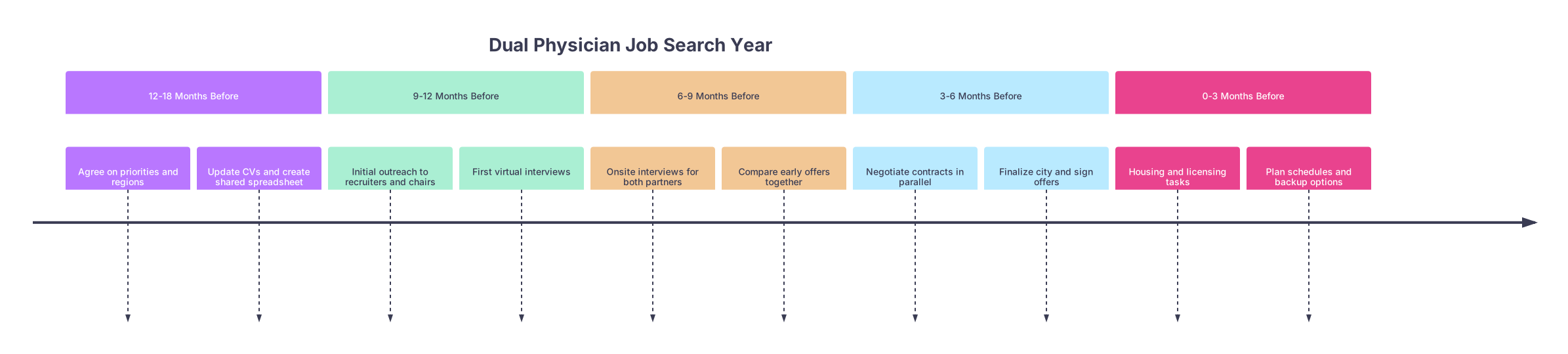
Aim for this:
- 18 months before graduation:
- Talk priorities
- Update CVs
- Start asking co-fellows and attendings for contacts in target regions
- 12 months:
- Start both reaching out to departments and recruiters in those regions
- Set up early virtual interviews
- 9–10 months:
- Coordinate onsite interviews in the same trip when possible
- 6–8 months:
- You should both be in active offer/negotiation stage in the same 1–2 cities
- 4–6 months:
- Lock in both jobs
- Start licensure and credentialing
If one partner starts their search 6 months later than the other, you’ll have mismatched offers and time pressure. That’s how people end up agreeing to garbage terms “just so we can be in the same city.”
Step 4: How to Talk to Recruiters and Departments as a Dual-Physician Couple
You have more leverage than you think—if you’re smart about it.
From your first real conversation (not the initial form email), you say some version of:
“I want to mention early on that my spouse is also a physician—[specialty]—and we are hoping to find roles within the same metro area. Are you aware of any opportunities for [their specialty] in your system or nearby groups?”
Do this even if you’re not sure the job is a fit yet. The goal is to get them thinking: “Two hires for the price of one recruitment process.”
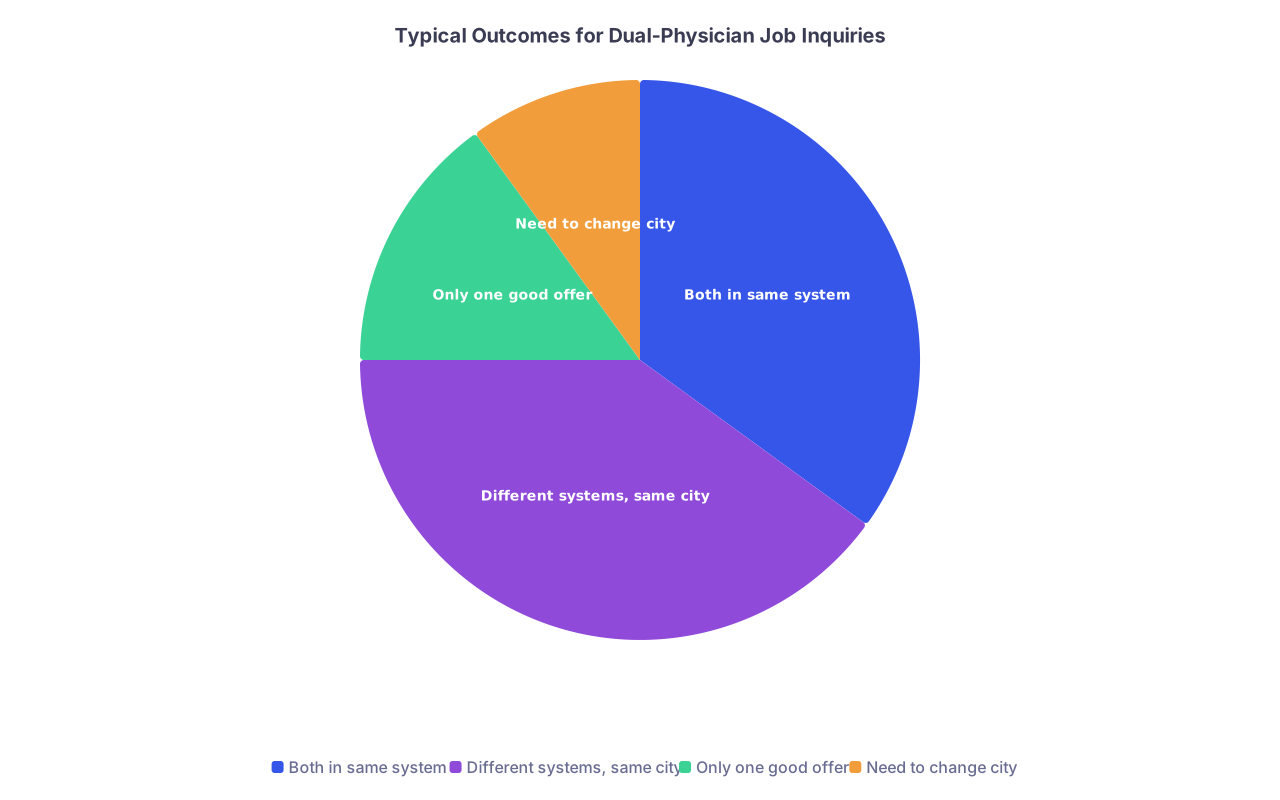
Common outcomes I’ve seen:
- Systems create a position for the trailing partner they didn’t formally advertise.
- Independent group calls the competing hospital across town on your behalf.
- Academic departments open a clinical instructor or hospitalist slot faster.
| Category | Value |
|---|---|
| Both in same system | 35 |
| Different systems, same city | 40 |
| Only one good offer | 15 |
| Need to change city | 10 |
Things you do not do:
- Hide your dual status until late. Programs hate late surprises.
- Let one partner accept an offer while the other is “still looking” in another region.
- Assume your spouse’s job is “not their problem.” They will care, because retention is their problem.
Step 5: Use a Shared Tracking System or You’ll Lose Track
Dual searches get messy. You need one shared source of truth.
Use a simple shared spreadsheet with columns like:
- Institution
- City / Region
- Partner A – Role / Status (applied, interview, offer, declined)
- Partner B – Role / Status
- Salary / bonus / RVU details
- Call expectations
- Academic vs private
- Visa support (if relevant)
- Notes (red flags, gut feeling, “loved the chair,” etc.)
You’re looking for overlapping green lights. A city where one of you is thrilled and the other is “I guess I could tolerate that” is how resentment grows.
I’ve seen couples choose:
- City where both are 8/10 satisfied → higher long-term happiness over
- City where one is 10/10 and the other is 4/10 → constant friction
Write your “gut score” individually after each interaction. Then compare later. You’ll catch concerns before contracts.
Step 6: Negotiating When One Offer Is Clearly Better Than the Other
Classic scenario:
- Partner A: Academic position, $230k, prestige, leadership track, lower pay.
- Partner B: Private practice or ED group, $420k, less control over schedule, more work.
Resentment creeps in fast if you do not think like a household.
Here’s what I tell couples:
- Think in combined post-tax income, not just “who earns more.”
- If one partner is sacrificing income or prestige for the location, the other partner should make that explicit and compensate in other ways: more years in their preferred city later, extra budget flexibility, etc.
- If one partner is taking the high-intensity/high-pay job, the other may need to carry more on the home front at first. That needs to be spoken, not assumed.
You can sometimes use the “stronger” offer to improve the weaker one:
“We’re very interested in both of us joining the system here. My spouse has an offer at $X in a competing group in the same city. If we could come closer on compensation or call expectations, it would make our joint decision much easier.”
Not a threat. Just clear information.
Step 7: Avoid These Specific Landmines
I’ve watched dual-physician couples trip on the same issues over and over.
Landmine 1: “We’ll Just Do Long-Distance for a While”
Translation: “We don’t want to make the hard decision now.”
If “a while” is more than 12 months and there is no written plan for merging cities, it becomes permanent drift. You start building separate lives. Travel fatigue sets in. Someone usually ends up compromising under worse conditions later.
Landmine 2: Two Different Time Horizons
Example:
- Partner A: “This is my dream job, I can see myself here 10 years.”
- Partner B: “I’ll tolerate this for 2 years max.”
You must treat that like a 2–3 year joint plan, not a 10-year life decision. Put a review date on the calendar. Seriously—put it in your phone.
Landmine 3: Mismatched Call / Shift Burden
Two new attendings, both in heavy-call roles, with no childcare/support? Disastrous.
When evaluating jobs, ask explicitly:
- “How often will I be on nights/weekends?”
- “How are parental leaves handled in practice, not just on paper?”
- “How flexible is scheduling with a dual-physician spouse?”
If one of you is ICU nights and the other is surgical home call with frequent return-to-OR, you need a robust childcare/backup plan before signing anything.
Step 8: Special Situations – Academia vs Private, Visas, and Fellowship
Academics vs Private Practice Pairing
Common scenario: one wants academics, the other doesn’t care.
Strategy:
- Anchor on the academic job, because options are fewer.
- Use the university’s network for the other partner: “Many of our faculty spouses work at [large community group X] or [hospital Y]. Let’s introduce you.”
Academic centers know spouse placement is a retention tool. Use it.
International Medical Graduates / Visa Issues
If one or both of you are on J-1 or H-1B, coordination is non-optional.
You need to track:
- Where can you both get waiver-eligible or cap-exempt jobs?
- Will one of you be in a university (cap-exempt) job while the other is in a community H-1B cap-subject role?
- Are you okay with rural or semi-rural for 3 years if that’s what the waiver requires?
In visa-heavy couples, I’ve seen:
- Both take J-1 waiver jobs in the same state, 45–90 minutes apart.
- Live mid-way, with clear plan to converge later after waivers. That’s fine if time-limited and intentional.
Don’t mess around here. Talk to an immigration lawyer before you fall in love with a job that cannot sponsor your situation.
One Still in Fellowship, One Finishing Earlier
This one shows up a lot. For example:
- Partner A: finishing IM this year, ready to work.
- Partner B: in GI fellowship, 2 more years in City Z.
Most rational structure:
- Partner A gets a job in or near City Z, even if it’s not long-term perfect.
- Partner A uses those 2 years to:
- Pay off debt
- Build experience (hospitalist, nocturnist, urgent care, etc.)
- Network locally for better future jobs
Then when Partner B finishes, you do a joint search or both re-negotiate in the same city with more leverage.
Step 9: Money and Lifestyle—Do the Math Together
You’re not just picking jobs; you’re picking a household financial trajectory.
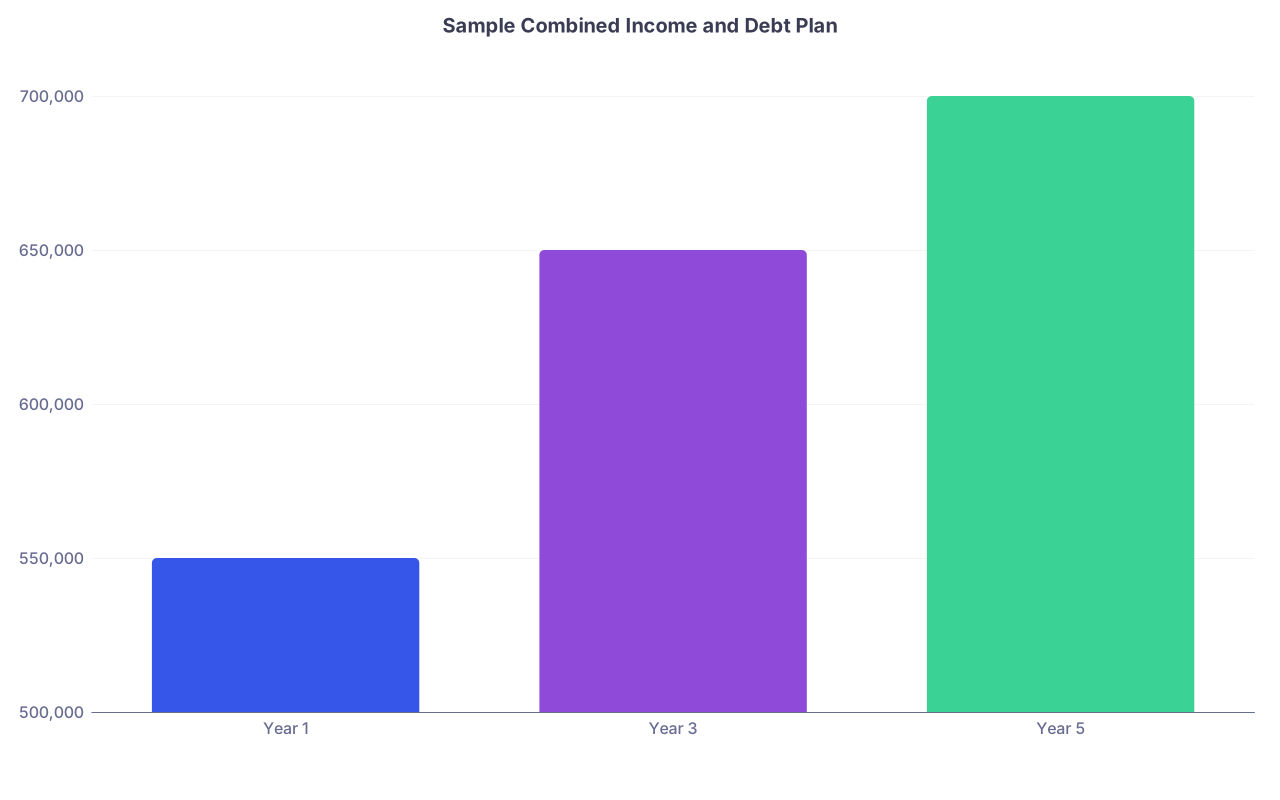
Sit down and estimate:
| Category | Value |
|---|---|
| Year 1 | 550000 |
| Year 3 | 650000 |
| Year 5 | 700000 |
Then map:
- How fast you want to pay off loans
- Whether one of you will reduce to 0.8 FTE once that’s done
- How much you’ll set aside to buy geographic freedom later (down payment, savings)
I’ve seen couples willingly accept slightly worse first jobs but slam $400k of loans in 3 years, then pivot to better lifestyle positions with far more freedom.
Other couples chase the “perfect” first job for one partner and stay broke with crushing lifestyle costs and child care they can’t sustain.
Neither choice is automatically right. You just cannot drift into it.
Step 10: Once You Sign—Plan the First Year Like a Joint Project
You’re not done when ink hits the contract. Now you need execution.
Talk through:
- Call coordination:
- “We’ll never both be on overnight call the same night if we can avoid it.”
- “We’ll line up our golden weekends when possible.”
- Commute times and childcare:
- If you both have 30–40 minute commutes and daycare closes at 5:30, you’re going to have problems.
- Backup plans:
- Trusted sitter/nanny
- Nearby family
- Hospitalist or shift-trade flexibility if someone is sick
One very practical move: alternate which partner’s job gets priority for schedule requests every 6 months. Half-year 1, you flex more around Partner A’s OR block or teaching commitments. Half-year 2, Partner B gets priority for conference weeks or lighter stretches.
That prevents the quiet accumulation of, “Your job is always the one that matters.”
Quick Example Scenarios (What It Looks Like When Done Well)
Scenario 1: Two Hospitalists, Different Needs
- Partner A: Wants academics, teaching, okay with lower pay.
- Partner B: Wants decent pay, flexible schedule, doesn’t care about title.
They:
- Target three cities with academic centers and strong community hospitals.
- Partner A interviews at university hospitalist groups.
- Partner B interviews at nearby community hospitalist groups on 7-on/7-off.
End state:
- Same city.
- Partner A: academic job, teaching, Q4 weekends.
- Partner B: higher pay, week-on/week-off, more time at home.
- Household income solid. Both feel like they “won” something.
Scenario 2: EM and Dermatology
- Partner A: EM, broad jobs nationwide.
- Partner B: Derm, fellowship-trained, limited cities.
They:
- Let Derm be the anchor—only certain metros have good derm group needs.
- EM partner explicitly tells recruiters: “I need X city or within 30 minutes.”
End state:
- Both in same mid-sized metro.
- EM partner took a slightly lower-paying but stable democratic group near the derm practice.
- Derm partner landed in highly desirable group that rarely hires. That’s a huge long-term asset.
FAQs
1. Should we ever accept jobs in different cities as new attendings?
Only if there is a clearly defined, time-limited reason (visa waivers, short fellowship, specific 1-year role) and a written plan to merge locations within 1–2 years. If it’s open-ended, it usually becomes permanent or ends with one of you taking a bad job under pressure.
2. When in the process should we tell employers we’re a dual-physician couple?
Early. As soon as you hit a real conversation with a recruiter or chair, mention it. Programs hate last-minute surprises but will often bend over backward to place a spouse if they know from the beginning that landing you means landing two hires.
3. What if one of us gets a dream offer and the other only has mediocre options in that city?
Then you talk like adults about time horizon and tradeoffs. You either (a) accept this city as a 3–5 year plan with the understanding that you’ll move later for the other partner’s dream phase, or (b) walk away and aim for a city where both are at least 7–8/10 happy. Do not pretend a 4/10 job will magically feel like a 9/10 once you move.
4. How much should salary differences between us matter in decision-making?
They matter at the household level, not the ego level. If one of you can earn significantly more with only a modest lifestyle tradeoff, it may make sense for them to lean into that while the other leans into flexibility or academic interests. But you should consciously design that, not slide into “my income = more say.” Power imbalances poison marriages. Design the system so both feel their work and sacrifices count.
With this kind of planning and ruthless honesty up front, you can walk into your first attending year as a coordinated unit rather than two independent contractors who happen to share an address. The dual-career puzzle doesn’t end here—three years from now you’ll be reassessing cities, kids, leadership roles, maybe even part-time work—but if you get this first transition right, you’ll have the stability and leverage to make those future moves on your own terms.


