

What’s the bigger mistake as a brand-new attending: leaving $40–100k on the table… or walking into your first job with zero real support?
Let me be blunt: most people overvalue the first-year paycheck and undervalue mentorship. And they pay for it later in stress, burnout, and stalled careers.
But “always pick mentorship” is too simplistic. Sometimes the “mentorship job” is just code for “we’ll pay you less to do the same work.” You need a framework, not a slogan.
Here’s how to think this through like an adult with loans, a life, and a long career ahead of you.
Step 1: What Problem Are You Actually Trying to Solve?
Before you compare salaries or mentorship promises, answer this honestly:
In the next 2–3 years, what’s the biggest thing you need?
Common answers I hear from new attendings:
- “I’m terrified of being completely alone on complex cases.”
- “I want to build a niche: interventional, advanced endoscopy, high-risk OB, HF clinic, etc.”
- “I need to get out of debt and finally stop living like a resident.”
- “I want an academic career: papers, titles, leadership.”
- “I care about lifestyle. I don’t want to hate my life in two years.”
Your priority drives the decision:
- If clinical confidence, niche skills, or academic trajectory are your main goals → mentorship is often worth real money.
- If you’re already clinically very strong, don’t want a niche, and mostly want income and time off → mentorship is still nice, but not always worth a huge pay cut.
- If your debt and personal finances are truly on fire → you may need to limit how much you’re willing to give up, but you still shouldn’t ignore support completely.
Write down your top 2–3 priorities. If “good mentorship” doesn’t show up in any of them, be very sure that’s actually true and not just optimism.
Step 2: How Big Is the Pay Cut… Really?
You can’t judge an offer off the base salary alone. Compare total compensation and realistic earning curves.
| Feature | Job A (High Pay, Low Mentorship) | Job B (Lower Pay, Strong Mentorship) |
|---|---|---|
| Base Salary (Year 1) | $380,000 | $300,000 |
| Expected Bonus | $20,000 | $10,000 |
| Call Pay | $30,000 | $15,000 |
| Total Year 1 | $430,000 | $325,000 |
| Partnership Track | 2 years | N/A (employed) |
| Projected Year 3 Income | $550,000 | $350,000 |
At face value, Job A crushes Job B financially. But now add reality:
- How many RVUs or shifts does that money assume?
- What’s the call burden and weekend load?
- How likely is that partnership?
- Are there hidden costs (unpaid admin work, no APP support, constant double-coverage)?
A $100k difference with a sane schedule and strong mentorship? That’s expensive.
A $50k difference with brutal call vs. better support and training? That might be cheap.
You’re not choosing between “more money vs. mentorship.” You’re choosing between:
- A certain income and a certain risk profile
- A certain learning curve and a certain lifestyle
Put numbers and reality to both.
Step 3: What Does “Real Mentorship” Look Like (vs. Lip Service)?
Groups throw around “mentorship” like candy. Most of it is fluff.
Real mentorship for a new attending usually looks like:
Someone in your specialty paid and expected to mentor you
Example: “Dr. X is your formal mentor. You’ll meet monthly to review cases, and she’ll co-manage your first 20 complex cases.”Structured support in the first year
Protected orientation, a ramp-up period, limited solo call initially, double-scrubbing or co-reading on tough cases.Backup that’s actually available
Call coverage where you can pick up the phone at 2 a.m. and not be shamed for asking; senior partners willing to come in for your first disaster.Clear path to skill-building
Time and support to develop in procedures, clinics, or academic/leadership areas you care about.
Fake mentorship sounds like:
- “We’re a very collegial group.”
- “Everyone helps each other out.”
- “You can always call someone if you need to.” (Translation: please don’t.)
If they can’t name:
- specific people,
- how often you’ll meet,
- how your first 3–6 months are structured,
…you’re probably not getting real mentorship.
Step 4: When Is a Lower-Paying Mentorship Job Absolutely Worth It?
Here’s where I stop hedging. These are scenarios where I tell people: yes, you should seriously consider taking the hit.
You’re doing high-risk or procedure-heavy specialty and don’t feel fully independent yet.
CT surgery, IR, interventional cardiology, advanced GI, neurosurgery, high-risk OB, EM in a solo or critical-access setting. If you’re still asking “Do I really know what I’m doing?”—you need guardrails.You want an academic or leadership career and this job actually builds that.
True mentorship in publishing, QI projects, building a program, getting leadership titles. If your dream is Division Chief or Program Director, the “mentorship” job at a strong institution can be a powerful launchpad.You’re transitioning into a niche or hybrid role.
Example: switching from pure clinical to combined clinical/admin, or building a novel service line (e.g., cardio-onc, EM ultrasound director, palliative in a big system). The right mentor saves you years.The “mentorship job” dramatically reduces your risk exposure.
Smaller panel, better backup, sane call. Your chance of burning out or making a catastrophic mistake as a totally unsupported new attending is not theoretical. I’ve watched it happen.
In those cases, a 10–25% pay cut for 2–3 years is often a good investment. Not forever. Strategically.
Step 5: When Is Taking the Lower-Paying Job Just Dumb?
Also important. There are real traps.
It’s probably not worth it when:
- The “mentorship” is mostly marketing and vague promises.
- The pay cut is massive (30–40%+) with no clear, time-limited upside.
- You’re doing bread-and-butter work you already do safely, and the higher-paying job still has reasonable support structures.
- The lower-paying job has other red flags: chaotic admin, toxic culture, insane metrics, constant turnover.
Sometimes the “mentorship job” is:
- An academic center that pays you resident-adjacent money but expects 120% effort.
- A small group that can’t compete financially, so they lean on “family culture” and “we’ll teach you everything” with zero structure.
- A system that chronically underpays physicians and calls it “mission-driven.”
In those cases, mentorship may not actually offset the lost income, stress, or opportunity cost.
Step 6: How to Test If Mentorship Is Real Before You Sign
You don’t guess. You interrogate.
Ask these questions explicitly during interviews:
“Who will be my primary clinical mentor my first year?”
Follow-up: “Is that a formal role or just informal?”“What does my first 3–6 months look like?”
You want to hear: lighter schedule, structured onboarding, double coverage where appropriate.“How is feedback given in this group?”
Are there regular check-ins? Or do you only hear about problems when someone’s angry?“Can I talk to 1–2 recent hires about their first year and how supported they felt?”
Then actually call them. Ask: “When you were stuck, who did you call? Did they come in? How often were you truly alone on something that scared you?”“If I struggle with volume or complexity early on, what happens?”
A good group has an answer that isn’t “we’ll see.”
If they dodge, minimize, or get vague, that tells you more than any glossy brochure.
Step 7: Don’t Ignore the Money – Run the Numbers
Let’s put some math to it.
Say you have:
- $300k student loans at 6–7%
- Two offers:
- Job HighPay: $430k total comp, weak mentorship
- Job Mentor: $350k total comp, strong mentorship, better support
Difference: $80k/year.
Over 3 years, that’s $240k gross. After taxes, maybe $140–160k extra in your pocket.
That’s not trivial. But now zoom out:
- If Job Mentor sets you up to:
- Avoid a malpractice disaster,
- Build a high-earning niche,
- Step into leadership,
- Or simply last 25 years without burning out,
…that $140–160k may end up being peanuts over the span of your career.
On the other hand, if:
- You’re already clinically solid,
- The mentorship is marginal,
- And the lower-paying job doesn’t open unique doors,
Then that same $140–160k might be very real lost progress on loans, savings, or buying yourself some life flexibility.
You can’t answer this in the abstract. Put your numbers, your risk tolerance, and your goals on paper.
Quick Decision Framework
Here’s a simple way to think about it.
How Mentorship Affects Long-Term Income (Not Just Year 1)
One more angle that people ignore: mentorship can change your income trajectory, not just your comfort level.
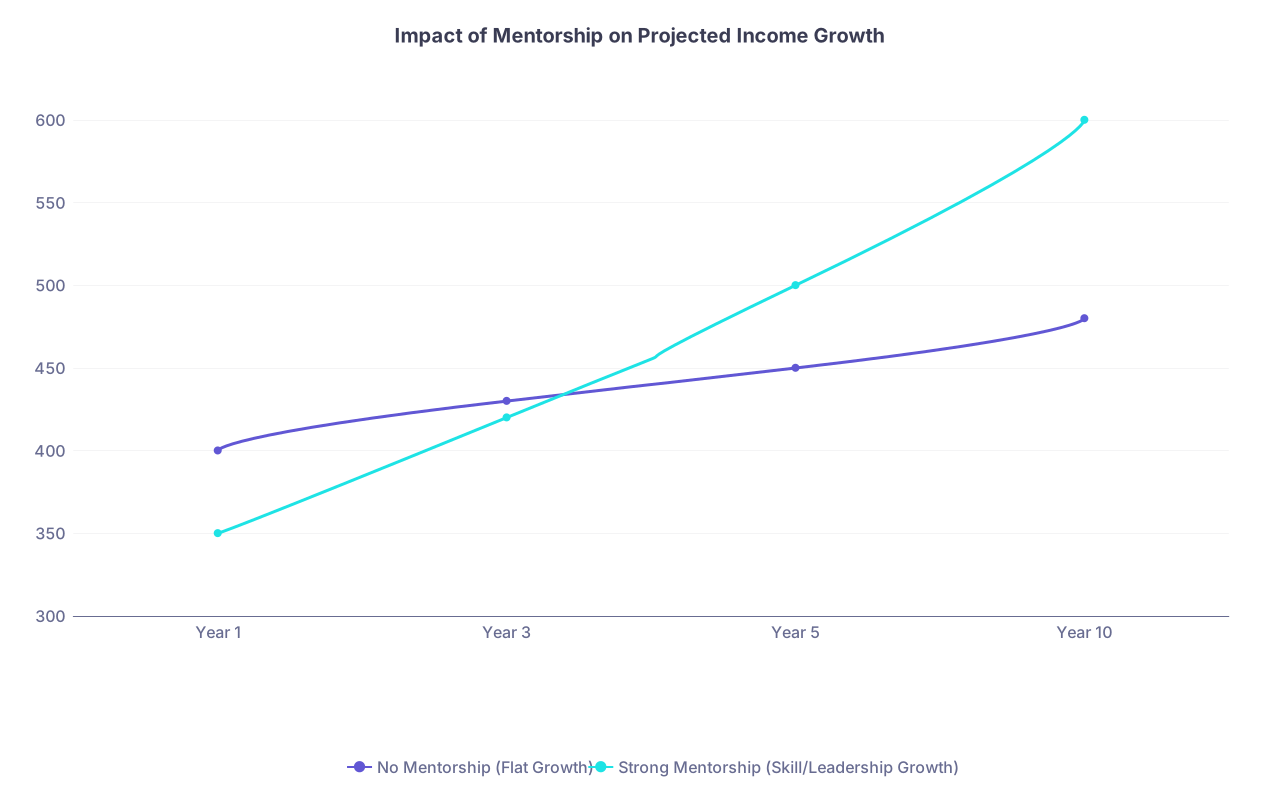
| Category | No Mentorship (Flat Growth) | Strong Mentorship (Skill/Leadership Growth) |
|---|---|---|
| Year 1 | 400 | 350 |
| Year 3 | 430 | 420 |
| Year 5 | 450 | 500 |
| Year 10 | 480 | 600 |
Is this simplified? Of course. But I’ve watched this pattern play out:
- The person who chased pure salary early on often plateaus. No niche, no leadership, no leverage.
- The one who took a hit for a couple years to build skills and relationships often ends up with:
- Higher pay later,
- More optionality (academics, private, admin),
- And more control over their schedule.
Short-term loss. Long-term leverage.
Final Reality Check: What Will You Regret More?
Fast-forward 3 years.
Scenario 1: You took the high-paying job.
- You’ve made more money.
- You’ve paid down more debt.
- But you feel shaky on complex cases, or you hate the culture, or you realize you’ve stagnated.
Scenario 2: You took the lower-paying mentorship job.
- You’re still paying off loans.
- You sometimes wince thinking about the money you “left on the table.”
- But you’re clinically confident, have a marketable niche or leadership role, and are getting recruited aggressively.
Neither is automatically right. But one of those probably feels more “you.”
If you’re honestly risk-averse about clinical safety, or ambitious about building a standout career, mentorship is rarely a waste.
If you’re mostly trying to maximize income and you’re solid clinically, you can justify prioritizing pay—as long as you’re not walking into a totally unsupported mess.
FAQ: Should I Take a Lower-Paying Job for Better Mentorship?
How big of a pay cut is reasonable for better mentorship?
For most new attendings, a 10–20% total compensation cut is defensible if:- Mentorship is real and structured, and
- It’s time-limited (you can renegotiate, move, or promote within 2–3 years).
Once you’re past 25–30% lower pay, you need serious upside: elite institution, niche training you can’t get elsewhere, or clear leadership/academic trajectory.
How many years should I stay in a lower-paying mentorship job?
Think of it as a 2–3 year investment. Long enough to:- Get fully comfortable as an attending,
- Build your skills and reputation,
- Collect strong references and maybe a niche.
After that, reassess. Either your current job should start to pay you more in line with your value, or you should feel solid enough to jump to a job that pays what you’re worth.
I’m in huge debt. Can I still justify taking a lower-paying mentorship job?
Yes, but you need boundaries. You might:- Accept a modest cut (e.g., $40–60k) in exchange for strong support,
- Aggressively live like a resident for 2–3 more years,
- Use that time to become extremely marketable.
What doesn’t make sense: taking a huge pay cut with vague mentorship at a place that won’t set you up for a future earnings jump.
What are red flags that “mentorship” is just an excuse to underpay me?
Watch for:- No named mentor, no schedule, no specifics.
- “We’re like a family,” “everyone helps out” as the entire pitch.
- No protected onboarding, no reduced load early on.
- Long history of underpaying physicians or high turnover.
If the mentorship pitch is emotional, not operational, be skeptical.
Does this decision differ for hospital employed vs. private practice jobs?
Usually yes.- Private practice: mentorship may be more informal, but financial upside later (partnership, ancillaries) can be higher. A short-term pay cut with strong mentorship and real partnership track can be very smart.
- Employed: pay is flatter. If they’re paying you less now, you may not see a huge jump later. So the mentorship needs to be outstanding or career-defining to justify it.
If I choose the high-paying job, how can I protect myself without built-in mentorship?
You build your own net:- Seek out senior colleagues you trust and explicitly ask them to review tough cases with you.
- Keep a low threshold to transfer, consult, or get help early on.
- Go to courses, CME, and simulation—on your own dime if needed.
It’s doable, but harder. You must be honest about your limits and not let pride or productivity pressure push you past safe boundaries.
Bottom line: what should I prioritize—money or mentorship?
As a brand-new attending, I’d prioritize safety and growth, with money as a close second, not the other way around.
If the pay difference is modest and the mentorship is truly strong, take the mentorship.
If the pay difference is huge and the mentorship is vague, don’t let the word “mentorship” guilt you into a bad deal.
Your goal isn’t just to survive year one. It’s to build a 20–30 year career you’re proud of—and still standing for.


