
Understanding Work-Life Balance in Anesthesiology
For an MD graduate considering anesthesiology residency, work-life balance is usually one of the most important—and misunderstood—factors. Anesthesia has a reputation as a “lifestyle residency,” but reality is more nuanced. The specialty offers strong opportunities for balance and flexibility, yet residency years can be intense, and certain practice settings are more demanding than others.
This article provides a detailed work-life balance assessment specifically for MD graduates exploring anesthesiology residency. You’ll find:
- How anesthesiology compares with other fields on lifestyle and duty hours
- What typical schedules look like in residency and beyond
- Practical strategies to protect your well-being during training
- Key questions to ask during the anesthesia match process
- Common myths about anesthesiology work hours and lifestyle
If you’re an allopathic MD graduate planning your rank list for the allopathic medical school match, this will help you assess whether anesthesiology residency fits your personal and professional priorities.
1. Anesthesiology as a “Lifestyle” Specialty: Myth vs. Reality
Anesthesiology is often grouped among the more lifestyle-friendly specialties, but it’s important to clarify what that means—and what it doesn’t.
1.1 Why Anesthesiology Is Viewed as Lifestyle-Friendly
Several features make anesthesiology attractive for MD graduates who care about residency work life balance and long‑term quality of life:
Shift-like work
Many anesthesiologists work scheduled shifts (e.g., 7 am–3 pm, 7 am–5 pm), particularly in academic groups, community hospitals, and large anesthesia practices. When your shift ends, you typically hand off cases to the next team.Minimal ongoing outpatient responsibilities
Unlike primary care or many surgical specialties, anesthesiologists generally do not carry patient panels or manage chronic issues in clinic. Once the perioperative episode is over, your continuity responsibilities usually end.Predictable non-call days
On most weekdays without call, you often know your approximate end time. While cases can run late, OR schedules are planned, so your day usually begins and ends in a relatively predictable window.Opportunities for part‑time or flexible work post-residency
After training, some anesthesiologists choose part‑time roles, 1099 locum work, or highly lifestyle-oriented practices (e.g., outpatient surgery centers with minimal nights/weekends).
1.2 The Reality: Why It’s Not an “Easy” Lifestyle
At the same time, labeling anesthesiology as an “easy lifestyle residency” can be misleading:
High-intensity decision-making
The hours may be comparable to other hospital-based specialties, but those hours can be psychologically intense: rapid responses to instability, airway emergencies, and high-stakes perioperative decisions.Early start times
ORs often start at 7 am or earlier, which means residents may arrive between 5:45 and 6:30 am to set up. This affects sleep patterns and family routines.Call is real
Overnight call, in-house or home call, is part of most residency programs and many practice models (especially those covering trauma centers, OB, or ICUs).Variable workload by subspecialty and setting
Cardiac anesthesia, transplant, trauma, or large tertiary centers may have heavier and less predictable schedules than smaller community or ambulatory surgery centers.
Bottom line: Anesthesiology can offer excellent long-term work-life balance, but residency will still be demanding. Your experience will depend heavily on your program, call structure, and future practice choice.
2. Duty Hours and Schedules in Anesthesiology Residency
Duty hours in anesthesiology residency are governed both by the ACGME and by each program’s staffing needs. Understanding general patterns can help you decide how this aligns with your priorities.
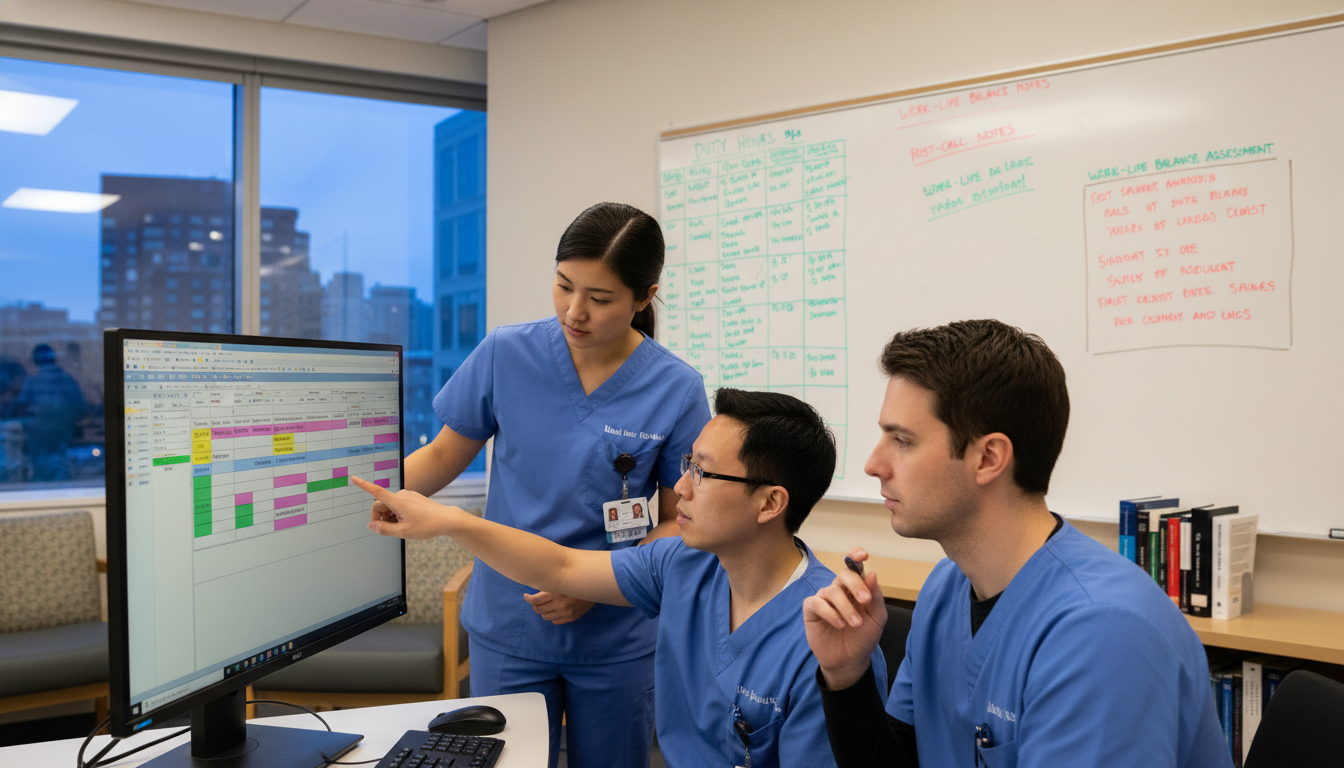
2.1 Typical Workday During Residency
While details vary widely, a typical non-call day for an anesthesiology resident might look like:
- 5:45–6:30 am: Arrive, check cases, set up equipment, draw medications, coordinate with surgeons and nursing
- 7:00 am: First case starts
- 7:00 am–3:00/5:00 pm: In the OR, pre-op evaluations, intraoperative management, possible add-on cases
- Afternoon: Relief by late shift or call team; sign out to on-call resident if leaving early
- Evening: Reading, lectures, simulation, or academic responsibilities when not on call
Many programs operate on a “late stay” system, where some residents are assigned to stay later for add-ons/emergencies while others leave earlier (post-call, post-late day, etc.).
2.2 Duty Hours: What MD Graduates Should Expect
Most anesthesiology residencies comply with standard ACGME duty hours:
- Maximum 80 hours per week, averaged over four weeks
- Maximum shift length commonly 24 hours plus a few hours for transition
- Minimum 1 day off in 7, averaged over four weeks
- 10 hours off between shifts, when feasible
In practice, during intense rotations (trauma, ICU, busy OB), you may approach the 70–80 hour range. During lighter rotations, you may be closer to 50–60.
Common rotation patterns related to work-life balance:
- General OR months: Often 50–60 hours/week, depending on call
- ICU rotations: Typically the heaviest; 60–80 hours/week with stretch of nights
- OB anesthesia: Can be busy with significant overnight activity
- Pain clinic rotations: Often more “clinic-like” hours, sometimes lighter weeks
2.3 Call Structures: In-House, Home Call, and Night Float
Call is a key driver of residency work life balance. Anesthesiology programs use different systems:
In-House Call
- Resident stays overnight in the hospital, often covering multiple services (e.g., main OR, OB, emergencies).
- Post-call day is usually protected, so you leave by late morning or noon.
- Frequency might be q4–q7 (every 4th to 7th night), varying by rotation and program.
Home Call
- Resident is at home but must respond quickly if called in.
- Common for OB, smaller hospitals, or later years of training.
- Can feel less disruptive on quiet nights, but truly restful sleep is not guaranteed.
Night Float
- Residents cover nights in blocks (e.g., 1–2 weeks at a time).
- Can improve circadian stability and predictability of days off.
- Some people like consolidated nights; others find the sleep disruption challenging.
When you interview for the anesthesia match, ask for:
- Average call frequency per month by PGY year
- Average number of in-house vs. home calls
- Whether there is night float and how often you rotate through it
- How strictly the program enforces post-call days off
3. Lifestyle Across Career Stages: From Residency to Attending
Work-life balance in anesthesiology changes significantly as you move from resident to fellow to attending. As an MD graduate evaluating anesthesiology residency, it’s useful to consider the full trajectory.

3.1 Residency (CA-1 to CA-3 / PGY-2 to PGY-4)
During residency, your control over schedule is limited, although some programs allow modest preferences for vacation and elective rotations. Key themes:
- High learning curve in CA-1 year with intense cognitive and emotional demands
- Variable schedule with heavy ICU and call months balanced by lighter rotations
- Less control over overtime—if your case runs late, you usually stay until relieved or finished
- Protected didactics may give some structure (e.g., one afternoon or morning a week)
Work-life balance in residency is strongly influenced by:
- How fairly call and “late stay” duties are distributed
- Whether attendings and senior residents respect duty hours
- Program culture around going home post-call and avoiding “post-call clinics”
3.2 Fellowship Training
Common anesthesiology fellowships include:
- Critical Care
- Cardiac Anesthesia
- Obstetric Anesthesia
- Pediatric Anesthesia
- Pain Medicine
- Regional Anesthesia/Acute Pain
Lifestyle impact of fellowships:
- Critical care and cardiac anesthesia often have heavier call and more weekends, both in fellowship and as a career.
- Pain medicine tends to have more office-hours-based schedules, often viewed as particularly lifestyle-friendly long term.
- Pediatric and OB anesthesia can involve frequent nighttime emergencies, depending on call model.
If you value lifestyle strongly, you might eventually choose:
- No fellowship and a general practice in a group with good coverage
- Pain medicine fellowship for a predominantly clinic-based schedule
- Regional anesthesia in settings where block teams work primarily daytime OR hours
3.3 Attending Practice: Setting Matters
After you complete anesthesiology residency, work-life balance is largely shaped by your practice environment:
Academic Medical Centers
- Mix of clinical, teaching, and possibly research duties
- Structured duty hours; residents and fellows help share call
- May include early starts and occasional late cases; call frequency depends on group size and services
- Often considered moderate in lifestyle—busy but predictable compensation and benefits
Community Hospitals
- Schedules can be very lifestyle-friendly in well-staffed groups:
- Example: 4-day work week, limited overnight call, generous post-call time
- Or demanding, if understaffed: frequent call, long days, less backup
- Often strong earning potential with a balance that can be tailored over time
- Schedules can be very lifestyle-friendly in well-staffed groups:
Ambulatory Surgery Centers (ASCs)
- Generally viewed as among the best lifestyle residencies translated into practice:
- Daytime-only hours, Monday–Friday
- Rare weekends or nights
- Mostly healthy patients and elective cases
- Income can be very competitive, especially if partnered with a group
- Generally viewed as among the best lifestyle residencies translated into practice:
Locums and Per Diem Work
- Flexibility to choose assignments and take extended breaks between contracts
- More control over how and when you work, though with less income stability and benefits
- Appeals to anesthesiologists prioritizing autonomy and travel/family time
For the MD graduate planning the anesthesia match, it’s helpful to view residency not as the endpoint but as the training phase that can lead to a highly customizable work-life arrangement afterwards.
4. Practical Strategies to Protect Work-Life Balance in Anesthesiology Residency
Whether or not anesthesiology becomes a “lifestyle residency” for you will depend partly on your own habits and boundaries. Even in a busy program, you can adopt strategies to protect your well-being.
4.1 Manage Sleep Aggressively
Anesthesia demands sustained attention and rapid decision-making, especially overnight. Poor sleep can compromise both safety and quality of life.
Practical tips:
- Treat post-call time as sacred: Aim to sleep soon after getting home instead of pushing through the day.
- Use strategic naps on pre-call evenings (20–40 minutes) to build a buffer.
- Dark, quiet sleep environment: Blackout curtains, white noise, and phone on “do not disturb” during daytime sleep.
- Plan social life around your schedule rather than forcing a “normal” pattern.
4.2 Use Commutes and Micro-Breaks Wisely
- Use commute time for decompression (audiobooks, podcasts, quiet time) rather than more medical content.
- During long days, take mini breaks: step out between cases, hydrate, quick stretch, short mindfulness exercises.
4.3 Protect Your Physical Health
- Exercise realistically: Short, high-yield workouts (20–30 minutes) 3–4 times/week are often more sustainable than ambitious daily routines.
- Keep healthy snacks and a refillable water bottle in your locker or workroom.
- Pay attention to ergonomics in the OR when setting up monitors, adjusting stool height, or positioning yourself for procedures.
4.4 Build Emotional Support
Anesthesia can be emotionally demanding—critical events, perioperative deaths, and high-pressure resuscitations are part of the job.
- Stay connected with family and friends, even through brief check-ins on busy weeks.
- Lean on co-residents: they understand the unique stresses of your role.
- Use institutional resources: counseling services, peer support programs, wellness initiatives.
4.5 Set Professional Boundaries Early
Within the constraints of training:
- Learn how to politely but firmly state limits, especially regarding post-call requests that are not truly necessary.
- If repeated late stays or duty-hour violations occur, document and discuss with your chief residents or program leadership.
- Avoid the trap of chronic overcommitment: it’s fine to be ambitious, but stacking research, extra moonlighting, and leadership roles in a single year can quickly erode your balance.
5. Choosing the Right Program: Work-Life Questions for the Anesthesia Match
As an MD graduate entering the allopathic medical school match, you have a chance to evaluate programs not just on prestige and case volume, but also on culture and lifestyle.
Here are targeted questions to ask residents and faculty during interviews or second looks.
5.1 Schedule and Call-Specific Questions
- “What is the average weekly clinical workload (hours per week) for CA-1, CA-2, and CA-3 residents?”
- “How often are you on call in a typical month? How many of those calls are in-house vs. home?”
- “How strict is the program about post-call days? Do residents ever stay the whole day post-call?”
- “Is there a night float system? How many weeks per year are on nights?”
5.2 Culture and Support
- “When a resident has a difficult case or bad outcome, what kind of support is available?”
- “How approachable are attendings when the OR slate is heavy or you’re feeling overwhelmed?”
- “Does leadership actively monitor duty hours and address chronic overwork?”
5.3 Flexibility and Individual Needs
- “How are vacation and elective rotations scheduled? Is there flexibility for major life events (weddings, childbirth, etc.)?”
- “Do residents with families or caregiving responsibilities feel supported here?”
Listen not just to the content but to the tone of responses. Do residents chuckle darkly and say, “It’s fine, we survive,” or do they give clear, specific, matter-of-fact descriptions of policies and protections? That difference can be a strong indicator of the true residency work life balance at that institution.
6. Is Anesthesiology a Good Fit for Your Lifestyle Priorities?
To decide whether anesthesiology is the right choice for you as an MD graduate, match your personal needs and temperament to the realities of the specialty.
6.1 You May Thrive in Anesthesiology If You:
- Enjoy intense but time-limited clinical encounters more than long-term continuity
- Prefer team-based care with surgeons, nurses, CRNAs, and techs
- Like the idea of shift-based work with a realistic chance—especially post-residency—of leaving work at work
- Can tolerate (or even enjoy) early mornings and occasional overnight emergencies
- Are comfortable with high-stakes, acute decision-making and short bursts of intense stress
6.2 You Might Reconsider If You:
- Strongly prefer late starts and find consistently early mornings unsustainable
- Desire deep, decades-long relationships with the same patients
- Are highly averse to night or weekend work, even temporarily during residency
- Feel that unpredictable acute events significantly worsen your anxiety, despite training and support
That said, anesthesiology is one of the more adaptable specialties for long-term lifestyle. Over time, many anesthesiologists adjust their practice setting, call responsibilities, and even subspecialty focus to better align with their evolving non-work priorities, such as parenting, hobbies, travel, or academic interests.
FAQs: Work-Life Balance for MD Graduates in Anesthesiology
1. Is anesthesiology residency really better for work-life balance than surgery or internal medicine?
Generally, yes—many MD graduates find anesthesiology more favorable for residency work life balance compared with surgical fields and some inpatient-heavy internal medicine pathways. OR days can be long and intense, and ICU rotations are demanding, but anesthesiology typically involves:
- Fewer “surprise” post-call clinic obligations
- Less ongoing outpatient follow-up
- More shift-like coverage models, especially post-residency
However, individual programs vary widely, and some high-acuity academic centers may have workloads similar to surgical residencies. It’s essential to compare specific programs, not just specialties.
2. How many hours per week do anesthesiology residents usually work?
Most residents report averaging 55–70 hours per week, depending on rotation and program:
- Lighter weeks (e.g., some general OR, pain clinic): closer to 50–60 hours
- Heavier weeks (e.g., ICU, busy OB, trauma): closer to 70–80 hours
These numbers generally comply with the official duty hours limit of 80 hours/week averaged over four weeks, but the day-to-day intensity can still be significant.
3. What is the lifestyle like for anesthesiologists after residency?
Post-residency lifestyle varies by practice type:
- Academic hospitals: Structured schedules and shared call, with intellectually stimulating environment and teaching responsibilities.
- Community groups: Can be highly lifestyle-friendly if well-staffed, with solid compensation and predictable vacations.
- Ambulatory surgery centers: Often excellent work-life balance—daytime hours, limited nights/weekends, particularly attractive to those seeking a true lifestyle residency equivalent in practice.
- Pain medicine practices: Typically office-based, clinic hours, and fewer emergencies, often considered one of the most lifestyle-friendly anesthesia paths.
Many anesthesiologists eventually transition into settings that better match their desired balance of income, free time, and professional interest.
4. Can I have a family and maintain work-life balance in anesthesiology?
Yes. Many anesthesiologists successfully balance family life with their careers. Factors that help:
- Programs and groups that respect parental leave and scheduling needs
- Partners or support networks who understand the demands of early mornings and call
- Thoughtful selection of practice setting post-residency (e.g., ASC or pain practice for maximal predictability)
If having children during residency is a possibility for you, ask specifically about:
- How often residents take parental leave and how it is handled
- Flexibility for prenatal appointments and child-related emergencies
- The program’s experience with residents who are parents, including duty hours and scheduling accommodations
As an MD graduate evaluating anesthesiology for the allopathic medical school match, you’re right to consider more than prestige and board scores; your future lifestyle matters. Anesthesiology offers a strong combination of intellectually engaging work, acute patient care, and significant long-term flexibility in shaping your duty hours and work patterns.
With careful program selection and deliberate boundary-setting, anesthesiology can be one of the most lifestyle-friendly specialties—both during residency and throughout your career.