Cardiothoracic surgery is one of the most demanding specialties in medicine—technically, mentally, and emotionally. For a Caribbean IMG thinking about this path, the biggest question often isn’t “Can I match?” but “Can I realistically have a life outside the hospital?”
This article focuses on a clear, honest work-life balance assessment for Caribbean IMGs considering a cardiothoracic surgery residency in the U.S., with a special lens on the experiences and challenges that may be unique to graduates from Caribbean medical schools (including those focusing on the SGU residency match and similar pathways).
Understanding the Reality: Is Cardiothoracic Surgery Compatible with Work-Life Balance?
Cardiothoracic surgery, especially heart surgery, has a reputation for being one of the least “lifestyle residency” fields. That reputation is partly accurate—but also oversimplified.
Why cardiothoracic surgery is so demanding
Several structural aspects of the specialty affect work-life balance:
Long, complex cases
- Open-heart procedures can last 4–10+ hours.
- Emergency cases (e.g., aortic dissections, cardiac tamponade) do not respect schedules.
- Many days start very early and end unpredictably.
High stakes, high intensity
- You are literally stopping and restarting the heart.
- Complications can be catastrophic, adding emotional weight and follow-up workload.
Frequent call responsibilities
- Even as a senior resident/fellow, you are often on call for emergencies and postoperative complications.
- Overnight calls and weekend work are the norm.
Academic and technical pressure
- Frequent conferences, M&M, research expectations, and constant technical skill development.
- Cardiac surgery is a rapidly evolving field—staying current can feel like a second job.
But “no life” is not the whole story
Despite this intensity:
- ACGME duty hours now cap resident work at:
- Maximum 80 hours/week, averaged over 4 weeks
- One day off in seven (averaged)
- Reasonable attempts at 10 hours off between shifts (program-dependent)
- Many programs have become more intentional about residency work life balance, even in high-acuity specialties like cardiothoracic surgery.
- As attendings, some surgeons shape their practice to allow more balance (e.g., primarily elective cases, academic vs. private practice, or focusing on specific subspecialties such as minimally invasive or structural heart).
A key mindset for Caribbean IMGs
As a Caribbean IMG, you already know how to survive intense academic and clinical pressure. However, cardiothoracic surgery demands proactive planning, not just endurance:
- You cannot rely on “I’ll just work harder.”
- You must deliberately build structure, set boundaries where possible, and manage your mental and physical health.
The question for you is not “Is there work-life balance?” but rather:
“Is the level and style of intensity in cardiothoracic surgery aligned with my personality, my support system, and my long-term goals?”
Training Pathways and How They Impact Lifestyle
Your work-life balance will depend heavily on the training route you choose. Caribbean IMGs, including those from SGU and similar Caribbean medical schools, must think strategically about feasibility and lifestyle.
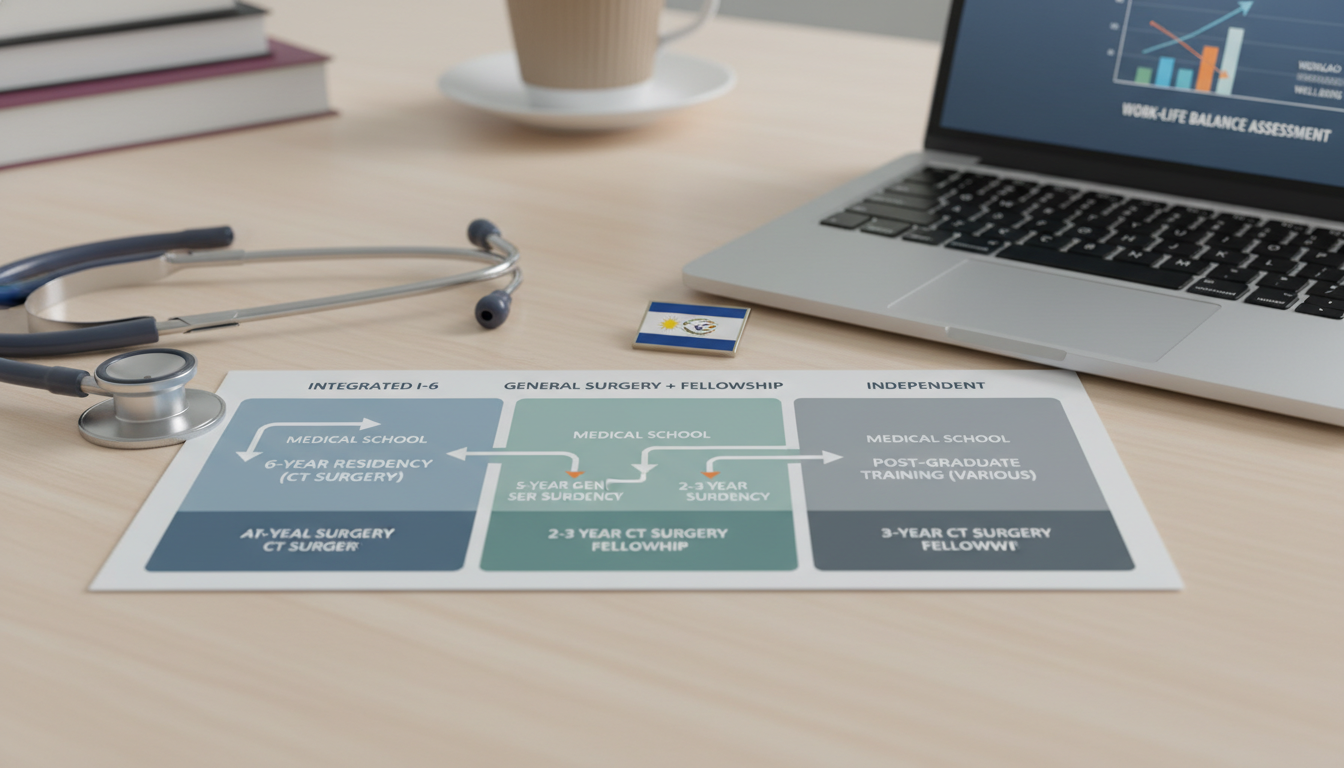
Common pathways to cardiothoracic surgery in the U.S.
Integrated I-6 Cardiothoracic Surgery Residency (6 years)
- Match directly into CT surgery after medical school.
- Combines core surgery training and subspecialty training into one continuous 6-year program.
- Highly competitive and still relatively rare.
- Limited spots; Caribbean IMGs do match occasionally, but rarely.
Traditional Pathway: General Surgery (5 years) → CT Surgery Fellowship (2–3 years)
- Most common route, especially for IMGs.
- You match into General Surgery first, then apply for CT fellowship.
- Total training: 7–8 years after medical school.
Independent / Alternative Pathways (e.g., overseas training, additional fellowships)
- Less standard and highly individualized.
- Often harder for Caribbean IMGs to navigate and less predictable.
Lifestyle differences between pathways
From a work-life balance perspective:
Integrated I-6
- Pros:
- More focused training from day one.
- Earlier exposure to CT surgery, which can improve confidence and efficiency.
- More structured progression with CT mentors.
- Cons:
- Intensity from the beginning of residency.
- You commit earlier, with limited flexibility to switch fields.
- Very demanding with long hours, high expectation for academic productivity.
- Pros:
General Surgery → CT Fellowship
- Pros:
- More flexibility: if you discover that CT surgery is not the right fit, you can remain a general surgeon.
- Slightly broader job options.
- You gain strong core surgical skills that can create some buffer for stress and confidence.
- Cons:
- Two intense phases of training: first as a general surgery resident, then as a CT fellow.
- Prolonged period of heavy workload and modest pay.
- Pros:
As a Caribbean IMG: which is more realistic?
Integrated I-6:
- Feasible, but extremely competitive for IMGs.
- Requires:
- Very strong USMLE scores (often 250+ historically for Step 2 CK).
- Multiple U.S. cardiac/CT surgery rotations.
- Solid CT surgery research with publications.
- Strong letters from U.S. CT surgeons.
- If you are in a top Caribbean medical school with strong academic performance and have early clarity about your career, this is worth attempting—but not as your only plan.
General Surgery First:
- More realistic and most common for Caribbean IMGs interested in cardiothoracic surgery.
- Matching into a strong General Surgery program with CT exposure is a strategic first step.
- But this means:
- 5 years of general surgery (long hours, heavy call).
- Followed by 2–3 more intense years in CT surgery.
- You should assume 7–8 years of high-intensity training with limited control over scheduling.
From a work-life balance standpoint, both paths are challenging. Your decision is less about which is “easier” and more about which is strategically achievable for you, and how much resilience and support you realistically have.
Day-to-Day Life, Duty Hours, and Expectations During Training
Understanding what daily and weekly life looks like is essential when assessing residency work life balance and long-term satisfaction.
Typical schedule in cardiothoracic surgery training
While specifics vary by program, many CT residents/fellows experience:
Pre-rounding:
- Start between 5:30–6:00 a.m., review labs, imaging, overnight events.
- Check on ICU and floor patients before attending rounds.
Morning rounds (6:30–7:30 a.m.)
- ICU first, then floor.
- Discuss overnight events, surgical planning, new consults.
Operating room (7:30 a.m. onward)
- Elective cases scheduled most weekdays.
- Common procedures:
- CABG, valve repairs/replacements, aortic surgery, congenital repairs (if pediatric), lung resections, thoracic oncologic cases, sometimes heart and lung transplants.
- Cases can go well into the late afternoon or evening.
- Emergencies can extend the day far beyond scheduled hours.
Post-op care and sign-out
- You follow your surgical patients to the ICU or step-down unit.
- Coordinate with intensivists, cardiologists, and nursing.
- Sign-out typically happens 6–8 p.m., but later is not unusual.
Call structure and its impact on lifestyle
Call schedules can vary, but generally:
In-house call (hospital overnight)
- 24-hour (sometimes 24+4) calls with some flexibility based on ACGME rules.
- Direct responsibility for emergencies and postoperative complications.
Home call
- More common for senior residents/fellows and attendings.
- You may be at home but are expected to come in for emergencies.
- Disruptive to sleep and family life, especially if your program has a high emergency volume or transplant service.
Weekend responsibilities
- Rounds, emergency surgeries, ICU management.
- “Golden weekends” (entire weekend off) may be rare, especially on CT rotations.
Duty hours vs. real life
While duty hours regulations are in place to prevent extreme overwork, real-world experiences vary:
- Some programs regularly push to the upper limit of 80 hours/week.
- As a CT resident or fellow, it’s common to feel like your effective duty time extends beyond what’s officially recorded because:
- You may come early or stay late to follow up on critical patients.
- Prepping for complex cases and conferences can spill into “off” time.
Your work-life balance will depend heavily on how your program:
- Schedules call.
- Enforces duty hour compliance.
- Supports fatigue management and wellness resources.
When you interview, you should ask directly:
- “How does your program monitor and address duty hour violations?”
- “What does a typical week look like on the CT service for a resident at my level?”
- “How often do residents get full weekends off?”
These questions show maturity and insight, not weakness.
Unique Work-Life Challenges and Strategies for Caribbean IMGs
As a Caribbean IMG, you carry additional layers of complexity that can directly affect your residency work life balance in a cardiothoracic program.

Distance from family and support systems
- Many Caribbean IMGs train far from home, sometimes in smaller U.S. cities without a strong Caribbean community.
- This can intensify:
- Loneliness.
- Cultural adjustment stress.
- Difficulty recharging emotionally.
Practical strategies:
Deliberately build local support
- Seek out residents or fellows with similar backgrounds (IMGs, other Caribbean grads, or other international physicians).
- Join hospital wellness or affinity groups.
- Attend local cultural events when possible, even infrequently.
Schedule protected contact with family
- Block recurring weekly video call times.
- Coordinate vacations well in advance to return home or bring family to you.
- Communicate your schedule reality so family understands you may be unavailable for stretches.
Pressure to “overperform” as an IMG
Caribbean IMGs often feel they need to constantly “prove themselves,” which can lead to:
- Volunteering for excessive extra work.
- Avoiding time off even when permitted.
- Neglecting sleep, exercise, or mental health care to appear more dedicated.
Over the long training arc of cardiothoracic surgery, this is unsustainable.
Actionable advice:
Distinguish dedication from self-sacrifice.
- Being reliable, prepared, and engaged earns respect.
- Chronic self-neglect leads to burnout and poorer clinical performance.
Use mentorship strategically.
- Identify at least one attending and one senior resident/fellow who understand your circumstances.
- Ask explicitly:
- “How can I show commitment and excellence here without burning out?”
- “What are high-yield ways to stand out in this program?”
Set micro-boundaries you can keep.
- Example:
- 15–20 minutes of daily physical movement, no matter how busy.
- Keeping at least one meal a day reasonably healthy.
- Allowing yourself 20–30 minutes of non-medical time before sleep (reading, music, meditation).
- Example:
Financial stress and its ripple effects
Caribbean medical schools are often expensive, and IMGs may carry significant educational debt. During training:
- You earn a modest resident salary while working very long hours.
- Financial stress can amplify burnout, especially when friends outside medicine have more time and income.
Manage this early:
- Build a simple, realistic budget before starting residency.
- Avoid lifestyle inflation even when you finally get a paycheck.
- If possible, choose lower cost-of-living locations among your viable residency options—this can meaningfully improve your quality of life.
Navigating visa and immigration issues
For non-U.S. citizens trained in Caribbean medical schools:
- Visa status (J-1, H-1B) can add stress—especially during the critical CT fellowship or job search.
- Worrying about immigration status can compound fatigue and emotional strain.
Proactive steps:
- Understand visa implications of every step of your training path before you commit.
- Ask programs directly during interviews:
- “Do you sponsor visas, and which types?”
- “Have you previously trained or hired Caribbean IMGs or other IMGs?”
- Seek immigration-savvy guidance early, ideally before applying for CT fellowship.
Long-Term Outlook: Work-Life Balance as an Attending Cardiothoracic Surgeon
While residency and fellowship are intense, they are time-limited. Many Caribbean IMGs planning for cardiothoracic surgery ask: “Does the lifestyle actually get better as an attending?”
The truthful answer: it depends on your practice model and choices.
Types of cardiothoracic practices and lifestyle implications
Academic cardiothoracic surgery
You work in a university or major teaching hospital.
Mix of:
- Complex cases.
- Research and teaching.
- Often transplant or mechanical circulatory support (which can be very time-consuming).
Lifestyle pros:
- More collaborative environment; shared call pools.
- Protected time for academic work at some institutions.
- Opportunities for leadership and innovation.
Lifestyle cons:
- High expectations for research and publication.
- Administrative responsibilities can creep into nights/weekends.
- Transplant call is especially disruptive.
Private practice cardiothoracic surgery
Focus on community cardiac and thoracic cases.
Often high surgical volume.
Lifestyle pros:
- Potential for more control over which cases you accept.
- In some groups, more predictable earnings and schedules.
Lifestyle cons:
- Financial and volume pressure.
- Fewer trainees to share workload.
- May involve covering multiple hospitals.
Hybrid models / niche practices
- Some surgeons carve out more “lifestyle-friendly” niches over time:
- Predominantly elective valve or CABG surgery.
- Mostly thoracic oncology with fewer emergencies.
- Focus on minimally invasive/structural heart with scheduled cath-lab / hybrid OR days.
- These can offer somewhat better lifestyle residency into lifestyle attending reality—though still demanding compared to many specialties.
- Some surgeons carve out more “lifestyle-friendly” niches over time:
Can cardiothoracic surgery ever be called “lifestyle”?
Compared to specialties widely considered most lifestyle-friendly specialties (like dermatology, PM&R, pathology, or some outpatient subspecialties), cardiothoracic surgery will never compete on raw hours or stress levels.
However:
- Some CT surgeons do achieve:
- Reasonable control over vacation.
- Predictable clinic/OR days.
- Strong income and the ability to outsource stressors (e.g., childcare, household tasks).
- Many describe their work as deeply meaningful, which offsets some of the burdens.
For a Caribbean IMG, the long-term lifestyle picture hinges on:
- Strategic early choices in training and practice setting.
- Deliberate cultivation of coping skills and personal resilience.
- Willingness to prioritize sustainable habits, not just career advancement.
Action Plan for Caribbean IMGs Considering Cardiothoracic Surgery
If you are a Caribbean IMG at an SGU-style school (or similar), and you’re serious about heart surgery training but worried about work-life balance, consider this staged approach:
Step 1: Honest self-assessment
Ask yourself:
- Do I derive energy from high-acuity, high-responsibility situations?
- Am I comfortable with prolonged training (7–8 years after med school)?
- Is my family prepared for my limited availability during residency and fellowship?
- Can I accept that my 20s and early 30s will be dominated by training?
If most answers are “yes,” CT surgery could be an aligned choice.
Step 2: Optimize for strong but supportive general surgery training (if not I-6)
Because most Caribbean IMGs will pursue General Surgery first:
- Target programs that:
- Have an affiliated cardiothoracic surgery department.
- Offer early CT or thoracic electives.
- Demonstrate good duty hours compliance and wellness initiatives.
During interviews, frame your questions to show ambition and realism:
- “I’m very interested in cardiothoracic surgery and also in sustainable training. How do residents here manage the workload on high-intensity rotations?”
- “What wellness or support systems exist for residents rotating on the CT service?”
Step 3: Build deliberate lifestyle habits from day one
- Prioritize sleep whenever possible—4–5 hours/night long term is dangerous.
- Use short, consistent exercise bursts (10–20 minutes daily).
- Eat strategically: aim for functional nutrition rather than perfection.
- Seek mental health support proactively if you notice:
- Ongoing low mood.
- Loss of motivation.
- Irritability or detachment.
- Thoughts of self-harm (which require immediate professional help).
Step 4: Plan for fellowship and attending life with lifestyle in mind
During CT fellowship applications and interviews, ask:
- “How is call structured? How many in-house nights per month?”
- “What is the typical weekly hour range for fellows here?”
- “Where have recent graduates gone, and what practices did they join?”
As you approach attending practice:
- Reflect on what balance you want:
- High complexity academic practice with research?
- High-income private practice with volume?
- More controlled niche practice with fewer emergencies?
- Reflect on what balance you want:
Let these answers guide your job search and contract negotiations.
FAQs: Work-Life Balance for Caribbean IMGs in Cardiothoracic Surgery
1. Is cardiothoracic surgery realistically compatible with any kind of work-life balance?
Yes—but “balance” will look very different from outpatient or low-intensity specialties. Expect:
- Long training (7–8 years after medical school).
- Weeks that approach 80 hours.
- Unpredictable call and emergencies.
Balance in CT surgery is more about sustainability and meaning than limited hours. If you find deep fulfillment in the work and build strong support systems, many surgeons describe their lives as demanding but rewarding and manageable.
2. As a Caribbean IMG, should I avoid cardiothoracic surgery if I care about lifestyle?
Not automatically. Being a Caribbean IMG does not mean you must avoid intense specialties. However, you should:
- Be realistic about the probabilities and competition.
- Recognize that you may need to work strategically (not just harder) to secure positions.
- Acknowledge that your path may involve added stressors (distance from family, visa, finances) that you must actively manage.
If your passion for CT surgery is strong and consistent, and you accept the lifestyle costs, it can still be a fulfilling path.
3. How do I compare cardiothoracic surgery with other surgical specialties in terms of lifestyle?
In general:
- More intense than:
- Most lifestyle-oriented specialties (derm, ophtho, radiology, pathology, PM&R).
- Similar or slightly more intense than:
- Trauma surgery, transplant surgery, neurosurgery, surgical oncology in high-acuity centers.
- Less intense than:
- There are few specialties that are reliably more stressful; high-volume transplant or acute-care surgery may feel similar or worse at some institutions.
The key differences in CT are the technical complexity, length of cases, and the emotional weight of operating on the heart and lungs.
4. How does the SGU residency match or other Caribbean medical school matches impact my chance for a “better lifestyle” program?
Graduates from large Caribbean schools (such as SGU, AUC, Ross, etc.) do match into solid General Surgery and occasionally integrated CT programs. However:
- You may have fewer options than U.S. MD graduates in terms of geographic location and program prestige.
- Some high-prestige programs with more robust support systems or more predictable schedules may be harder to access as a Caribbean IMG.
You can still optimize for lifestyle by:
- Ranking programs with clearer duty hour compliance policies higher.
- Asking hard questions about schedule, call, and institutional culture on interview day.
- Seeking mentors who understand both CT surgery and the unique IMG experience to help interpret what you hear from programs.
Cardiothoracic surgery is not, and will never be, a classic lifestyle residency. For a Caribbean IMG, the journey demands resilience, clarity of purpose, and careful planning. But if you are genuinely drawn to heart and thoracic surgery, and you approach your training with intention and structure, it is possible to build a life that is demanding yet meaningful—and, over time, personally sustainable.