

Understanding Work-Life Balance in Medicine-Psychiatry as a Caribbean IMG
Medicine-Psychiatry (Med-Psych) is a unique combined residency that trains you fully in both internal medicine and psychiatry over five years. For a Caribbean IMG, it can be an appealing pathway: intellectually rich, clinically versatile, and increasingly valued in systems focused on integrated behavioral and physical health.
But there is a critical question you should ask early: What is the realistic work-life balance in a Med-Psych residency and career—especially if you are a Caribbean medical school graduate trying to navigate licensing, visas, and the SGU residency match or other Caribbean medical school residency pathways?
This article breaks down:
- How Med-Psych training is structured and what that means for lifestyle
- Typical duty hours and call patterns
- Program culture and how to identify lifestyle-friendly residencies
- Long-term career paths with better work-life balance
- Specific considerations and strategies for Caribbean IMGs
The goal is to give you a clear, nuanced assessment of work-life balance so you can make informed decisions about applying to medicine psychiatry combined programs.
1. What Makes Medicine-Psychiatry Unique—and How It Affects Lifestyle
Medicine-Psychiatry is a 5-year combined program that confers board eligibility in both internal medicine and psychiatry (assuming you meet all board requirements). You are essentially doing two full residencies in one streamlined pathway.
1.1 Structure of a Typical Med-Psych Program
While programs vary, most Med-Psych residencies:
- Last 60 months (5 years)
- Are ACGME-accredited combined programs
- Alternate between medicine-heavy blocks and psychiatry-heavy blocks, with some integrated rotations (e.g., consult-liaison, inpatient psych with complex medical comorbidity, collaborative care clinics)
A common structure might look like:
- PGY-1: Mostly internal medicine (wards, ICU, night float), plus some inpatient psychiatry
- PGY-2: Mix of internal medicine and psychiatry, sometimes heavier in psychiatry
- PGY-3–4: Increasing responsibility, more subspecialty experiences (C-L, addiction, geriatrics, outpatient clinics)
- PGY-5: Chief-level or senior responsibilities in both fields; more electives and focus on career goals
1.2 Lifestyle Features Compared With Categorical Medicine and Psychiatry
Compared with Internal Medicine alone:
- Med-Psych can feel more intense overall because you’re meeting ACGME requirements for two specialties.
- You will still experience the same inpatient medicine wards, ICU, and night calls as categorical medicine residents in most programs.
- However, your psychiatry rotations generally have more regular hours and less overnight call, which helps offset the most intense blocks.
Compared with Psychiatry alone:
- Med-Psych is clearly more demanding than a categorical psychiatry residency.
- You will have more inpatient, higher-acuity medicine time and more night work.
- Psych rotations themselves, though, tend to be more lifestyle-friendly, with better control over schedule and fewer emergencies compared with high-intensity medicine blocks.
Net effect on work-life balance:
Med-Psych sits between internal medicine and psychiatry in terms of lifestyle:
- More manageable than a pure inpatient heavy internal medicine career
- Less easygoing than a mostly outpatient psychiatry path
- But in the long term, it can open excellent lifestyle-oriented roles, especially in integrated care, consult-liaison, and collaborative environments.
For a Caribbean IMG, the added complexity is that you may be juggling:
- Visa or immigration constraints
- Need for strong exam performance (USMLE/COMLEX)
- Pressure to match, possibly via SGU residency match or similar pathways
So, work-life balance during residency is not just about hours—it’s also about stress load and support systems in a dual-training environment.
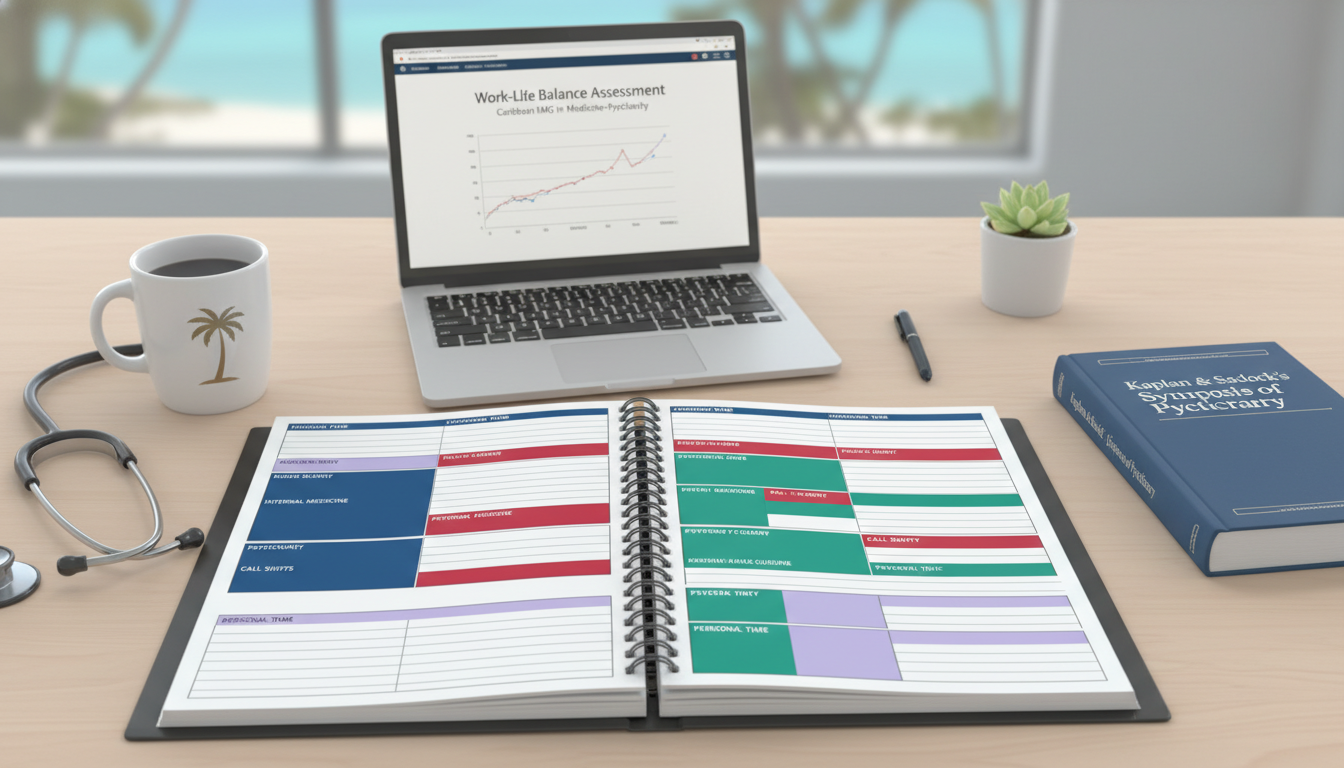
2. Duty Hours, Call, and Day-to-Day Lifestyle in Med-Psych Training
2.1 Duty Hours: What to Expect
All ACGME-accredited programs, including Med-Psych, must comply with duty hours regulations, which typically include:
- Maximum 80 hours per week, averaged over 4 weeks
- 1 day off in 7, free from clinical and educational responsibilities, averaged over 4 weeks
- Maximum 24 hours of continuous in-hospital duty (plus 4 hours for transitions/education) in most settings
- Adequate rest periods between shifts (varies by year of training and specialty rules)
In practice, lifestyle varies by rotation type:
On Internal Medicine rotations:
- Inpatient wards:
- Often 60–80 hours/week
- Early start (6–7 AM), late sign-out (5–7 PM)
- Possible q4–q6 call or night float depending on program
- ICU rotations:
- Among the heaviest: 70–80 hours/week
- Night shifts and rotating schedules are common
On Psychiatry rotations:
- Inpatient psychiatry:
- Typically 45–60 hours/week
- More predictable days; less frequent overnight call if any
- Outpatient psychiatry / clinic:
- Often 40–50 hours/week
- Rare overnight call; occasional evening clinics or call coverage
Because Med-Psych residents rotate through both, your schedule will swing between high-intensity medicine blocks and comparatively lighter psychiatry blocks. The “easier” months on psych can create room to recover, study, and attend to personal life.
2.2 Call and Night Float
Medicine service call:
- Expect traditional call or night float systems, similar to categorical internal medicine residents.
- Night float weeks can be tough but are usually time-limited.
- Cross-covering large numbers of patients adds to cognitive load and fatigue.
Psychiatry call:
- Often involves emergency psych consults, admissions to inpatient psych units, and occasionally cross-cover of inpatients.
- Frequency depends heavily on program; some have residents on call every 4th–7th night, others use night float or have more attending-heavy coverage.
- The acuity feels different: less ventilator management, more crisis intervention and risk assessment.
Most Med-Psych programs integrate you into both call pools at various points. This dual exposure can be demanding but also very enriching—though you will need to be deliberate about rest and boundaries.
2.3 Sample Week: Medicine vs. Psychiatry Block
Example: PGY-2 on Medicine Inpatient Service
- Mon–Fri:
- 6:00 AM – Arrive, pre-round
- 7:30 AM – Rounds with attending
- 12:00 PM – Noon conference
- 1:00–5:30 PM – Orders, family meetings, admissions, discharges
- One or two days may extend to 7–9 PM with admissions or cross-cover
- Sat:
- Long day or call every other weekend
- Sun:
- One full day off most weeks
Example: PGY-3 on Outpatient Psychiatry
- Mon–Fri:
- 8:30 AM – Clinic begins
- 12:00 PM – Didactics or supervision
- 1:00–4:30 PM – Afternoon clinic
- 4:30–5:00 PM – Note completion, admin tasks
- Weekends:
- Often free; may have rare call or backup duties
From a residency work life balance perspective, your experience will be a hybrid of these patterns over five years. That fluctuation is important when thinking about burnout and long-term sustainability.
3. Program Culture and Lifestyle: How to Judge Fit as a Caribbean IMG
Even within the same specialty, residency work life balance varies dramatically by program. For a Caribbean IMG, the program’s culture can make or break your training experience.
3.1 Culture Markers of a Lifestyle-Friendly Med-Psych Program
When you research programs, look for:
Clear Respect for Duty Hours
- Residents report duty hours accurately without fear.
- Leadership responds when violations occur.
- Call schedules are transparent and equitable.
Integrated Support for Med-Psych Residents
- You are not treated as an “extra body” for either department.
- There is dedicated Med-Psych leadership (Program Director or Associate PD) who advocates for your needs.
- Schedules are thoughtfully built to avoid back-to-back heavy rotations.
Protected Educational Time
- Regular, protected didactics (neither medicine nor psychiatry teams interrupt them lightly).
- Access to mentors in both specialties.
- Time and support for research or academic interests if desired.
Wellness Infrastructure
- Access to mental health resources and confidential counseling.
- Wellness initiatives that go beyond token activities.
- Culture where asking for help is normalized, not stigmatized.
Graduate Outcomes and Satisfaction
- Alumni are accessible, speak positively about training, and not all burned-out hospitalists.
- Graduates enter balanced careers (e.g., outpatient Med-Psych, consult-liaison, collaborative care, academic work with teaching time).
3.2 Specific Considerations for Caribbean IMGs
As a Caribbean IMG (whether from SGU or another Caribbean medical school), you will want to assess:
Openness to IMGs:
- Does the program routinely interview and rank Caribbean medical graduates?
- How many current or recent residents are IMGs?
- This matters for your Caribbean medical school residency strategy and match likelihood.
Visa Sponsorship
- If you need a visa, confirm whether they sponsor J-1 and/or H-1B.
- Visa needs can indirectly affect your lifestyle (extra paperwork, limitations on moonlighting, anxiety about renewals).
Remediation and Support Systems
- Ask how the program supports residents who struggle in either domain (medicine or psychiatry).
- A dual-training program with weak remediation structures can be high-risk for burnout.
Geographic and Social Support
- For Caribbean IMGs, moving far from home is often stressful.
- Consider cost of living, distance to family/support networks, and local Caribbean or international communities.
3.3 How to Gather Real Information (Beyond Websites)
During interview season—whether in person or virtual—use every opportunity to ask specific, behavior-focused questions:
- “In the last year, how often have medicine rotations hit the 80-hour cap?”
- “What happens when duty hours are exceeded?”
- “How often do residents actually get their post-call day off?”
- “Do Med-Psych residents ever feel pulled more heavily into medicine or psychiatry as service needs, rather than training needs, dictate?”
- “What proportion of graduates choose outpatient or lifestyle residency positions vs intensive inpatient or hospitalist roles?”
Also:
- Reach out to current Med-Psych residents, especially any IMGs.
- Ask programs if you can talk to a recent graduate.
- Use unofficial online forums cautiously—prioritize direct conversations over anonymous posts.

4. Long-Term Work-Life Balance: Career Paths in Medicine-Psychiatry
The real lifestyle payoff of a Med-Psych residency is often post-residency. While training can be demanding, the skillset opens doors to many lifestyle residency–style careers once you are an attending.
4.1 Common Med-Psych Career Paths and Lifestyle
Outpatient Integrated Care / Collaborative Care
- Work in primary care clinics that embed psychiatric services.
- Structured clinic hours: typically 8–5, weekdays, minimal or no call.
- Excellent for work-life balance, especially if you prefer continuity and longitudinal relationships.
Consult-Liaison (C-L) Psychiatry with Medical Emphasis
- Focus on psychiatric care for medically ill patients in hospital settings.
- Schedule varies: some roles are regular weekdays with home call, others more intense.
- Intellectually stimulating and rewarding; lifestyle depends on hospital and group culture.
Hospitalist with Strong Psych Skills
- Traditional hospitalist schedule (e.g., 7-on/7-off) with specialized interest in patients with severe mental illness or complex behavioral challenges.
- Pay is often higher, but hours can be intense during working weeks.
- Time off between blocks can support balance—if you use that time well.
Partial Hospitalization / Intensive Outpatient Programs
- Often weekday-based, structured programs.
- Blend of group, individual therapy, and med management.
- Predictable hours; favorable for family life.
Academic Med-Psych Positions
- Mix of teaching, clinical work, research, and administrative tasks.
- Lifestyle can be quite good if clinical load is reasonable and protected time is real.
- Academic centers often value Med-Psych training highly.
Correctional Health or Community Mental Health with Medical Co-Management
- Can offer stable hours and predictable schedules, though resources may be limited.
- Great fit if you are committed to underserved populations.
4.2 What Roles Tend to Be Most Lifestyle-Friendly?
From a residency work life balance perspective as you transition to attending life, these are generally the most lifestyle-friendly options:
- Outpatient psychiatry–dominant roles with some internal medicine component
- Collaborative care clinics with structured working hours
- Academic Med-Psych positions with a balanced clinical-educational split
Roles that may be less lifestyle-friendly include:
- Full-time ICU or busy inpatient internal medicine hospitalist tracks
- Positions with frequent night shifts or 24-hour in-house call
- Under-resourced community settings with heavy patient loads and limited support
For a Caribbean IMG, visa and employment constraints can initially limit options, but over time (especially after obtaining permanent residency or citizenship), you’ll have more freedom to choose balanced roles.
5. Practical Strategies to Preserve Work-Life Balance as a Caribbean IMG in Med-Psych
Even in a demanding combined program, there are concrete steps you can take to protect your well-being.
5.1 Before Matching: Designing a Balance-Conscious Application Strategy
Target programs that value IMG diversity.
Look for programs with a history of Caribbean medical school residency matches, including those known for SGU residency match outcomes or similar.Consider location and cost of living.
A modestly paid residency goes further in low-cost areas. Financial stress is a major lifestyle factor.Clarify program structure.
Ask: “How are medicine and psychiatry blocks scheduled to avoid burnout?” Programs that intentionally intersperse heavy and lighter rotations are better for sustainability.Assess mentorship.
Identify programs where Med-Psych residents have dedicated mentors in both departments.
5.2 During Residency: Daily and Weekly Habits
Own Your Schedule Within Limits
- Even on busy rotations, plan small non-negotiables: 15–20 minutes for exercise, a weekly call with family, one protected personal activity.
- Use psychiatry blocks to establish consistent routines (sleep, meals, reading, finite leisure time).
Protect Sleep Relentlessly
- Avoid unnecessary screen time after call.
- Use naps strategically on night float.
- Set boundaries for non-urgent tasks after late shifts.
Use “Slack” Time Wisely
- On lighter psych or elective rotations, batch life admin tasks (financial planning, visa paperwork, board prep).
- Build a modest emergency fund—even small savings reduce stress over time.
Leverage Peer and Faculty Support
- Build relationships with co-residents, especially other IMGs who understand your context.
- Seek early help if you struggle clinically or emotionally—problems almost always worsen if hidden.
Be Strategic About Career Planning
- By PGY-3, start discussing long-term career interests with mentors.
- If lifestyle is a priority, be explicit: “I am looking for a position with predictable clinic hours and minimal call.”
- Explore electives in collaborative care, outpatient integrated clinics, and academic roles that align with those goals.
5.3 As an IMG: Managing Extra Layers of Stress
Caribbean IMGs navigating Caribbean medical school residency routes often face:
- Visa concerns
- Distance from family
- Financial pressure from loans
- Perceived stigma about training background
To protect your work-life balance:
- Clarify visa timelines early with GME and immigration offices; uncertainty drains mental energy.
- Prioritize community building—find cultural, religious, or social groups that feel familiar.
- Reframe your Caribbean training as an asset: high clinical exposure, adaptability, and resilience.
- Compare yourself to your past self, not constantly to others; residency is full of high performers, and imposter feelings are common.
6. Is Med-Psych the Right Lifestyle Fit for You as a Caribbean IMG?
Medicine-Psychiatry can be a fantastic choice if you:
- Love both the complexity of internal medicine and the depth of psychiatry
- Want flexibility to work in integrated or niche roles
- Are willing to accept a more intense 5-year training period to gain broad, long-term options
In pure “lifestyle residency” terms, categorical psychiatry is usually more relaxed than Med-Psych, and internal medicine is often more demanding. Med-Psych combines both realities:
During residency:
- Expect mixed months—some very intense, others comparatively calm.
- Your baseline duty hours may trend higher than a psychiatry-only track but lower than the busiest medicine programs.
After residency:
- You can intentionally seek positions that maximize work-life balance, especially outpatient and integrated care roles.
- Your dual training often makes you more competitive for these jobs.
For a Caribbean IMG, the key is to ensure that:
- The program you choose is IMG-friendly, supportive, and well-structured.
- You go in with eyes open about duty hours and stressors.
- You keep your long-term lifestyle goals front and center when selecting your first attending job.
If you are excited by complex patients, enjoy both somatic and psychological medicine, and are ready for a challenging but rewarding training path, Med-Psych can offer both professional satisfaction and a sustainable, balanced career trajectory.
Frequently Asked Questions (FAQ)
1. Is Medicine-Psychiatry more or less lifestyle-friendly than internal medicine for a Caribbean IMG?
Med-Psych is generally more lifestyle-friendly than pure internal medicine, mainly because psychiatry rotations and many eventual Med-Psych careers have more regular hours, fewer emergencies, and lower overnight burden. However, it is less lifestyle-friendly than categorical psychiatry during training.
For a Caribbean IMG, the intensity is similar to what categorical U.S. graduates experience—but you’ll also need to manage exam pressures, possible visa issues, and cultural adjustment. Choosing a supportive, IMG-friendly program is crucial.
2. How do duty hours in Med-Psych compare to other residencies?
Duty hours in Med-Psych must comply with the same 80-hour/week ACGME duty hours rules. On medicine rotations, your hours may reach the upper end (60–80 hours/week), especially on wards or ICU. Psychiatry blocks often average 40–60 hours/week with fewer nights.
Compared with surgical fields, Med-Psych is typically lighter. Compared with psychiatry alone, it is heavier. Compared with internal medicine alone, it’s similar on medicine months but offset by lighter psych months.
3. What careers after Med-Psych offer the best work-life balance?
The best work-life balance for Med-Psych graduates usually comes from:
- Outpatient psychiatry or integrated care roles
- Collaborative care clinics in primary care settings
- Academic positions with a mix of clinic, teaching, and some protected time
These roles often feature predictable daytime schedules, minimal or no overnight call, and flexibility in tailoring your practice mix between medicine and psychiatry.
4. As a Caribbean IMG, will being Med-Psych trained help or hurt my chances of getting a lifestyle-friendly job later?
In most cases, Med-Psych training will help:
- Employers value your ability to manage complex patients with both medical and psychiatric needs.
- Outpatient and integrated care roles, which are often more lifestyle-friendly, are well aligned with your dual skillset.
- Your versatility can make you more competitive, allowing you to negotiate better hours, part-time options, or academic roles.
The main challenge is getting into an IMG-friendly Med-Psych program; once you complete training and establish yourself, your combined expertise typically enhances, not restricts, your options for a balanced career.


