Interventional Radiology (IR) is often described as a “lifestyle residency” compared to many surgical fields—but that phrase can be misleading. For a US citizen IMG or American studying abroad who is considering IR, understanding the real day-to-day demands, duty hours, and long‑term lifestyle is critical before committing to this competitive pathway.
Below is a detailed, practical work-life balance assessment of interventional radiology residency and early practice, tailored specifically for the US citizen IMG.
Understanding the Interventional Radiology Training Pathway
Interventional radiology training in the US has changed substantially over the last decade. The structure of training strongly influences your lifestyle and work hours.
The Main IR Training Routes
Integrated IR/DR Residency (6 years total)
- 1 preliminary/transition year (usually internal medicine or surgery)
- 3 years primarily diagnostic radiology
- 2 years primarily interventional radiology
- You match directly into IR/DR as an MS4 (or during a gap year before/after graduation).
- Work-life balance changes across phases: the internship feels more like medicine or surgery, while DR-heavy years are generally more lifestyle-friendly than surgical programs.
Independent IR Residency (After DR)
- Complete a DR residency first (4 years after prelim year).
- Then match into a 2-year independent IR residency.
- This path may be more common for those who discover IR later or who don’t match integrated IR.
Early Specialization in IR (ESIR) within DR residency
- During DR, you complete an ESIR track that can shorten the independent IR training to one year.
- Lifestyle during DR with ESIR track is generally similar to standard DR but may involve more procedural and call exposure.
Implication for US Citizen IMG
As a US citizen IMG:
- Entry point matters for work-life balance.
- The preliminary year and IR-heavy years will feel more intense (duty hours, call, procedural stress) than the diagnostic years.
- Your ability to strategically select programs—and especially your willingness to match into different geographic regions—will influence both your IR match chances and your lifestyle.
Realistic Duty Hours and Call in IR Residency
Interventional radiology is procedure-heavy and often emergent. Work-life balance hinges on how the program structures its IR service and call system.
Duty Hours: What You Can Expect
Across training, IR/DR residents are bound by ACGME duty hour regulations (max 80 hours/week averaged over 4 weeks, at least 1 day off in 7, etc.). In practice:
Intern Year (Preliminary/Transitional Year)
- If medicine prelim: 60–80 hours/week is common, with q4 or q5 call on wards.
- If surgery prelim: similar or higher; early mornings, later evenings, frequent weekends.
- Lifestyle: This is often the worst work-life balance year in the IR pathway.
Diagnostic Radiology Years (PGY-2 to PGY-4/5)
- Typical ranges: 45–60 hours/week.
- Mix of day shifts, evening shifts, some night float.
- Fewer physically exhausting duties compared to surgery or IM; more mental fatigue and eye strain.
- Call may be night float or home call for some rotations.
- Lifestyle: For many, these are “lifestyle residency” years relative to other hospital-based specialties.
IR-Focused Years (Late integrated IR or independent IR years)
- Typical on-service ranges: 55–70+ hours/week, depending on case volume and call structure.
- Early starts (6:30–7:30 am), procedures through the day, add-on/emergent cases in evenings or overnight.
- On busy call rotations, some weeks may approach the 80-hour limit.
- Lifestyle: Fluctuates—high-intensity blocks followed by more relaxed off-service or vacation time.
Call: In-House vs. Home Call
Call structure has major lifestyle implications:
In-House Call (more common in resident-heavy academic centers)
- You stay in the hospital during nights.
- Handle emergent procedures: trauma embolizations, stroke thrombectomies (where IR is involved), GI bleeds, line placements, abscess drains, etc.
- Post-call day is usually lighter or off, depending on program.
- More disruptive to sleep, but you clearly separate “on call” and “not on call” days.
Home Call
- You’re at home but need to come in quickly for emergent cases.
- Sleep may be interrupted several times in a night.
- Day after call may still be a full workday, depending on the call volume and program rules.
- Can feel more unpredictable, especially if the hospital has high ED/inpatient volume.
For many IR residents, a realistic month might look like:
- 2–4 weeks of IR service with call (q3–q6, depending on team design).
- 1–2 weeks off-service on DR, electives, or ICU with less intense hours.
- 3–4 weeks of vacation spread over the year, depending on program.
Lifestyle Pros and Cons of Interventional Radiology
Many applicants are drawn to IR as a procedural specialty with better work-life balance than surgery, but the reality is more nuanced.
Lifestyle Advantages of IR
Shorter Scheduled Days than Many Surgical Specialties
- Most elective IR lists run during standard daytime hours.
- Residents and attendings may start early (6:30–7:30 am) but can often leave by late afternoon if there are no add-on cases.
- Less chronic “staying until the last patient leaves the OR” compared to some surgical services.
Shift and Team-Based Care
- IR is often structured with rotating coverage rather than a single surgeon managing a panel of inpatients.
- This can facilitate more predictable off days and vacations.
- Once you sign out to the on-call IR team, you are usually truly off.
Less Longitudinal Clinic Burden
- Compared to specialties like internal medicine, family med, or surgery, outpatient clinic volume is often lower.
- More procedure-based encounters; fewer recurring, complex chronic-care clinic visits.
- Administrative after-hours work (in-basket, refills, patient messages) can be less intensive, especially in some practice models.
Flexibility in Practice Models After Training
- Pure IR, IR-focused hybrid, or combined IR/DR roles.
- Private practice vs. academic vs. hospital-employed.
- In some settings, interventional radiology can be tailored to lifestyle preferences, with more or less call and case intensity.
Cognitive-Technical Balance
- Work involves imaging interpretation plus high-skill procedures.
- Some find this balance engaging and less emotionally draining than direct longitudinal patient management in ICU or oncology.
Lifestyle Challenges of IR
Emergent, Time-Sensitive Procedures
- Trauma, hemorrhage, stroke, sepsis with abscesses—these don’t wait.
- Nighttime and weekend emergencies can heavily affect sleep and personal plans.
- Duty hours may be respected on paper, but call intensity can be exhausting.
Unpredictable End Times
- Add-on cases in late afternoon (e.g., GI bleed, acute limb ischemia) can turn a “normal” day into a late one.
- Particularly true in level 1 trauma centers or large tertiary referral IR practices.
High Acuity, High Responsibility
- Rapid decision-making with real-time imaging guidance.
- Errors can have immediate and serious consequences.
- This mental load can spill over into off-hours, affecting overall sense of balance.
Burnout Risk
- IR faces similar burnout issues as other acute care specialties.
- Sources: high acuity, production pressures, EMR burdens, on-call stress, and sometimes under-recognition from other services.
- Wellness culture varies widely by program/facility.
Radiation Exposure Considerations
- While typically modest with modern safety protocols, there is ongoing concern about chronic radiation exposure.
- This can add to stress, particularly around pregnancy and long-term occupational health.
Work-Life Balance Challenges Specific to US Citizen IMGs
As a US citizen IMG or American studying abroad, the IR match and lifestyle equation comes with unique pressures.
Match Competitiveness and Work-Life Tradeoffs
Interventional radiology residency is among the most competitive specialties. For a US citizen IMG:
- You may need to:
- Apply very broadly (different states and regions).
- Accept programs in locations less aligned with your personal or family preferences.
- Consider DR → ESIR → IR as a more realistic pathway.
These decisions directly intersect with lifestyle:
- Moving far from your support system (family, close friends) can make long hours and call more stressful.
- Being in an area with high cost of living and heavy service demands can amplify burnout.
- Choosing a lower-cost, mid-size or smaller city may offer a better residency work life balance even if the name recognition is lower.
Perception and Performance Pressure
Compared to US MDs, US citizen IMGs often feel added pressure to:
- Prove themselves on rotations and electives.
- Take on extra projects, research, and responsibilities.
- Be maximally “available” to show commitment.
In IR, this can translate into:
- Volunteering for extra call or staying late on cases.
- Taking on additional research/QA projects in limited off-hours.
- Saying “yes” to everything and quietly sacrificing personal time.
Over time, this can compromise work-life balance and lead to burnout and resentment, especially if unrecognized.
Visa vs. Citizenship Benefits (and How They Affect Lifestyle)
Although you’re a US citizen IMG (so visa issues are usually not your concern), you will often compete side-by-side with non-US citizen IMGs who need visa sponsorship. This can indirectly impact you:
- Programs that are more “IMG-friendly” often have:
- Higher service demands.
- Greater reliance on residents to keep services running.
- Less institutional prestige but potentially more hands-on experience.
These programs can be excellent for procedural experience, but you should carefully evaluate:
- Actual duty hours vs. advertised hours.
- Resident satisfaction and burnout.
- Faculty support and backup during heavy call.

Practical Strategies to Optimize Work-Life Balance in IR as a US Citizen IMG
While you cannot fully control the demands of an interventional radiology residency, you do have leverage points. Here’s how to make IR as lifestyle-friendly as possible at each stage.
1. During the IR Match Process (As an Applicant)
A. Research Program Culture Beyond the Website
Ask residents in pre-interview chats or post-interview follow-ups:
- “On average, what are your duty hours on IR months? On DR months?”
- “How often do you actually hit the 80-hour cap?”
- “How many overnight calls per month do IR residents take?”
- “How much hands-on procedural time do juniors vs. seniors get?”
- “Does the program enforce post-call days off or reduced schedules?”
Pay attention to:
- Whether residents hesitate or give non-specific answers.
- Differences between what faculty say and what residents say.
- Whether residents seem genuinely satisfied or guarded.
B. Consider Program Volume and Case Mix
High-volume tertiary centers:
- Pros: Exceptional training, strong case logs, prestige.
- Cons: More call, more after-hours emergencies, potentially heavier documentation burden.
Smaller or community-affiliated programs:
- Pros: Often slightly more predictable hours, fewer overnight emergencies.
- Cons: May need careful confirmation of case volume and training scope.
As a US citizen IMG, you might be inclined to accept any IR spot you can get—but if you have options, balance:
- Training quality
- Location/support system
- Realistic lifestyle over 6+ years
C. Look at DR Training Environment Too
Remember that the majority of your IR/DR residency is diagnostic radiology:
- Ask about DR call structure, night float, and how residents feel about the overall workload.
- Programs with reasonable DR duty hours often provide breathing room between intense IR blocks.
2. During Training: Protecting Your Life Outside the Cath Lab
A. Use DR Years to Build Stability
During diagnostic years:
- Establish habits that will carry you through intense IR blocks:
- Regular exercise (even 20–30 minutes on most days).
- Predictable sleep schedules on non-call nights.
- Meal prepping or efficient ways to maintain nutrition.
- Solidify support systems:
- Friends inside and outside medicine.
- Regular communication with family, particularly if you trained abroad and are far from home.
B. Manage IR Call Strategically
When on IR rotations:
- Treat heavy weeks as “sprints”:
- Prioritize sleep above nearly everything else.
- Pre-plan simple, healthy meals or delivery options for busy stretches.
- Communicate clearly with co-residents:
- Swap call fairly to protect key personal events (weddings, family illness, etc.).
- Don’t be the person who always says yes at the cost of your health.
C. Set Boundaries Early (Professionally and Kindly)
For example:
- If attendings regularly schedule add-on elective cases late in the day:
- Ask how the team handles case cutoff times.
- Clarify expectations about resident presence for routine vs. emergent cases.
- Learn to say:
- “I can stay for this emergent case, but I’m post-call tomorrow morning—who will be covering the list?”
- “I want to help with that research project; can we map out a realistic timeline given my call schedule?”
Boundaries build respect and sustainability; they do not signal lack of commitment when framed professionally.
3. Long-Term: Planning for a Sustainable IR Career
Your post-residency practice setting is where you’ll truly see the payoff or cost to your lifestyle:
A. Understand Different IR Practice Models
Academic IR
- Pros: Teaching, research, complex cases, support staff.
- Cons: High acuity, often more call; sometimes more administrative tasks.
- Lifestyle: Can be good, but highly variable by institution.
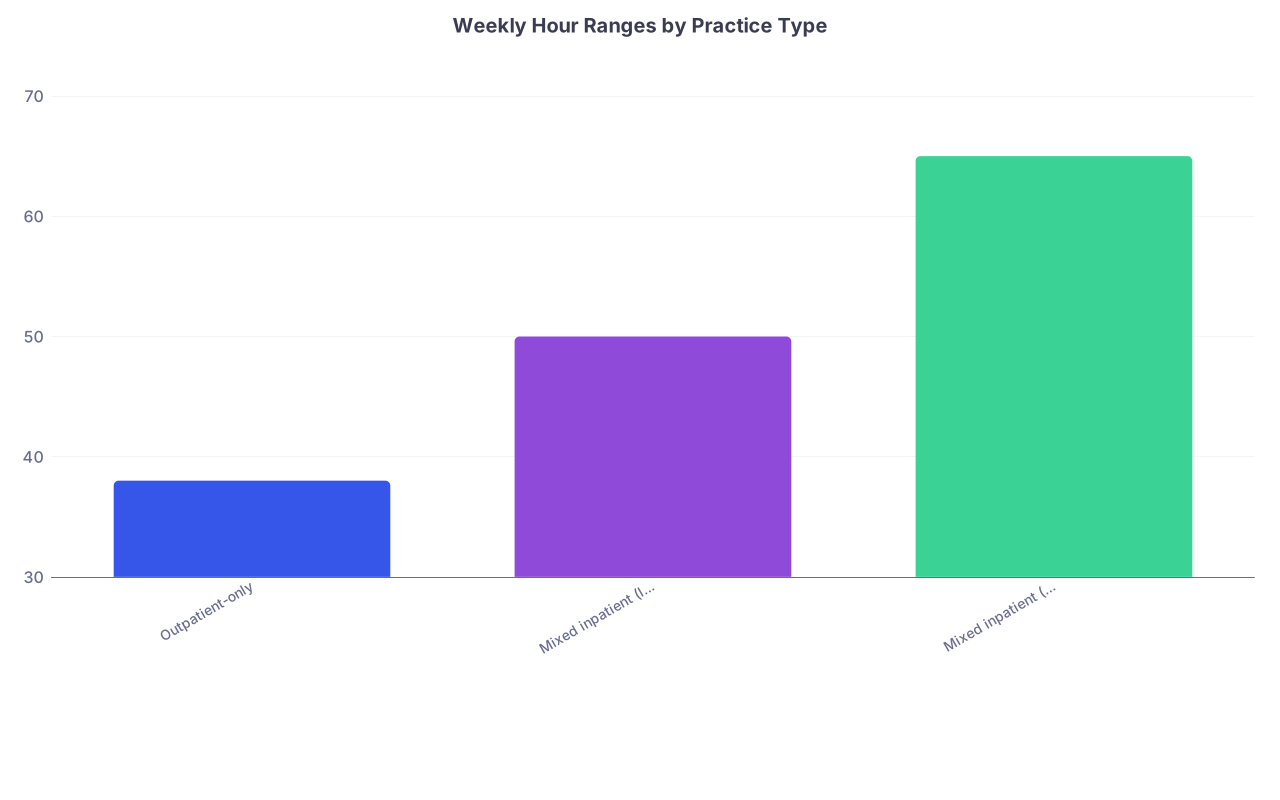
Private Practice with IR/DR Mix
- Pros: Often good compensation, some control over IR vs DR mix; potentially fewer nights if group is large.
- Cons: Pressure to be productive; may shift between IR suites and reading rooms frequently.
- Lifestyle: Often reasonable if group shares call and respects days off.
Focused Outpatient/Office-Based IR
- Pros: Typically more scheduled, daytime procedures; fewer emergent cases.
- Cons: May involve building a practice, marketing, or entrepreneurial stress.
- Lifestyle: Can be among the best for residency work life balance in the long run.
B. Negotiate Call and Expectations at Job Search
When interviewing:
- Ask straightforward questions:
- “How often will I be on primary IR call?”
- “What’s the average number of call nights per month?”
- “Is there backup for complex overnight cases?”
- “How many weeks of vacation and CME time are typical?”
- Assess group culture:
- Are they proud of supporting each other’s time off?
- Do they explicitly talk about burnout prevention?
Realistic Comparison: IR vs Other “Lifestyle Residencies”
For applicants seeking a lifestyle residency with control over duty hours, interventional radiology sits somewhere in the middle:
More lifestyle friendly than:
- General surgery
- Neurosurgery
- Orthopedic surgery
- Many surgical subspecialties
Less lifestyle friendly than:
- Dermatology
- Pathology
- Certain outpatient-focused specialties (e.g., allergy/immunology)
- Many non-procedural radiology jobs
Comparable or variable vs:
- Emergency medicine (shift work vs. IR call)
- Anesthesiology (OR call vs. IR call)
- Hospitalist medicine (7-on/7-off vs IR call models)
For an American studying abroad who wants complex procedures, technology-driven care, and relatively better lifestyle than surgery, IR can be an excellent choice—as long as you accept that it is not a low-intensity specialty, especially during training.
FAQs: Work-Life Balance for US Citizen IMG in Interventional Radiology
1. Is interventional radiology truly a “lifestyle residency” for a US citizen IMG?
It depends what you’re comparing it to. Relative to general surgery or neurosurgery, IR can feel more lifestyle-friendly, especially in diagnostic years and in certain post-training jobs. However, IR residency includes high-acuity call, nighttime emergencies, and variable hours, particularly in IR-heavy years. For a US citizen IMG, the need to match into more service-heavy programs may initially tilt things toward harder work with less control, but this can improve significantly after training if you choose your first job carefully.
2. How many hours per week do IR residents typically work, and how bad is call?
Most IR/DR residents average:
- 45–60 hours/week during DR rotations.
- 55–70+ hours/week on busy IR months, with peaks nearing ACGME limits at some high-volume centers.
Call can be in-house or home call. Busy centers may have multiple nighttime emergencies per call shift, affecting sleep and next-day function. The good news is that IR call is often shared among several residents/fellows/attendings, and programs vary widely—so you can preferentially apply to those with more balanced call systems.
3. Does being a US citizen IMG make the lifestyle in IR worse or better?
The clinical day-to-day work is the same regardless of your training background. What differs is:
- Where you match: As a US citizen IMG, you may be more likely to match at programs with heavier service demands and fewer residents to share the workload.
- Psychological pressure: Many US citizen IMGs feel they must continually overperform; this can lead to longer hours and less boundary-setting.
Over time, once you complete training and enter the job market, your IMG status has much less impact on lifestyle; your choice of practice setting and call structure becomes the main driver.
4. After training, can interventional radiologists have good work-life balance?
Yes—with deliberate choices. Many practicing IRs enjoy:
- Shift-based or rotational call with guaranteed days off.
- Practices that limit overnight emergencies via protocols and call distribution.
- Hybrid IR/DR roles where more DR shifts provide predictable schedules and mental breaks from procedural intensity.
If work-life balance is a top priority, you can seek:
- Larger groups where call is shared.
- Practices with strong midlevel/PA/NP support.
- Outpatient-focused or office-based IR centers with minimal emergency work.
The key is to remember that your post-training job choice can transform IR from a demanding, high-intensity specialty into a sustainable, fulfilling career with a solid balance between duty hours and personal life.
By understanding the true demands of interventional radiology residency and strategically approaching the IR match, training, and job search, a US citizen IMG can successfully build a career in IR that is both professionally exciting and personally sustainable.