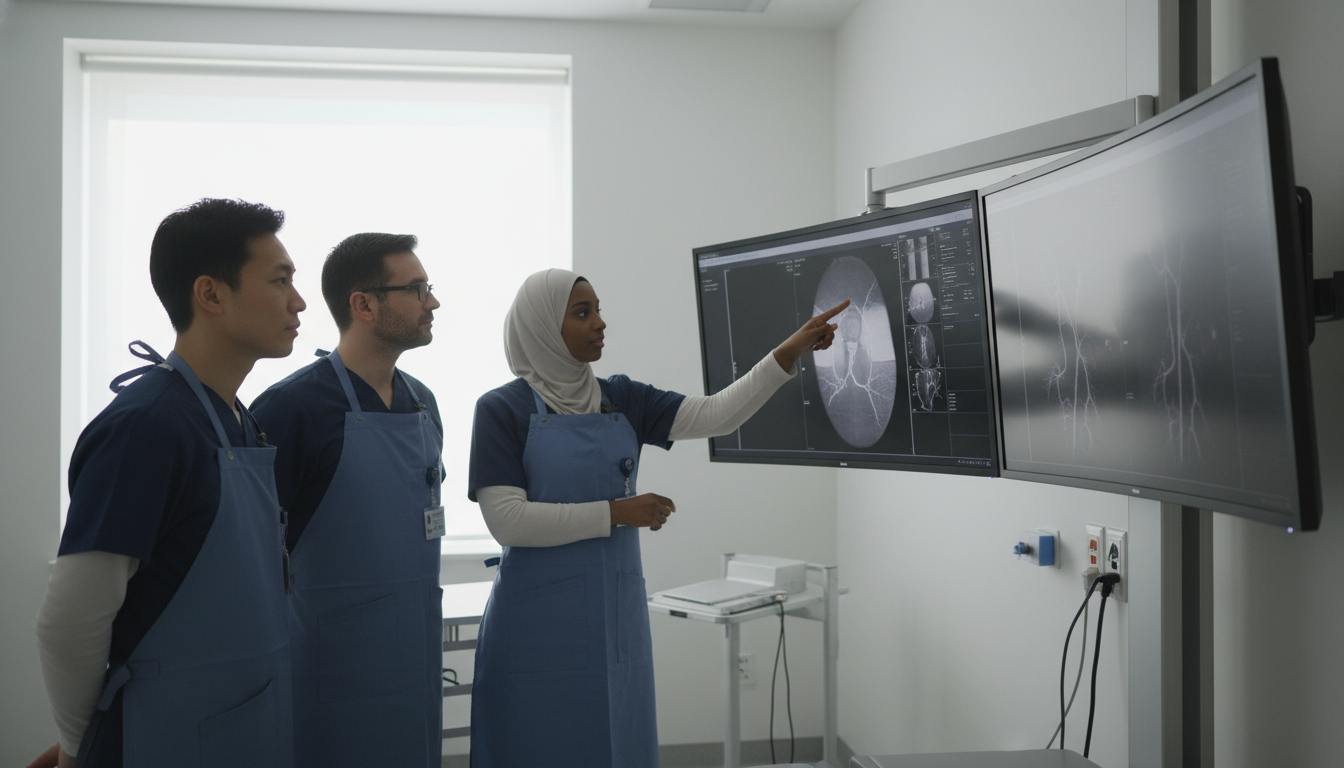
Understanding Work–Life Balance in Interventional Radiology as a Non‑US Citizen IMG
Interventional Radiology (IR) has a reputation for being both cutting‑edge and intense. For a non-US citizen IMG (international medical graduate who is a foreign national medical graduate), it can be challenging to know whether IR offers a sustainable residency work life balance, especially when you also navigate visas, cultural adjustment, and distance from family.
Work–life balance in IR is not a simple “good” or “bad” label. It depends on:
- The structure of IR training (integrated vs independent)
- Hospital type (academic vs community vs hybrid)
- Call model and case mix
- Program culture and leadership
- Your personal priorities (career goals, family, finances, location)
This article breaks down what you can realistically expect during IR residency and early practice as a non-US citizen IMG—and how to strategically select programs and build habits that protect your well-being.
1. How IR Training Is Structured – And Why It Matters for Balance
Interventional radiology residency in the US is typically one of three pathways:
Integrated IR/DR Residency (most common for IMGs now)
- 6 years total after medical school
- Years 1–3/4: Primarily diagnostic radiology (DR) with some IR exposure
- Final 2 years: Heavy IR focus, IR call, and procedures
- This is the main IR match pathway for non-US citizen IMG applicants.
Independent IR Residency
- 2 years after completing a DR residency
- More intense IR exposure in a shorter time frame
- More commonly pursued by those already in US DR residencies.
Early Specialization in IR (ESIR)
- DR residency with an IR-focused curriculum that allows one year of credit toward independent IR training
- Can smooth the transition but doesn’t eliminate the workload.
Balance During Different Stages of Training
Early DR Years (PGY-2 to PGY-4)
- More structured schedule, little to no primary call for procedures.
- Duty hours usually predictable: mostly daytime with some night float or evening shifts.
- Many residents describe this phase as relatively “lifestyle friendly,” especially compared with surgical specialties.
- Great time to study for boards, integrate into US culture, and stabilize your personal life.
IR-Heavy Years (PGY-5 and PGY-6 in Integrated IR)
- More demanding:
- Longer days in the IR suite
- Frequent pages from wards and ICU
- More frequent home call or in-house call
- You function more like a procedure-based consultant than a pure diagnostician.
For a non-US citizen IMG, these later years often overlap with critical life tasks: applying for jobs or fellowships, renewing visas, planning for family, and possibly sending financial support abroad. This intersection makes work–life balance planning even more important.
2. Typical IR Residency Schedule, Call, and Duty Hours
Day-to-Day IR Resident Schedule
A common IR resident weekday at a busy academic center might look like:
- 06:30–07:00 – Arrive, review the schedule, pre-round on complex patients, check labs
- 07:00–08:00 – IR rounds, discuss consults, decide plan for add-on cases
- 08:00–17:00+ – Cases in the angio suite:
- Vascular interventions (EVAR, angioplasty, stents)
- Oncologic procedures (chemoembolization, ablation)
- Non-vascular procedures (biopsies, drainages)
- Trauma and emergent embolization
- 17:00–19:00+ – Finish late cases, documentation, service calls, finalize notes
In reality:
- Some days will end at 16:30.
- Some will extend to 19:00 or later, especially with add-on or emergent cases.
Call Models and Lifestyle Impact
Call pattern is one of the biggest determinants of residency work life balance in IR.
Common models:
Home Call
- You take call from home, come in for urgent procedures (e.g., massive GI bleed, trauma embolization, septic patient needing urgent drainage).
- Frequency: often q3–q6 nights depending on program size.
- Pros:
- You may sleep a full night on quieter calls.
- Less emotionally draining than q4 in-house shifts.
- Cons:
- Sleep fragmentation when call is busy.
- Several consecutive nights can accumulate fatigue.
In-House Call / Night Float
- You stay in the hospital, cover IR and sometimes vascular calls.
- More common in large trauma centers.
- Pros:
- Clear boundaries: after shift ends, you usually go home and sleep.
- Predictable rotation structure (week of nights).
- Cons:
- Nights are demanding and can be high-volume.
- Circadian rhythm disruption.
Hybrid Models
- Some combination of home call plus occasional in-house coverage.
Across all models, programs must adhere to ACGME duty hours:
- Max 80 hours/week, averaged over 4 weeks
- At least 1 day off in 7 (averaged over 4 weeks)
- Minimum 8 hours between shifts (ideally 10)
- No more than 24 hours of continuous clinical duty, plus 4 hours for transitions
Most IR residents hover between 60–75 hours/week, with peaks around 80 hours in very busy months.
Case Example: Duty Hours in Different Settings
Academic Level 1 Trauma Center
- IR service very busy with trauma, GI bleeds, complex oncology.
- IR weeks may approach or hit 80 hours at times.
- Night call often busy; home call frequently leads to trips to the hospital.
Community/Hybrid Hospital
- Fewer high-acuity emergencies but steady elective/interventional volume.
- 55–65 hours/week more typical.
- Many foreign national medical graduate residents find this more compatible with family life, especially with young children.

3. Unique Work–Life Challenges for Non-US Citizen IMGs in IR
Your experience as a non-US citizen IMG in an interventional radiology residency is shaped by more than just duty hours. There are structural and personal stressors that can intensify or undermine balance.
3.1 Visa and Immigration Pressures
Most non-US citizen IMGs train on:
- J-1 visa – Sponsored by ECFMG, relatively common
- H-1B visa – More restrictive; not all IR programs sponsor this, and it can be harder to secure for procedure-heavy specialties
These realities affect your work–life balance:
- Administrative Burden
- Visa renewals, documentation, travel limitations, fear of delays
- Extra paperwork at key career transition points (from residency to fellowship/job)
- Limited Flexibility
- Harder to take research years or extended leaves
- Job searches often constrained to visa-friendly employers, which may not always offer the lifestyle or location you want
- Financial Pressure
- Often responsible for supporting family in your home country
- Limited ability to “step back” or choose a lower-paying role for better lifestyle
Practical step:
Ask explicitly during interviews:
“Do you have current or past non-US citizen IMG residents in IR? What visas do you sponsor, and how has that worked in terms of scheduling and time off for immigration processes?”
Programs that are accustomed to foreign national medical graduate trainees usually have systems to help you handle this with minimal disruption.
3.2 Distance from Your Support System
Time-zone differences, distance from family, and cultural adaptation add to emotional load:
- You may miss important life events (weddings, funerals, births) because of visa/travel constraints or IR call obligations.
- Holidays may not align with your culture; you might work through key cultural festivals.
This makes local support critical:
- IR co-residents and attendings who are inclusive and understanding
- Institutional wellness resources, counseling, and affinity groups
- Mentors who also trained as IMGs and understand your context
3.3 Cultural and Communication Demands
IR is a patient- and procedure-facing specialty:
- You consent patients for complex, high-risk interventions.
- You coordinate with surgeons, intensivists, oncologists.
- You navigate tense situations (e.g., emergent bleeds, complications, end-of-life discussions).
For non-native English speakers, this can be draining early on:
- You may spend extra cognitive effort ensuring clear communication.
- Worry about accent, idioms, or misunderstanding informed consent.
Balance tip:
Use your early DR years to:
- Practice medical English in low-stress contexts (e.g., preliminary reads, non-urgent consults).
- Observe how senior residents and attendings talk to patients and other teams.
- Ask for feedback on your communication style.
Over time, this becomes second nature, but the learning curve does temporarily add to mental fatigue.
4. Is Interventional Radiology a “Lifestyle Residency”? A Realistic Assessment
Many applicants ask whether IR is one of the most lifestyle friendly specialties. The honest answer:
- IR is not a classic “lifestyle residency” like outpatient dermatology, many pathology jobs, or some radiology-only roles.
- But IR can be more controllable than many surgical specialties and some high-acuity medicine subspecialties—especially after training.
Comparing IR with Other Specialties for Work–Life Balance
Compared to General Surgery / Trauma Surgery
- Similar acuity and emergency nature, but IR often has more home call and less in-house overnight coverage.
- Fewer “clinic + OR + inpatient” layers to manage; a lot of work is focused on the procedural suite and consults.
Compared to Diagnostic Radiology
- IR has more call, more emergencies, and more prolonged procedures.
- However, some IR jobs incorporate significant diagnostic reading, which can add “softer” time to your schedule.
Compared to Cardiology / Critical Care
- IR emergencies are intense but typically episodic; you are not continuously managing entire ICU populations.
- Your role is often consultative and procedural, not primary longitudinal care.
Bottom line:
During residency, expect a moderate-to-high workload. IR is not a “lifestyle residency” in the sense of low hours, but it often allows more predictability and autonomy than many other procedural specialties once you are in attending practice.
Early Career IR Lifestyle: Beyond Residency
As an attending, your work–life balance depends heavily on:
- Group size (more partners usually means more distributed call).
- Hospital type (academic with many fellows vs single-IR community hospital).
- Subspecialty niche (e.g., heavy trauma vs primarily elective oncology).
- Negotiated schedule (4-day weeks, part-time options, or split DR/IR roles).
Many IR attendings eventually shape jobs that:
- Have 1–2 weekdays off per month.
- Offer call 1:4 to 1:8, often home call.
- Allow academic or research time with fewer clinical hours.
For a non-US citizen IMG, visa status may initially limit how selective you can be. But long-term, IR absolutely can support a sustainable, family-friendly lifestyle with careful job selection.

5. Choosing IR Programs with Better Work–Life Balance as a Non-US Citizen IMG
Program choice is your single biggest lever for residency work life balance. Here’s how to evaluate programs during the IR match process.
5.1 Red Flags and Green Flags in Program Culture
Red Flags
- Residents appear exhausted or guarded when asked about call.
- Program leadership dismisses or minimizes wellness questions.
- No clear answer about duty hours tracking or ACGME compliance.
- Historically high attrition or burnout.
- Only vague or negative responses when you ask, “Do you currently train non-US citizen IMG residents?”
Green Flags
- Current residents openly discuss schedules, including “bad” rotations, without fear.
- The program director acknowledges that IR is demanding but describes concrete wellness measures:
- Float pools or backup coverage when volume spikes
- Protected post-call days
- Strict enforcement of 80-hour rules
- Presence of several non-US citizen IMG residents or fellows, with positive experiences.
- Clear policies around holidays, parental leave, and sick leave.
5.2 Smart Questions to Ask on Interview Day
Targeted questions you can ask (or send by email if time is limited):
Schedule and Call
- “What is the typical weekly hour range during IR-intensive rotations?”
- “How is home call structured? How many nights per month?”
- “Do residents get a post-call day off after heavy call?”
Support for IMGs
- “Have you sponsored J-1 or H-1B visas for IR residents? Any challenges?”
- “Do IMGs have difficulty taking time off for visa interviews or international travel?”
- “Are there faculty or residents who also trained as non-US citizen IMG doctors?”
Culture and Wellness
- “What do you do if a resident is consistently over 80 hours per week?”
- “Is there formal mentorship for IR residents, particularly those from international backgrounds?”
- “What resources exist for resident mental health and burnout prevention?”
Listen not only to the words, but also the tone. Programs that respect resident well-being will be transparent rather than defensive.
5.3 Aligning Program Choice with Your Priorities
Interventional Radiology residencies vary; consider:
- If you prioritize procedural intensity and academic prestige:
- Larger, big-name academic centers will deliver, but expect heavier call and longer hours.
- If you prioritize family time and a gentler lifestyle:
- Consider smaller, community-based integrated IR programs
- Slightly lower “brand name” can translate into more sustainable daily life.
Be realistic: as a non-US citizen IMG, you may feel tempted to accept any IR spot. But among your options, you can still rank higher those programs where residents genuinely appear supported.
6. Personal Strategies to Protect Balance During IR Training
Even in a demanding interventional radiology residency, there are practical strategies to preserve a healthy lifestyle.
6.1 Time and Energy Management
- Batch your tasks:
- Dictate notes and reports in focused blocks between cases rather than piecemeal.
- Group non-urgent phone calls.
- Use downtime efficiently:
- Read IR literature or board materials during case turn-over instead of scrolling your phone.
- Protect sleep aggressively:
- On home call, sleep as soon as it’s quiet, even if early.
- Use blackout curtains, white noise, and a consistent pre-sleep routine.
6.2 Building a Support Network
- Find at least 1–2 mentors:
- Ideally, one IR faculty and one senior resident.
- If possible, another foreign national medical graduate who understands immigration-related pressures.
- Connect with other IMGs across specialties:
- Share practical tips (taxes, visas, remittances, community resources).
- Social connection buffers against burnout.
6.3 Maintaining Identity Outside Medicine
- Block at least one half-day per week where you:
- Do something non-medical (hobby, religious/community gathering, sports, language classes).
- Avoid IR emails and PACS work unless truly urgent.
- For those with families:
- Establish simple rituals—weekly video calls to parents abroad, Friday dinners with your partner or friends.
6.4 Financial Planning for Stability
Work–life balance is harder when you constantly worry about money or remittances.
- Budget with:
- Estimated residency salary
- Visa-related costs
- Support sent home
- Avoid overextending yourself on housing or lifestyle during residency.
- If possible, work with a financial planner or trusted senior IMGs who have navigated US credit, loans, and visas.
Stability in finances often translates into greater freedom to choose jobs with better lifestyle later, instead of being forced into the highest-paying but most demanding positions.
FAQ: Work–Life Balance in Interventional Radiology for Non-US Citizen IMGs
1. Is interventional radiology too demanding for someone who also needs to manage visa and immigration issues?
Not necessarily. IR is demanding, but many non-US citizen IMG residents complete IR training successfully each year. The key is to choose a program that is familiar with visa sponsorship and has institutional support (legal, GME office) to help you handle immigration logistics without sacrificing essential rest. Early and organized planning around renewals, travel, and deadlines reduces stress significantly.
2. As a foreign national medical graduate, will I have less flexibility to take vacation or time off compared with US graduates?
Formally, vacation policies apply equally to all residents. However, non-US citizen IMG residents may need to cluster vacation time around international travel or visa appointments. Transparent communication with program leadership is crucial; programs experienced with IMGs are usually accommodating as long as duty hours and service coverage are maintained.
3. Does IR offer good long-term lifestyle after training, or is it always intense?
Long-term, IR can offer a very reasonable lifestyle, but it depends on your job choice. Large groups with multiple IR physicians and established call schedules typically provide better balance (e.g., 1:5–1:8 call, mostly home call). Smaller hospitals may have heavier call but sometimes lower daily volume. Many IR attendings eventually tailor roles to their preferences—some focus more on outpatient clinics and elective procedures, others mix in diagnostic radiology to reduce overnight demands.
4. For the IR match, should I prioritize program prestige or lifestyle if I’m a non-US citizen IMG?
It depends on your goals. If you are aiming for highly competitive academic positions or niche IR subspecialties, a prestigious, high-volume program can open doors—even if the lifestyle in residency is more intense. If your primary goal is long-term stability, family time, and staying in the US with a manageable schedule, it’s reasonable to rank somewhat less famous programs higher if residents report healthier work–life balance. Either path can lead to a fulfilling career; the best choice aligns with your personal values and circumstances.
Interventional Radiology can be an excellent, rewarding specialty for a non-US citizen IMG, but it’s not automatically a “lifestyle residency.” With realistic expectations, careful program selection, and intentional strategies for personal well-being, you can build a sustainable and satisfying life both inside and outside the IR suite.