
A low Step score does not kill your chances; a weak research profile does.
If your score is below where you wanted, research stops being “nice to have” and becomes your primary weapon. But only if you design it correctly. Random case reports and your name buried as author #14 on a giant database paper will not rescue a 205.
Let me break this down specifically.
Step Score Reality Check: What Research Can And Cannot Fix
First, some cold water.
Research cannot magically turn a 205 into a 260 in a program director’s head. But it can do three very specific things for you:
- Change which pile your application lands in (auto-screen vs “let’s discuss”).
- Reframe your narrative: from “low scorer” to “clinically oriented, productive, and motivated candidate.”
- Open backdoor channels via mentors who can email, call, and vouch for you.
Where you are on the Step spectrum matters for strategy.
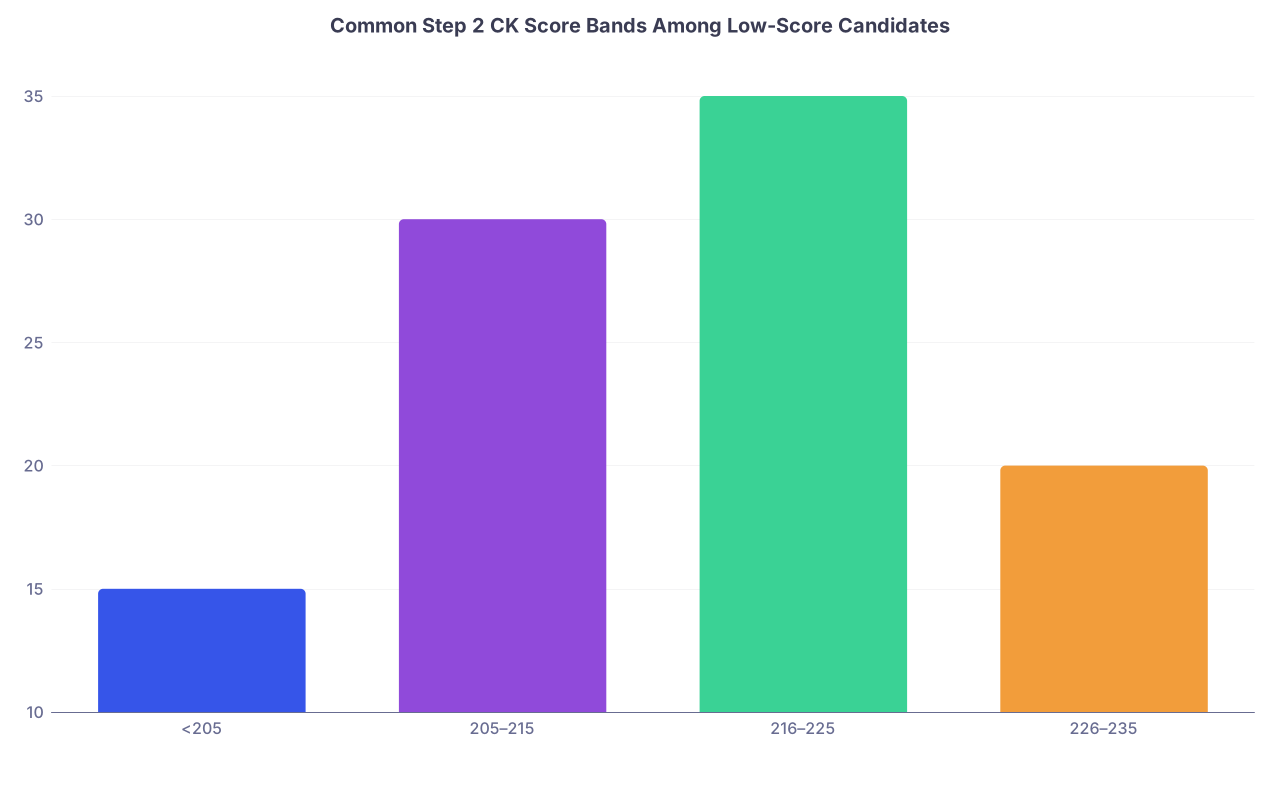
| Category | Value |
|---|---|
| <205 | 15 |
| 205–215 | 30 |
| 216–225 | 35 |
| 226–235 | 20 |
Broadly:
- 226–235: You are not “low” for many community programs and some academics, but you are below average for competitive specialties. Research can push you into serious consideration for mid-tier academics and some competitive fellowship pipelines.
- 216–225: You will get filtered at many academic places. Research plus strong letters and a coherent story can re-open doors.
- 205–215: You are in “concern” territory for most academic programs and some community ones. You need research that clearly signals: adult, reliable, finishes work, understands the field.
- <205: You must be extremely deliberate. Target less competitive specialties, community-heavy lists, and leverage research mainly for connections and narrative, not for “wow factor.”
If your score is pass/fail only (Step 1) and the problem is a low Step 2 or failed attempt, same rules apply.
The key question is not “Do I have research?” but:
“Does my research communicate that I will be a safe, mature, and useful resident in this specialty despite the score?”
Choosing Your Niche: Strategic Targeting For Low Scores
Random research is wasted research. Low score candidates need surgical targeting.
Step 1: Accept your realistic specialty tier
I have watched students with 208 Step 2 spend a year chasing neurosurgery research and then act surprised when nothing matched. That is not “grit.” That is denial.
Ask yourself bluntly:
- Am I aiming for a less competitive specialty (FM, IM, Psych, Peds, Path, Neuro, PM&R)?
- A mid-tier competitive (OB/GYN, Gen Surg, EM, Anesthesia)?
- A high-tier (Derm, Ortho, ENT, Plastics, Neurosurg, Rad Onc)?
If your score is low and you are in the last group, you must either:
- Commit to a dedicated, high-yield, publication-heavy research year with a true heavy-hitter mentor in that field, and accept a high chance of not matching.
- Or pivot to a related but more realistic specialty (IM for future cards, FM for sports, Path for neuropath, etc.) and design your research accordingly.
For most low-score candidates, the play is: choose a specialty where research can tip you from “risky” to “worth a shot,” not from “no chance” to “miracle match.”
Step 2: Pick a clinical niche that telegraphs maturity
Within your specialty, you want a theme that makes PDs think:
- “This person understands sick patients.”
- “They think about systems, quality, or outcomes.”
- “They finish what they start.”
Fields that do this well:
- Outcomes research (readmissions, mortality, complications, LOS, costs)
- Quality improvement (QIs that were actually implemented, not theoretical)
- Medical education (curriculum design, assessment, remediation)
- Health services / disparities / access
- Pragmatic clinical work: large retrospective cohorts, registry-based studies, chart reviews
The trap for low score candidates is “cute but trivial” projects:
- One-off weird zebras with no generalizable value
- Case reports that show you were present but not that you can think
- Basic science bench work that you barely understand and cannot explain at the interview
You want work where, in an interview, you can say things like:
“Our project identified that patients with X condition discharged on Y had a 20% lower 30-day readmission rate. We built that into a discharge checklist.”
That sounds like a resident. Not a student scrambling for lines on a CV.
Selecting Projects: Depth Over Noise
Programs do not count your PubMed links like baseball cards. They care whether your work looks:
- Coherent
- Sustained
- Progressively more complex
- Connected to their world
Let me show you the contrast.
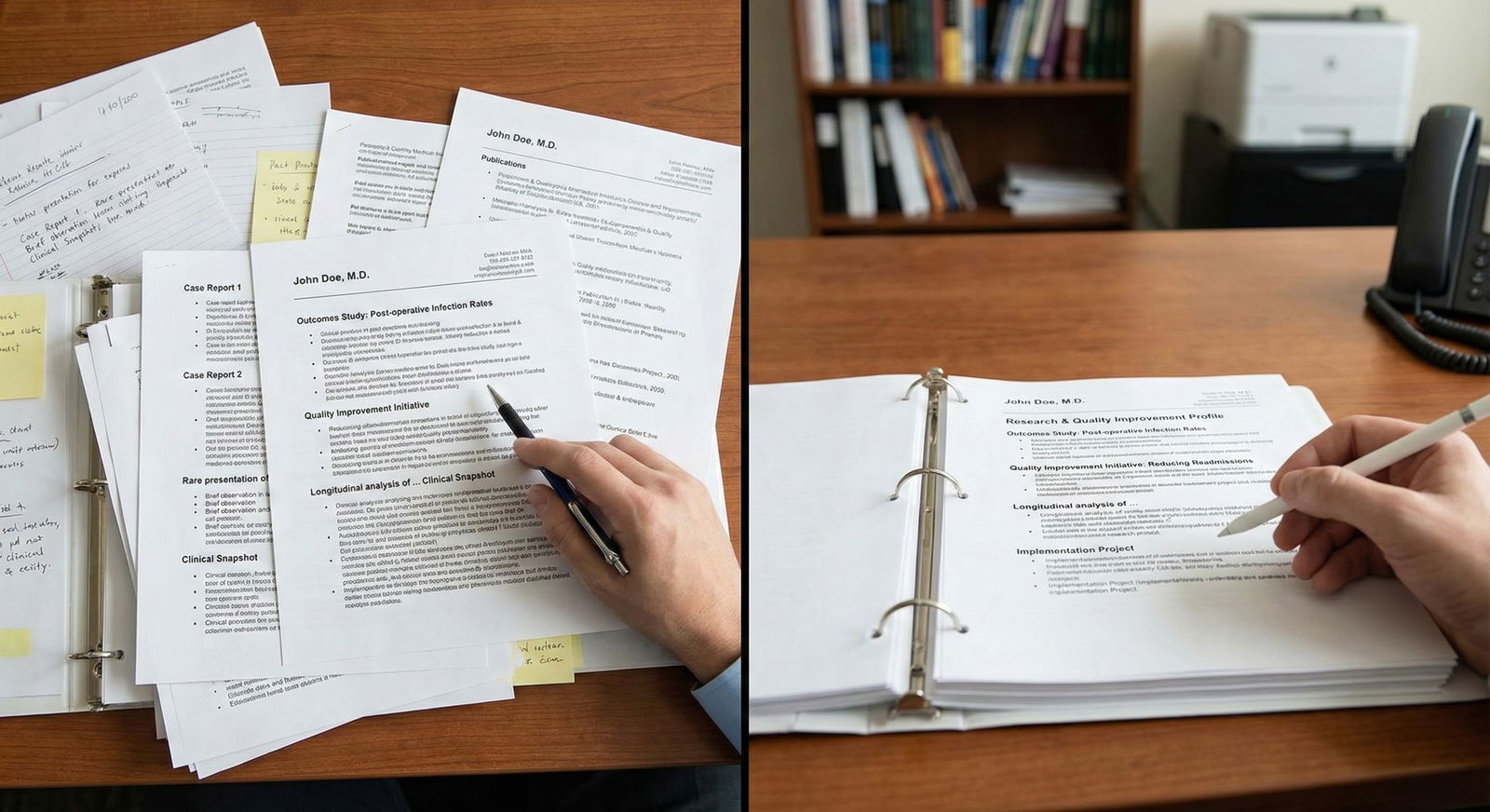
Bad pattern for a low score candidate
- 3 unrelated case reports in different specialties (GI, Derm, Ortho)
- 1 poster about a molecular pathway you cannot pronounce
- 1 abstract as 13th author on a multi-center registry paper
This screams: “I begged for anything I could get; nothing stuck; nobody trusted me with responsibility.”
Strong pattern for the same candidate
- 1 longitudinal QI project in your chosen specialty, implemented at your institution
- 1 retrospective cohort study on outcomes in a common disease in that field (poster + manuscript submitted)
- 1 invited oral or poster presentation at a national or regional meeting in that specialty
- 1 additional project in a neighboring theme (e.g., medical education in that specialty)
This says: “I pick problems, work them through, and leave something useful behind.”
If you have time for only 2–3 serious projects, that is fine. Make them coherent and complete.
Finding The Right Mentor: Your Single Most Important Decision
A low Step score candidate with a strong mentor is more competitive than a high Step candidate drifting alone. That is not theoretical; I have watched this play out on rank lists every year.
You are not just looking for “someone with publications.” You want:
- A faculty member in your target specialty
- With an existing pipeline of ongoing projects
- Who has a track record of med student and resident co-authors
- And ideally sits on an admissions, recruitment, or clinical competency committee
If you can, scan faculty pages. Look for:
- 3–5 first/last author clinical papers in the last 2–3 years
- Topics that a student can realistically join: chart review, QI, database studies
- Mentoring statements or med ed roles
When you reach out, your email needs to sound like a person who will lower their workload, not add chaos.
| Component | Strong Version |
|---|---|
| Subject line | MS3 interested in outcomes research in X |
| Opening | Brief intro, school, current training year |
| Score framing | Honest, 1 line, not apologetic |
| Offer | Specific skills and time availability |
| Ask | Concrete: join existing project or meet |
Example skeleton (edit to sound like you, not like a robot):
Dear Dr. Smith,
I am a third-year medical student at [School], strongly interested in internal medicine with a focus on heart failure outcomes. I recently completed Step 2 CK with a score of 217. It is not where I hoped to be, so I am prioritizing building a strong, clinically relevant research foundation in this field.
I can commit 8–10 hours per week for at least the next 9 months, and I have experience with data extraction from the EMR and basic statistical analysis in R (logistic regression, Kaplan–Meier). I would be grateful for the opportunity to contribute to any ongoing outcomes or quality improvement projects related to HF or hospital medicine.
Would you be open to a brief meeting to discuss where I might be useful to your group?
Sincerely,
[Name]
That one paragraph about your score? It disarms the elephant in the room. It also signals you understand you must compensate, and you are already doing it.
Designing Your “Research Year” (Or Research Block) With Discipline
If you are taking a dedicated research year (or a semi-dedicated 6–9 months), you cannot drift. Low-score candidates need structure, not vibes.
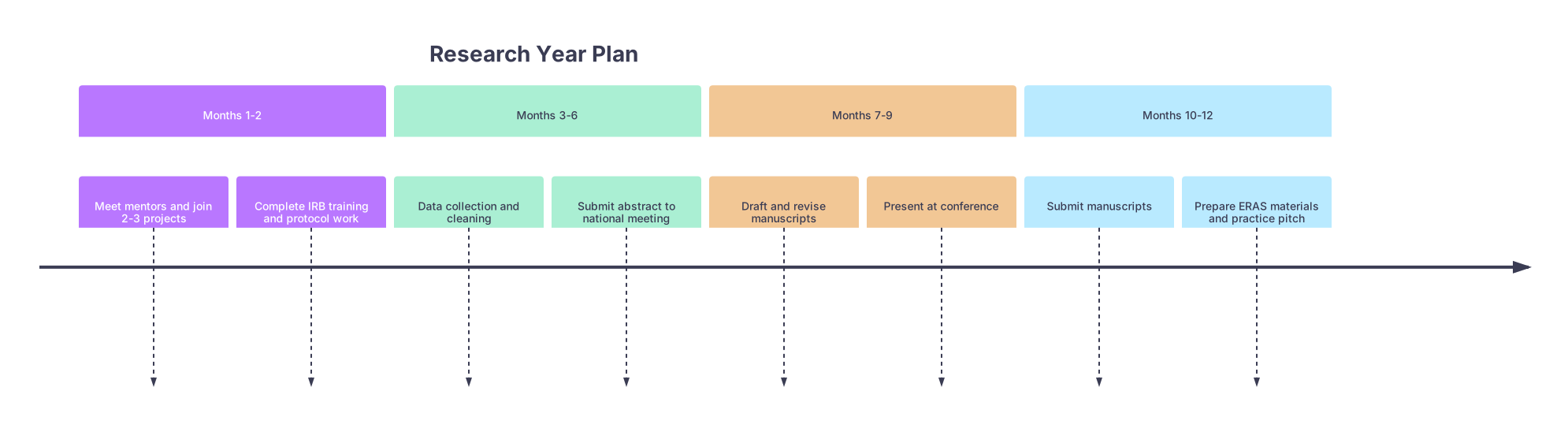
Target outputs by the end of the cycle:
- 1–2 submitted manuscripts (even if not yet accepted)
- 2–3 abstracts or posters (ideally at specialty-specific meetings, not random generic ones)
- 1 solid letter from a research mentor who can say, “This student functions like an intern.”
The less time you have, the more you must favor:
- Retrospective chart reviews with existing databases
- Ongoing projects that are stuck at data cleaning or writing stage
- QI projects with short loops (PDSA cycles) that can be done in 3–6 months
Bench research, from a standing start, with no prior experience? For a low-score candidate? That is almost always a mistake.
Concrete Project Types That Work For Low Scores
Let’s get very specific. If your Step score is low and you have limited time, these are high-yield categories.
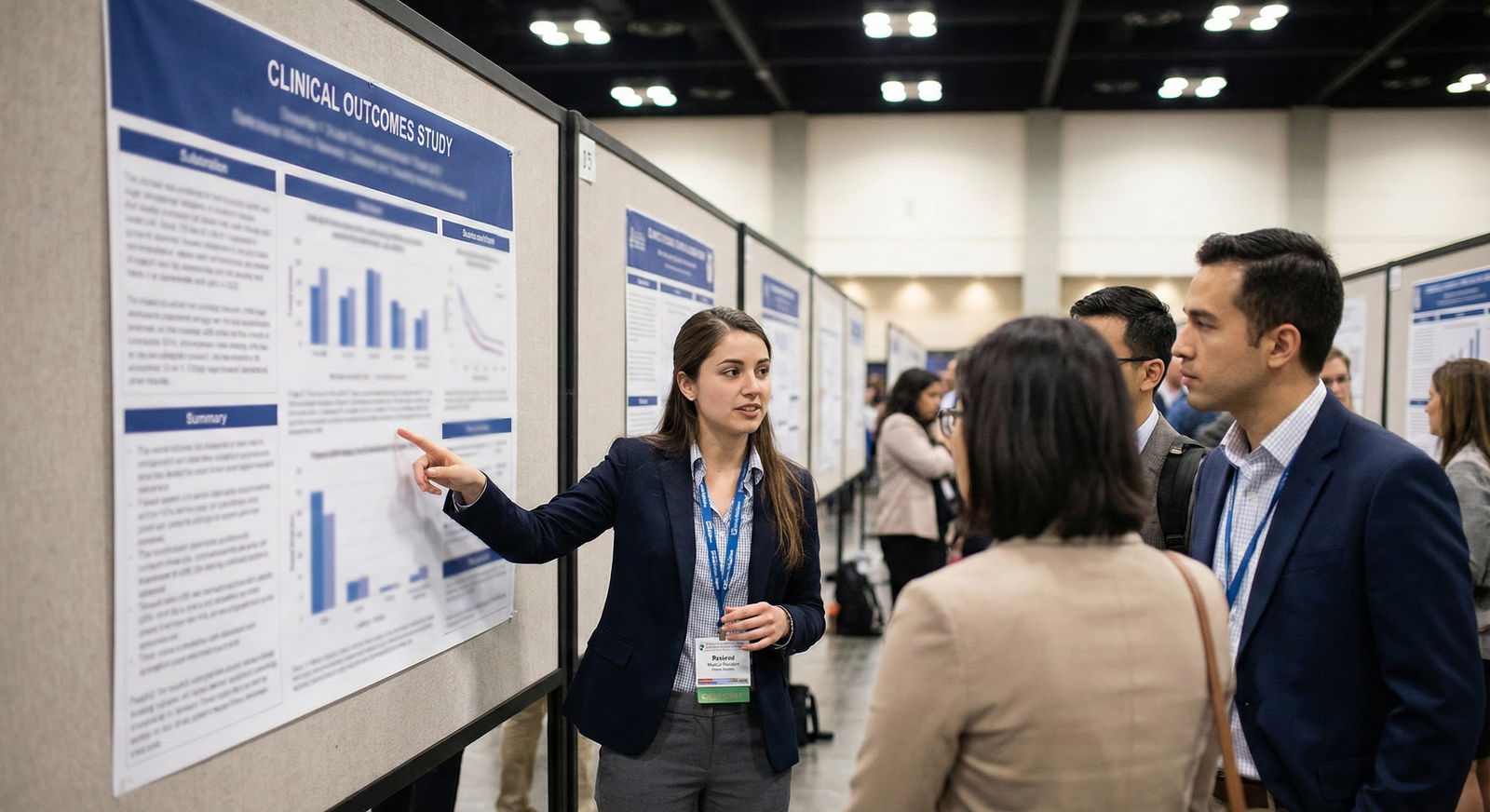
1. Retrospective Outcomes Study
Example: “30-day readmission rates in patients with decompensated cirrhosis discharged from our hospital before and after implementation of a standardized discharge checklist.”
Why it works:
- Clearly clinical and relevant.
- Shows you can handle data, confounders, and limitations.
- Easy to talk about in interviews.
Your role can be substantial:
- Extract data from EMR
- Help design data dictionary
- Run or assist with basic statistics under supervision
- Draft methods and results
You want your name near the front. First or second author if you did the grunt work.
2. Quality Improvement (QI) With Real Implementation
Example: “Improving timely antibiotic administration for sepsis in the ED via triage alert and order set optimization.”
High-yield features:
- Defined problem, measurable outcome, clear intervention.
- Short cycles (3–6 months) with pre–post comparisons.
- Often IRB-exempt or expedited.
Your ERAS description should not say: “We designed a tool.” It should say: “We implemented X and reduced Y from 60 minutes to 35 minutes over 4 months.”
3. Medical Education in Your Specialty
Example: “Development and evaluation of a simulation-based curriculum for central line placement among interns.”
This is underrated. PDs love residents who can teach without drama.
Strong med ed projects:
- Include assessment of learning (pre/post tests, skills checklists).
- Have some scholarship: poster at an education or specialty meeting, short paper in a med ed or specialty journal.
- Involve collaboration with residency leadership – key for letters.
4. Database / Registry Studies
Access dependent, but powerful if your mentor has such a pipeline.
Example: Using NSQIP or NIS to analyze outcomes of laparoscopic vs open appendectomy in obese patients.
Your contribution:
- Help with variable selection and data cleaning.
- Conduct initial exploratory analyses.
- Draft intro/discussion around literature context.
Beware: Multi-institution papers can bury you as middle author. Insist on a defined role that justifies near-front authorship, especially if this is your main project.
5. Selective Case Series / Case Reports (As Supplement, Not Core)
One or two well-written, genuinely educational case reports or small series – in your specialty – can complement the above. They cannot replace them.
Use them to:
- Show you can write clearly.
- Illustrate an area of niche interest (e.g., autoimmune encephalitis in neurology, peripartum cardiomyopathy in OB/IM).
But if your CV is 6 case reports and nothing else, it reads like: “Present at every poster session possible, no longitudinal thought.”
Making The Research “Score-Aware”: How To Frame Your Narrative
Your low Step score must be contextualized. Research is how you do that.
The worst move is to pretend the score does not exist. PDs see it. So you pivot the conversation:
From: “Why did you score low?”
To: “What have you done since that tells me you will not fail in residency?”
Your research story should hit three points.
1. Evidence of Discipline and Reliability
You want your mentor’s letter to include phrases like:
- “Completed tasks ahead of deadlines.”
- “Handled complex data extraction with minimal error.”
- “Required supervision similar to a junior resident.”
Those phrases directly attack the unspoken concern that a low score means disorganized or unreliable.
2. Evidence of Cognitive Growth
Low score raises a question: is this a permanent ceiling?
Your research should demonstrate you can:
- Understand and explain study design.
- Interpret p-values and confidence intervals responsibly.
- Think about bias, confounding, and generalizability.
In interviews, you should comfortably walk through:
- Why you chose retrospective vs prospective.
- Your primary and secondary outcomes.
- One or two limitations and how you would address them in a future study.
That sounds like an intern. Not like someone who crammed for Step and forgot everything.
3. Clear Link Between Research and Clinical Practice
Always tie projects to how they change patient care, workflow, or education.
Example phrases that work:
- “This project taught me to anticipate where delays happen in sepsis care.”
- “Working on this outcomes study sharpened my understanding of risk stratification in heart failure.”
- “Designing this curriculum improved my own ability to break down procedures into safe, teachable steps.”
You want PDs to hear your research summary and think: “This person will already be thinking at a systems level on day 1.”
Translating Research Into Application Strength
Research sitting silently on a CV does very little. You must weaponize it across ERAS, your PS, and interviews.
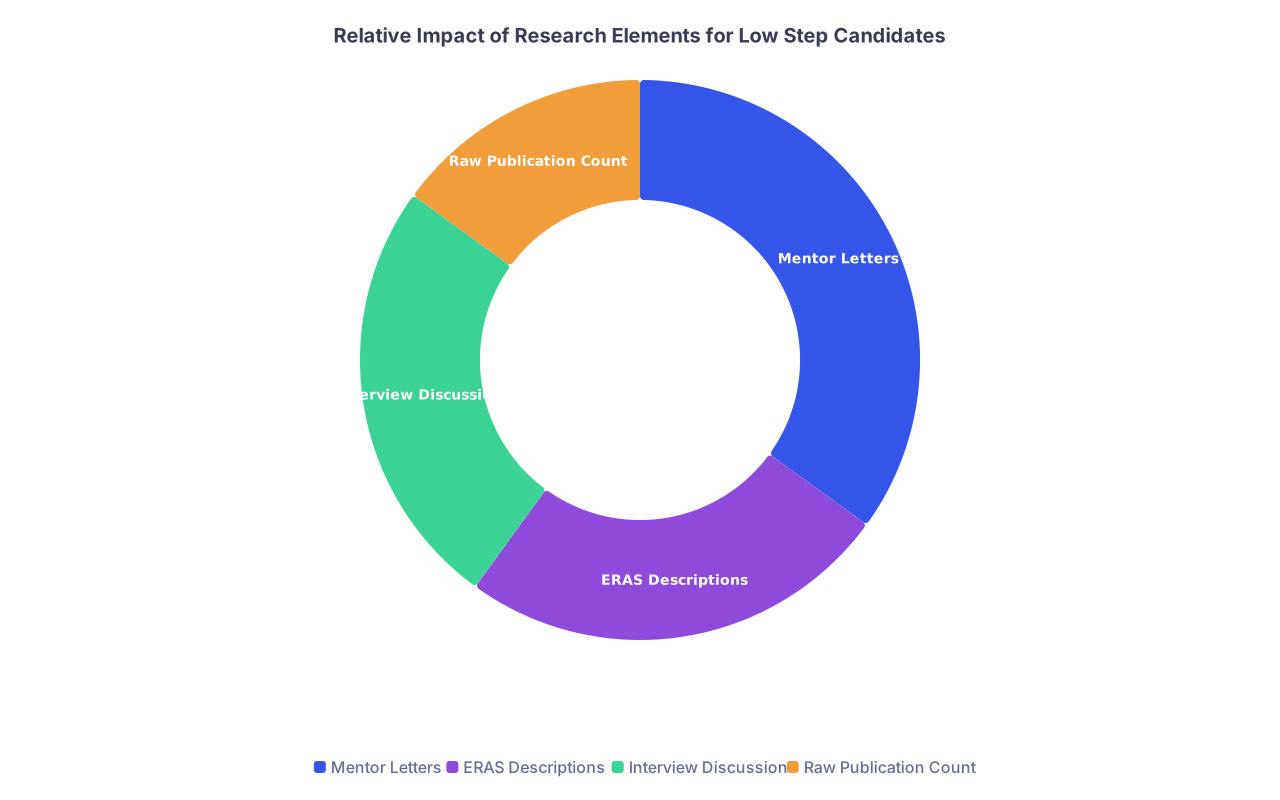
| Category | Value |
|---|---|
| Mentor Letters | 35 |
| ERAS Descriptions | 25 |
| Interview Discussion | 25 |
| Raw Publication Count | 15 |
ERAS Research Entries: Stop Writing Garbage
Most students write entries that sound like this:
“Assisted with data collection and analysis. Helped with manuscript preparation.”
That is totally useless.
Instead, emphasize:
- Your role in design, data extraction, and interpretation.
- Tangible outcomes (abstracts, posters, submissions, policy change).
- Leadership: did you coordinate the research team, manage timelines, interface with IRB?
Example ERAS entry for a low-score candidate:
“Retrospective cohort study of 530 patients hospitalized with decompensated cirrhosis from 2018–2022. Created the data dictionary, extracted chart data, and assisted with multivariable logistic regression to identify predictors of 30-day readmission. Led abstract submission and presented findings at [Conference]. Manuscript drafted and under review at [Journal].”
That reads like someone you could trust to handle sign-out.
Personal Statement: Use Research Surgically, Not As a Monologue
You are not writing a PhD thesis in your PS. Use research to:
- Explain the pivot from a disappointing score to constructive growth.
- Show why you are invested in this specialty’s clinical problems.
- Demonstrate follow-through.
One paragraph is enough:
“My Step 2 score was below my expectations and forced me to confront gaps in how I approached complex, multi-step problems. Under Dr. Smith’s mentorship, I joined a project examining 30-day readmissions in heart failure. Working through each step of study design, data extraction, and analysis demanded a more disciplined, longitudinal mindset than I had used for board prep. That shift has carried into my clinical work and is a large part of why I am confident in my readiness for residency despite that early misstep.”
You are not asking for pity. You are showing evolution.
Letters Of Recommendation: Make Your Mentor Do Real Work
Do not accept generic letters if you are depending on research to offset your score.
- Explicitly mention your Step score context (if they know) and state that it does not reflect your current performance.
- Compare you favorably to other students or even early residents.
- Cite specific behaviors: response time, attention to detail, initiative, ability to synthesize literature.
You cannot write their letter, but you can:
- Provide them with a summary of your contributions.
- Remind them of specific instances (e.g., “when we found the data discrepancy,” “when I rewrote the methods section”).
- Share your Step context and how you hope the letter can help.
Strong mentors will understand the assignment.
Strategic Program Targeting: Where Research Actually Moves The Needle
Here is the unspoken truth: not every program cares about your research. But the ones that do, really do.
| Program Type | Research Impact Level | Notes |
|---|---|---|
| Top academic, highly competitive | Moderate | May get you past initial filter only |
| Mid-tier academic | High | Can override concerns with low scores |
| Community with strong teaching | Moderate–High | Helps if mentor is connected locally |
| Pure service community | Low | Clinical evals and work ethic dominate |
Your move:
- Apply broadly to programs where your mentor has connections.
- Favor mid-tier academic and strong community programs that actually have research/QI built into residency.
- Use your mentor to send targeted emails to PDs and APDs you are applying to, attaching your CV and highlighting your work.
If your research mentor is well known and writes, “This student is one of the most reliable I have worked with in five years; I strongly recommend an interview,” that email gets read even if your score is under their usual cutoff.
Do not be shy asking for these emails. That is part of why you did the work.
Common Pitfalls I See Low Score Candidates Make
Let me be blunt about mistakes because I have watched them sink otherwise salvageable applications.

Chasing quantity over coherence.
Ten unrelated abstracts look worse than three tightly connected projects in your chosen specialty.Saying “I am interested in research” but having no concrete skills.
Learn one statistical package (R, Stata, SPSS) well enough to be genuinely useful. Know basic concepts: odds ratio, hazard ratio, p-value, CI.Doing research in a different specialty than the one you are applying to without a clear bridge.
If you must, draw the line explicitly: “My earlier radiology outcomes work sharpened my interest in internal medicine by…”Taking on projects you cannot finish before ERAS opens.
Manuscripts “in preparation” that are still a blank Word document fool no one. Focus on projects where you can at least hit abstract/poster level by application season.Avoiding the conversation about your score with your mentor.
They need the full picture to write a useful letter and to advocate for you. Hiding it just makes the eventual letter generic.
How This Plays Out On Interview Day
On interview day, your Step score will sit silently in their file. Your job is to make them forget it 5 minutes into the conversation.
You should be able to:
- Give a 60–90 second summary of your main project: question, design, main finding, why it matters.
- Answer one technical follow-up without sweating (e.g., “Why did you use logistic regression?” “How did you handle missing data?”).
- Pivot to how this work will shape you as a resident (“It made me more systematic in how I approach…”)
If they ask directly about your score, and you have this research backbone, you can say:
“My Step 2 score was disappointing. I realized I had treated it as a short-term sprint rather than building the kind of longitudinal, systems-level understanding medicine demands. Working on our heart failure outcomes project forced me to change that approach: months of data work, methodical review, repeated drafts. That discipline has carried over to my clinical work now, and I think the consistency you see in my third- and fourth-year evaluations and my research output reflects that better than that one number.”
No excuses. No blaming test day. Just a clear arc: mistake → response → growth.
At that point, your research is not just lines on a CV. It is the spine of your redemption story.
Where You Go From Here
You do not need perfect scores to build a serious, respected career. But if your scores are low, you cannot afford a casual, opportunistic approach to research.
You design it.
You pick a niche, recruit the right mentor, execute tightly scoped projects that finish, and then you weaponize that work across ERAS, letters, and interviews. Do that, and your Step score becomes one piece of data, not the verdict on your potential.
You have the outline now. Next comes the harder part: actually sending the emails, saying yes to the grunt work, and turning your research year (or research months) into real, visible output. Once you have that in motion, we can talk about the next layer—how to structure your rank list and use interview season strategically as a low-score, high-research candidate. But that is a separate battle.