
The way most applicants talk about a low Step score is soft, apologetic, and forgettable. That is a mistake.
You cannot hide a weak score. But you can weaponize it. Turn it into proof of resilience, insight, and upward trajectory—if you frame it with precision.
Let me break this down specifically.
1. Understand What Your Low Score Actually Signals (To Them, Not You)
Before you start “explaining” anything, you have to understand how program directors read a low Step score. They are not psychoanalyzing you. They are sorting risk.
Here is what a low Step score quietly screams in their heads:
- Risk of board failure in residency
- Questionable baseline knowledge or test-taking ability
- Possible professionalism / discipline issues (poor planning, procrastination)
- Potential extra work for the program (remediation, board reviews, institutional board pass statistics)
They are not worried about your feelings. They are worried about their accreditation metrics, board pass rates, and their own lives getting harder.
So your job is not to “justify” the score. Your job is to:
- Reduce perceived risk.
- Demonstrate growth and insight.
- Show a clear, believable upward trend.
If your framing does not hit those three, it fails.
2. The Three Core Narratives That Actually Work
Most low-score explanations fall into one of three buckets. Only one of these is usually safe.
- Catastrophic event narrative
- Chronic struggle narrative
- Growth narrative
The growth narrative is what you are aiming for. The other two can be used, but only under strict conditions.
2.1 Catastrophic Event Narrative (Use Sparingly)
This is the “my grandmother died during dedicated, and I had COVID, and my exam center flooded” story.
Programs have read variants of this thousands of times. When overused, it sounds like excuse-making.
It can work if:
- The event was clearly time-limited and verifiable (hospitalization, major surgery, severe acute illness).
- The rest of your record is strong and consistent.
- You show you corrected course afterward (strong Step 2, shelf exams, clinical performance).
You must avoid sounding like: “If that had not happened, I would have done great.” That line kills you.
Better framing:
“I underestimated how much a single acute event could derail me, and I failed to protect my exam window. Here is what I changed, and here is the outcome.”
2.2 Chronic Struggle Narrative (Very High Risk)
“I have always struggled with standardized tests.”
“I have ADHD / test anxiety / processing issues.”
This immediately raises red flags: chronic, persistent risk. Programs do not want to sign up for four years of the same story.
You should only go this route if:
- You have a diagnosis AND documented, effective treatment / accommodations.
- Your more recent scores show clear improvement under the new conditions.
Even then, you emphasize the interventions and results, not the label.
2.3 Growth Narrative (What You Actually Want)
This is the only narrative that consistently works across specialties:
“I had a concrete deficit. I recognized it, confronted it, changed my system, and now my performance proves that I learned how to fix it.”
Key idea: the low score is the before photo. You must provide an after that looks significantly better—ideally Step 2 CK, but also shelves, OSCEs, in-training exams, etc.
Your message is:
- I am coachable.
- I can self-audit honestly.
- I build systems, not excuses.
- When I fail, the next iteration is stronger.
That is the growth narrative.
And you need to build it with actual data.
3. Map Your Data First: You Cannot Frame What You Have Not Measured
Before you write a single sentence in ERAS or talk to a single interviewer, you need a brutally honest “trajectory map.”
Collect this:
- Step 1 score and context (first attempt? fail then pass? CBSE trend?)
- Step 2 CK score
- NBME / practice test trajectories
- Shelf exam scores (especially in your intended specialty and core rotations)
- Preclinical grades (if relevant; especially if you had an early slump then recovery)
- Any in-training or institutional comprehensive exams
- Concrete outcomes: honors on key rotations, class percentile, AOA / GHHS (if they exist), etc.
Now look at this like a PD would. No emotion.
Ask:
- Do I have a clear upward trend after the low score?
- Is Step 2 ≥ specialty’s typical mean? Within striking range?
- Do shelf scores contradict or support the Step story?
- Does my clinical performance suggest “strong resident” or “borderline”?
If you do not know your specialty’s Step 2 / board expectations, that is an information gap you need to fix.
| Specialty Tier | Typical Competitive Step 2 CK Range |
|---|---|
| Most Competitive (Derm, Plastics, Ortho, ENT, Neurosurg) | 250+ |
| Upper-Mid (EM, Anesthesia, Radiology, Gas, Urology) | 245+ |
| Mid (IM, Gen Surg, OB, Neuro, PM&R) | 235–245 |
| Less Competitive (FM, Psych, Peds, Path) | 225–235 |
Do not obsess over single-point ranges; use this as rough orientation. The question is: does your Step 2 look like a recovery and not a repeat?
If not, your narrative has to lean more heavily on clinical strength and non-test metrics. Still doable, but your story has to be sharper.
4. Advanced Framing Structure: From Damage Control to Signal Boost
You are not writing a confession. You are writing a controlled, high-yield explanation that does three things in 3–6 sentences:
- Acknowledge the data point without defensiveness.
- Identify one primary, believable cause (not five).
- Show specific changes you implemented and the objective results.
Think of it as a mini-abstract:
- Background: Low score X.
- Problem analysis: What went wrong (succinct, specific).
- Intervention: What you changed (system, behavior, support).
- Outcome: Better performance + skills gained that matter in residency.
Here is the key: the “skills gained” cannot just be “I learned to study better.” That is too soft. Tie it to resident-level behaviors:
- Time management under heavy workload
- Early self-identification of weaknesses
- Willingness to seek feedback and adjust
- Building sustainable study routines that will carry into in-training exam prep
This is how you quietly tell them: “My low Step score is a solved problem, and the solution actually makes me a better resident.”
5. Where To Put The Narrative (And Where To Shut Up)
You have multiple potential venues to address a low Step score:
- ERAS “Additional Information” / “Education” section
- Personal statement
- Dean’s letter / MSPE (you cannot control this, but you must anticipate it)
- Secondary program questions (when they ask directly)
- Interview answers
Each has different rules.
5.1 ERAS Application: Short, Surgical, and Boring
This is where you put the most straightforward version. Think “competent, not dramatic.”
Good ERAS note example (for a single low Step 1 score improved by Step 2):
“On Step 1, my score did not reflect the level of understanding I had built during preclinical coursework. I relied heavily on passive review and underused practice questions, which limited my ability to apply concepts under timed conditions. For Step 2 CK, I restructured my preparation around active recall, spaced repetition, and timed question blocks, while seeking faculty feedback on my approach. This resulted in a 20-point improvement and more consistent performance on shelf exams, and gave me a sustainable framework I now use for ongoing exam preparation.”
Notice what this does:
- States problem without melodrama.
- Pinpoints a strategy failure, not a character flaw.
- Shows a specific, plausible intervention.
- Ends with data (20-point improvement, consistent shelves).
No trauma dump. No “I was devastated” paragraphs.
If you had a fail:
“After failing Step 1 on my first attempt, I recognized that my preparation was overly focused on memorizing details rather than building conceptual understanding and question strategy. I met regularly with our academic support team, created a structured daily schedule prioritizing UWorld and NBME self-assessments, and used performance data to target weak areas. I passed on my second attempt and later improved my performance further on Step 2 CK, where my score aligned more closely with my clinical evaluations and shelf exam performance.”
That is the tone. Responsible. System-focused. Outcome-based.
5.2 Personal Statement: Only If It Serves the Larger Arc
Your personal statement is about who you are as a physician and why that matters to their program. A low score should not be the headline of your life.
Use the personal statement for score explanation only if:
- The score is a glaring outlier that demands context (fail, huge discrepancy, Step 2 below specialty norms).
- The cause is tightly linked to a meaningful professional growth arc (e.g., you learned how to manage chronic illness while maintaining performance).
If you mention it, keep it to one short paragraph embedded in a story that is primarily about your development as a clinician, not a test taker.
Example insertion (for a low Step but strong clinical performance):
“Early in medical school, I misjudged how to translate knowledge into timed standardized exams. My Step 1 score reflected that gap more than my day-to-day performance in the classroom. The experience forced me to treat learning as a deliberate, trackable process rather than something I could trust to ‘feel’ prepared. I began using structured question banks, weekly self-assessments, and dedicated time for feedback from residents on my clinical reasoning. The same disciplined approach that led to a stronger performance on Step 2 CK has shaped how I show up on the wards: prepared, intentional, and consistently looking for blind spots.”
You are not asking for pity. You are showing how you converted a weak metric into a professional habit.
5.3 Secondary Questions: Answer Directly, Then Pivot
When a program asks directly—“Please explain any low or failing Step scores”—you answer cleanly, then pivot to what matters.
Suggested structure:
1–2 sentences: what happened
2–3 sentences: what you did about it
1–2 sentences: evidence of improvement and why that predicts resident success
Do not get defensive. Do not overshare. They want to know whether this is a recurring liability.
6. Interview Day: Real-Time Framing Without Rambling
If your low score is conspicuous, expect at least one faculty interviewer to ask:
“I see you had a lower Step 1 score but improved on Step 2. Can you talk about that?”
This is where people sabotage themselves—either by freezing, over-talking, or sounding rehearsed and fake.
Use a simple 4-step spoken framework:
- Acknowledge succinctly
- Identify the cause
- Describe 2–3 concrete changes
- Land on the results and what it means now
Example answer:
“Yes, my Step 1 score was lower than I expected. Looking back, I relied too much on passive review—videos and rereading—without enough timed practice questions, so my test-taking under pressure was not where it needed to be. For Step 2, I built a detailed schedule around UWorld questions, weekly NBME self-assessments, and dedicated time to review missed concepts with faculty and peers. That led to about a 22-point improvement and more consistent shelf scores across third year. More importantly, I now have a system for preparing for high-stakes exams that I will use for in-training exams and boards.”
You are calm. You are factual. You are not begging them to forgive you.
If they press with, “Why should we trust you will pass boards?” you do not get rattled. You extend the same narrative:
“I think that is a fair concern. The main reason I am confident is that the same study system I used for Step 2 I have continued using for our institutional exams, where I have consistently scored above the class mean. I monitor my performance over time and usually start board-level prep months in advance, so there are no surprises. I have already planned out how I would approach our specialty in-training exam if I match here.”
This sounds like someone who has their act together now. That is the entire goal.
7. Specialty-Specific Tweaks: You Cannot Use the Same Story Everywhere
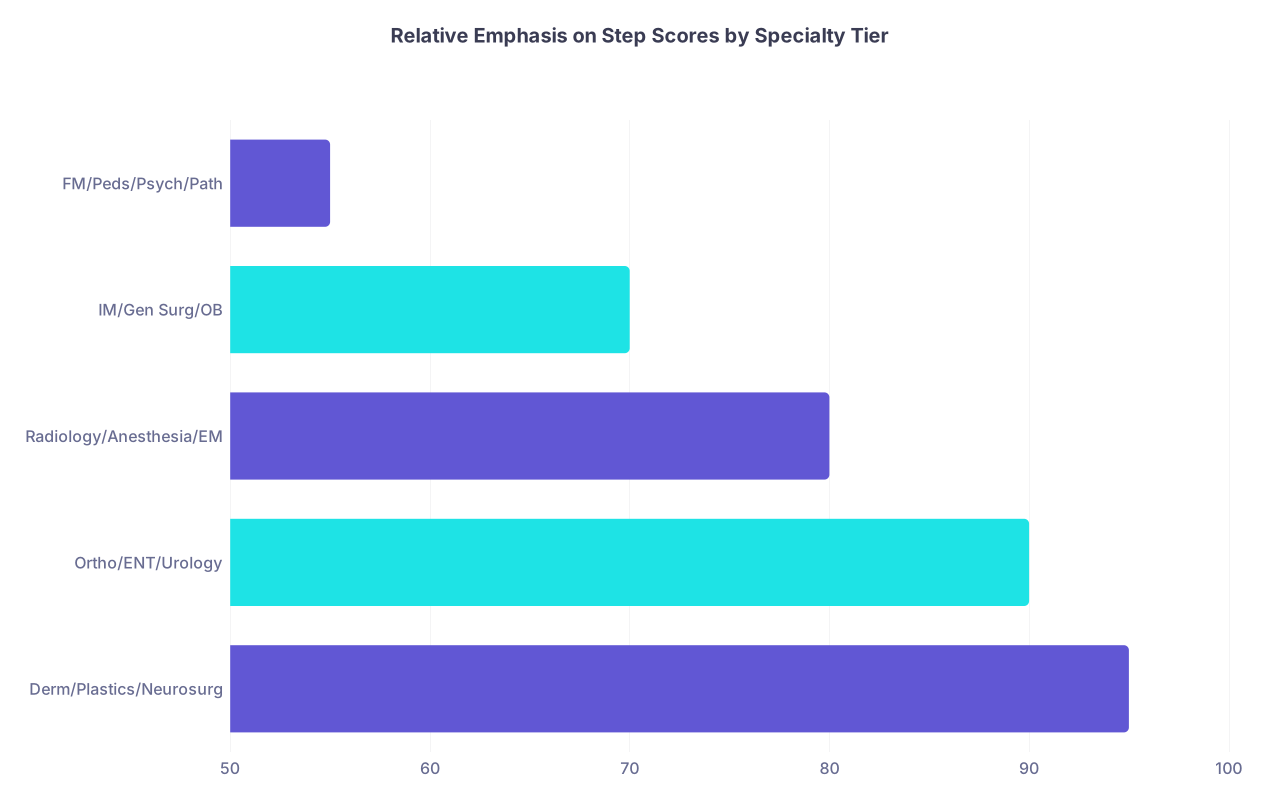
Not all programs weigh scores the same way.
| Category | Value |
|---|---|
| Derm/Plastics/Neurosurg | 95 |
| Ortho/ENT/Urology | 90 |
| Radiology/Anesthesia/EM | 80 |
| IM/Gen Surg/OB | 70 |
| FM/Peds/Psych/Path | 55 |
Interpretation: the more competitive and procedure-heavy the field, the more neurotic they are about board metrics.
7.1 Highly Competitive Surgical and Procedure Fields
Reality: if your Step 1/2 are significantly below their typical range, most doors are closed. But not all.
If you are applying to these despite a low score:
- Your growth narrative must lean heavily on objective recovery (big Step 2 jump, strong away rotation evaluations, concrete procedural exposure).
- You should explicitly address board pass risk and how your new system mitigates it.
- Letters of recommendation must reinforce that you are meticulous, prepared, and reliable—not “nice, eager student.”
Do not waste characters in your application whining about the score. Use the narrative space to hammer trajectory and clinical performance instead.
7.2 IM, EM, Anesthesia, OB, General Surgery
Here, a low Step can be offset by:
- Strong Step 2
- Robust clinical evaluations
- Evidence you function well under pressure (night float, sick patients)
- Clear signs you are “low maintenance”
Frame your narrative to highlight how the same habits that improved your scores have made you more organized on service. Talk about running lists, pre-rounding systematically, structured post-call reading tied to patient cases.
7.3 FM, Peds, Psych, Path
These specialties tend to tolerate slightly lower scores if the rest of the application is strong, especially if you are aiming for community or less competitive academic programs.
Your narrative should:
- Briefly acknowledge the score, without over-apologizing.
- Highlight consistency on Step 2 and shelves.
- Put more weight on patient interaction, communication, and longitudinal growth.
Even here, a high Step 2 makes your life easier. But your growth narrative can lean more on interpersonal and systems-based improvements, not just raw test performance.
8. Avoid These Common Framing Disasters
I have watched otherwise strong applicants tank their low-score handling by making the same mistakes.
Here are the biggest offenders.
Turning the explanation into an emotional monologue.
“I was devastated, I cried for days, I felt like a failure…”
This might be true. It does not belong in your ERAS explanation. Programs are not your therapist.Blaming the exam.
“The exam did not reflect my knowledge.”
Everyone says this. It sounds like denial. Instead: “My preparation strategy did not translate my knowledge into timed performance.”Listing five different excuses.
Sick family member + poor faculty support + bad test day + anxiety + scheduling issues = no one believes any of it. Pick the most central, credible factor.Overexposing mental health issues without tying them to stability.
Mentioning depression, anxiety, or ADHD can be appropriate, but only if you quickly anchor it to:- Treatment
- Stability
- Documented improved performance
You are not auditioning for a vulnerability contest; you are reassuring them about reliability.
Ignoring the score completely.
If it is bad enough that you know they will notice, pretending it does not exist makes you look oblivious.Making the explanation the centerpiece of your application.
Your life story is not “the student who once got a low score.” Frame it, then move on to who you actually are.
9. Build a Coherent “Growth Portfolio,” Not Just a Paragraph
The most persuasive growth narrative is not a single well-written explanation. It is a consistent pattern across your entire file.
You want alignment between:
- Narrative text (ERAS / personal statement / secondaries)
- Scores (upward trends)
- Clinical evaluations
- Letters of recommendation
- Interview answers
| Category | Value |
|---|---|
| Preclinical Exams | 60 |
| Step 1 | 55 |
| Core Shelves | 70 |
| Step 2 CK | 78 |
| Sub-I Evaluations | 85 |
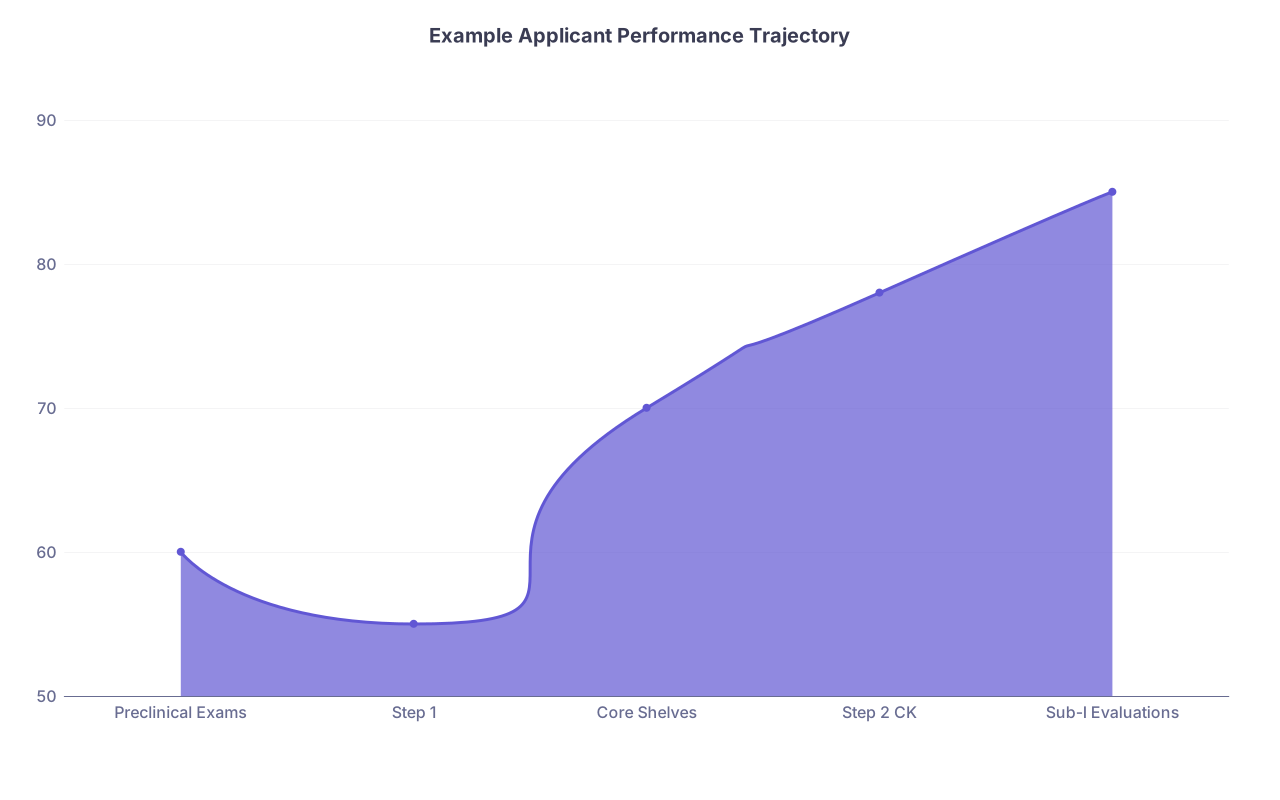
This tells a simple story: slow start, concrete growth, now strong near residency level.
Work backwards:
- Ask letter writers to comment—subtly—on your reliability, improvement over time, and responsiveness to feedback.
- If your school MSPE includes narrative comments, highlight rotations where you clearly improved mid-rotation.
- In your personal statement, anchor your story in a theme like “intentional growth,” “systems-building,” or “learning from failure,” then show that across multiple domains, not just Step scores.
The point is to make a PD think: “Yes, the score was low, but the trajectory is obvious. This person figured it out.”
10. Two Case Studies: Weak vs Strong Framing
Let me show you how this plays out concretely.
Case 1: Weak Framing (What I Actually See in ERAS)
“I was very disappointed in my Step 1 score. During that time, my grandmother was very ill and I had difficulty focusing. On test day I did not feel well and had trouble sleeping the night before. I know that my score does not reflect my true potential, as seen by my hard work and dedication on the wards.”
Problems:
- Purely emotional/biographical, no system-level analysis.
- Multiple vague excuses, nothing verifiable.
- No specific interventions.
- No objective outcomes beyond “hard work.”
Case 2: Strong Framing (Same Scenario, Fixed)
“Early in dedicated Step 1 studying, I struggled to balance a full exam schedule with family responsibilities. I tried to compensate by extending my hours late into the night, but my preparation remained fragmented and overly focused on reading rather than practice questions. After the exam, I worked with our academic support office to design a structured study plan centered on UWorld questions, daily Anki review, and weekly self-assessments. Using this system consistently over third year led to higher performance on shelf exams and a 19-point improvement on Step 2 CK, which more accurately reflects my current test-taking skills and clinical knowledge.”
This version:
- Mentions family context without dwelling.
- Admits a specific strategic failure.
- Describes a specific, realistic intervention.
- Shows a concrete, favorable outcome.
Same life. Different framing. Completely different impression.
11. If Your Step 2 Did Not “Fix” Things
Let us deal with the hardest scenario: Step 1 low, Step 2 still mediocre or only slightly better.
You cannot pretend this is a non-issue. But you can still construct a growth narrative anchored in clinical performance, not just scores.
Your arc then becomes:
- I started with weak standardized performance.
- I made changes that improved my functioning on the wards and in patient care.
- My exams improved modestly but my supervisors consistently saw resident-level behaviors.
You emphasize:
- Strong comments on sub-internships: “functions at intern level,” “manages multiple patients reliably,” etc.
- Any institutional or shelf exams where you did hit above-average performance.
- The systems you use now to prepare for knowledge checks and how they are working in real time.
Your written explanation must be very measured, because you do not have a big Step 2 “win” to hide behind.
You might say:
“My standardized exam performance has historically lagged behind my day-to-day clinical work. After Step 1, I shifted from passive review to active question-based learning and scheduled regular self-assessment blocks. While my Step 2 score increased modestly, this new system aligned with a noticeable change in my clinical performance, reflected in stronger feedback on sub-internships and improved scores on our institutional exams. I continue to use the same structured approach and expect further gains as I prepare for in-training exams.”
You are not overselling. You are making a credible case that the direction is positive and your behaviors are stable.
12. Final Check: How To Know Your Narrative Is Tight Enough
Before you submit anything, run your explanation through this filter:
Can someone summarize your main cause in one sentence?
(“They misused study time and fixed it,” “They had acute family illness and built better boundaries,” etc.)Is there at least one objective metric that clearly improved afterward?
Step 2, shelves, institutional exam, sub-I comments.Does your explanation sound the same across ERAS, personal statement, and interviews?
Not word-for-word. Just aligned.Does it make you sound like an adult taking responsibility, or a student asking for sympathy?
If you are uncertain, read it out loud to someone who is not afraid to be blunt and ask them:
“Does this sound like an excuse or a solution?”
If they hesitate, trim the drama, sharpen the intervention, and emphasize outcomes.
Key Takeaways
- A low Step score is not something you hide; it is something you frame—as a solved problem, with data-backed growth and a clear trajectory.
- The strongest narrative is simple: specific cause → concrete system changes → objective improvement that predicts board success and solid residency performance.
- Consistency across your entire application—scores, comments, letters, and interviews—matters more than any single paragraph. Make the story of your growth impossible to miss.