
Most applicants with low scores misuse away rotations—and the evaluation forms prove it.
You do not fix a weak Step 1 or Step 2 score by simply “crushing your away.” You fix it by understanding what the evaluation form actually measures, then engineering your day-to-day behavior to light up every high-yield checkbox that matters to a program director.
Let me break that down specifically.
1. The Real Role of Away Rotations When Your Scores Are Low
Away rotations are not magic. They are a high‑risk, high‑reward audition.
When your board scores are below a program’s usual range, your away rotation evaluation can do three things:
- Override screening bias for your application at that program (and sometimes their “friends” programs).
- Generate extremely specific advocacy from faculty (“We should rank this person highly despite their scores”).
- Provide written, concrete evidence that contradicts the narrative implied by your scores (e.g., “This person is not lazy or careless; they are outstanding clinically and work incredibly hard”).
But away rotations can also hurt you:
- A mediocre or lukewarm eval confirms the PD’s fear: “They are average with low scores. Pass.”
- A negative line or two (“occasionally disorganized,” “needs frequent reminders”) is lethal when paired with already low numbers.
This is why you cannot approach an away rotation casually if you have a Step 1 of 208 or a Step 2 of 224 in a competitive field like ortho, EM, ENT, or derm. You are walking into an audition where the written evaluation is the only objective lever you still control.
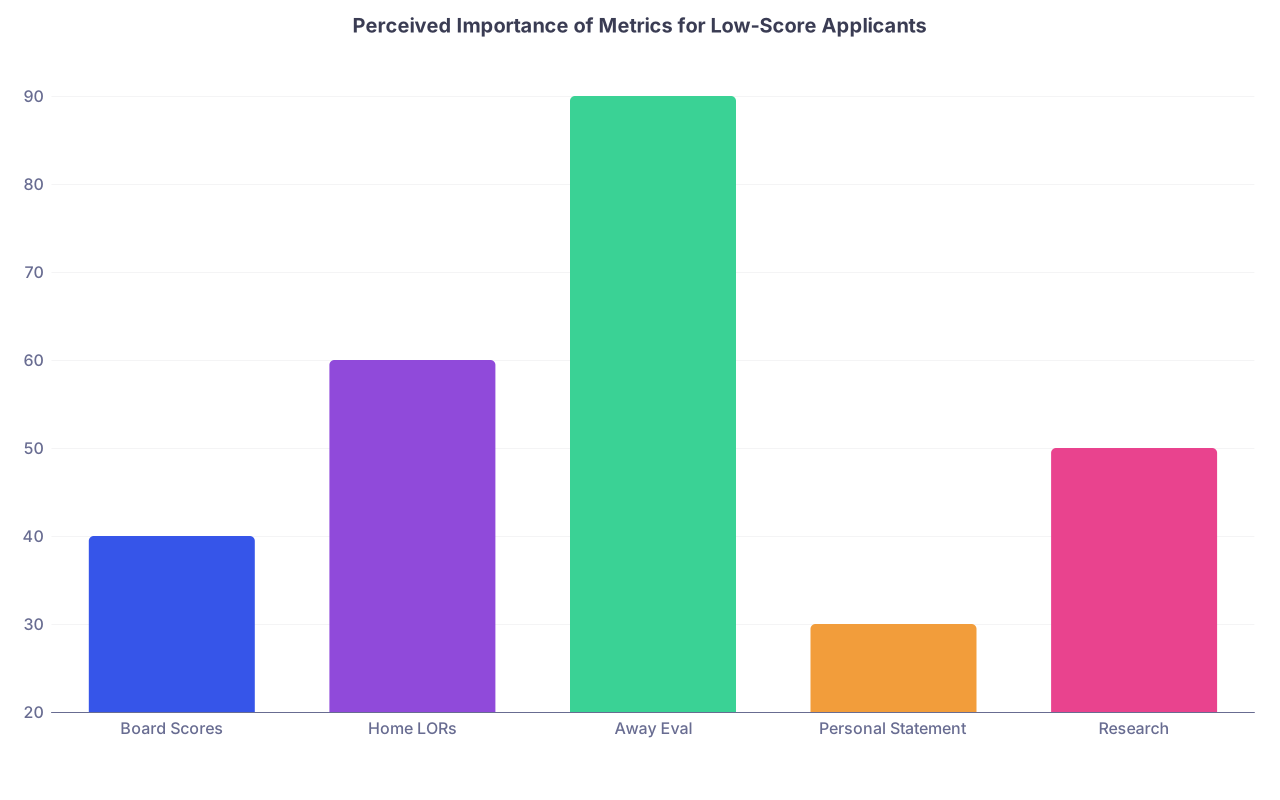
| Category | Value |
|---|---|
| Board Scores | 40 |
| Home LORs | 60 |
| Away Eval | 90 |
| Personal Statement | 30 |
| Research | 50 |
Away rotations matter more for you than for the applicant with a 255. They can coast on scores. You need receipts.
2. What Evaluation Forms Actually Look Like (And Why That Matters)
Most students have never really read the forms that attendings and residents fill out for them. They just hear, “you did great.”
That is useless.
Let me show you the pattern I have seen repeatedly across institutions. Different programs, same core structure.
Common domains on away rotation evaluation forms:
- Medical Knowledge
- Clinical Reasoning / Problem-Solving
- Work Ethic / Initiative
- Professionalism / Teamwork
- Communication (with team, nursing, patients)
- Procedural Skills (for surgical / procedural fields)
- Overall Clinical Performance / “Residency Potential”
- Global Recommendation / Ranking:
- Below expectations
- Meets expectations
- Exceeds expectations
- Outstanding / among the best
Some forms are numeric (1–5). Others are anchors like “Below / At / Above / Far Above Level.” Some have forced rank (“Top 10% of students I have worked with,” etc.).
The point: your day-to-day behavior must be engineered to generate consistent “Exceeds” and “Outstanding” marks in the specific boxes that program directors weight heavily.
Here is how this typically looks from the PD side.
| Domain | Weight for PD | Comment for Low Scores |
|---|---|---|
| Work Ethic / Initiative | Very High | Must be clearly superior |
| Professionalism | Very High | Any concern is fatal |
| Clinical Reasoning | High | Needs to be “strong for level” |
| Communication / Team | High | Drives letters and word-of-mouth |
| Medical Knowledge | Moderate | Evaluators know low-scorers often lag |
| Procedures (if relevant) | Moderate | Bonus, not primary for redemption |
If your scores are low, evaluators already assume you are weaker on testable knowledge. You are not going to change that perception completely in 4 weeks. What you can do is make the non‑cognitive boxes so strong that they drown out concerns.
3. The Hidden Traps Built Into Evaluation Forms
Evaluation forms are not neutral. They have design traps that work against you if you are not proactive.
Trap 1: “Meets Expectations” = Death by faint praise
On many forms, “Meets expectations” sounds nice. It is not. It reads as: “Fine, generic student. Nothing special.”
For an applicant with a 250, “Meets expectations” is acceptable. For you? With a 215 or a fail‑then‑pass Step 1? This equals, “There is no reason to take a risk on this person.”
You are aiming for:
- “Exceeds expectations” in several domains, and
- Some version of “Top 10–25% of students I have worked with” on the global question.
Anything less, and you are just one more average rotating student with low scores.
Trap 2: Vague comments sabotage you
Examples I have actually seen:
- “Pleasure to work with.”
- “Very nice, eager to learn.”
- “Will be a solid resident.”
For a low‑score applicant, these comments are useless. They do not counter the concrete metric (your score). They do not give PDs ammunition to argue for you.
You want comments like:
- “Best work ethic of any rotating student this year.”
- “Consistently read ahead and anticipated patient care needs without prompting.”
- “Functioned at the level of an intern by the end of the rotation.”
- “Given their standardized score history, their performance here was notably strong and far exceeded expectations.”
That last sentence is gold because it explicitly contradicts what your scores imply.
Trap 3: One negative word overshadows 10 positives
Program directors are paranoid. They should be. One bad hire can poison a call schedule.
Words and phrases that kill you:
- “Sometimes scattered.”
- “Needed reminders to follow through.”
- “Occasional lapses in attention to detail.”
- “Had difficulty integrating feedback.”
- “Variable engagement.”
This stuff sticks to you harder than “very hard-working” helps you. You need to structure your behavior so these words never appear on your form.
4. Reading Between the Lines: How PDs Interpret Evaluation Forms
Let me be blunt: PDs skim. They are not reading your form like a novel.
Their mental process usually looks like this.

| Step | Description |
|---|---|
| Step 1 | See applicant with low score |
| Step 2 | Open away eval |
| Step 3 | Dismiss as risk |
| Step 4 | Scan comments fast |
| Step 5 | Flag as strong despite scores |
| Step 6 | Discuss at ranking meeting |
| Step 7 | Global rating high? |
| Step 8 | Any red flags? |
They hit the global ranking questions first:
- “How do they compare to other students?”
- “Would you rank this student in your own program?”
- “Recommend with strongest enthusiasm / with enthusiasm / with reservation / do not recommend.”
Then they scan comments, not to be inspired, but to look for concerns. If comments are strong and clearly specific, you get bumped up. If they are generic, you default back to “low score, nothing special.”
This is why your goal is simple:
- Generate a top‑tier global ranking.
- Pack the comment sections with concrete, differentiating examples.
- Avoid even a whiff of negative phrasing.
The only way to do that reliably is to backwards design your rotation from the evaluation form.
5. Backwards Designing Your Rotation From the Form
Stop thinking “I need to impress them.” Start thinking “I need to trigger specific boxes and phrases.”
Here is how to do that.
Step 1: Get the actual evaluation form early
You can do this without being weird:
Email the rotation coordinator:
“I am trying to get the most out of this rotation. Would it be possible to see the student evaluation template so I know what domains I will be assessed on?”Or ask your first-week resident:
“What does the student eval look like here? What do attendings actually fill out?”
Once you have it, analyze line by line.
Circle:
- Any “global” question (top %, overall rating).
- Any domain where you can drastically outperform (work ethic, initiative, teamwork).
- Any comment prompts like “Describe strengths” / “Areas for improvement.”
Print it. Put it in your notebook. This is your playbook.
Step 2: Translate every domain into daily behaviors
“Professionalism” is not a word. It is a pattern of micro‑behaviors.
Example mapping:
Work Ethic / Initiative →
- Arrive 30–45 minutes before your resident.
- Pre‑chart on every patient. Have vitals, labs, imaging, and overnight events ready.
- Volunteer first for scut that matters (discharge summaries, follow‑up calls, tracking consults).
- Ask “What can I take off your plate?” at least twice per day.
Teamwork / Communication →
- Proactively update nurses when plans change.
- Summarize plans clearly on rounds.
- Hand off any unfinished tasks explicitly: “I called GI, they will see the patient at 3 pm, note pending.”
Clinical Reasoning →
- Present A&P structured and prioritized.
- For each problem, state 1–2 differential considerations and why you favor one.
- Read one short article or guideline per key patient problem and reference it the next day.
You build a checklist for week 1, week 2, week 3, week 4 tied directly to those domains.
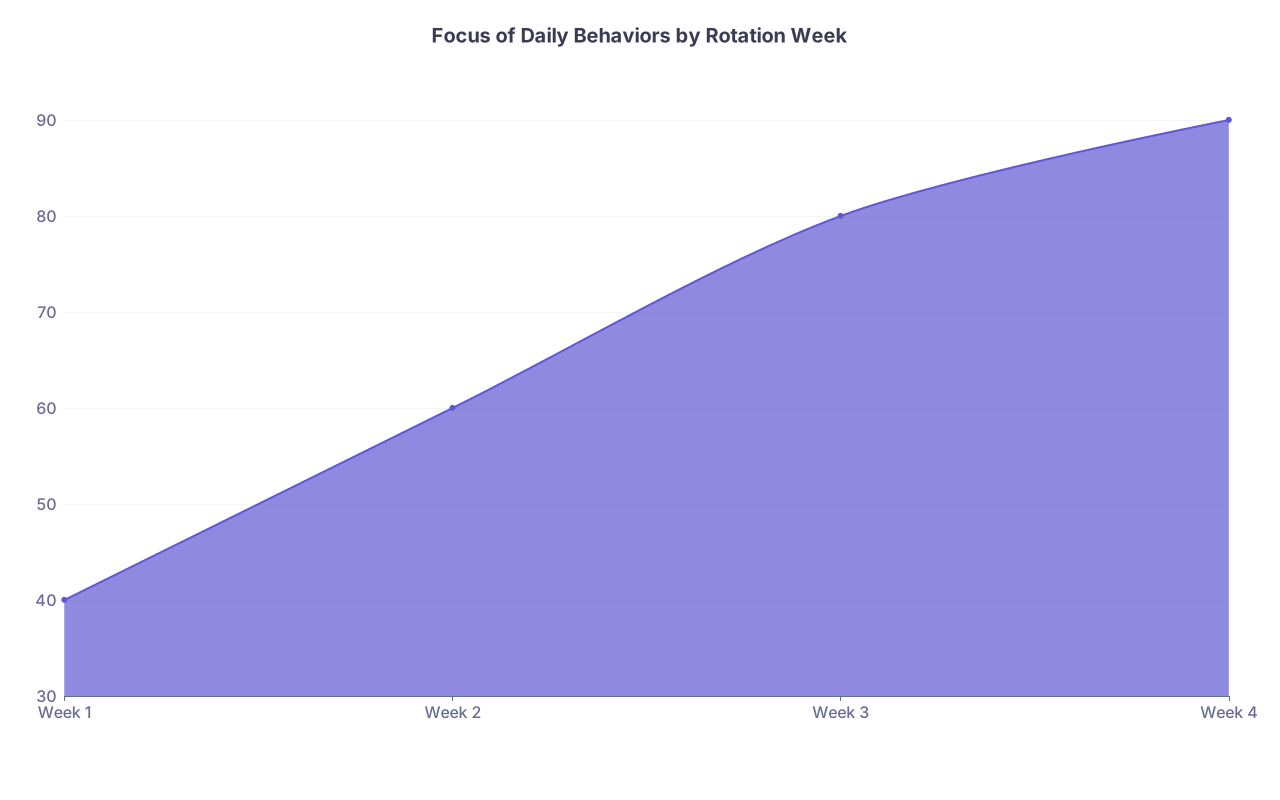
| Category | Value |
|---|---|
| Week 1 | 40 |
| Week 2 | 60 |
| Week 3 | 80 |
| Week 4 | 90 |
Interpretation: Your intensity and alignment with the eval form should not plateau at “good enough”; it should escalate as you learn the local culture.
Step 3: Engineer “comment-worthy” moments
Generic effort yields generic comments. You need standout episodes that force your evaluators to remember you when they sit down to write.
Examples:
- Staying late without being asked to help stabilize a crashing patient, while still being efficient and not in the way.
- Catching a near‑miss (e.g., wrong dose, missed allergy) because you actually read the order carefully.
- Drafting an excellent, organized discharge summary for a complex patient, saving the resident 20–30 minutes.
- Reading on a rare condition your patient has and bringing a concise, relevant paper to rounds.
When those happen, do not assume they are obvious. Gentle calibration is allowed:
- End of week: “Dr. Smith, I have really appreciated the chance to help with the GI bleed case and the complex discharge yesterday. I am trying to improve and I know evaluations matter a lot for me this year. Is there specific feedback on how I handled those situations?”
You are reminding them of concrete examples they can later write down.
6. Using Mid‑Rotation Feedback to Steer the Evaluation
Too many students treat feedback as a grade, not as a steering wheel.
You, with low scores, cannot afford that.
Ask for real, not polite, feedback
End of week 1 or 2 with your primary attending:
“Dr. Lee, I want to ask for very specific feedback. I know my Step scores are not stellar, and this rotation is extremely important for me. If you were filling out my evaluation today, what boxes would be ‘Meets’ and what would be ‘Exceeds’? What would keep you from putting me in your top group of students?”
If you say this calmly and without defensiveness, most attendings will tell you the truth. I have heard:
- “You are working hard, but your presentations are still scattered.”
- “You are quiet on rounds. I do not hear your reasoning.”
- “You need to own your patients more—anticipate, not just react.”
Perfect. That is your roadmap.
Document, then overcorrect
Write their words down that evening. Translate into actions.
Example:
Feedback: “Presentations scattered.”
Action plan:
- The next day, use a structured template—Chief complaint, brief HPI, bullets for overnight events, then systems-based A&P.
- Ask a senior: “Can I run one practice presentation with you before rounds for 5 minutes?”
- Before you see your attending, tell them: “I tried to tighten my presentations based on your feedback; please let me know if this is closer to what you expect.”
You are visibly responsive. That triggers a specific evaluation phrase: “Incorporates feedback exceptionally well.”
Which shows up all the time on forms and PDs love.
7. Positioning the Evaluator: How to Get the Right Person to Fill Out the Form
Not all evaluations are equal. A glowing form from a PGY‑2 no one knows is weaker than a strong form from a core faculty or PD‑adjacent attending.
You cannot always control who officially fills out the form, but you can strongly influence whose voice dominates it.
Strategy:
Identify 1–2 attendings early who:
- Are involved with the residency.
- Actually watch you work (not the attending who is at clinic 4 days a week while you live with the fellow).
- Seem to care about teaching.
Attach yourself (within reason) to their patients, their consults, their cases.
When evaluation time comes, you can nudge the system:
Email to coordinator or attending near the end:
“Dr. Patel, I believe you have seen me the most this month, both on rounds and in clinic. If you are comfortable, I would be very grateful if you could be the primary evaluator for my rotation, as this away is a key part of my application.”
Most places have some flexibility. Use it.
8. Converting a Strong Evaluation Into Application Firepower
A good form is helpful. A good form plus a strong away letter of recommendation is exponentially better.
Here is how to link them.
Step 1: Time your letter request
Ask near the end of the rotation after you have already demonstrated growth and effort:
“Dr. Nguyen, I have really valued working with you. This rotation and your evaluation are going to be critical for me because my Step scores are below average for this field. Based on what you have seen, would you feel comfortable writing me a strong letter of recommendation for residency?”
The word “strong” is not optional. If they hesitate: back off. A tepid letter plus low scores is application suicide.
Step 2: Feed them your best “evaluation bullets”
When they agree, you send a short, structured email:
- Your CV
- Step scores (yes, be transparent)
- A 1‑page “Highlights from my rotation with you” list:
Examples:
- “Arrived early daily to pre‑chart and often had full plans ready before rounds.”
- “Led family meeting for X patient with your supervision.”
- “Identified medication interaction on Y patient that led to a change in therapy.”
Those become the specific comments that echo what is on the evaluation form. Consistency = credibility.
Step 3: Use the evaluation explicitly in your application narrative
In your personal statement or interview, you can reference:
“I recognize my Step 1 score (207) does not reflect my current clinical abilities. During my away rotation at [Program], I was evaluated as ‘exceeding expectations’ in work ethic, teamwork, and clinical reasoning, and the faculty commented that I functioned at the level of an intern by the end of the month. That rotation was a turning point for me.”
You are not just hand‑waving. You are citing concrete evaluation language.
9. Common Mistakes I See Low‑Score Students Make on Aways
Let me call out the patterns that sink people.
- Treating the away like a “try out this city” month instead of an audition.
- Being “polite and quiet” rather than engaged and appropriately assertive.
- Avoiding feedback because it feels uncomfortable.
- Assuming “working hard” is obvious and will automatically lead to outstanding evaluations. (It will not. You have to convert effort into visible, documentable behavior.)
- Not knowing what the evaluation form looks like until after the rotation is over. That is malpractice on your own career.
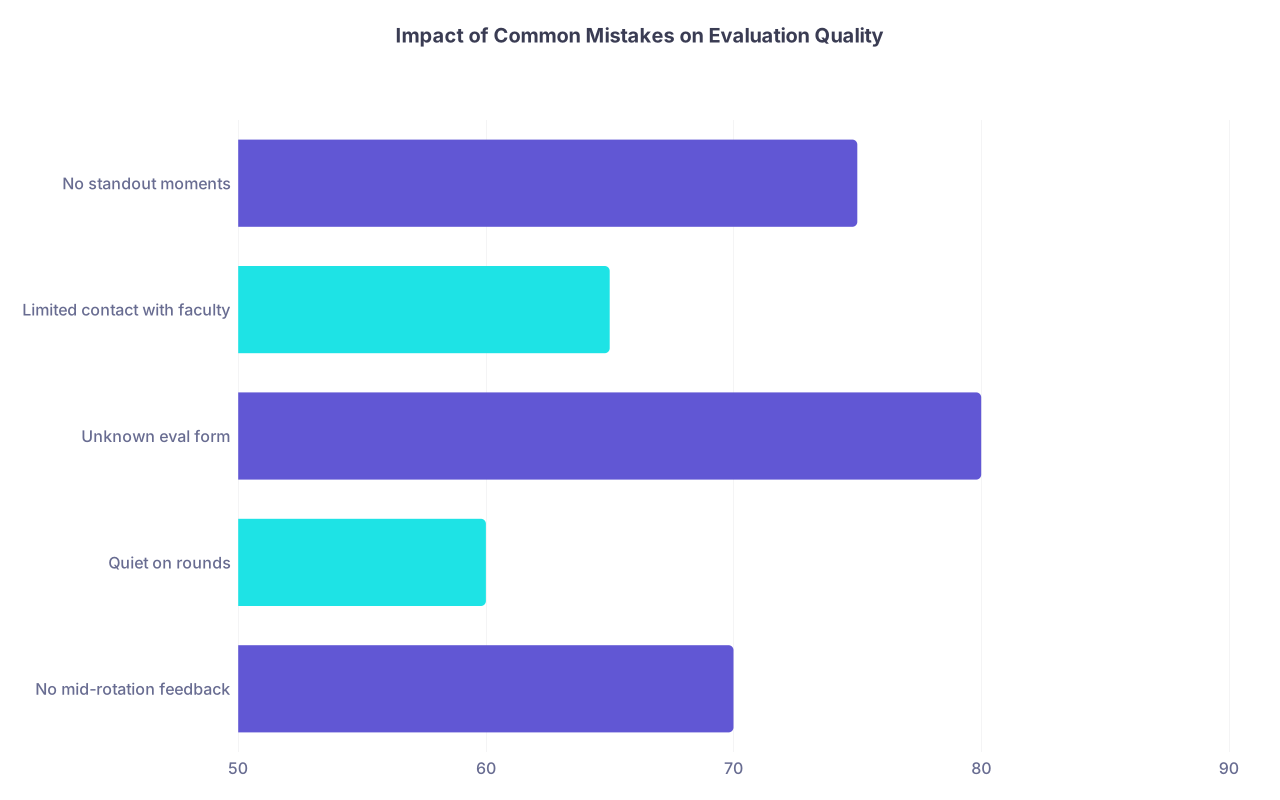
| Category | Value |
|---|---|
| No mid-rotation feedback | 70 |
| Quiet on rounds | 60 |
| Unknown eval form | 80 |
| Limited contact with faculty | 65 |
| No standout moments | 75 |
Higher value = more likely to result in “Meets expectations” only. You cannot afford those odds.
10. Special Considerations by Specialty
Different fields weight different domains. You adapt accordingly.
Surgery / Ortho / ENT / Neurosurgery
- Procedural skill matters, but reliability and grit matter more.
- High yield for eval: “Never complained, always stayed late, first in, last out, always hungry to scrub.”
- Red flag: “Sometimes disappeared from the OR” or “Less engaged on floor work.”
Translation: you live in the hospital for that month and you look like someone who will not melt down during a Q3 trauma call.
Emergency Medicine
- EM SLOEs (Standardized Letters of Evaluation) are essentially formalized evaluation forms. PDs treat them as gospel.
- Key boxes: “Work ethic,” “Ability to function at expected level,” “Global assessment,” and the “Ranks among students” section.
- A SLOE that says “Middle third” in the global ranking + low score = your application sinks at most competitive places.
You need, at minimum, an “Upper third” assessment and concrete comments about being reliable under pressure.
Internal Medicine / Pediatrics / Family Medicine
- These are more forgiving about scores but still competitive at strong academic programs.
- PDs care about whether you will be a safe, thoughtful intern. Eval language like “already functioning at or near intern level” is huge for you.
- I have seen applicants with 210s match at solid academic IM programs because away evals and letters were off the charts strong.
11. One Concrete 4-Week Blueprint
Let me make this painfully tactical. Assume 4-week away, low Step 1 and 2, aiming to flip the narrative.
Week 1 – Culture scan and baseline
- Get evaluation form.
- Identify key domains.
- Arrive absurdly early, stay until work is truly done.
- Ask senior resident: “What separates the best students you have worked with from the average ones here?”
- Start a nightly 20–30 minute review of your patients’ conditions.
Week 2 – Feedback and correction
- Ask your main attending for explicit mid‑rotation feedback using the language above.
- Overcorrect on any weaknesses.
- Engineer at least 1–2 standout “above and beyond” moments this week.
- Make sure you are talking, not just existing, on rounds: articulate your reasoning.
Week 3 – Push to ‘Exceeds’ territory
- Take ownership: know every detail of your patients before anyone else.
- Offer to help residents with small but high‑yield tasks (discharge prep, follow‑up coordination).
- Ask: “Is there anything that would stop you from saying I am in your top group of students?” Then fix it.
Week 4 – Lock in eval and letter
- Reconfirm with attending that they will be your main evaluator if appropriate.
- Ask about a strong letter.
- Email them a concise summary of your contributions.
- Stay consistent—many students fade out in week 4. Do not.

12. Quick Reality Check: Can Aways Truly Counter Low Scores?
Yes—but only in specific situations.
Away rotations help you most if:
- Your scores are modestly low (e.g., 210–220), not catastrophic with multiple failures.
- You are aiming at programs that value “known quantity” over pure numbers.
- You can generate at least one exceptional evaluation and letter that explicitly addresses your performance.
They help less if:
- You have multiple exam failures without a clear upward trend or explanation.
- You are aiming at ultra‑elite, high‑volume academic flagships that drown in 250+ applications.
- Your rotations produce only generic “meets expectations” evaluations.

Used correctly, away rotations let you say to programs: “Judge me by how I actually work with your team, not just by a number I cannot change.”
If you design your behavior from the evaluation form outward, that message comes through loud and clear.
And once you have mastered that, the next step is turning those hard-won evaluations and letters into a rank list that maximizes your odds of matching where you will actually thrive. But that is a story for another day.