
A low Step score is not the problem; a badly constructed academic CV is.
Let me be blunt. Programs see bad or mediocre Step scores all the time. What gets applicants quietly filtered out is the combination of weak numbers and a sloppy, unfocused CV that screams: “There’s nothing else here.” Your job is to make your CV do the exact opposite.
You are not going to hide your Step 1 or Step 2 CK. That would be dishonest and impossible in ERAS. But you absolutely can reframe the narrative with a CV that is so academically dense, organized, and strategically weighted that your score becomes one data point rather than the headline.
Let me break this down specifically.
1. First Principles: What PDs Actually Look For On A CV
Before you start editing lines, you need to understand how your CV will be scanned in real life.
Most program directors, chiefs, and faculty reviewers look at an ERAS application something like this:
- Board scores (often Step 2 CK now, Step 1 if available)
- Medical school / class rank (if provided)
- Research and scholarly output
- Letters (if they know the letter writer)
- Clinical experiences / sub-Is / away rotations
- Leadership, teaching, and “evidence of being a grown, reliable human”
Your CV has one main job: shift attention away from Step scores by overwhelming the reader with organized, credible evidence of academic and clinical value.
That means:
- No fluff at the top.
- No seven-line descriptions of irrelevant volunteer work.
- No random formatting that looks like you never saw an academic CV before.
Your CV should mimic what strong residents and junior faculty use. Think: structure, clarity, and a clear hierarchy of what matters.
2. CV Structure That Softens The Impact Of Low Step Scores
Here is the hierarchy I recommend for applicants with low Step scores. The order is deliberate.
- Contact and demographic info
- Education
- Academic honors / awards
- Research and scholarly activity
- Teaching experience
- Clinical experience (sub-Is, externships, unique rotations)
- Leadership and service
- Additional skills (languages, technical, certifications)
- Professional memberships
- Licensure and exams (boards, if you include them at all)
Notice what is last.
Step scores do not need a front-row seat on your CV if they already appear in ERAS. You are not hiding them; you are just not spotlighting them.
Where to place exams on the CV
You have three options:
Not on the CV at all
Perfectly acceptable if ERAS already includes your Step scores. Many academic CVs from residents and attendings never list exam scores.Under a “Licensure and Board Examinations” section near the end
Example:- USMLE Step 1 – Passed (first attempt)
- USMLE Step 2 CK – 220 (first attempt)
- USMLE Step 2 CS – Passed (first attempt) – if applicable/older
Grouped with other certifications
If you hold ACLS, BLS, ATLS, etc., you can cluster exam outcomes with them. It visually dilutes the weight of the Step line.
What you do not do: bold the number, stick it in your education section as if it is an honor, or put “USMLE Step 2 CK: 218” under your name like a subtitle. That is asking readers to fixate on it.
3. Education Section: Clean, Neutral, Non-Defensive
Your education section should be factual and boring—in a good way. Do not editorialize. Do not apologize. Do not try to “explain” here.
Example structure:
Doctor of Medicine (M.D.), University of X School of Medicine, City, State
Expected graduation: May 2025
Class rank or quartile (if favorable or neutral and reported)Bachelor of Science in Biology, University of Y, City, State
Graduated magna cum laude, May 2019
If your class rank is poor and your school gives quartiles, you can leave it out from the CV and let ERAS report it if required. The CV is not a confessional; it is a curated academic document.
What you can emphasize here if your scores are low:
- Honors (Dean’s list, Alpha Omega Alpha, Gold Humanism, scholarship awards)
- Completion of an honors research track or MD with thesis
- Dual degrees (MD/MPH, MD/MS, etc.)
Those signal “academic engagement” that counterbalances standardized metrics.
4. Research Section: The Single Best Buffer Against Low Scores
If you have weaker exam outcomes, your research section is where you either recover, or you sink.
Programs forgive a lot if they see:
- Multiple publications (especially PubMed-indexed)
- Posters or podium talks at recognized meetings
- Ongoing, clearly described projects with plausible completion
- A coherent theme (e.g., consistent work in cardiology, critical care, or med ed)
Here is how to build and present research so it does real damage control.
4.1 Ordering Your Research
Use this order:
- Peer-reviewed publications
- Manuscripts under review or in preparation
- Abstracts, posters, and presentations
- Other scholarly work (book chapters, QI projects, significant curricular design)
Inside each category, list items in reverse chronological order.
If you have one half-finished project and a Step 2 score of 214, that will not impress anyone. But 3 posters + 1 submitted manuscript + multiple ongoing studies reads as “academically alive,” even if every line says “co-author.”
4.2 Formatting That Looks Like You Know What You are Doing
Use standardized citation format. I favor something like:
Lastname AB, Lastname CD, Lastname EF. Title of article. Journal Name. 2024;15(3):123–129.
If the paper is accepted but not published:
Lastname AB, Lastname CD. Title of article. Journal Name. Accepted for publication, 2025.
If in review:
Lastname AB, Lastname CD. Title of article. Journal Name. Under review, 2025.
And here is the important nuance for low-Step applicants: emphasize productivity, not prestige.
A handful of solid, small-journal publications beats one “We submitted to NEJM” line that went nowhere.
4.3 Strategic Detail In Research Descriptions
Under each research position (not each publication), one or two bullets that show real responsibility:
- Designed data collection forms and performed chart review for 120-patient retrospective cohort study in sepsis outcomes.
- Led weekly data meetings; coordinated abstract submission that resulted in poster at SCCM 2024.
That language signals work ethic and reliability. PDs love that more than the impact factor of your journal.
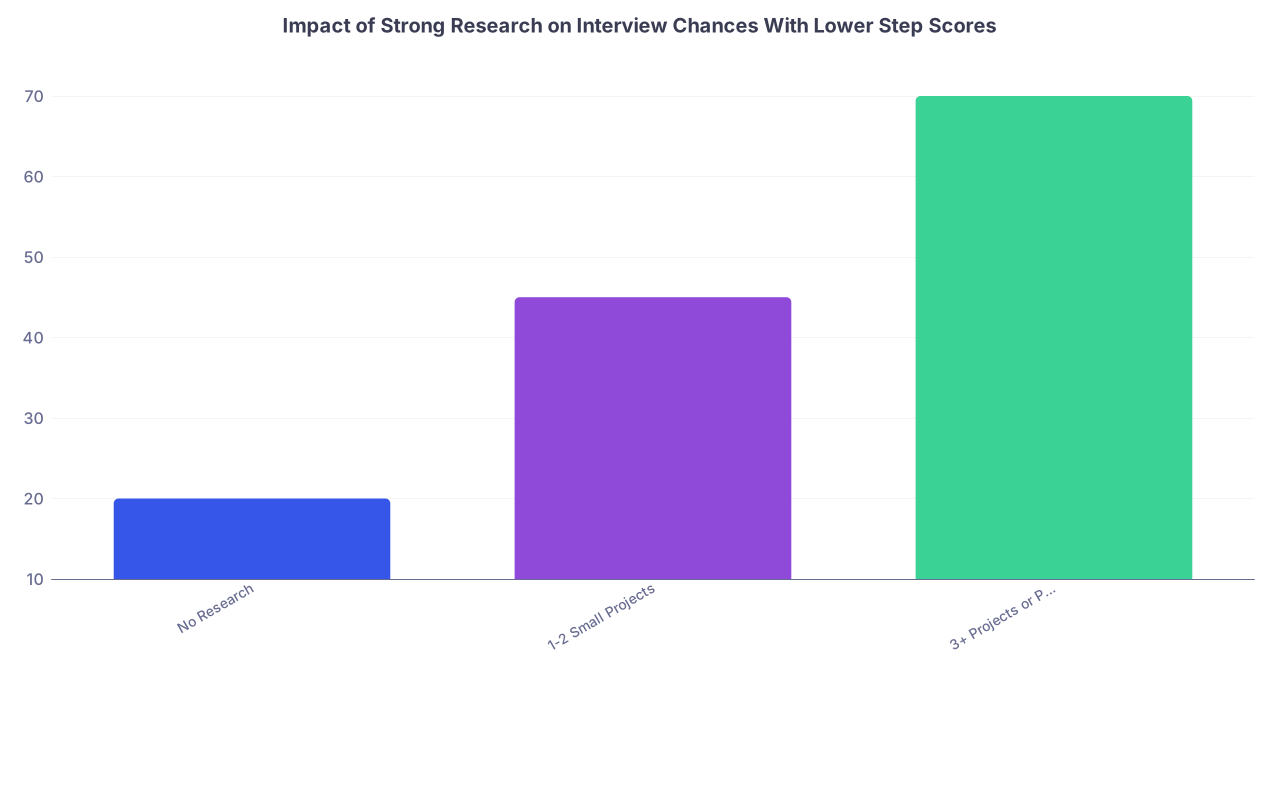
| Category | Value |
|---|---|
| No Research | 20 |
| 1-2 Small Projects | 45 |
| 3+ Projects or Publications | 70 |
5. Teaching Experience: Underused But Powerful
Low scores say, “possible test-taking weakness.” They do not say, “bad resident.” One of the strongest counter-signals is teaching.
Programs need residents who can:
- Teach medical students
- Run small group sessions
- Give 10–15 minute chalk talks on rounds
If you have any of these, do not bury them:
- Peer tutor (Step, pre-clinical courses, OSCE prep)
- Small-group or PBL facilitator
- Teaching assistant for anatomy, physiology, etc.
- Formal teaching electives
- Curriculum development roles
Structure:
Teaching Experience
Small Group Facilitator, Cardiovascular Physiology
University of X School of Medicine, 2023–2024
- Led weekly 1.5-hour sessions for 8 first-year students; created practice questions and short cases.
- Received average evaluation score 4.8/5 across 12 sessions.
Short, concrete, outcome-focused. That sells better than “I enjoy teaching.”
6. Clinical Experience: Make Rotations Work For You
For applicants with low Step outcomes, away rotations and high-quality clinical work become key leverage points.
Your CV needs a distinct, clearly labeled section:
Clinical Rotations and Electives (Selected)
Sub-Internship in Internal Medicine, University Hospital Z, July 2024
- Functioned at intern level on general medicine service; independently managed 6–8 patients under supervision.
- Delivered daily evidence-based presentations on management topics (e.g., hyponatremia, COPD exacerbation).
If you did an away rotation at the program’s institution or in their specialty, put that rotation as high as possible within the clinical section.
Avoid laundry-listing every required core rotation. Focus on:
- Sub-internships
- Acting internships
- Away rotations
- Unique electives (ICU, ultrasound, global health)
These show that despite a lower Step score, you can operate in real clinical environments at or above expected level.

7. Leadership, Service, And “Grown-Up” Roles
This is where many applicants quietly fail. They either:
- List every club attendance as “leadership,” or
- Ignore real leadership and service that actually matters.
For someone with low boards, you want substantive roles:
- Chief tutor or coordinator for a tutoring program
- Committee membership with defined output (e.g., wellness committee that implemented X)
- Organizer of a conference, symposium, or interest group event
- Long-term, structured community service (not one-off health fairs)
Example:
Leadership and Service
Co-Director, Student-Run Free Clinic
University of X, 2022–2024
- Coordinated weekly clinic operations serving 40–60 uninsured patients per month.
- Implemented new triage protocol that reduced wait times by 30%.
- Supervised 20+ student volunteers per semester.
That entry beats six random “volunteered at blood drive” lines. Quality over volume.
Programs want residents who will step up when the service is slammed, not disappear. Leadership and serious service show that.
8. Where Low Step Scores Can Appear Without Dominating
Let me be precise. You have three main locations where Step outcomes might surface beyond ERAS:
- CV
- Personal statement
- Letters of recommendation
For the CV, the least damaging approach is:
Licensure and Board Examinations
- USMLE Step 1 – Pass (first attempt)
- USMLE Step 2 CK – 218 (first attempt)
Short. Neutral. No excuses.
If Step 1 was failed once, but Step 2 is decent, you might consider:
- USMLE Step 1 – Pass
- USMLE Step 2 CK – 232 (first attempt)
Do not mention attempts in the CV if ERAS already declares them. You are not lying; you are avoiding redundancy and overemphasis.
If you took Step 1 pre-pass/fail and the score is weak but Step 2 is clearly stronger, put only Step 2 numerically:
- USMLE Step 1 – Pass
- USMLE Step 2 CK – 238
Let the upward trajectory speak for itself without editorial comment.
9. Tactical Formatting: Quietly Downplaying Weak Points
Details matter. There are subtle format tricks that shift attention.
9.1 Font, Bold, And Spacing
- Use consistent font and size (e.g., 11–12 point).
- Bold your role or title, not your exam scores.
- Use the same font style for all lines in the “Licensure and Board” section so the Step score does not visually pop.
Bad:
USMLE Step 2 CK – 218
Better:
USMLE Step 2 CK – 218 (first attempt)
9.2 Page Real Estate
If your entire first page is thin and your Step scores sit close to the top, readers will stare at them longer. If your first page is heavy with:
- Research
- Teaching
- Leadership
- Awards
…then by the time they see the Step section on page two, their impression of you is already anchored as “academic and engaged,” not “low score.”
9.3 Avoiding Redundancy
Do not do this:
Education
Doctor of Medicine …
USMLE Step 1 – Pass
USMLE Step 2 CK – 221
Licensure
USMLE Steps listed again
Every repetition of a mediocre number is a self-inflicted wound.
| Strategy | When To Use |
|---|---|
| Omit scores from CV entirely | ERAS already lists scores; most common |
| Place in Licensure section late | You want full transparency in one place |
| List Step 2 only (numeric) | Step 2 stronger than Step 1 |
| Pass/Fail only for Step 1 | Weak pre-pass/fail Step 1 |
| Include attempts wording | Rarely; only if explicitly requested |
10. What Not To Do (The Self-Sabotage List)
I have watched otherwise decent applicants tank themselves with these mistakes.
Putting Step scores in the header
Name, email, Step 1: 205, Step 2: 218 – this is wild. You are turning your biggest weakness into your logo.Over-explaining test performance on the CV
“Despite initially struggling with standardized exams…” – No. The CV is not your personal statement. Explanations belong elsewhere, and even there, used sparingly.Inflating weak, irrelevant experiences
You do not need five bullets describing that you helped organize the class holiday party.Inconsistent dates and formats
Sloppy structure radiates “disorganized,” which is the last thing you want attached to “low Step.” If your CV feels chaotic, PDs will assume your clinical work is too.Listing every old, irrelevant job in full detail
That college barista job can be one line under “Prior Employment” if you absolutely must include it. Focus your word count on medicine and academics.
11. Using The CV To Support A Coherent Story
The real power move is aligning your CV content with the narrative you want PDs to see.
Example profiles:
11.1 “The Clinically Strong, Patient-Focused Applicant”
Scores: Step 1 fail then pass; Step 2 CK 222
CV emphasis:
- Heavy clinical elective and sub-I section with concrete responsibilities.
- Longitudinal involvement in free clinic or community care.
- Strong teaching section, especially bedside teaching.
- Letters requested from attendings who comment on your clinical acumen.
11.2 “The Late-Blooming Academic”
Scores: Step 1 low but pass, Step 2 CK 231
CV emphasis:
- Research ramping up in MS3–MS4 years.
- Evidence of improving performance over time (later honors, thesis).
- Poster presentations and one or two submissions to journals.
11.3 “The Systems / QI / Leadership Person”
Scores: Below average across the board.
CV emphasis:
- Serious quality improvement projects with measurable outcomes.
- Leadership roles with documented results (e.g., new workflow, reduced no-shows).
- Committee work, guidelines implementation, informatics interests.
In all three, the CV is doing the same job: reframing. It says: “Yes, the numbers are what they are. But look at all this.”

| Step | Description |
|---|---|
| Step 1 | Open ERAS Application |
| Step 2 | See Step Scores |
| Step 3 | Check CV For Strengths |
| Step 4 | Proceed As Usual |
| Step 5 | Consider Interview |
| Step 6 | Low Priority or Screen Out |
| Step 7 | Scores Below Average? |
| Step 8 | Strong Research Teaching Leadership? |
12. Quick Reality Check: Your CV Will Not Magically Erase Scores
I will be clear so you are not delusional about this.
A brilliant CV will not:
- Get you into the most competitive programs with catastrophic Step outcomes.
- Force PDs to ignore institutional cutoffs.
What it does:
- Keeps you out of the automatic “no” pile at programs that review holistically.
- Makes your file attractive enough that borderline numbers are tolerated.
- Sets up your interviews, if you get them, for a different conversation than “Why did you score so low?”
And honestly, that is the real win.
13. Implementation Plan: How To Rebuild Your CV In 7 Steps
If you need a practical way to act on all this, follow this sequence:
Strip your current CV down to headings only: Education, Research, Teaching, Clinical, Leadership, etc.
Move any mention of exams, Step scores, or NBME results into a single section near the end. Delete duplicates.
Under each heading, sort entries by:
- Relevance to residency
- Recency
- Impact
Then trim the bottom 20–30% of fluff.
Reformat research and presentations to look like actual academic citations. Clean, consistent, professional.
Expand 2–4 of your highest-impact roles (research, leadership, clinic) with 1–2 sharp, outcome-oriented bullets each.
Scan the first page: you should see mostly research, teaching, and real responsibility—not exam language.
Have a resident or fellow in your target specialty review it and ask them one question:
“If you only saw this CV and knew nothing else, would you be surprised my Step scores are below average?”
If their answer is “No, I would have guessed,” you are not done.
FAQ (Exactly 5 Questions)
1. Should I ever completely omit my Step scores from my CV?
Yes, and it is common. If ERAS already reports your scores, there is no requirement to duplicate them on your CV. Many residents and attendings do not list historical exam scores on their academic CVs. Omitting from the CV is not hiding; it is avoiding unnecessary emphasis.
2. If my Step 2 CK is much stronger than Step 1, can I list only Step 2?
Yes. Listing only Step 2 CK (especially if it shows improvement) is a reasonable compromise. You can put “USMLE Step 1 – Pass” without a number and “USMLE Step 2 CK – 235” with the score. Programs see the full numbers in ERAS anyway, but the CV visually spotlights the upward trend rather than the earlier weakness.
3. Is it ever helpful to explain poor Step scores within the CV itself?
No. The CV is not the place for narrative or justification. Any contextual explanation (illness, crisis, adaptation issues) belongs—if used at all—in a brief, focused section of your personal statement or in a faculty letter. On the CV, explanations read as excuses and draw more attention to the problem.
4. How much research do I “need” to offset low Step scores?
There is no magic number, but pattern matters more than quantity. Three or more meaningful projects—ideally with at least one publication or national poster—start to look like genuine scholarly engagement. One token poster with no ongoing work is not going to balance very low boards. Depth, continuity, and real roles (data collection, analysis, writing) are what matter.
5. For community programs that claim not to care about research, should I still frontload academics on my CV?
Yes. Even community programs value evidence of discipline, follow-through, and intellectual engagement. Research and teaching sections still show those traits, even if the program does not prioritize publications. You can adjust emphasis slightly—expand clinical and leadership sections—but the overall strategy of pushing exam info to the end and elevating your strengths remains exactly the same.
Key points:
- You cannot hide low Step scores, but you can stop centering them on your CV.
- A dense, well-structured academic CV—heavy on research, teaching, and real responsibility—reframes your entire application.
- Every line either pulls attention away from your weakest metrics or pushes it toward them. Build your CV so the reader forgets your score until they are already impressed.