
The myth that a low Step score automatically kills your residency chances is lazy thinking and only half true.
It can hurt you badly. But in a genuine holistic review system, strong clinical performance can neutralize or even outweigh a disappointing score—if (and this is the part people ignore) the rest of your application is built intelligently around that weakness.
Let me break this down the way it actually plays out in committee rooms.
1. What “Holistic Review” Really Means Behind Closed Doors
Most applicants misunderstand “holistic review.” They hear that phrase and think, “Scores don’t matter anymore.” That is wrong.
Holistic review means committees consider:
- Metrics (Step, clerkship grades, class rank, transcripts)
- Experiences (clinical, research, leadership, work, service)
- Attributes (professionalism, resilience, communication, fit)
- Context (school rigor, personal background, disruptions, life events)
The trick is this: metrics still open or close doors, but they are not the final word. Committees use them differently at three points:
- Initial screen
- Pre-interview discussion
- Rank meeting
Each phase weights “low scores vs. clinical performance” differently.
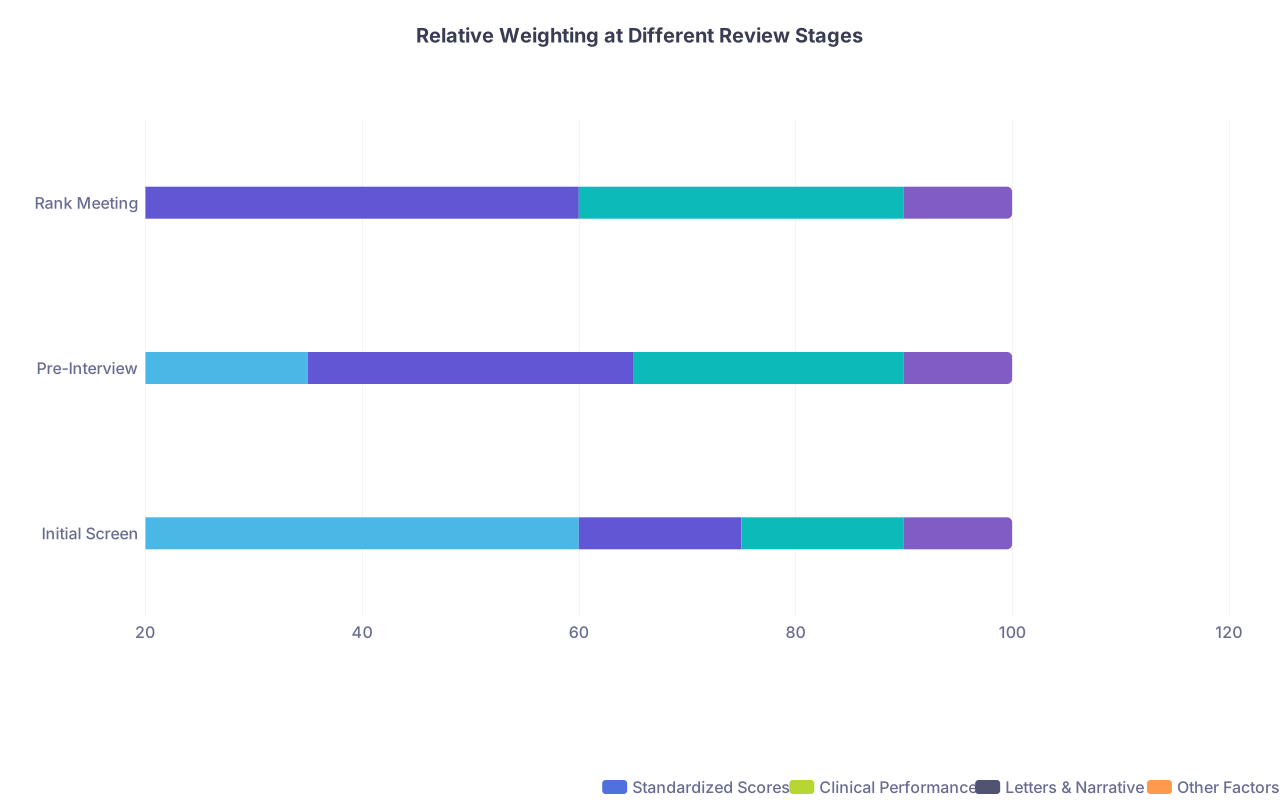
| Category | Standardized Scores | Clinical Performance | Letters & Narrative | Other Factors |
|---|---|---|---|---|
| Initial Screen | 60 | 15 | 15 | 10 |
| Pre-Interview | 35 | 30 | 25 | 10 |
| Rank Meeting | 20 | 40 | 30 | 10 |
Are these exact percentages? No. But this is roughly how many programs function.
- Early: scores are a blunt triage tool.
- Middle: rotation narratives, MSPE, and letters start to dominate.
- End: “Would I want this person on my team at 3 a.m.?” matters more than a 2-digit number.
Here is the part that most applicants never see: attendings and residents in those meetings absolutely fight for students with strong clinical reputations and weaker scores. I have watched multiple PDs say, “Yes, his Step 1 was a 211, but everyone says he is the best sub-I they have seen in three years. I will take him over another anonymous 250 any day.”
Not in neurosurgery at Mass General, sure. But in a large percentage of programs in IM, FM, peds, psych, OB, and even some mid-tier surgical programs, that debate happens.
2. How Different Specialties Actually Treat Low Scores vs. Clinical Performance
You cannot talk about “holistic review” in a vacuum. Anesthesia ≠ ortho ≠ family medicine. Different games, different rules.
| Specialty Type | Score Emphasis | Clinical Performance Emphasis | True Flexibility with Low Scores |
|---|---|---|---|
| Ultra-competitive (Derm, Ortho, ENT, Plastics, NSG) | Very High | High | Very Low |
| Competitive (Radiology, Anesthesia, EM at strong sites) | High | High | Low–Moderate |
| Mid (IM at academic centers, OB/GYN, General Surgery) | Moderate–High | Very High | Moderate |
| Less competitive (FM, Psych, Peds, Community IM) | Moderate | Very High | High |
Notice something: in the majority of fields, clinical performance can compete with or surpass test scores in importance once you pass the basic screening.
But that “once you pass” caveat is crucial. If your Step 2 is 202 and you failed once, no amount of glowing evals will save you at big-name academic general surgery programs. You have to be realistic.
3. The Three Core Data Streams Committees Use
When a holistic review committee is weighing a low score against strong clinical performance, they are essentially trying to answer one question:
“Does this person function at the level we need, in a real hospital, with real patients, on day one?”
They use three main buckets of evidence.
3.1 Standardized Scores: What They Actually Signal
Step scores (now mostly Step 2 CK, with Step 1 pass/fail) are treated as:
A crude proxy for:
- Test-taking ability
- Knowledge acquisition
- Work ethic / consistency over 1–2 years of study
A risk management tool:
- Will this resident pass boards?
- Will they require remediation?
- Are we going to be writing “failure to progress” documentation?
Committees do not love scores. They use them because they are:
- Comparable across schools
- Easy to sort
- Defensible to GME offices and hospital leadership
If your score is low, the subconscious reaction some committee members have is, “Will this be a headache for us later?” Holistic review is the process of either confirming or disproving that fear using the rest of your file.
3.2 Clinical Performance: The Signals That Overrule Scores
“Clinical performance” is not one thing. It is a set of converging signals:
- Core clerkship grades
- Sub-I / acting internship evaluations
- Narrative comments in the MSPE
- Letters from people who actually worked with you on the wards
- How you performed on away rotations (for some fields, this is everything)
What committee members look for is consistency and trajectory.
High-value phrases they key in on:
- “Top 5% of students I have worked with”
- “Already functioning at the level of an intern”
- “Sought out feedback and applied it quickly”
- “Managed complex patients independently with appropriate supervision”
- “Strong clinical judgment and can be trusted overnight”
Damning phrases:
- “Meets expectations” with no elaboration
- “Required closer than usual supervision”
- “Knowledge base is developing” (committee code for: not strong)
- “Sometimes struggled with multitasking and follow-through”
I have seen borderline scores essentially forgiven when multiple evaluators independently describe the same high-functioning, reliable, “I would take them on my team” phenotype. Conversely, I have seen very strong scores overridden by red flags like “difficult to work with” or “unreliable.”
3.3 Narrative + Interviews: The Context Layer
Holistic review is incomplete without context:
- Did you have a bad family event during Step 1 prep?
- Were you working 20–30 hours a week during preclinicals?
- Did you dramatically improve from Step 1 to Step 2?
- Did your clerkship grades rise as you got more comfortable clinically?
Context comes from:
- Personal statement
- MSPE contextual comments
- Advisor letter (at some schools)
- Your interview explanation—succinct, honest, not defensive
If your scores are low but everything else screams “excellent clinician,” committees often label you as “low test taker risk, low clinical risk” and move on.
4. The Internal Math: How Committees Reconcile a Low Score with Strong Clinical Work
Picture an actual discussion from a real meeting. It goes like this.
Applicant X:
- Step 1: Pass on second attempt
- Step 2: 224
- Core clerkships: H/H/H/HP/HP/P (but with clear upward trend)
- Sub-I: “Best student this year; can run the list independently”
- LOR from PD: “We are ranking him to match; please strongly consider him”
A senior faculty says: “Scores are below our usual median, I am concerned about boards.”
Then the PD says: “Yes, but his clinical performance is stellar, and our colleagues at his home program love him. He is exactly the type who does very well as a resident despite testing issues.”
The “math” they are doing in their heads is:
- Score risk: moderate
- Clinical performance risk: low
- Professionalism risk: low (assuming no concerns)
- Fit: high (if letters/interview align)
If the program genuinely follows holistic review, he is not only rankable—he can land in the middle of the list, ahead of multiple higher-scorers who were mediocre or awkward clinically.
The reverse is also true. Someone with:
- Step 2: 260
- Clerkships: mostly HP, some P
- Comments: “Bright but difficult to work with at times”
That person often ends up far lower on the rank list than they expected.
5. Different Program Types: How Much They Really Flex on Scores
You must match your strategy to the type of programs you are targeting.
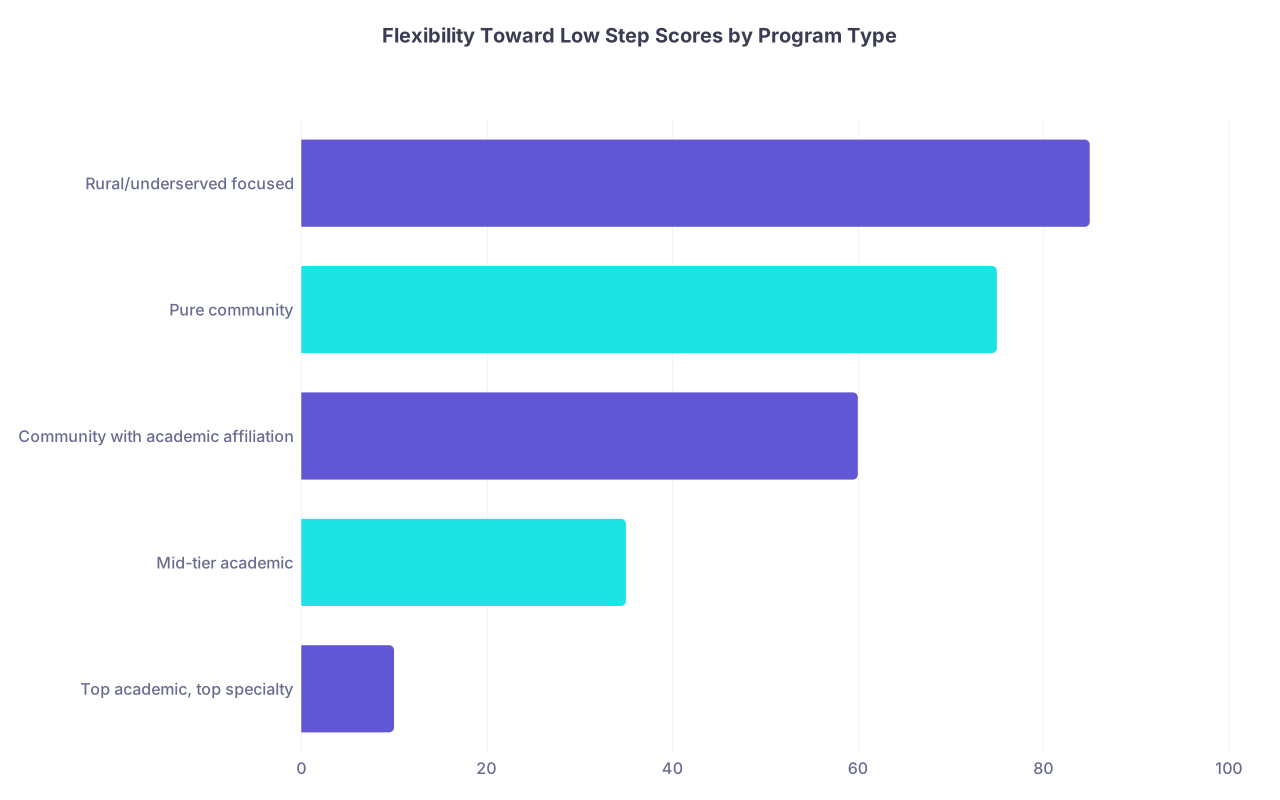
| Category | Value |
|---|---|
| Top academic, top specialty | 10 |
| Mid-tier academic | 35 |
| Community with academic affiliation | 60 |
| Pure community | 75 |
| Rural/underserved focused | 85 |
5.1 Top Academic, Top Specialty Programs
Examples:
- Ortho at HSS
- Derm at UCSF
- ENT at Iowa
Reality:
- Scores still used as a de facto gatekeeper.
- Holistic review tweaks which high-scorers get ranked high, not whether low-scorers get in.
- A low Step 2 (<230 for these fields) will almost always be disqualifying unless you have something extraordinary (PhD with heavy publications, former NCAA athlete with insane letters, etc.). Even then, odds are poor.
In these spaces, outstanding clinical performance is expected, not compensatory.
5.2 Mid-Tier Academic Programs
Think: university-based IM, OB, gen surg at large state schools.
Here, committees have tension between service needs and prestige. They need residents who:
- Will function safely on busy services
- Will pass boards on the first try
- Will not embarrass the program academically
This is where holistic review really matters. A few patterns I have seen:
The “low Step, stellar sub-I” candidate often makes the list if:
- They performed well at that specific institution
- They have a letter from someone the PD trusts
- They interviewed like a functioning intern, not a lost MS4
PDs will say things like:
- “Our intern class cannot be all 260s with no work ethic or social skills.”
- “I care more about whether I can put them on nights in July.”
5.3 Community and Community-Affiliated Programs
These programs live and die by resident performance on the wards.
Better PDs at these programs care deeply about clinical reliability. They often:
- Use score cutoffs only to filter out extreme risk (e.g., multiple fails, very low Step 2)
- Give real weight to:
- Strong letters from busy hospitals
- Comments like “runs the code team confidently”
- Extended sub-I time (4–8 weeks at their site)
If you have low scores but excellent clinical performance, this is where you have the most leverage.
6. What Counts as “Strong Clinical Performance” in Their Eyes
Applicants dramatically overestimate how meaningful “High Pass” on a transcript is and underestimate how much the narrative drives decisions.
Let’s break down what actually moves the needle.
6.1 Grades and Trends
Committees look for:
- How you performed in the core that matches the specialty:
- IM grades for IM, EM, cards, heme/onc
- Surgery for gen surg, ortho, ENT
- Psych for psych
- Upward vs downward trajectory
- Weak early, then H/HP in later rotations = forgiveness for early stumbles
- Strong early, then HP/P in advanced rotations = concern
6.2 Sub-I / Acting Internship Performance
This is where they want to see clear evidence you are basically already at PGY-1 level:
- Managed 6–8 patients independently
- Wrote complete, accurate notes without constant correction
- Anticipated tasks (labs, imaging, consults) without being spoon-fed
- Stayed late when the team was drowning, without being asked
Strong letters from these rotations are gold. Especially if they are from the same specialty and at the home or target program.
6.3 MSPE (Dean’s Letter) Narrative
Many students barely read their MSPE. Committees read it carefully. They look for:
- Patterns: “always prepared,” “strong work ethic,” “excellent bedside manner” showing up across different rotations
- Outliers: one rotation with “required additional supervision” will be heavily scrutinized
- Any reference to professionalism issues or remediation (these weigh more than any test score)
I have seen PDs write “No” in big letters next to an applicant because of a single, ugly professionalism comment—even with a 250+.
6.4 Letters of Recommendation: The Real Tiebreaker
Letters are not all equal. Committees give more weight to:
- Letters from people they know or institutions they respect
- Letters from PDs and vice chairs over junior faculty, unless the junior faculty is clearly substantive and specific
- Letters with concrete examples:
- “On a busy night float, she took responsibility for cross-covering 70 patients, handled multiple rapid responses, and communicated clearly with seniors.”
Vague letters with a high-level summary are almost worthless. They do not help override low scores.
7. Specific Scenarios: How Holistic Review Plays Out for Different Score Profiles
Let’s run through real-world archetypes.
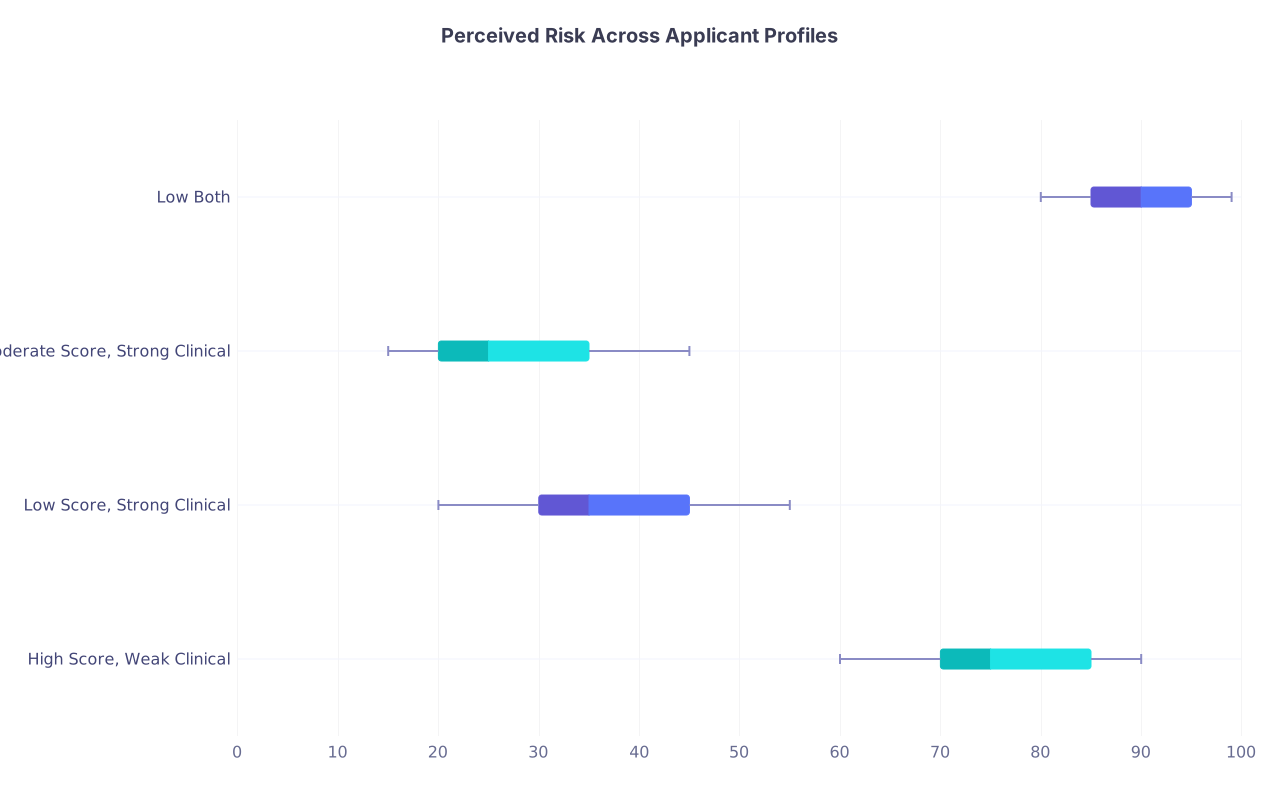
| Category | Min | Q1 | Median | Q3 | Max |
|---|---|---|---|---|---|
| High Score, Weak Clinical | 60 | 70 | 75 | 85 | 90 |
| Low Score, Strong Clinical | 20 | 30 | 35 | 45 | 55 |
| Moderate Score, Strong Clinical | 15 | 20 | 25 | 35 | 45 |
| Low Both | 80 | 85 | 90 | 95 | 99 |
Here, a higher number = higher perceived risk to the program.
7.1 Low Step 1, Higher Step 2, Strong Clinical
Example:
- Step 1: 205, Step 2: 238
- Clerkships: strong with upward trend
- Sub-I letters: “One of our best students”
How committees see this:
- Academic trajectory: improving.
- Core question: “Was Step 1 a fluke, or a predictor?”
- With a strong Step 2, many programs will consider Step 1 forgiven, especially if you explain briefly (not melodramatically) in your interview.
This is the classic “salvageable” profile where clinical performance can absolutely outweigh the initial low score.
7.2 Modestly Low Step 2, Excellent Clinical, Great Letters
Example:
- Step 1: Pass, Step 2: 220–225
- All H/HP in relevant clerkships
- MSPE glowing
- Sub-I at their institution: “We would be happy to have them as an intern”
Committee reaction:
- “Scores are a mild board risk. But clinically, this person is strong and everyone loves working with them.”
- In IM, FM, psych, peds, many programs will rank this applicant comfortably.
- In gen surg/OB at mid-tier places, still possible with a strong audition and home support.
7.3 Strong Scores, Mediocre Clinical, Weak Fit
Example:
- Step 2: 245
- Clerkships: mostly HP, a couple P
- Comments: “Needed frequent redirection,” “Occasional difficulty with feedback,” “Reserved; had trouble integrating with team”
This is where committees lean on holistic review to downgrade someone.
They often say: “She is clearly smart, but will she struggle on nights? Will patients like her? Will nurses call us complaining?” If there are plenty of strong applicants, they may not bother taking that risk.
8. What You Should Actually Do if Your Scores Are Low
Enough theory. Let me give you actual strategy.
8.1 Diagnose Your Situation Honestly
You cannot fix what you refuse to see.

| Step | Description |
|---|---|
| Step 1 | Low Step Score |
| Step 2 | Push clinical strength |
| Step 3 | Focus on less competitive fields and community programs |
| Step 4 | Emphasize improvement, remediation, and support |
| Step 5 | Target mid and community programs |
| Step 6 | Heavily leverage home institution and advisors |
| Step 7 | Step 2 above pass by >15? |
| Step 8 | Multiple fails? |
Figure out:
- How low are we talking? Barely above passing is different from 225 vs 250 target.
- Did you improve from Step 1 to 2?
- Are your clinical evals actually strong, or just “fine”?
8.2 Maximize Your Clinical “Stack”
If scores are your weakness, your clinical portfolio must be airtight:
- Choose rotations where you will be seen and trusted, not where you can hide. Busy inpatient services beat cushy outpatient electives.
- Do a sub-I in the specialty you want, ideally at:
- Your home institution, and
- One or two realistic target programs (not fantasy reach programs that will auto-filter your score)
On those rotations:
- Be the first one there and the last to leave when the team is drowning.
- Own your patients; know everything about them. The intern should trust your notes.
- Ask for feedback early, implement it, and circle back: “Am I progressing as you would expect?”
You want attendings to write things like “ran the team list,” “anticipated care needs,” “rare level of ownership.” That is how you override a number.
8.3 Construct a Coherent Narrative
Holistic review means they expect you to integrate your own story.
Your personal statement and interview should:
Acknowledge the testing weakness briefly, with no excuses:
- “I underperformed on Step 1 during a period when I had not yet figured out how to study for large standardized exams. I adjusted, sought faculty support, and improved both my Step 2 and my performance on shelf exams, which better reflect how I approach patient care.”
Pivot quickly to:
- Concrete clinical strengths
- What you did differently
- How your current performance reflects who you actually are
Do not write a three-paragraph tragedy about your Step 1. No one on a committee wants that.
8.4 Leverage Advocates Strategically
One strong voice in the room matters more than you think.
- Ask attendings who really know your work clinically to write your letters, not the biggest name who barely remembers you.
- Tell them, explicitly but respectfully:
- “I had a relatively low Step score, but my clinical work has been much stronger. If you feel you can honestly speak to my readiness to function as an intern, that would be incredibly helpful.”
A PD reading “Despite a below-average Step score, I have zero hesitation about this student’s ability to handle the workload and complexity of our residency” will relax about your metrics.
9. Where the Line Is: When Even Holistic Review Cannot Save You
Some situations are simply very hard to overcome:
- Multiple Step failures, with no subsequent strong test performance
- Consistently mediocre or poor clinical evaluations
- Documented professionalism breaches in MSPE
- No strong letters from the specialty you are applying into
Holistic review is not magic. It is not a charity. Programs have service needs, accreditation requirements, and call schedules to cover.
If your file signals:
- High risk of board failure
- High risk of clinical incompetence
- High risk of professionalism problems
No amount of wordsmithing will change that. In those scenarios, the smart move is:
- Adjust specialty choice and program tier
- Consider a transitional/prelim year if advised by trusted faculty
- Sometimes, reassess the path entirely if multiple advisors are steering you away
That sounds harsh. It is. But pretending otherwise does you no favors.
10. The Bottom Line: How Committees Actually Weigh It
Let me distill the reality.
When a holistic review committee looks at “low scores vs. clinical performance,” they are not picking one or the other. They are doing an informal risk-benefit calculation:
- If scores are low but:
- Clinical performance is excellent
- Letters are strong and specific
- Behavior is professional
- Story is coherent
They often say: “We will take the testing risk to get this caliber of teammate.”
If scores are strong but:
- Clinical feedback is lukewarm or negative
- Fit is poor or professionalism is questionable
They say: “We can find someone else with a good score who is not a headache.”
Your job, if you have low scores, is not to argue that scores “should not matter.” They do. Your job is to build such an overwhelmingly strong clinical, letter, and narrative profile that any reasonable committee concludes:
“This person may not be a perfect test-taker, but on the wards, I would trust them. And that is what matters most.”
Key points:
- Holistic review does not erase low scores, but strong, well-documented clinical performance can absolutely override them at many programs and in many specialties.
- Committees make decisions based on perceived risk: steady clinical excellence, specific letters, and a clear upward trajectory lower that risk more than any apology about Step 1 ever will.
- If your scores are weak, your only rational strategy is to double down on high-intensity clinical rotations, secure powerful letters from supervisors who truly know your work, and present a concise, honest narrative that shows growth rather than excuses.