
Most students handle low Step scores badly—and their Dean’s Letter addendum makes it worse, not better.
Let me walk you through how to do this correctly, like someone who understands how program directors actually think.
You are not writing an apology note. You are building a controlled, professional, evidence-based narrative that lets PDs understand: “This is what happened, this is why it is unlikely to happen again, and here is why you should still trust me with your residency spot.”
We are talking specifically about a Dean’s Letter addendum (MSPE addendum), not just a personal statement paragraph. Different audience. Different purpose. Different rules.
1. What a Dean’s Letter Addendum Actually Is (And Is Not)
A Dean’s Letter/MSPE addendum is a formal institutional statement, usually:
- Written or co-written by a dean or student affairs dean
- Attached to or embedded within the MSPE
- Used to contextualize anomalies: low or failed Step scores, leaves of absence, professionalism notes, major personal/health crises
You are not the primary author in some schools; in others, you draft and they edit. But your job is the same: shape the content and tone so it helps you rather than quietly undermines you.
Here is the core problem:
Most addenda are either:
- Vague: “Student had personal circumstances affecting performance.” Translation for PDs: chaos.
- Overconfessional: long emotional narratives, too much detail. Translation: liability.
- Defensive: blames the exam, NBME, Prometric, “test anxiety.” Translation: risk.
Your goal is none of those. Your goal is targeted, specific, restrained.
2. When You Actually Need a Dean’s Letter Addendum
Not everyone with a low Step score needs an addendum. Some of you are trying to “explain” scores that do not need rescuing.
Broadly:
USMLE Step 1 (pre‑pass/fail era)
- Below ~210: explanation helps, especially for competitive specialties or strong academic programs.
- A fail: explanation is mandatory.
USMLE Step 2 CK (current reality)
- Below ~220: borderline for competitive specialties; an addendum may help if there is a clear, contained explanation and strong upward trajectory.
- Below ~210: most PDs will want context.
- A fail: you need an addendum. Non‑negotiable.
If there is a clear event cluster (illness, family crisis, leave of absence, documented neurocognitive condition) that intersects with the exam date → you should consider an institutional addendum, not just a throwaway line in your personal statement.
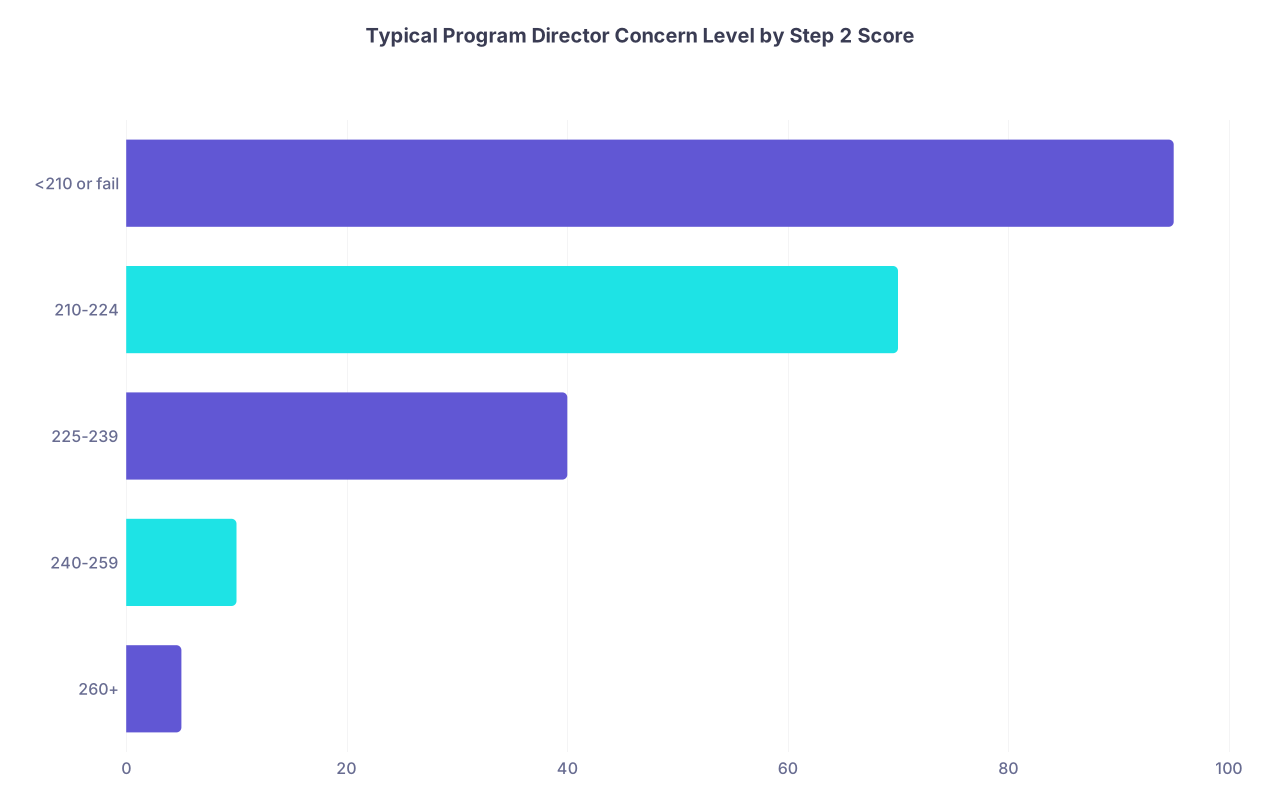
| Category | Value |
|---|---|
| 260+ | 5 |
| 240-259 | 10 |
| 225-239 | 40 |
| 210-224 | 70 |
| <210 or fail | 95 |
I have seen PDs say this verbatim: “I can work with a low score if I understand it and see evidence it is not a pattern.” That is exactly what your addendum is built for.
3. Strategic Principles Before You Draft Anything
If you ignore this section and just start writing, you will probably overexpose yourself.
Principle 1: PDs read these as risk assessments, not heartwarming stories
They ask:
- Is this problem likely to recur?
- Does this student accept responsibility?
- Is there evidence of growth and remediation?
- Are they going to fail boards in residency?
Emotional impact is secondary. Predictive value is primary.
Principle 2: Less is more, but “less” must be concrete
Vague: “There were personal circumstances that affected performance.”
Better: “During the 6 weeks before Step 2, the student was managing a first‑degree family member’s critical illness requiring frequent out‑of‑state travel; this is now resolved.”
Do not list every detail. Do not narrate the ICU day by day. But give enough specificity to demonstrate:
- This was real.
- This was time‑limited.
- This is not ongoing.
Principle 3: Never sound like you are blaming the test
“I am a poor standardized test taker” with no evidence of change = PD kryptonite.
If you have a documented learning disability or ADHD that was diagnosed late, you can reference it briefly, but only in the context of:
- Now formally evaluated
- Accommodations in place
- Demonstrated improvement (clerkship exams, NBME shelves, remediation results)
No diagnosis? Do not casually drop “test anxiety” as your main explanation. It reads as generic and unconvincing.
Principle 4: Anchor your explanation in documented facts
This is an institutional letter. Assume PDs may verify content by:
- Looking for leaves of absence
- Reviewing transcript timing
- Noticing gaps in clerkships
If your “crisis” does not match anything in the record and has no paper trail, tread carefully. It does not need to be fully documented in the chart, but it should at least be plausible and consistent with your timeline.
4. The Ideal Structure of a Dean’s Letter Addendum
Think of this like a carefully controlled, 4‑paragraph professional memo. Not a personal essay.
Here is the backbone structure that works:
- Identification of the issue
- Context—brief, factual explanation
- Evidence of improvement / remediation
- Forward‑looking reassurance
Let me break down each part with sample language.
1) Identification of the issue
One or two sentences. Straight, professional.
- “Student X sat for USMLE Step 2 CK on [month/year] and achieved a score of 209, which was below the student’s institutional performance expectations and below the national mean.”
- “Student X initially did not pass USMLE Step 1 on the first attempt (score: xxx), and subsequently passed on the second attempt.”
No hedging. No euphemisms like “slightly below potential.” PDs see the score right in ERAS anyway.
2) Context—brief, factual explanation
Three to five sentences. This is where most students either under‑ or over‑share.
Examples:
“The period leading up to Step 2 CK coincided with a major personal stressor. A first‑degree family member experienced a sudden critical illness requiring multiple hospitalizations and out‑of‑state travel. The student continued clinical responsibilities while managing these demands, which limited dedicated preparation time. The family member’s condition has since stabilized, and these responsibilities have resolved.”
“During the preclinical years, Student X struggled with undiagnosed attention‑related challenges that affected standardized test performance. A formal neuropsychological evaluation in [month/year] resulted in a diagnosis of ADHD and the initiation of appropriate treatment and testing accommodations. These interventions occurred after the initial Step 1 attempt.”
You will notice:
- Concrete but not graphic.
- Time‑bounded description (“during the 6 weeks leading up to”).
- Clear resolution or change.
What you must avoid:
- Excessive emotion: “I was completely devastated and could not focus at all.”
- Moral self‑judgment: “This was entirely my fault because I did not manage my time and I let everyone down.”
- Blame shifting: “The exam questions were poorly written and did not reflect the material I studied.”
3) Evidence of improvement / remediation
This is the part most people forget. Without it, your explanation is a story, not data.
You need objective signals that PDs recognize:
- Later exams
- NBME shelf trends
- Repeated course performance
- USMLE Step 2 (if you are explaining Step 1)
- In‑training exam practice results (if available through your school)
| Metric Type | Strong Signal Example |
|---|---|
| NBME Shelves | Scores trending to ≥70th % |
| Step 2 CK | ≥ 15–20 points above Step 1 |
| Clerkship Honors | Multiple core honors |
| Remediation | Passed on first repeat with solid margin |
Sample language:
“Since that time, Student X has demonstrated substantially improved performance on standardized assessments. NBME subject examinations have ranged from the 60th to 80th percentile across core clerkships, and the student passed all clinical rotations on the first attempt.”
“Following the initial Step 1 result, Student X engaged in a structured remediation plan including weekly meetings with the learning specialist, a revised study schedule, and targeted question‑bank usage. This culminated in a passing score on the second Step 1 attempt and a Step 2 CK score of 232.”
If you do not have strong upward data, you need to be honest but as constructive as possible. Then you lean more on process: tutoring, learning specialists, coaching, standardized test prep, etc. It is weaker, but still better than silence.
4) Forward‑looking reassurance
One or two sentences. This is where the dean endorses your readiness.
“Based on this trajectory and the student’s consistently strong clinical evaluations, our faculty believe that Student X is prepared to meet the academic requirements of residency training.”
“We expect that Student X will continue to perform reliably on future standardized assessments with the structure and support of a residency program.”
This is subtle but important. PDs want to know: Does the home institution still trust this person?
5. How to Work with Your Dean’s Office Strategically
You are not writing this in a vacuum. You are working inside a political, risk‑averse academic office. Understand that reality.
Step 1: Request an addendum the right way
Do not show up saying, “I need you to explain my low score so programs don’t think I am dumb.” That is a good way to get a flat no.
Instead, frame it like this:
- “Given the timing of [specific event] relative to my Step performance, I wanted to ask whether an MSPE addendum would be appropriate to briefly contextualize the score.”
- “I have documentation of [illness/leave/evaluation] and have shown improvement on NBME shelves and clerkship performance. Would you be open to including a concise addendum to help programs interpret my record accurately?”
You are signaling three things: there was a real event, it is documented, and there is improvement.

| Step | Description |
|---|---|
| Step 1 | Identify Step issue |
| Step 2 | Gather documentation |
| Step 3 | Analyze performance trend |
| Step 4 | Email Student Affairs dean |
| Step 5 | Meeting to discuss |
| Step 6 | Draft proposed language |
| Step 7 | Shift explanation to personal statement |
| Step 8 | Dean edits and finalizes |
| Step 9 | Addendum attached to MSPE |
| Step 10 | Dean agrees? |
Step 2: Draft suggested language yourself
Most deans are busy. If you give them a clean, professional draft, many will lightly edit and sign off.
Your draft should:
- Follow the 4‑part structure above
- Be 150–300 words max
- Use neutral, institutional tone (third person, no “I”)
Example opening you would send:
“Below is suggested language for an optional MSPE addendum regarding my Step 2 CK performance. Please feel free to modify or shorten as you think appropriate.”
Deans appreciate that framing. You are not dictating; you are offering.
Step 3: Push back gently if they over‑sanitize to meaninglessness
Sometimes the edited version becomes:
“Student X’s Step 2 CK score should be interpreted in the context of personal circumstances.”
That says nothing. PDs will assume the worst.
It is reasonable to respond:
- “Would it be possible to keep one brief sentence describing the nature and timing of the circumstances (e.g., managing a critically ill first‑degree family member during the 6 weeks prior to the exam) and one sentence referencing the improvement in NBME shelf scores? I think that would give programs just enough context without excessive detail.”
You will not always get what you want. But you can usually get something stronger than vague platitudes.
6. Sample Addendum Templates You Can Adapt
Let me give you concrete patterns. These are not copy‑paste; they are scaffolds.
A. Low but passing Step 2 CK due to acute family crisis
“Student X sat for USMLE Step 2 CK in August 2025 and scored 211, below our institutional average. The 6 weeks leading up to the exam coincided with a sudden critical illness in a first‑degree family member, necessitating frequent travel and substantial family caregiving responsibilities concurrent with clinical rotations. These acute demands limited dedicated preparation time. The family member’s condition has since stabilized, and these responsibilities have resolved.
Since that exam, Student X has demonstrated strong and consistent clinical performance, with NBME subject examination scores ranging from the 55th to 75th percentile and positive evaluations across all core clerkships. Based on this trajectory, we believe this Step 2 CK score underestimates the student’s current capabilities, and we expect continued reliable performance on future assessments in residency.”
B. Initial Step 1 fail followed by strong Step 2 CK
“Student X did not pass USMLE Step 1 on the first attempt in June 2023. At that time, the student was adjusting to a new testing environment and had not yet engaged fully with institutional learning resources. After this result, Student X worked closely with our academic support team, revised study strategies, and completed a structured remediation program. The student passed Step 1 on the second attempt in February 2024.
Following this remediation, Student X’s performance on subsequent standardized assessments improved substantially. NBME subject examinations during the third‑year clerkships were consistently at or above the national mean, and USMLE Step 2 CK was completed in August 2024 with a score of 234. Our faculty view this improvement as reflective of the student’s current academic abilities and readiness for residency training.”
C. Chronic learning difficulty, late diagnosis
“Throughout the early preclinical curriculum, Student X experienced difficulty with timed, standardized examinations, despite satisfactory performance in coursework and small‑group settings. In late second year, the student underwent formal neuropsychological assessment and was diagnosed with ADHD. Treatment and appropriate testing accommodations were initiated shortly thereafter.
This diagnosis and subsequent interventions occurred after the initial Step 1 attempt, which resulted in a marginal pass. Since implementing these accommodations and working with our learning specialist, Student X has demonstrated improved exam performance, including NBME subject exam scores generally at or above the 60th percentile and successful completion of all core clerkships. Based on this pattern and the strategies now in place, we anticipate that the student will be able to meet the exam requirements of residency.”
Edit the details to match your situation, but keep the structure.
7. Where Else to Address the Low Step Score (And What to Avoid)
The Dean’s Letter addendum is not your only tool. You still have:
- Personal statement
- ERAS experiences section
- Interview conversations
But you must keep stories consistent across all channels.
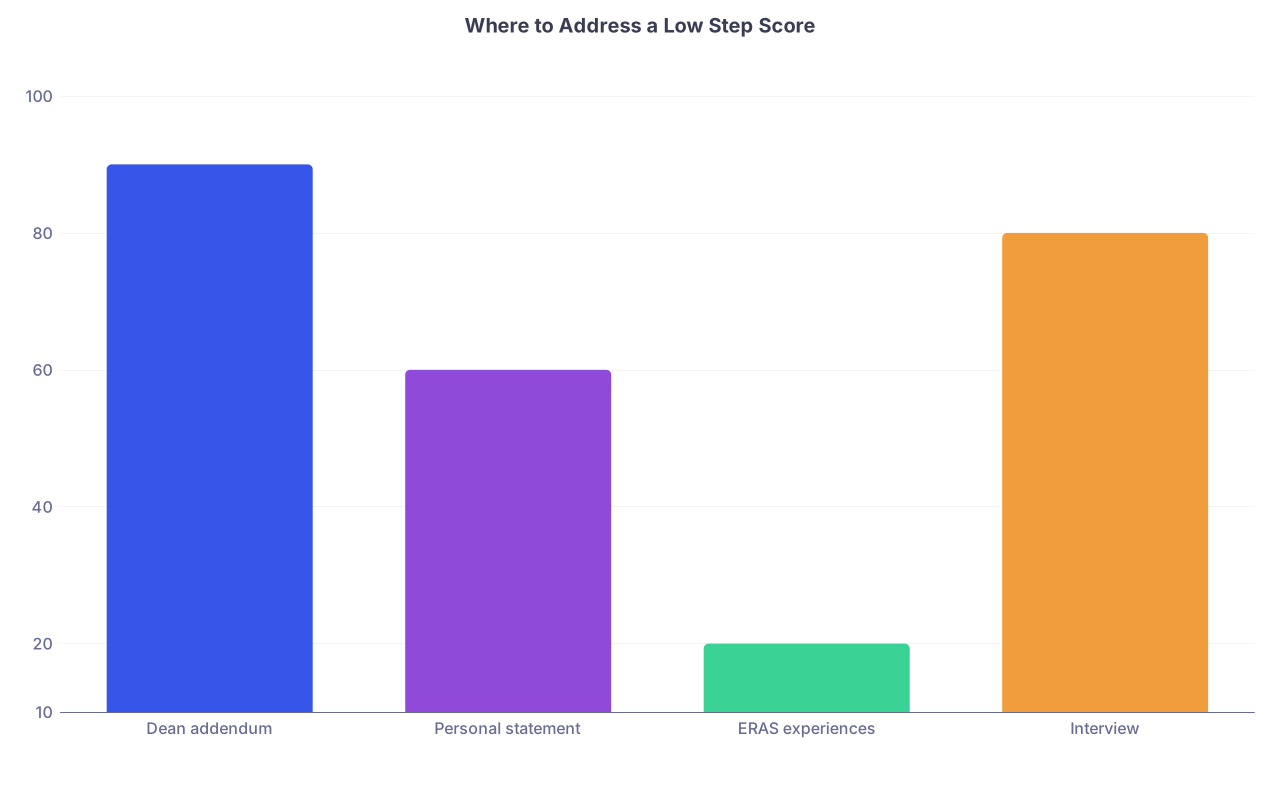
| Category | Value |
|---|---|
| Dean addendum | 90 |
| Personal statement | 60 |
| ERAS experiences | 20 |
| Interview | 80 |
Dean’s Letter Addendum
- Tone: institutional, neutral, third person
- Function: objective context and reassurance
- Audience: PDs, interview screeners
Personal Statement
Very brief reference if needed, usually one to two sentences, and only if it ties logically to a broader theme (resilience, growth, learning style).
Bad:
“I failed Step 1 and was devastated, but this taught me perseverance.”
PD reaction: overdone, generic.
Better:
“A challenging Step 1 experience forced me to reassess my learning approach. Through structured remediation and support, I developed more efficient study methods that later translated to stronger clinical exam performance.”
Interview
If they bring it up—and many will—you need a 60–90 second answer that matches the addendum.
Framework:
- Briefly state what happened
- Name one or two contributing factors
- Describe what you changed concretely
- End with your evidence of improvement
If your story in the interview does not match the MSPE language, PDs will notice. I have heard them comment on it in rank meetings.
8. Common Mistakes That Quietly Sabotage You
Let me be blunt. I see the same errors over and over.
Turning the addendum into therapy
You are not processing your feelings here. You are signaling risk level to PDs.Overemphasizing “test anxiety” with no hard evidence of change
If your pattern is: MCAT low, Step 1 low, Step 2 low, NBME shelves low—no amount of “I have test anxiety” will convince them that future board exams will magically be different.Blaming the school, curriculum, or NBME
Any hint of “they did not prepare me” or “the exam content was unfair” makes you look unprofessional.Writing like a student, not an institution
The addendum should not sound like an email you wrote at 2 am. It must sound like the dean’s office—measured, formal, fact‑based.Going silent when a fail or very low score obviously needs context
Silence invites speculation. Speculation is usually harsher than reality.
9. A Simple Checklist Before You Finalize Anything
Before you send a draft to your dean’s office, run through this:
- Does it clearly identify the exam and the performance issue in 1–2 sentences?
- Does it provide a specific, time‑limited context, not just “personal circumstances”?
- Is there at least one clear piece of objective evidence of improvement?
- Is the tone factual, not emotional, blaming, or self‑punishing?
- Is it under ~300 words?
- Does it align with what you might say in an interview if asked?
If you can answer yes to all of those, your addendum is probably doing its job.

10. Final Thoughts
Low Step scores are not automatic death sentences. But unexplained, uncontextualized low Step scores? Those are much harder to overcome.
A well‑constructed Dean’s Letter addendum does three critical things:
- It converts mystery into a bounded, understandable event. PDs can work with that.
- It points to credible evidence that the problem has been addressed. Not just “I learned a lot,” but real performance data.
- It lets your institution publicly stand behind you. That endorsement matters more than applicants realize.
Use the addendum as a precise tool, not an emotional outlet. Facts, structure, restraint. That is how you contextualize a low Step performance without letting it define your entire application.