
The myth that “a low Step score ruins everything” is lazy thinking. Program directors do not look at your score in a vacuum—they weigh it against your clinical performance, reliability signals, and trajectory. Clerkship grades are one of the few levers that can actually counterbalance a weak Step.
Let me break down exactly how that tradeoff really works on the PD side of the screen.
How PDs Actually Integrate Scores and Clerkships
Most students imagine a clean hierarchy: Step score first, then everything else. That is not how busy PDs work through 2,000 ERAS files.
A more honest version looks like this:
Hard screens
- Board scores (if still using numeric or pass/fail history)
- Fails or repeats (Step and clerkships)
- Home/affiliate school preference
- Visa / citizenship status
“Is this person safe?” check
- Any exam failures?
- Any remediation or professionalism concerns?
- Shelf/subject exam patterns?
- Big inconsistencies in performance?
Differentiation among the “maybes”
- Clerkship grades trend and narrative language
- Comparative ranking: “top 5% of students I’ve worked with” vs “solid performer”
- Letters contextualizing low scores
- Research / fit / life experience
Your Step score gets you through (or knocks you out of) step 1 and 2. Your clerkship grades + narrative comments do most of the work in step 3. With a low Step, your clerkship record often becomes your only way back into serious consideration—especially in core clinical specialties (IM, FM, peds, psych, EM, OB/GYN, gen surg).
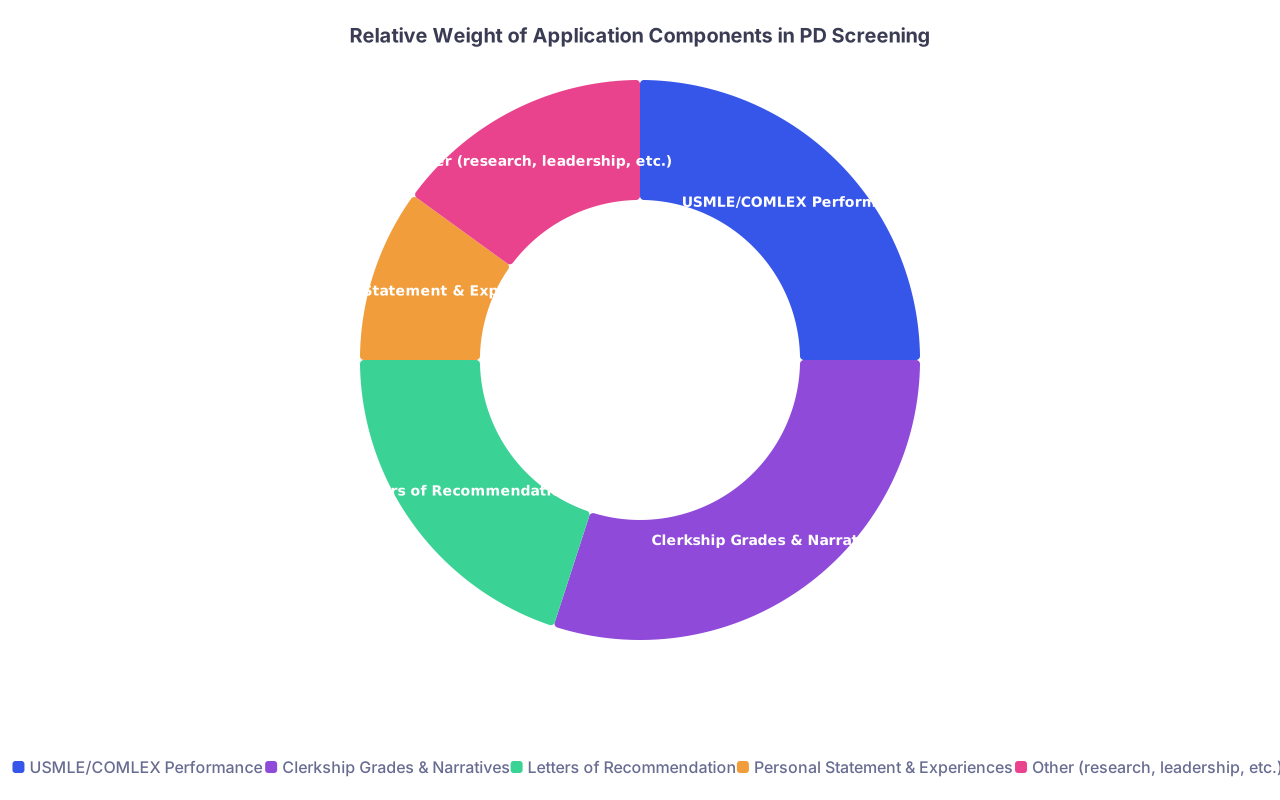
| Category | Value |
|---|---|
| USMLE/COMLEX Performance | 25 |
| Clerkship Grades & Narratives | 30 |
| Letters of Recommendation | 20 |
| Personal Statement & Experiences | 10 |
| Other (research, leadership, etc.) | 15 |
Those weights are not exact, but they capture reality: once you clear raw score filters, clerkships plus letters drive most decisions.
The Baseline Rules: When Low Step Scores Are Actually Disqualifying
You cannot “clerkship your way out” of every score problem. Some combinations are structurally toxic in PD eyes.
Think of three separate problems:
- Low but passing score (e.g., Step 2 CK 212 for IM, 222 for surgery)
- Very low score near failure cutoff
- Actual exam failure (Step 1, Step 2, COMLEX Level 1/2)
PDs do not treat these the same, and no amount of honors in clerkships neutralizes a serious standardized testing liability in highly competitive fields.
| Scenario | PD Initial Reaction | Can Outstanding Clerkships Rescue You? |
|---|---|---|
| Slightly low but passing (borderline for specialty) | Cautious, but open | Yes, particularly in core clerkships for that specialty |
| Very low but passing (near fail line) | Concern about exam safety | Partially, but will need explicit explanations in MSPE/letters |
| One Step or COMLEX fail, then solid pass | Major red flag, but context-dependent | Only in less competitive specialties and with strong upward trend |
| Multiple exam failures | Essentially disqualifying at most places | Rarely salvageable no matter how good clerkships are |
Here is the blunt version:
- A single low-but-passing score: clerkships matter a lot.
- A fail: clerkships matter, but mainly to decide whether you get a mercy look, usually in less competitive settings.
- Multiple fails: programs are thinking risk management, not rescue missions.
How PDs Read Clerkship Grades When Scores Are Weak
Clerkship grades are not interpreted in isolation. PDs are asking a specific question:
“Does this person’s actual clinical performance reassure me that their low score is not who they really are?”
They are looking for patterns in three buckets:
- Grade distribution by clerkship
- Shelf vs. clinical evaluation mismatch
- Narrative comments and comparative language
1. Grade Distribution: Where You Honored Matters
Not all honors are created equal. If your Step score is low and you are applying to internal medicine, an Honors in psych and OB means less than High Pass/Honors in IM and surgery.
Here is how PDs mentally rank clerkship relevance for a few specialties (assuming low score scenario):
| Specialty | Highest-Impact Clerkships | Moderate Impact |
|---|---|---|
| Internal Medicine | IM, Sub-I in IM | Surgery, FM, Neurology |
| General Surgery | Surgery, Surgical Sub-I | IM, EM |
| Pediatrics | Peds, Peds Sub-I | FM, OB, IM |
| Family Medicine | FM, IM | Peds, Psych, OB |
| Psychiatry | Psych, IM | Neurology, FM |
If your Step 2 CK is 215 and you want IM, but you have:
- IM: Honors
- Surgery: High Pass
- FM: Honors
- Peds: High Pass
A lot of PDs will mentally downgrade their concern. They will think: “Okay, test is weak, but clinically this person functions at or above expectations in the exact environment I care about.”
Flip it:
- IM: Pass
- Surgery: Pass
- Peds: High Pass
- Psych: Honors
With the same Step 2 CK, now the narrative changes to “low score plus weak performance in the core I care about.” Many PDs will not take the risk, especially with plenty of applicants in the queue.
2. Shelf vs Clinical Performance: “Test Problem” vs “Work Ethic Problem”
PDs understand that not all low scores reflect intelligence. They try to extract whether your issue is:
- Primarily standardized test weakness, or
- A more global problem: effort, organization, clinical thinking.
They do this by comparing:
- Shelf exam scores/percentiles (if reported)
- Clinical evaluation ratings (work ethic, reliability, communication)
Here is a pattern that reassures PDs when Step is low:
- Step 2 CK: 214
- IM shelf: 60th percentile
- IM clinical eval: “Top 10% of students… self-directed, reads daily, presents clearly.”
- Final IM grade: High Pass or Honors
Interpretation: “This person tests better in the real context than on the single big exam. They show up clinically. Probably test anxiety or bad timing for the Step, not a fundamental knowledge gap.”
Now compare with this:
- Step 2 CK: 214
- IM shelf: 25th percentile
- IM clinical eval: “Meets expectations; sometimes needs prompting to read about patients”
- Final IM grade: Pass
Interpretation: “Consistent low performance on standardized and real-world measures. No evidence they can rise above baseline.”
Clerkship grades help PDs decide whether your low Step is an aberration or a representative sample.
3. Narrative Language: The Phrases That Really Matter
You will not see many PDs admit this, but the exact adjectives and ranking language in narrative evaluations often outweigh the letter grade.
Some examples I have seen turn decisions:
- “Among the top 5% of students I have supervised in the last 10 years.”
- “Already functioning at the level of a first-year resident.”
- “Our team repeatedly commented on how much we trusted this student with complex tasks.”
- “Exceptional clinical reasoning and ownership of patient care.”
Those phrases, attached to a low Step score, say: “Yes, the score is mediocre, but this person is absolutely strong where it counts.”
Compare that with dead, faint-praise language:
- “Pleasant and cooperative.”
- “Will make a solid resident.”
- “Shows appropriate interest in patient care.”
- “Completed assigned tasks.”
In a low-score context, this type of language sinks you. It confirms the PD’s concern instead of countering it.
Concrete Score–Clerkship Scenarios and How PDs React
You want specifics. Let us run through some composite cases that mirror what PDs actually see.
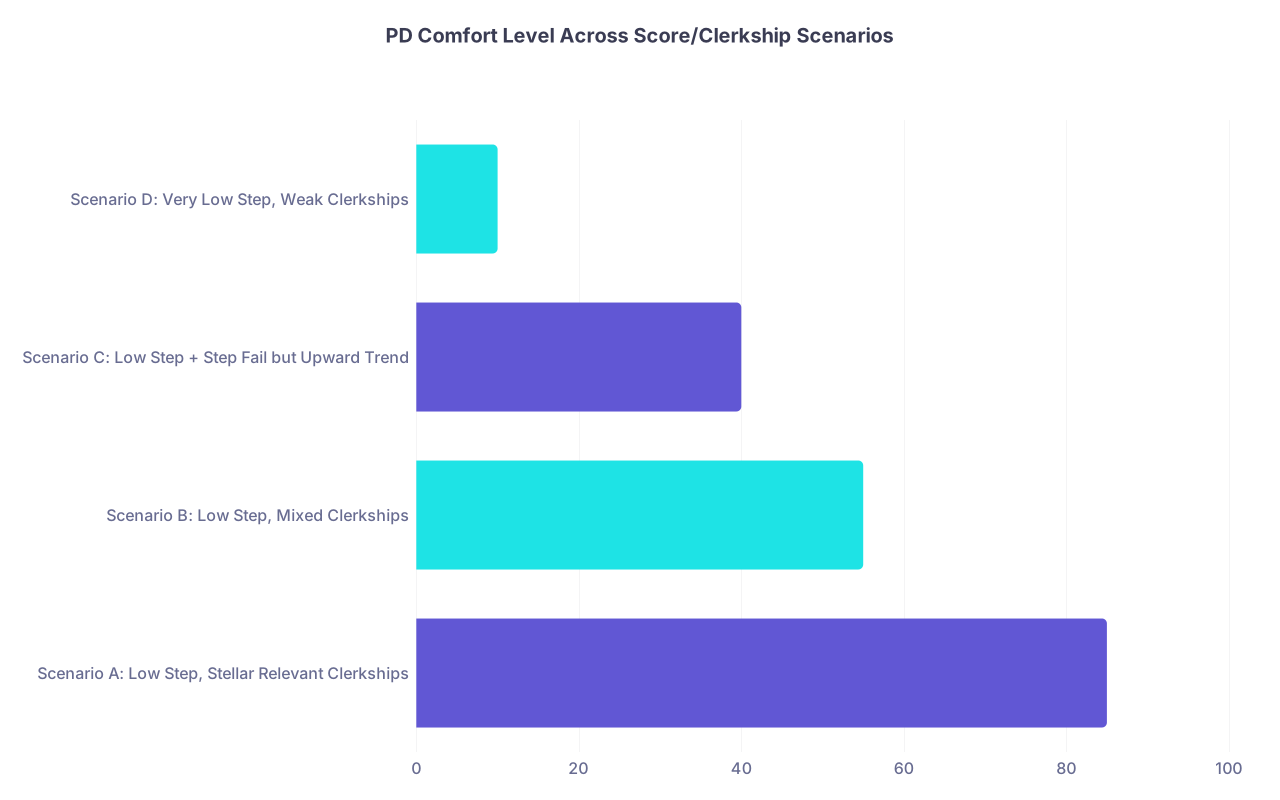
| Category | Value |
|---|---|
| Scenario A: Low Step, Stellar Relevant Clerkships | 85 |
| Scenario B: Low Step, Mixed Clerkships | 55 |
| Scenario C: Low Step + Step Fail but Upward Trend | 40 |
| Scenario D: Very Low Step, Weak Clerkships | 10 |
Scenario A: Low Step, Stellar Core Clerkships
- Specialty: Internal Medicine
- Step 2 CK: 215
- Clerkships:
- IM: Honors, “top 10%” language
- Surgery: High Pass
- Peds: High Pass
- FM: Honors
- No exam failures.
PD thought process at a mid-tier academic IM program:
- Score is below our typical mean, but not catastrophic.
- Direct evidence they function extremely well in IM.
- Letters likely to back this up.
- If their MSPE/letters confirm strong clinical reasoning and reliability, they are very much interviewable.
In other words: the clerkships neutralize a lot of the Step liability. You are unlikely to match at top-10 IM programs, but you are absolutely competitive for solid academic and strong community programs—if the rest of your application is coherent.
Scenario B: Low Step, Mixed Clerkships
- Specialty: Pediatrics
- Step 2 CK: 212
- Clerkships:
- Peds: High Pass, “performed at expected level”
- IM: Pass
- Surgery: Pass
- Psych: Honors
- No failures.
At a pediatrics program, PD sees:
- Lowish score.
- Okay but not stellar performance in the target specialty.
- Weakness in IM and surgery—areas they care about for generalist training.
Here clerkship grades do not save you. They keep you in the “maybe” pile for lower- to mid-tier programs, but you lose ground to applicants with similar scores but stronger Peds/IM performance.
This is where targeted away rotations and sub-Is can help. If you claw out an Honors on a Peds sub-I with a killer narrative letter, you can partially rewrite your profile. Without that, you are hoping to land in programs that prioritize personality/fit and service need over pure metrics.
Scenario C: Step Failure + Strong Recovery + Great Clerkships
- Specialty: Family Medicine
- Step 1: Fail on first attempt, then Pass
- Step 2 CK: 219
- Clerkships:
- FM: Honors, “functioned like an intern”
- IM: High Pass
- Peds: High Pass
- OB: Pass but with “worked hard, very receptive to feedback” language
PD at a community-based FM program:
- The fail is a real problem but we see solid recovery.
- Step 2 is still below national average, but not frightening.
- Clinical performance, especially FM and IM, looks excellent.
- Letters and MSPE explanation will determine whether we interview.
Here, clerkship strength does not erase the fail, but it reframes it as “early stumble, then real growth” instead of “chronic marginal performance.” That difference matters in fields like FM, psych, peds, and some IM programs that are more willing to take contextualized risks.
Scenario D: Very Low Step, Weak Clerkships
- Specialty: General Surgery
- Step 2 CK: 208
- Clerkships:
- Surgery: Pass, comments about needing close supervision
- IM: Pass
- EM: High Pass
- Peds: Pass
This is basically unrecoverable for categorical general surgery at any program that has options. Low score + poor performance in the core specialty + narrative concerns about independence is a trifecta you cannot offset with essays or personal charm.
The realistic play here is: re-evaluate specialty choice. Use your relatively better EM performance to consider EM only if you have very strong other signals and a safety plan, or pivot to less competitive fields where your EM strength aligns better with expectations (some FM programs love strong EM performance).
How Different Specialties Weigh Clerkships vs Scores
Specialties are not monolithic. Some care intensely about Step numbers; others care more about whether you can carry a service and function as a trustworthy intern.
Broadly:
Score-heavy and prestige-obsessed: Derm, plastics, ortho, neurosurgery, ENT, urology, radiation oncology
- Low scores are rarely salvageable, even with stellar clerkships.
- Clerkships help distinguish among high-scorers more than rescue low-scorers.
Balanced but competitive: General surgery, EM, OB/GYN, anesthesiology, radiology
- Strong clerkships in the target and related rotations can mitigate slightly low scores.
- True outlier low scores or fails remain hard to overcome.
More willing to weigh clinical performance heavily: IM (non-elite), FM, peds, psych, neurology, PM&R
- Clear upward trajectory + top-notch clerkship performance + strong explanations can offset quite a bit of Step weakness, especially at community and mid-tier academic programs.
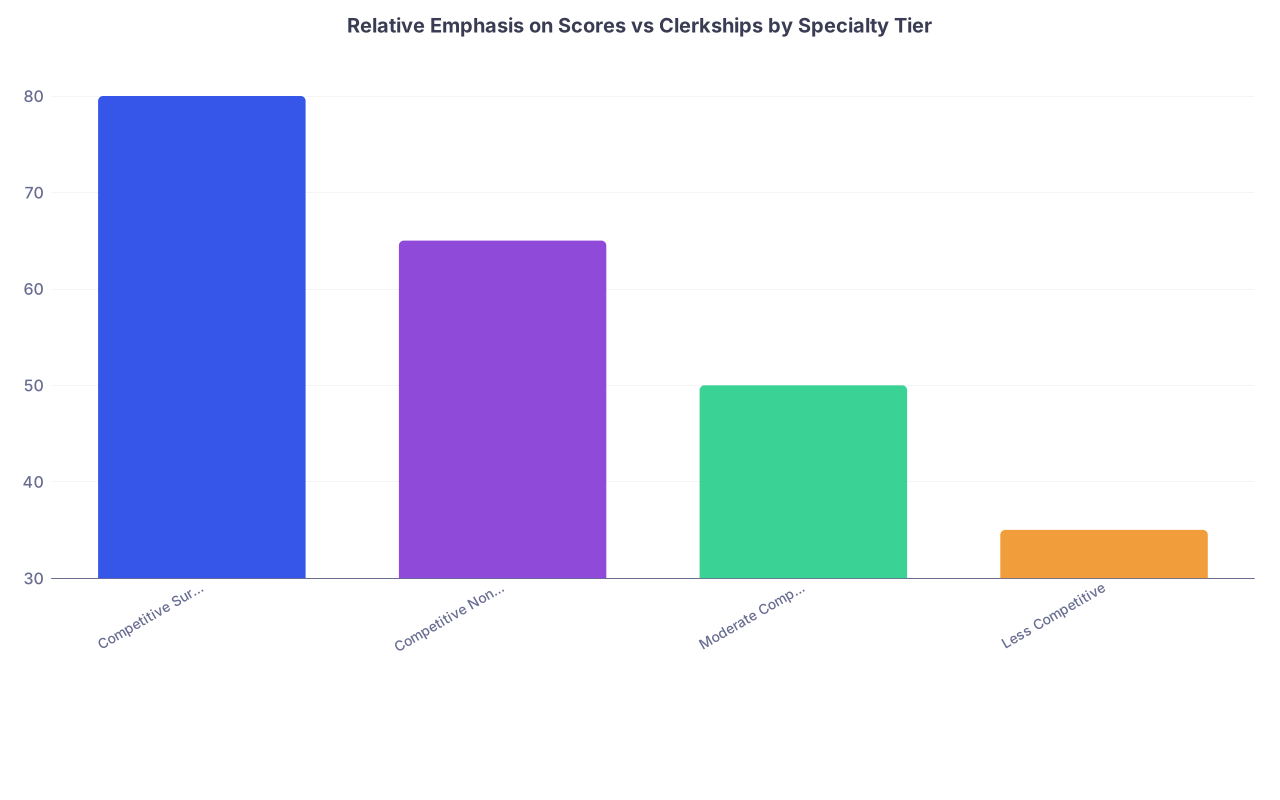
| Category | Value |
|---|---|
| Competitive Surgical | 80 |
| Competitive Non-Surgical | 65 |
| Moderate Competitiveness | 50 |
| Less Competitive | 35 |
That number is an approximation of “percent of initial decision-making influenced by pure test performance” in low score contexts. As that number drops, your clerkships have more room to pull you back into contention.
Strategic Moves If You Already Have a Low Step
Let us move from theory to damage control. If your low Step score is already baked in, your playbook during and after clerkships should be ruthlessly targeted.
1. Prioritize Dominating the Most Relevant Clerkships
You cannot afford to “just get by” on the rotations that matter most to your chosen specialty.
Tactical points:
- Identify 2–3 absolutely critical rotations for your target field (IM + sub-I for IM; FM + IM for FM; psych + neurology/IM for psych).
- Front-load your preparation: question banks, core texts, structured shelf prep.
- Explicitly tell attendings and residents early: “I had a lower Step score than I wanted. I am really focused on proving my clinical strength and reliability here.” That honesty often buys more detailed mentorship and feedback.
2. Engineer Narrative Strength, Not Just Grades
You want your evaluations and letters to say: “Whatever you think about their score, you would be crazy not to interview this person.”
That does not happen by accident. It happens if:
- You consistently volunteer for work that makes your intern’s life easier.
- You know every patient better than anyone else on the team.
- You ask for mid-rotation feedback and actually change based on it.
- Near the end, you say directly: “If you feel comfortable, I would be grateful for very honest, specific comments in my evaluation that describe how I performed relative to other students—especially since my Step score is not as strong as I hoped.”
People who act like grown colleagues, rather than passive students, tend to get those “top 10%” type phrases.
3. Use Sub-Internships as “Score Replacement Tests”
For applicants with low scores, sub-Is function as a second-chance exam—but this time the test is “Can you do the job?”
A strong sub-I can modify PD perception more than a 5–10 point difference in Step 2 would have.
Think about:
- Doing your sub-I in the specialty at a program that realistically might rank you.
- Treating it as a month-long audition: punctuality, note writing, procedures, night coverage if allowed.
- Asking for a letter from someone who supervised you day-in, day-out, and saw you handle real responsibility.
At many programs, faculty remember the sub-I who “ran the list” at 5 a.m. better than they remember yet another 240+ Step applicant who was just okay.
4. Make Your MSPE and Letters Explicitly Address the Score
Silence looks like avoidance. A well-framed explanation, backed by clear evidence of competence, shifts PD thinking from “risk” to “resolved issue.”
Good pattern:
- Briefly acknowledge: “My Step 1/Step 2 score does not reflect my current level of knowledge and performance.”
- One or two sentences of honest context (timing, effective study methods learned late, personal stressors—without sounding like excuses).
- Then anchor: “Subsequent clerkship and sub-internship performance, particularly in [specialty], is a more accurate indicator of my readiness.”
The best letters from attendings echo this: “While their Step score is below the average of our matched residents, their clinical performance places them among the top tier of students I have supervised.”
5. Choose Your Target Programs with Discipline, Not Ego
The interaction between clerkship strength and low scores is also filtered by where you apply. Some PDs will not budge from their score cutoffs. Others will.
If you have:
- Low scores but top-notch, specialty-relevant clerkships and letters → Mix of mid-tier academic and strong community programs that emphasize teaching.
- Low scores and more mixed clerkships → Heavier tilt toward community programs, newer residencies, and institutions in less saturated geographic areas.

| Step | Description |
|---|---|
| Step 1 | Low Step Score |
| Step 2 | Prioritize mid tier academic + community teaching programs |
| Step 3 | Focus on community and newer programs |
| Step 4 | Apply broadly within chosen tier |
| Step 5 | Further increase program count and flexibility on location |
| Step 6 | Strong core clerkships in target specialty? |
| Step 7 | Any exam failures? |
This is where students sabotage themselves. They pair a low Step with an unnecessarily top-heavy application list and then act surprised by poor results. PDs cannot rescue you if you never appear in the applicant pool at programs that would actually take a chance.
One Hard Truth: Consistency Beats a Single “Hero” Rotation
I have seen students attempt to fix a 205 Step 2 with legendary performance on one sub-I while the rest of their record is mediocre. PDs are not fooled.
They look for internal consistency:
- Low Step, but steadily improving shelves, then solid clerkships, then a great sub-I → believable growth story.
- Low Step, random good rotation surrounded by passes, erratic narrative comments → luck or one faculty member who really liked you.
Your goal is not to “find one attending who will save me.” Your goal is to build enough converging evidence—from multiple rotations, multiple evaluators—that the score is the outlier, not the norm.
Key Takeaways
Program directors use clerkship grades and narratives as the primary way to confirm or override the story your Step score tells. With low scores, strong specialty-relevant clerkships and explicit “top tier” language can pull you back into contention—especially in less score-obsessed fields.
Not all clerkships or comments carry equal weight. Honors in the target specialty and closely related rotations, with concrete praise of clinical reasoning and reliability, matter far more than scattered honors in unrelated fields or bland, generic evaluations.
If the low Step is already done, your only rational move is to treat every key clerkship and sub-I as a month-long exam. Engineer consistency, push for specific narrative feedback, pick realistic programs, and make sure your MSPE and letters clearly frame the score as an early weakness overcome by later, verifiable performance.