
The right letter of recommendation can make a program director stop caring about your low Step score.
Not “help a little.” Neutralize it. As in: they see the number, then they read the letter, and the number drops three lines down in their mental priority list.
Let me break down exactly how that happens.
1. What A Letter Must Do To Overwrite A Bad Step Score
Step scores are lazy sorting tools. PDs use them because they are drowning in applications. A low score flags you as risk: academic risk, test-taking risk, maybe work-ethic risk.
A letter that neutralizes that risk has to do three things very clearly:
- Reclassify you from “test risk” to “clinical asset.”
- Provide concrete, verifiable behaviors that contradict the stereotype implied by a low score.
- Signal to the reader: “I, as an attending you respect, will personally vouch for this applicant’s success.”
If a letter does not do these three things, it is background noise. You do not have the luxury of background noise.
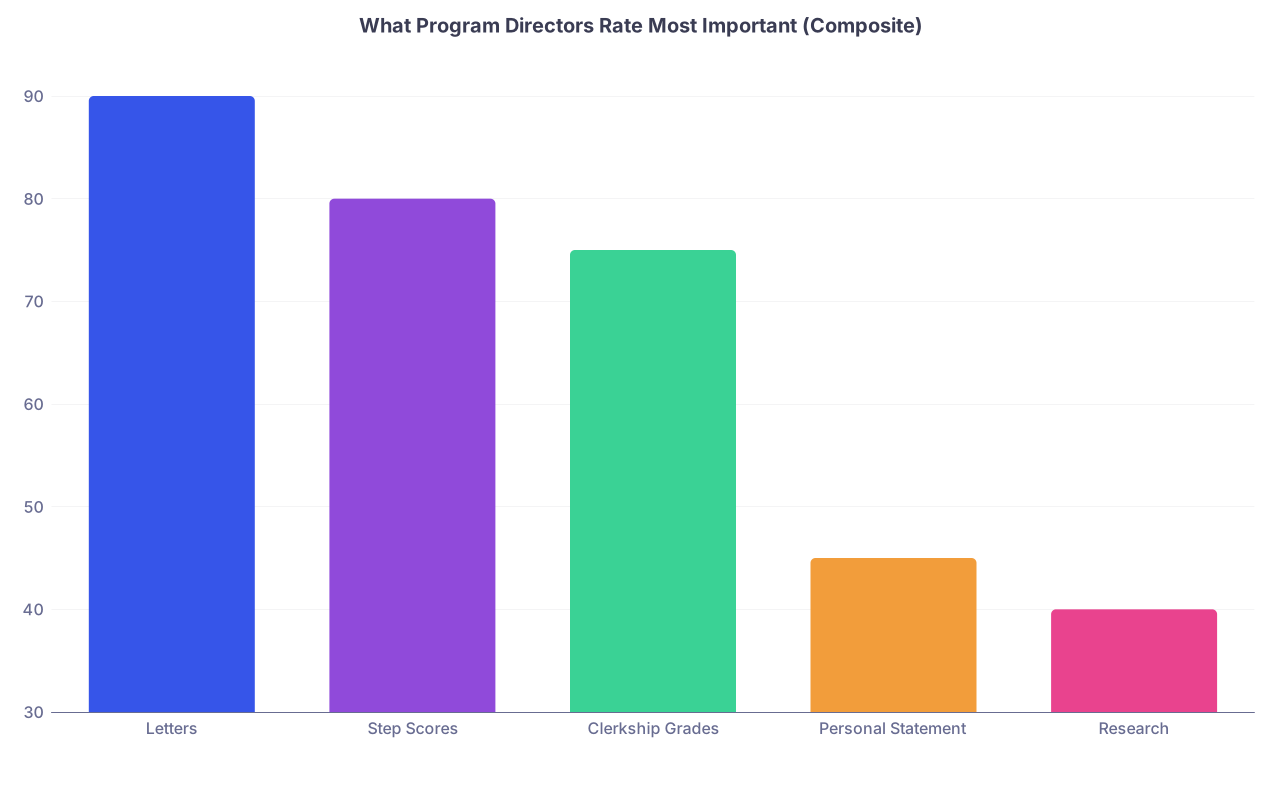
| Category | Value |
|---|---|
| Letters | 90 |
| Step Scores | 80 |
| Clerkship Grades | 75 |
| Personal Statement | 45 |
| Research | 40 |
Those numbers mirror what you hear in hallways: “I’ll interview a 215 with a killer letter over a 250 with bland letters.” I have heard that verbatim from a community IM PD. Academic places are a bit harsher, but the principle holds.
So you need letters that are:
- Stronger than “good team player”
- Strategically written to address the Step issue without obsessing over it
- Specific to residency performance, not general “good student”
Everything below is about engineering that.
2. Choosing The Right Authors When You Have A Low Step Score
Most applicants choose letter writers by title and fame. That is wrong for you.
You need writers who will:
- Go on the record with clear, comparative statements
- Mention your Step score context or your academic turnaround if appropriate
- Describe situations where you outperformed your score
Rank order your choices like this.
| Rank | Writer Type |
|---|---|
| 1 | Core specialty attending who supervised you closely |
| 2 | Clerkship director in the specialty |
| 3 | Program director or associate PD from your home institution |
| 4 | Subspecialist in your field who saw you on consults/elective |
| 5 | Non-core attending with deep clinical interactions |
Now the nuance.
2.1. “Big Name” vs “Big Content”
A famous department chair who barely knows you will not help. The letter will read like a brochure. PDs can smell this in three sentences.
A mid-career hospitalist who worked with you for four weeks, saw you present, saw you pre-round, watched you handle cross-cover — that letter can absolutely neutralize a 209 Step 1.
If you are choosing between:
- Chair of Medicine you worked with for 2 half-days, vs
- Hospitalist on your IM sub-I who watched you run the team for a week when they were slammed
Choose the hospitalist. Every time.
2.2. The PD Letter Trap
Everyone loves the idea of “my PD wrote me a letter.” But unless they truly know you, it becomes a generic character reference.
Best-case PD letter for a low Step applicant:
- PD has seen your clinical work or read detailed evaluations
- PD can say: “We would be happy to have this student in our program”
- PD explicitly references your trajectory relative to the Step score
If your PD does not know you, prioritize the direct supervisor who does. You can still list the PD as a supplemental advocate who will respond to phone calls.
2.3. Who Should Explicitly Address The Low Step?
Not every letter needs to touch the Step score. Ideally, only one does it directly, and the others reinforce the “strong clinician” narrative without re-litigating the exam.
Good candidates to address it:
- Clerkship director who can speak to exam performance, shelf scores, and trend
- Specialty sub-I attending who saw you right after your Step struggles and can attest to rebound
- Academic advisor who knows your remediation or learning disability documentation
Do not have all three letters say, “Despite a low Step score…” That just fixates the reader on the number.
3. Anatomy Of A Truly Protective Letter
Let’s dissect what a Step-neutralizing letter looks like, line by line.
3.1. Structural Overview
The skeleton is simple:
- Opening: Clear strength signal + relationship definition
- Clinical core: Specific behaviors and scenarios
- Comparative ranking: “Top X% / I would rank this student highly”
- Addressing the Step score (if this is the designated letter)
- Closing: Explicit endorsement and residency projection
Weak letters die in sections 1 and 3. Strong letters live in 2 and 4.
3.2. The Opening: You Need an Immediate Vouch
Bad opening:
“I am writing on behalf of John Smith, a fourth-year medical student applying to Internal Medicine, whom I worked with during his rotation.”
Strong, Step-neutralizing opening:
“I am very pleased to recommend John Smith for a position in your Internal Medicine residency program. I worked closely with him for four weeks on our inpatient teaching service, where he consistently performed at or above the level of an intern.”
You want your letters to open with:
- “Very pleased” / “Strongly recommend” / “It is a pleasure to recommend”
- Relationship duration and depth
- Early hint that you are functioning at resident level
Phrases that help you blunt the Step baggage:
- “Performed at or above the level of a first-year resident”
- “One of the strongest M4 students I have supervised in the last several years”
- “Stood out immediately for…”
If the PD sees that in paragraph one, your Step score becomes “background concern” instead of “primary filter”.
4. Phrases And Paragraphs That Specifically Counter Low Scores
This is what you actually came for: the language.
4.1. Directly Addressing the Low Step Score (When Appropriate)
You want one writer — not you — to contextualize the score. Never sound defensive. Calm, factual, then pivot to strengths.
Template that works:
“You will notice that Alex’s Step 1 score is lower than many of your applicants. This score does not reflect his current knowledge base or clinical performance. On our rotation, he consistently demonstrated strong fund of knowledge, sound clinical reasoning, and excellent preparation, and he performed at a level that I would expect from a successful first-year resident.”
Variations you can suggest (depending on your situation):
For clear upward trend (Step 1 low, Step 2 much better):
“Alex’s Step 1 score is not representative of his current abilities. His subsequent performance, including a significantly improved Step 2 CK score and honors in multiple clinical clerkships, better reflects his work ethic and clinical acumen.”
For documented personal/health issues at Step time (only if you’re comfortable having it referenced, and it’s already addressed elsewhere):
“Alex’s Step 1 score was impacted by personal circumstances at the time of the exam, which have since been resolved. In the years following, he has consistently performed at a very high level in both clinical work and standardized assessments, and I have no concerns about his ability to meet the demands of residency.”
For someone who is a slower standardized test taker but strong clinically:
“While standardized multiple-choice exams have not been Alex’s greatest strength, I have found his clinical judgment, bedside manner, and reliability to be outstanding. When faced with real patients, he integrates information quickly and safely, asks appropriate questions, and follows through meticulously.”
Key point: The letter must pivot from the Step comment to visible, concrete strengths within 1–2 sentences. No dwelling.
4.2. Phrases That Reassure PDs About Test Risk
Program directors worry about:
- Passing in-service exams
- Passing specialty boards
- Surviving academic review committees
So you want language like:
“He consistently scored in the top third on our rotation quizzes and oral exams.”
“On our end-of-rotation oral examination, she performed above the class average and demonstrated strong understanding of core internal medicine concepts.”
“He has shown steady academic improvement, culminating in a strong performance on Step 2 CK and on our departmental shelf-equivalent exam.”
Let me be blunt: vague reassurance like “I am confident he will pass his boards” is okay, but better when backed with example or trend.
For example:
“Based on his performance on our service and his subsequent Step 2 CK score, I have no concerns about his ability to pass the Internal Medicine boards on his first attempt.”
If you do not have a strong Step 2 yet, lean harder on local exams, shelves, or complexity of cases managed.
4.3. Clinical Performance Language That Overpowers Scores
Specific is your friend. Think “I can picture this student at 2 a.m. on a cross-cover night.”
Strong, PD-calming phrases:
“On night float, we entrusted her with independently evaluating new admissions before staff review; her assessments were consistently thorough and safe.”
“He routinely arrived early, pre-rounded on all assigned patients, and had concise, accurate presentations that incorporated up-to-date literature.”
“During a particularly demanding week, when our team was short-staffed, she voluntarily took on additional patients and managed them with the maturity and organization I typically see in interns.”
“He was the student other students went to with questions about management and workflow, and he was generous with teaching and support.”
The subtext here: This applicant will carry their weight. I do not care as much about the 214.

4.4. Comparative Language: The Secret Weapon
Program directors read “hardworking,” “team player,” and “excellent” 200 times per season. It is white noise.
Comparative statements cut through.
Examples that directly counter the Step signal:
“In my 10 years as a teaching attending, Alex ranks in the top 10% of students I have worked with in terms of clinical reasoning and professionalism.”
“Among the 30–40 medical students I supervise each year, she stands in the top group that I would be delighted to recruit to our own residency.”
“I would place him in the top tier of students I have worked with and would have no hesitation in matching him into our program.”
You want at least one letter with a line like that. Two is ideal.
5. What You Should Explicitly Ask Your Writers To Do
You cannot dictate a letter, but you can guide it. Most attendings appreciate clarity.
When you request a letter, your ask should be specific:
- Remind them of concrete cases or situations where you performed strongly
- Mention the Step concern and how you hope the letter can contextualize it
- Provide them with phrasing examples, not a full script
Example email (tuned for a low Step applicant):
Dear Dr. Patel,
I wanted to thank you again for the opportunity to work with you on the inpatient cardiology service in July. I learned a tremendous amount from that month.
I am applying to Internal Medicine this cycle and hoped you might be willing to write a strong letter of recommendation on my behalf. I valued your feedback on my presentations and patient management, and I know programs will look closely at my performance on core rotations.
I am aware that my Step 1 score is below the average for some programs I am applying to. My Step 2 CK score showed significant improvement, and I am hoping that your letter could speak to my clinical performance, work ethic, and reliability on the rotation, to provide programs with a fuller picture of my abilities. In particular, I remember the week we admitted multiple complex heart failure patients and your feedback that I was functioning at an intern level; if you felt comfortable referencing that type of example, I believe it would be very helpful.
I have attached my CV, personal statement draft, and rotation evaluation for reference. I know your time is limited, and I would be very grateful for your support.
Sincerely,
[Name]
You are not putting words in their mouth. You are reminding them of specifics and signaling what matters for your application.
6. Sample Paragraphs You Can Hand To Your Writers
Do not write their whole letter. But giving a paragraph or example phrases is reasonable, especially if they ask.
Here are some plug-and-play blocks they can adapt.
6.1. “Low Step, High Clinical Function”
“Although [Name]’s Step 1 score is below what many programs may see, that number is not at all representative of his current capabilities. On our medicine sub-internship, he independently managed a full intern-level patient load, formulated thoughtful assessment and plans, and communicated effectively with both the multidisciplinary team and patients. I observed him handle complex situations, including acute decompensated heart failure and sepsis, with calm professionalism and sound judgment. Based on his performance with us, I have no reservations about his ability to succeed in a rigorous residency program.”
6.2. “Trajectory + Step 2 Improvement”
“You may notice that [Name]’s Step 1 score is lower than average; however, his subsequent performance has demonstrated a clear upward trajectory. He achieved a significantly improved Step 2 CK score and honored several core clerkships, including our rotation. This pattern aligns with what I have seen clinically: once he transitioned from preclinical to patient care, his strengths in communication, pattern recognition, and clinical reasoning became much more apparent.”
6.3. “Board Reassurance Without Overdoing It”
“Given his demonstrated improvement on standardized exams, consistent strong performance on our rotation assessments, and his disciplined approach to studying, I am confident he will pass his in-training examinations and board exams without difficulty.”
These are not magic words. But they give your letter writer a roadmap.
7. The Mistakes That Quietly Kill Applicants With Low Scores
A low Step score is not fatal by itself. The combination of a low score plus weak or generic letters is.
I keep seeing the same errors.
7.1. Letters That Ignore The Obvious
If your Step 1 is 200 and Step 2 is 204, and nobody mentions exams, many PDs will assume the worst:
- “Maybe there were professionalism issues.”
- “Maybe they struggled through clerkships.”
- “Maybe they are barely passing everything.”
Having one trusted faculty member say, “I know you see the score; here is why I am not worried,” is much better than pretending the number does not exist.
7.2. Defensive or Excuse-Heavy Letters
You do not want:
“Due to several personal and family difficulties, his Step 1 score was low…”
…followed by a long list of hardships and very little about your actual performance.
It is fine for a mentor to mention significant life events, but the letter must pivot quickly:
- 1–2 lines of context
- 5–10 lines of strengths and current performance
If the letter reads like an explanation rather than an endorsement, it will hurt you.
7.3. Overemphasis on “Hardworking, Punctual, Nice”
The “hardworking, punctual, pleasant” triad is the kiss of death when you have a low Step. It says: “No disasters, no brilliance.”
You need language like:
- “Intern-level”
- “Top X%”
- “Strong clinical reasoning”
- “Would happily recruit”
- “No concerns about…”
If you see a draft (some attendings will share), and it is all “nice, reliable, on time,” thank them, but try to secure at least one more letter that carries more weight.

8. Coordinating Letters With The Rest Of Your Application
The letter is part of an ecosystem. It works best when everything else points in the same direction.
8.1. Align Your Personal Statement
If your letter writer is going to mention your Step score context, your personal statement should not sound surprised or disconnected.
You do not have to mention the score explicitly in your statement, but you can echo the narrative:
- Academic struggle → learning how you study → later success
- Personal event timing → growth → renewed focus
- Transition from preclinical to clinical → finally in your element
Simple alignment:
- Letter: “Once he reached the clinical years, his performance dramatically improved.”
- Statement: “I struggled in the first two years, largely trying to learn medicine as a memorization exercise. On the wards, when I could connect facts to patients, the work finally made sense.”
That coherence feels intentional, not like damage control.
8.2. Make Your MSPE/Dean’s Letter Work For You
Most PDs read the MSPE. If your school comments on your Step score or academic standing, you cannot hide it.
If you have a supportive dean or advisor, you can ask:
- That they highlight your improved performance in clinical years
- That they avoid repeating raw Step numbers if not required by your match system (some countries differ)
- That they place your score in context if your school’s average is similar
The ideal stack for you:
- MSPE: Describes honest academic path, highlights clinical strengths
- One letter: Directly contextualizes Step + test performance
- Two letters: Ignore the score and sell you as a high-functioning clinician

| Step | Description |
|---|---|
| Step 1 | Low Step Score |
| Step 2 | Emphasize Upward Trend |
| Step 3 | Emphasize Clinical Strength |
| Step 4 | Letter 1 - Address Step and Trend |
| Step 5 | Letter 2 - Strong Clinical Detail |
| Step 6 | Letter 3 - Comparative Praise |
| Step 7 | Aligned Personal Statement |
| Step 8 | Strong Step 2? |
9. Specialty-Specific Considerations
Not all fields treat Step scores the same way.
9.1. Internal Medicine, Pediatrics, Family Medicine
These specialties will absolutely take a flyer on a lower score if letters scream “safe, hardworking, resident-ready.”
Strong phrases to ask for:
- “We would be happy to have her in our own residency.”
- “He is prepared to function as an intern on day one.”
- “Patients consistently commented on her clarity and empathy.”
9.2. Surgery and Surgical Subspecialties
For low Step + surgery, letters must double down on:
- Work ethic
- Grit
- Technical potential
Useful lines:
“He consistently volunteered to stay late to assist in cases and was eager for feedback on his technical skills.”
“Her stamina and resilience during long cases and difficult call nights stood out even among our strongest students.”
You still want at least one line addressing exam concern:
“Although his Step 1 score is lower than many applicants, his Step 2 CK score improved markedly, and I am confident he will meet the academic demands of surgical training.”
9.3. Competitive Roadblocks: Derm, Ortho, ENT, Plastics, Rad Onc
Here the reality is harsher. If your Step score is significantly below the typical range, letters alone may not “neutralize” it, but they can:
- Get you looks at mid-tier or less competitive programs
- Keep doors open for transitional/prelim years with later re-application
You will need:
- Letters from known people in the field if possible
- Very strong language: “Top 5%,” “best student in the past X years,” “we would advocate strongly for this applicant.”
Without that level of advocacy, letters become “nice story, but the score still kills them” territory.
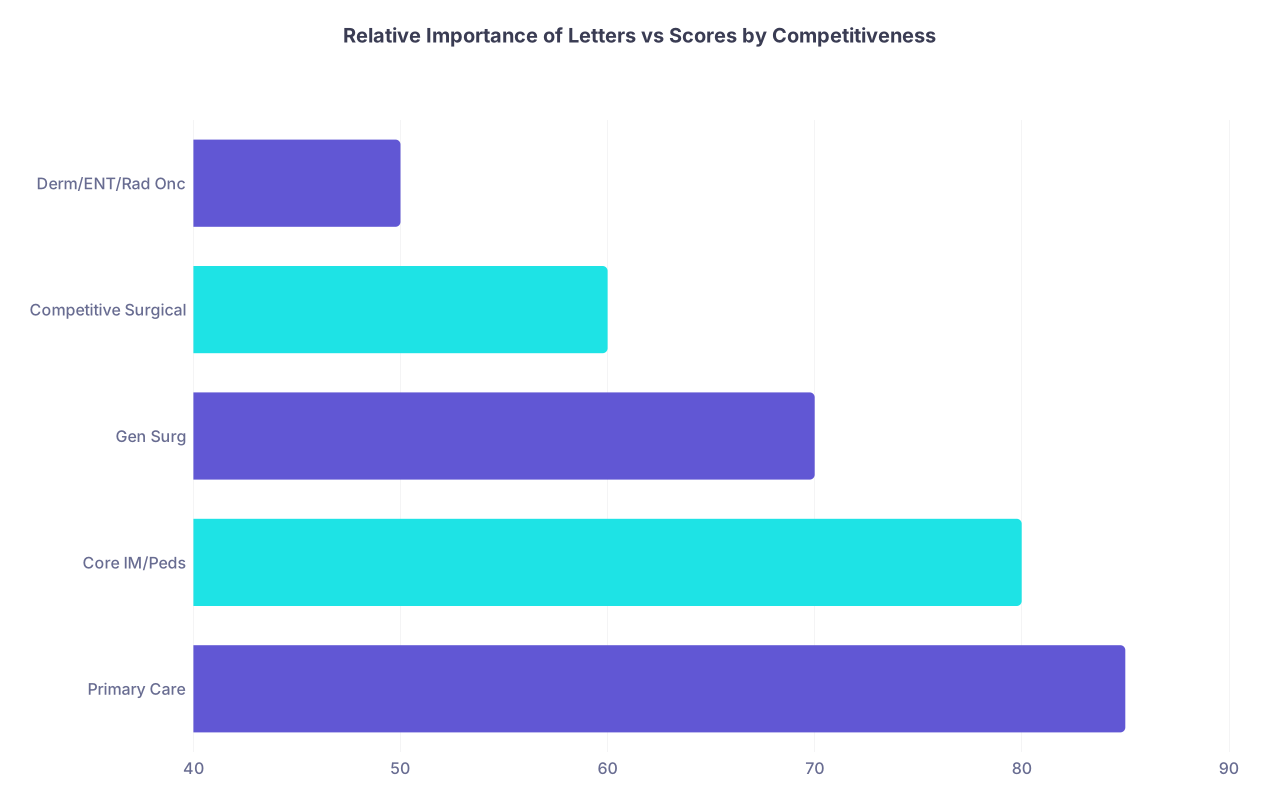
| Category | Value |
|---|---|
| Primary Care | 85 |
| Core IM/Peds | 80 |
| Gen Surg | 70 |
| Competitive Surgical | 60 |
| Derm/ENT/Rad Onc | 50 |
10. Timing, Logistics, And Quiet Power Moves
Two small but real advantages you can give yourself.
10.1. Timing: Recent Rotations Talk Loudest
Letters from the immediate past 6–12 months are taken more seriously. Especially:
- Sub-I / acting internship
- Away rotations
- ICU rotations for IM/Anesthesia
If your low Step score is old history and your recent performances are strong, make sure most of your letters are from the last year. Do not lean only on a glowing but ancient preclinical research letter that predates your Step issues.
10.2. Getting the “Off-ERAS” Endorsement
One underused move: give your strongest attending permission to take phone calls or send a direct email if a PD reaches out.
PDs trust back-channel endorsements more than any written letter. If your attending says on the phone:
“Ignore the Step 1. This student worked like an intern, handled cross-cover, no drama, I would absolutely match them here.”
That single sentence can outweigh a poor numeric filter.

11. Putting It All Together: A Model Letter Skeleton
Here is a condensed example structure you want at least one of your letters to resemble. Not for you to send as a script, but to understand the anatomy.
- Strong opening: who the writer is, how they know you, and early endorsement.
- Detailed clinical paragraph: specific behaviors, responsibility level, complexity managed.
- Comparative assessment: top X%, intern-level, would recruit.
- Step contextualization (for one letter): brief mention + clear statement that performance contradicts the concern.
- Closing: explicit, enthusiastic recommendation and no-reservations language.
If a PD skims and can pull out:
- “Intern level”
- “Top 10–20%”
- “Step not representative”
- “No concerns about boards”
- “We would happily have them”
Your low Step score has been, if not erased, at least heavily discounted.
The Essentials To Remember
- One letter must calmly and confidently contextualize your low Step score; the others must aggressively sell your clinical value without rehashing the number.
- Comparative, specific language (“top 10%,” “intern-level responsibility,” “we would be happy to match them”) overrides generic praise and is what actually neutralizes risk in the PD’s mind.
- Your job is to choose the right writers, remind them of concrete examples, and align your whole application so the story is clear: the Step score is the outlier; your performance and trajectory are what really define you.