
The way most applicants “explain” low board scores in a personal statement is terrible. Hand‑wavy, defensive, or melodramatic. Program directors read it, roll their eyes, and move on.
Let me show you how to do it precisely, clinically, and in a way that can actually help you.
You are not trying to win a pity contest. You are trying to convince a busy faculty member that:
- you understand exactly what went wrong,
- the problem is now controlled, and
- it will not follow you into residency.
Everything you write should serve those three points. Everything else is noise.
First: Should You Even Address Low Scores In The Personal Statement?
Before wordsmithing, you need triage. Not every low score belongs in your main essay.
Here is the basic decision tree I have seen work in real life:

| Step | Description |
|---|---|
| Step 1 | Low or failed Step score |
| Step 2 | Briefly address in PS or addendum |
| Step 3 | Address clearly in PS; need strong plan |
| Step 4 | Optional brief mention; consider addendum |
| Step 5 | Safer to address; show insight and plan |
| Step 6 | Single low pass vs fail? |
| Step 7 | CK improved? |
| Step 8 | Big jump next exam? |
Let me break that down more concretely.
When it belongs in the main personal statement
You should integrate it into the main statement if:
- You failed Step 1 or Step 2 CK, or
- Your score is well below the historical mean for your target specialty, and
- It reflects a real and addressed issue (test anxiety, poor planning, untreated ADHD, unmanaged depression, language barriers, etc.), and
- You have evidence of improvement or at least a convincing plan and track record since.
For example:
- Failed Step 1, passed on retake, then scored solidly on CK and honored medicine, neuro, and sub‑I.
- CK 214 for a field where programs prefer ≥ 230, but you went from barely passing school exams to consistently high NBME shelves after specific changes.
In those cases, not addressing it can feel evasive. Programs will fill in the story themselves, and their version will not be generous.
When a small, separate note or Dean’s letter is better
If your story is highly technical, bureaucratic, or long (e.g., testing center incident, prolonged illness with documentation), it often plays better as:
- An MSPE/Dean’s letter explanation, and/or
- A short ERAS “additional information” blurb, and
- Possibly one brief line in your personal statement that signals awareness but does not hijack the essay.
Your personal statement should not read like an incident report.
When you probably should not talk about it
You usually skip it in the PS if:
- You have a single modestly low Step 1 (e.g., 220) and then a strong CK (e.g., 245+), and
- Your specialty is not hyper‑competitive, and
- You have other strengths (research, leadership, solid letters).
In that situation, obsessing over the score in your essay does more harm than good. It advertises a weakness that many readers would have mentally filed as “fine.”
What Program Directors Actually Want To See When You Explain Scores
Nobody is looking for a dramatic confession. Directors are looking for three things: pattern recognition, insight, and risk mitigation.
Think of it like charting on yourself as a patient.

1. Pattern recognition
They want you to show that you can objectively analyze your own performance.
Bad: “I have always struggled with standardized tests.”
Better: “My early medical school exams and first NBME practice tests revealed a consistent pattern: I was missing questions in multi-step pathophysiology and time management in the final 20 questions.”
See the difference? One is a vague self‑label. The other is a specific, fixable pattern that a resident could act on.
2. Insight and ownership
They want to see that you are not blaming the universe or your school.
Bad: “The pandemic disrupted my learning and unfairly affected my Step preparation.”
Better: “During the sudden shift to remote learning, I underestimated how much structure I needed. I delayed creating a dedicated Step study plan and relied too heavily on passive resources. By the time I recognized the gap in my preparation, I had less time to remediate weak areas.”
You can mention circumstances. You must still own your part.
3. Risk mitigation: will this be a problem again?
This is the real question behind every skeptical read:
“Is this student going to fail in‑training exams? Board certification? My call schedule?”
Your explanation must answer, implicitly:
- What exactly went wrong?
- What did you change?
- What objective evidence do we have that the change worked?
If your narrative does not include all three, it is not doing its job.
Correctly Framing Test Anxiety: Real Problem, Wrongly Used Excuse
“Test anxiety” might be the most overused, under‑explained phrase in applications. If you just drop the term with no specifics, faculty treat it like white noise. Translation in many readers’ heads: “I panic on tests; I will probably panic on your in‑service exam too.”
You cannot afford that.
| Aspect | Weak Explanation | Strong Explanation |
|---|---|---|
| Specificity | "I have test anxiety." | "In timed exams I rushed, changed first instincts, and left 10 questions blank." |
| Professional evaluation | None mentioned | "I was formally evaluated by counseling services in M3." |
| Concrete interventions | "I tried to calm down." | "I used CBT, scheduled breaks, and simulated test conditions." |
| Objective outcomes | "I feel better now." | "NBME scores improved from 198 to 228 over three months." |
How to talk about test anxiety without sinking yourself
If “test anxiety” is genuine and documented, you need four components in your narrative:
- A specific description of what happened in the exam setting
- Evidence that you sought structured help, not just “I tried harder”
- Concrete strategies you implemented
- Data that show improvement in similar situations
A tight paragraph might look like this:
Early in medical school, high‑stakes exams triggered a predictable pattern: I would spend the first half of the test re‑checking questions, then rush through the final blocks and leave items unanswered. After underperforming on my first two NBME shelves, I met with student counseling and was diagnosed with performance‑specific test anxiety. We worked on CBT‑based strategies and strict timing drills using retired NBME questions. Over the next three clerkships, my shelf scores improved from below the 10th percentile to consistently above the 60th, and I passed Step 2 CK on my first attempt with a score aligned with our class average.
Notice what this does:
- Names the problem precisely
- Shows professional involvement
- Describes specific interventions
- Shows measurable improvement
That is the level of detail that changes “red flag” to “managed risk.”
Where In The Personal Statement Should This Live?
Placement matters. Your explanation should not eat the entire essay.
Think in terms of architecture:
- 60–70%: who you are clinically and professionally, why this specialty, your growth and values
- 10–20%: the test/anxiety/score section
- 10–20%: closing forward‑looking paragraph
Three structures that actually work
Structure A: Middle “insight and growth” paragraph
This is the cleanest, most common approach.
1st paragraph: Hook + why this specialty.
2nd–3rd: Clinical experiences, strengths, values.
4th: The board/test story.
5th: Tie back to readiness for residency.
This has the advantage that your low score is framed within a larger story of development, not as the headline.
Structure B: Brief mention near the end
Useful when the issue is less dramatic (low but passing score) and you have strong offsets.
You might have:
1–3: Strong clinical and personal narrative.
4: One short paragraph: acknowledge, explain, show response.
5: Forward‑looking final paragraph.
Think 4–6 sentences, not a page.
Structure C: Integrated cause‑and‑effect thread
Sometimes the problem and the solution are woven through the whole story. For example, a student who started medical school while managing untreated ADHD, then was diagnosed mid‑M2, adjusted, and finished strong.
Done well, this can work. Done badly, it turns into a therapy letter. Use this only if your whole trajectory—clinically, academically, and personally—tightens around that central arc of “identified problem → addressed → now a strength.”
Language: Exact Phrases That Help (And Those That Hurt)
Words signal mindset. Directors read between your lines quicker than you think.
Phrases that help
You can steal these structures and adapt the details.
- “I underestimated…”
- “I recognized a consistent pattern in…”
- “In response, I…”
- “I sought help from…”
- “Over the next X months/rotations, my performance…”
- “This experience forced me to develop…”
- “These strategies have remained part of how I prepare for complex tasks, including…”
This is the language of insight and action.
Phrases that hurt
Avoid these; they scream defensiveness or lack of ownership.
- “Unfortunately, due to circumstances beyond my control…”
- “I have always been bad at standardized tests.”
- “Despite working as hard as I could, my score did not…”
- “This score does not reflect my true abilities.”
- “I was never a good test taker.”
- “I am not defined by a number” (true, but it sounds like a bumper sticker, not a serious self‑assessment).
You are allowed to be human. But you are applying to a profession that lives and dies on objective metrics. Pretending metrics do not matter is tone‑deaf.
Concrete Scenarios: How To Write Them Correctly
Let us go through real‑world style cases and rewrite them in a way that works.

Scenario 1: Failed Step 1, passed on second attempt, CK solid
Wrong way (I have seen almost exactly this):
I failed Step 1 because the pandemic significantly disrupted our curriculum and I did not feel adequately prepared. I was deeply disappointed because I had always been a strong student and I do not feel this score reflects my knowledge or work ethic. On my second try, I was able to pass, and I believe this shows my perseverance and resilience.
This tells me almost nothing about what actually changed. It sounds like a generic excuse paragraph.
Stronger version:
I entered dedicated Step 1 study without a structured plan and relied heavily on passive resources. My first attempt reflected that, and I failed. That experience forced a complete redesign of how I learn. I met weekly with our academic support faculty to build a schedule centered on active question‑based learning and spaced repetition. I tracked my progress with NBMEs and used missed questions to create focused review lists. On my second attempt I passed Step 1, and I carried those same habits into my clinical year, where my NBME shelf scores rose from below average to above the 60th percentile in medicine, surgery, and neurology, and I scored [XX] on Step 2 CK. That period was humbling, but it fundamentally changed how I approach complex material and self‑assessment.
Note:
- Clear admission of poor initial strategy.
- Specific help sought.
- Specific process used.
- Concrete evidence that the new process works beyond just “I passed.”
Scenario 2: CK significantly below specialty average, but clear upward trend and strong performance elsewhere
Imagine: Step 1 pass (no score), CK 219, interested in IM (reach) and prelim spots. Strong sub‑Is and letters.
You do not need a multi‑page confession. You need one sharp paragraph that acknowledges the obvious and puts it in context.
My Step 2 CK score of 219 does not reflect the level of clinical reasoning I expect of myself, nor the standard I have since demonstrated on the wards. During dedicated study, I struggled to balance a heavy schedule of required clinical responsibilities with CK preparation and relied too long on passive reading instead of deliberate practice with timed questions. After receiving my score, I met with our academic support office and developed a new structure focused on daily timed blocks of questions, immediate post‑test review, and weekly content synthesis sessions with a faculty mentor. Since then, my performance has aligned more closely with my goals: I honored both of my internal medicine sub‑internships, scored in the top quartile on our institution’s internal in‑training exam, and received strong evaluations that highlighted thoroughness and clinical judgment. I have kept the same disciplined approach to ongoing learning and plan to apply it rigorously as a resident.
Again, this is not about groveling. It is about convincing someone you are unlikely to repeat the same mistake when their board pass rate is on the line.
Scenario 3: Test anxiety with clear intervention
We touched on this earlier; one more variation, succinct:
Throughout my early exams, I noticed that anxiety in timed settings led me to second‑guess correct answers and rush at the end, leaving questions blank. Recognizing that this pattern could jeopardize my board performance, I sought help from our student counseling service during my second year and was diagnosed with performance‑oriented test anxiety. Together we developed concrete strategies: simulated exams with strict timing, CBT techniques for managing intrusive thoughts, and a standardized pre‑exam routine. After implementing these changes, my NBME practice scores improved by more than 20 points, I passed Step 1 and Step 2 CK on my first attempts, and I completed my clinical clerkships with solid shelf performance. More importantly, I learned to respond to anxiety with structured preparation rather than avoidance, a mindset I now apply to new and unfamiliar clinical situations.
Notice: no drama, no self‑pity. Just a clean clinical narrative.
What To Avoid: Landmines That Torpedo Otherwise Good Applications
You can do most things right and still kill your explanation with a few missteps.
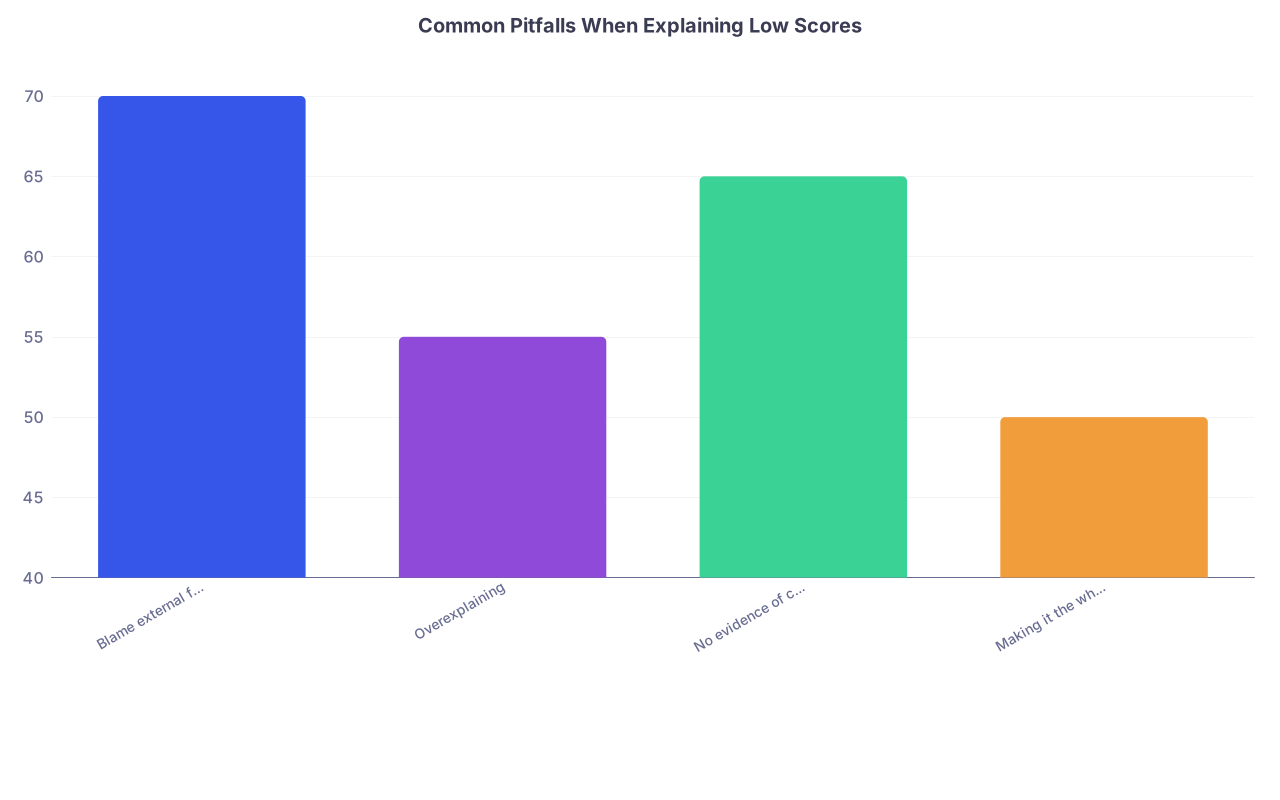
| Category | Value |
|---|---|
| Blame external factors | 70 |
| Overexplaining | 55 |
| No evidence of change | 65 |
| Making it the whole essay | 50 |
1. Blaming the school, NBME, or “unfair” circumstances
Yes, schools bungle schedules. Testing centers make noise. Life is inconvenient.
You can mention context briefly. But if the emotional center of your explanation is “this was unfair,” you look risky. Directors think: “Residency will be unfair too. What then?”
2. Overdisclosing vulnerable details without clear boundary
I am not your therapist. Neither is the PD.
Mentioning major depression, panic disorder, ADHD, family death, or trauma can be appropriate — if and only if:
- It is directly tied to the academic outcome,
- It has been treated / stabilized, and
- You show a long enough track record since then to reassure them.
If you are not sure whether something crosses the line, run it by your Dean’s office or a trusted attending. I have seen strongly qualified applicants throw away interviews with raw, unprocessed disclosure in personal statements.
3. Making the score the central “theme” of your essay
Your personal statement is not “My Journey Through Test Failure.” It is “Why I will be an excellent resident in your specialty who also learned something the hard way.”
If readers finish your essay and the single thing they remember is your Step number or that you failed an exam, you misbalanced the piece.
Advanced Move: Turning The Experience Into A Credible Strength
No, you do not get to call failure itself a “strength.” That is spin. But you can credibly argue that how you responded to it built skills that residents actually need.
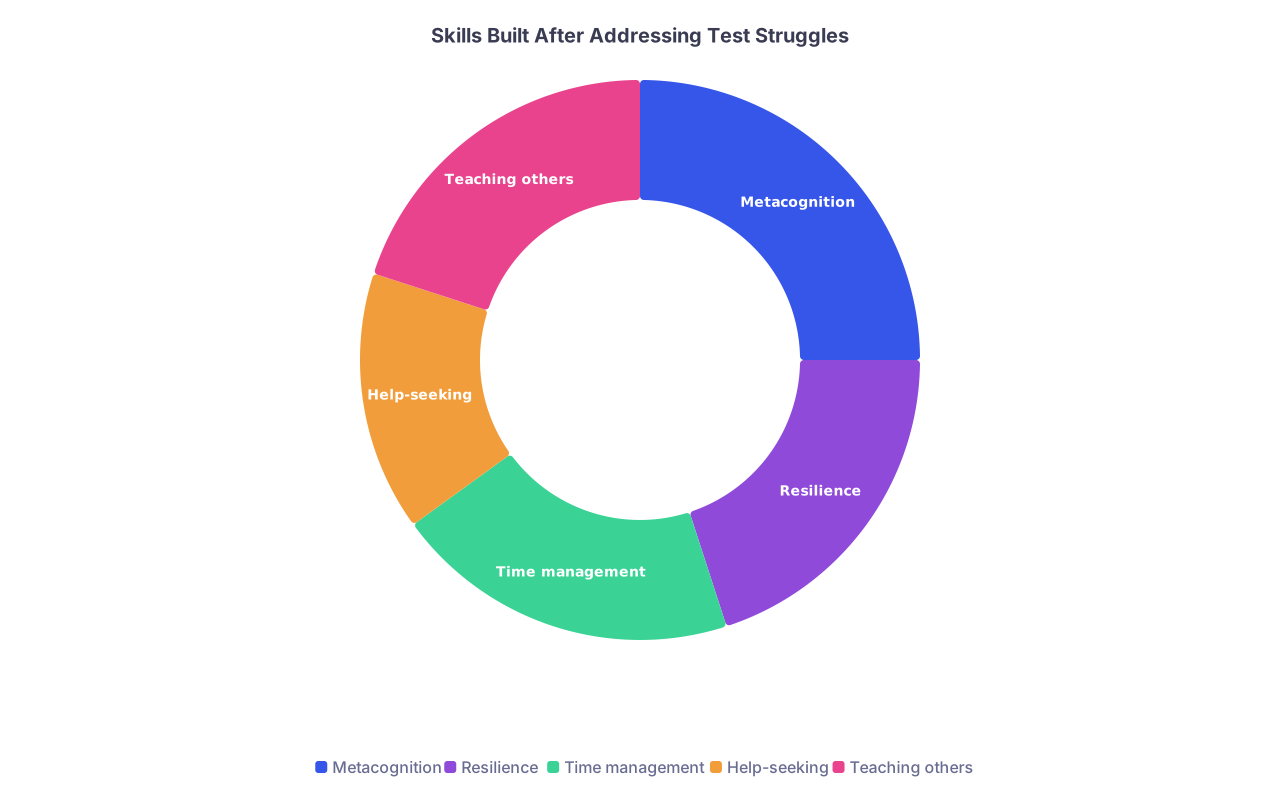
| Category | Value |
|---|---|
| Metacognition | 25 |
| Resilience | 20 |
| Time management | 20 |
| Help-seeking | 15 |
| Teaching others | 20 |
Examples of real strengths that can emerge:
- Metacognition: you are unusually good at diagnosing your own learning gaps and fixing them.
- Time management: after losing months to poor planning, you became ruthless and efficient.
- Empathy and teaching: you now help struggling juniors with concrete study strategies, not platitudes.
- Comfort with feedback: you are not destroyed by red ink; you use it.
You must show, not just claim.
Weak:
Failing Step 1 ultimately became a strength because it taught me resilience.
Stronger:
After failing Step 1, I began meeting weekly with two classmates who were also re‑taking the exam. I structured our sessions with targeted question blocks, error log reviews, and mini‑teaching segments on high‑yield topics. All three of us passed on our second attempt, and I have continued using that small‑group teaching format with third‑year students on the wards. That experience taught me how to turn a setback into a system, and how to support others through academic stress with specific, actionable help.
Now you are not just “resilient.” You are a resident who can run an effective board review session.
How To Pressure‑Test Your Paragraph Before Submitting
Before you lock anything into ERAS, run your score/anxiety paragraph through three tests.
1. The “blame” swap
Re‑read it and ask:
- If I replaced “I” with “the curriculum,” “the pandemic,” or “the exam,” would the paragraph still make sense?
If yes, you are probably under‑owning your role.
2. The “future risk” lens
Imagine yourself as a PD who cares most about board pass rates and in‑training scores.
Ask three questions:
- Do I understand exactly what went wrong?
- Do I see specific steps this person took to fix it?
- Is there objective evidence that those steps worked?
If any answer is “no,” the paragraph is not done.
3. The “proportion” check
Look at the full PS word count.
If more than ~20% of your statement is about your scores, you are over‑rotating. Cut it down or move some details to the Dean’s letter or a supplemental note.
Putting It All Together: A Sample Skeleton You Can Adapt
Here is a high‑level skeleton with the test piece integrated correctly. This is a structure, not something to copy.
- Opening: a concrete clinical moment that points to your interest in the specialty.
- Paragraph or two: your path into the field, key clinical traits, what you value in patient care.
- Middle paragraph: focused explanation of the low score / test anxiety:
- 1–2 sentences: factual acknowledgment.
- 2–3 sentences: specific causes and your responsibility.
- 2–4 sentences: actions taken and objective outcomes since.
- Paragraph: how the process shaped skills you bring to residency (metacognition, teaching, etc.).
- Closing: what you are looking for in a program and what you will contribute.
If your draft does not more or less fit that kind of balance, revise.
Final Thought: The Score Is A Data Point. Your Response Is The Story.
You cannot change the number sitting on your score report. You can absolutely control how it is interpreted.
Handled vaguely, your low Step score or test anxiety becomes a silent liability that readers project all their fears onto. Handled with precision—specific causes, concrete interventions, clear outcomes—it becomes evidence that you already passed one of residency’s core tests: the ability to confront your own weaknesses, fix them, and keep going.
Get that right, and your personal statement stops being damage control and starts being what it should have been from the start: a clear, honest preview of the resident you are becoming.
With that foundation, the next step is even more tactical: aligning your application list, letters, and interview talking points with this same narrative so every piece reinforces “identified problem, solved, now an asset.” But that orchestration is another conversation.