
Building a Competency-Based Portfolio When Your Scores Are Below Average
It is late September. ERAS is submitted. You know your Step 1 and Step 2 scores have “issues” because you have memorized the ranges on Charting Outcomes and they are not your ranges. Interview invites start trickling into other people’s inboxes. Your phone stays quiet.
You start hearing the same line from advisors and upperclassmen: “Just highlight your strengths beyond test scores.” That sounds nice. It is also completely useless unless you translate it into something concrete.
This is where a competency-based portfolio actually matters. Not as some abstract “reflective exercise,” but as a blunt instrument to redirect attention away from mediocre (or bad) scores and toward evidence that you are safe, effective, and valuable in a residency program.
Let me walk you through how to build that. Specifically. Not theory. Structure, documents, and phrases you can actually drop into ERAS, your email, and your interviews.
Step 1: Accept the Stats Reality and Define Your Asks
Before you build anything, you need to be brutally honest about what your scores do and do not allow you to say.
A below-average Step profile does three things in most PDs’ heads:
Triggers concern about:
- Knowledge acquisition
- Test-taking under pressure
- Risk of board failure during residency
Pushes you into the “borderline” or “maybe” pile by default.
Forces you to outperform on everything else just to be considered “average.”
You are not trying to pretend this is not true. You are trying to answer—proactively—the questions your scores raise:
- “Can this resident safely manage patients on day one?”
- “Will this resident pass the in-training exam and boards?”
- “Will this resident be reliable, low-drama, and coachable?”
So your portfolio has to be designed around those questions, not around your ego.
The “ask” you are making of programs is not “ignore my scores.” That is delusional. The real ask is:
“Look at my full competency profile. You are not taking a risk on me, because I have already demonstrated clinical performance, professionalism, growth, and resilience that compensate for weaker test scores.”
Everything that follows is about building the evidence for that statement.
Step 2: Know the Competencies You Need to Prove
You are building a competency-based portfolio, not a scrapbook of “things I did.” That means you anchor everything to defined competency domains.
Use the ACGME core competencies (because PDs think this way whether they say it out loud or not):
- Patient Care
- Medical Knowledge
- Practice-Based Learning and Improvement
- Interpersonal and Communication Skills
- Professionalism
- Systems-Based Practice
And if you want to think like a PD, also track:
- Reliability / Work Ethic
- Teamwork / Leadership
- Teaching / Mentorship
- Adaptability / Resilience
You do not have to use every label in your materials, but you need to know which boxes each activity checks.
Here is how scores intersect with competencies, roughly:
| Area | PD Initial Worry From Low Scores |
|---|---|
| Patient Care | May miss key details / slower |
| Medical Knowledge | Weak fund of knowledge |
| Practice-Based Learning | Poor test strategy, limited reflection |
| Communication Skills | Usually neutral |
| Professionalism | Usually neutral |
| Systems-Based Practice | Usually neutral |
Your job is to over-deliver on the neutral zones (communication, professionalism, systems-based practice) and directly counter the “worry zones” (medical knowledge, PBLI) with specific evidence.
Step 3: Audit What You Already Have (And Reframe It)
Do a 60–90 minute audit. No distractions. Open:
- Your MedHub/Oasis/evaluation system
- Old emails from attendings
- Dean’s letter / MSPE draft if available
- CV draft
- Any teaching, QI, or research project documents
Create a simple spreadsheet with columns:
- Experience / Document
- Date / Duration
- Setting (core rotation, sub-I, research, job, etc.)
- Competencies demonstrated (tag 2–4 from the list above)
- Evidence type (narrative eval quote, hard metric, project outcome)
- “Use in…” (CV, personal statement, supplemental app, letters, interview stories)
You are mining your own history for evidence, then labeling it by competency.
Example entries:
- “IM Sub-I (July–Aug): PC, MK, Prof, ICS – quote: ‘functions at intern level, independently managed 8–10 patients.’ Use: personal statement + interview.”
- “Student QI project: ‘Decreased ED handoff delays by 25%.’ Competencies: SBP, PBLI, teamwork. Use: ERAS experiences + interview.”
- “Peer teaching in anatomy review sessions: ICS, MK, teaching. Feedback: ‘clear explanations, structured review.’ Use: supplemental question about teaching.”
This is not busywork. This is your raw material for the portfolio.
Now, notice two things:
- You probably already have stronger evidence in some competency areas than you realized.
- There are likely obvious gaps. For example:
- Tons of “volunteering” but nothing showing systems thinking.
- Research listed, but no outcomes or reflection.
- Good comments about being “hardworking,” but nothing about knowledge growth.
Those gaps are your target zones for the next few months.
Step 4: Translate Experiences into Competencies on ERAS
Most ERAS entries are garbage: “Helped take care of patients and saw how the health system works.” That tells a PD nothing.
You are going to use a competency lens to write each significant experience.
Structure each description around:
- Context: where/what
- Role: what you actually did
- Competency evidence: outcome, feedback, or process
- Growth: what changed in how you practice
Example 1 – Clinical experience reframed
Bad:
“Completed sub-internship in internal medicine. Worked with residents and attendings caring for hospitalized patients.”
Competency-based:
“Four-week internal medicine sub-internship on a high-volume teaching service. Independently managed a census of 6–8 patients, writing daily notes and placing orders under resident supervision. Led family meetings for complex discharge planning and received feedback from the attending for clear explanations and realistic goal setting. By the end of the rotation, was asked to precept new third-year students on constructing assessments and plans.”
Tags in your spreadsheet: Patient Care, ICS, Professionalism, Teaching.
Example 2 – QI project
Bad:
“Worked on a QI project to improve discharge summaries.”
Competency-based:
“Co-led a QI project aimed at improving discharge summary timeliness on the medicine service. Collected baseline data, identified delays at the attending sign-off step, and piloted a standardized ‘ready for discharge’ afternoon checklist. Within eight weeks, improved on-time discharge summary completion from 62% to 84%. Presented findings to the department QI committee. Integrated project feedback into my own practice by building discharge plans earlier in the hospitalization.”
Tags: Systems-Based Practice, PBLI, Teamwork.
You are making PDs think: “Scores are lower, but this person actually functions like a resident in real clinical systems.”
Step 5: Build a Simple, Shareable Portfolio Document
You are not going to send a 20-page dossier to programs uninvited. They will not read it.
But you should absolutely have a 2–4 page “Competency Portfolio” PDF you can:
- Upload in systems that allow additional documents (some prelim/TY, some smaller specialties).
- Reference in emails to PDs or program coordinators (“Happy to share a brief competency summary if helpful.”).
- Pull from quickly when answering interview questions so your stories are polished.
Structure:
Cover block (half page)
- Name, contact, photo optional
- One short paragraph: where you are from, specialty applying to, core message.
Example:
“Fourth-year medical student at [School], applying to Internal Medicine. While my Step 1 and Step 2 scores are below the national mean, I have consistently performed at or above the expected level in clinical settings, including high-intensity sub-internship rotations. This portfolio summarizes concrete evidence of my strengths in patient care, communication, and systems-based practice, as documented by faculty evaluations, project outcomes, and teaching experiences.”Competency summary grid (1 page)
Sample Competency Summary Grid Competency Evidence Snapshot (Abbreviated) Patient Care IM Sub-I: managed 8–10 patients, ‘intern level’ Medical Knowledge Surgery clerkship: ‘top 10% fund of knowledge’ PBLI Self-directed Step 2 remediation, improved 23 points Communication Skills Led 12+ family meetings; praised for clarity Professionalism Perfect attendance; ‘most reliable student’ comment Systems-Based Practice / QI ED handoff QI: reduced delay by 25% Under the table, you can add 3–4 bullet statements like:
- “Consistently evaluated at or above level 4 (on 1–5 scale) in clinical performance metrics.”
- “Selected by clerkship director to mentor junior students due to strong communication skills.”
Selected evidence (1–2 pages)
For each competency, 1–2 short vignettes with:- Setting
- What you did
- Verbatim evaluation quote (with attribution like “– IM Sub-I attending”)
- Objective data if available (scores, before/after metrics)
Example snippet:
“Patient Care – Internal Medicine Sub-Internship, July 2025- Managed full intern-level patient load on a busy teaching service; assumed primary responsibility for overnight admissions for 3 nights.
- Evaluation comment: ‘Functioned at the level of a new intern by the second week; anticipates patient needs and recognizes early deterioration.’ – Dr. [Name], Associate Program Director.”
This is not meant to be handed to everyone. It is your “in case a program is on the fence” weapon and your own script generator.
Step 6: Address “Medical Knowledge” and Test Concerns Head-On
Low Step scores automatically raise a “Medical Knowledge / PBLI” red flag. You can either let PDs fill in the blanks with their worst assumptions, or you can give them a clean narrative.
Elements you want in that narrative:
- You understand why you underperformed (in a mature, non-excuse way).
- You changed your approach in a specific, testable manner.
- You have objective signs of improvement.
- You have systems in place to keep improving during residency.
Example for personal statement / interview:
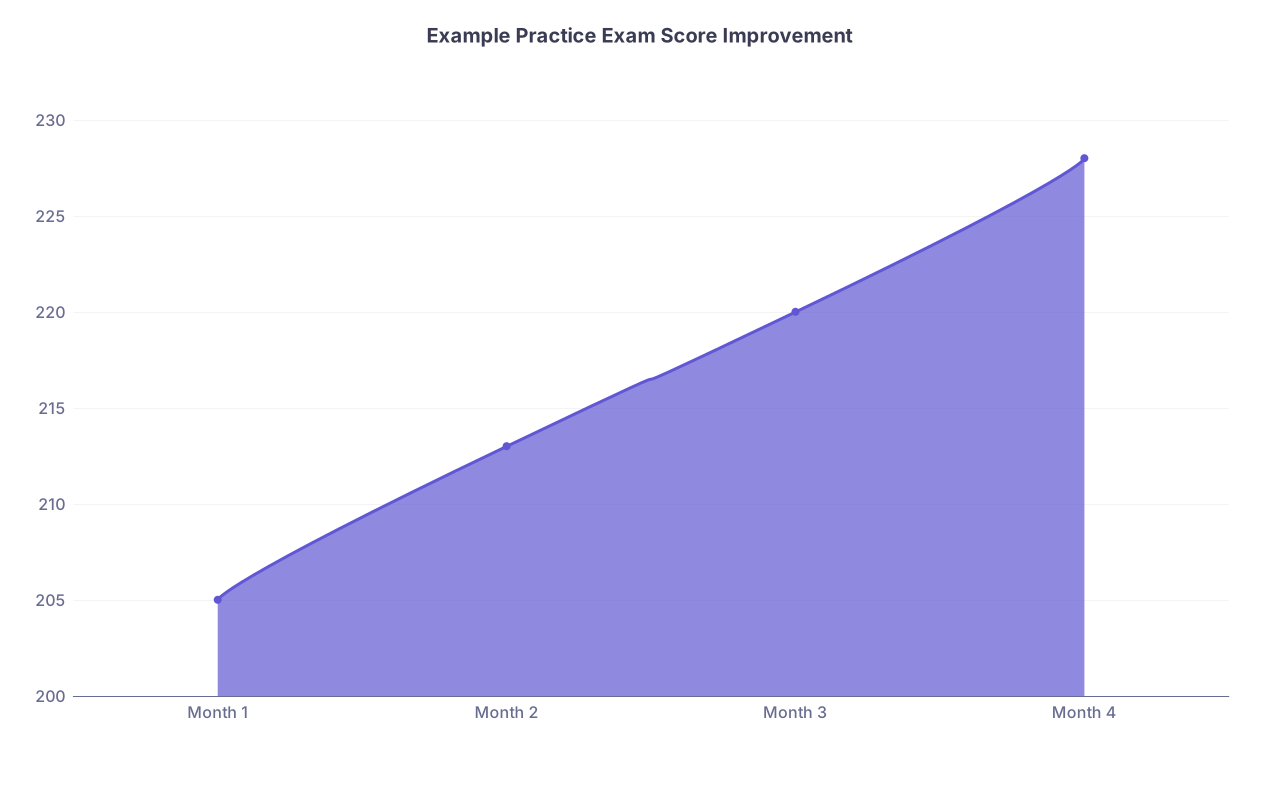
“I did not perform well on Step 1. I underestimated the volume and pace I needed to maintain on a daily basis and relied too heavily on passive review. After receiving my score, I met with our learning specialist, mapped out a structured schedule, and shifted to active question-based learning with weekly self-assessment blocks. On my first NBME practice exam for Step 2, I scored a 205 equivalent; by my last practice exam, six weeks later, I had improved to a 228 equivalent and ultimately scored a 230 on Step 2. On my surgery and medicine clerkships, attendings consistently commented on my clinical reasoning and application of knowledge at or above the expected level for my training. I now use a weekly review and spaced repetition system that I plan to carry into residency, particularly for board preparation.”
If your Step 2 did not improve, you must lean more on:
- Strong clerkship grades
- Shelf exam trends (if they are better)
- In-training-type assessments (if your school has them)
- Concrete self-study systems
You want PDs thinking: “This person knows their weakness and has built a functioning PBLI system around it.”
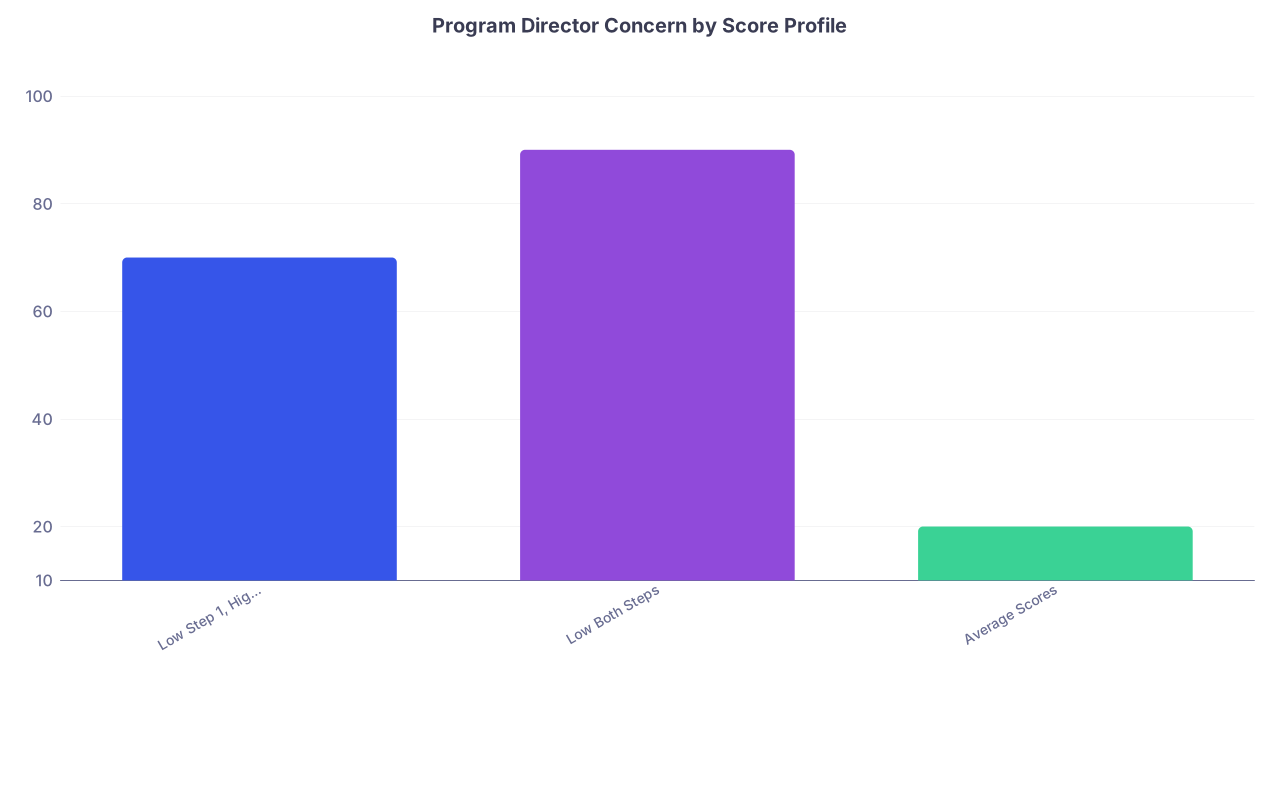
Here is how confidence vs concern often breaks down in PD minds:
| Category | Value |
|---|---|
| Low Step 1, Higher Step 2 | 70 |
| Low Both Steps | 90 |
| Average Scores | 20 |
Rough interpretation: you have to work harder if both are low, but neither is a death sentence if the rest of your file screams reliability and growth.
Step 7: Leverage Letters as Competency Proof, Not Just Praise
Letters of recommendation are often generic: “hardworking, a pleasure to work with.” They do nothing to counteract low scores.
You need at least 1–2 letters that explicitly address:
- Clinical reasoning and patient care
- Ability to grow and learn quickly
- Reliability / professionalism
- How your performance compares to peers with “better” numbers
When you ask for letters, you must give faculty very pointed guidance. And yes, doctors actually appreciate specificity.
When you request:
“I am applying to Internal Medicine this cycle. As you know, my Step scores are below the national average. Programs will rightly be concerned about my ability to handle the cognitive load of residency and pass boards. If you feel you can do so honestly, it would be extremely helpful if your letter could speak specifically to my clinical reasoning, day-to-day performance on the wards, and capacity to grow over the course of the rotation.”
You can even include a one-page “evidence sheet” pulled straight from your portfolio:
- 2–3 cases you handled
- Specific feedback they gave you during the rotation
- Projects or presentations you completed under their supervision
You are nudging them to write a competency letter, not a character reference.
Step 8: Rehearse High-Yield Competency Stories for Interviews
You are going to be asked the usual garbage: “Tell me about a time you made a mistake,” “Talk about a conflict,” “What is a weakness?”
Most applicants ramble through these. You will not.
You will:
- Pick 5–7 specific stories from your portfolio.
- Map each to 1–2 competencies.
- Use them flexibly across different questions.
For each story, explicitly identify:
- Starting point (what was the problem / context?)
- Your actions (not “we,” but you)
- Outcome (numbers, feedback, or changed behavior)
- Competencies demonstrated
Example story – Addressing “weakness/growth” and PBLI:
“During my medicine clerkship, I realized that my initial written assessments were often too descriptive and did not clearly prioritize the problem list. My resident pointed this out after reading one of my notes on a complex CHF exacerbation. That evening, I reviewed several UpToDate examples and compared them with my own notes. I started forcing myself to write a problem-based assessment with a clear ‘most likely’ and ‘must not miss’ for each issue, plus 1–2 evidence-based references. Over the next two weeks, the resident commented that my notes had become much more focused and helpful during rounds. I have kept that structure for all subsequent rotations and it has made my oral presentations more concise as well.”
Competencies: PBLI, Patient Care, ICS.
Example story – Systems-Based Practice / QI:
“In our ED rotation, we frequently had handoff delays when patients were boarded and changed teams after midnight. I noticed this pattern on three consecutive shifts, so I started tracking the time from admission order to first note by the receiving team. Over about 20 patients, the median delay was nearly 6 hours. I brought this data to my attending and asked if we could trial a simple paging script for cross-cover residents when patients were boarding. We ran an informal pilot on my next three shifts; the median delay dropped to around 3 hours when we used the script. The attending later incorporated this into a broader QI project. For me, the experience changed how I think about communication during transitions of care.”
Competencies: SBP, PBLI, ICS, Initiative.
You notice the pattern: every story is a competency proof, not just an “interesting thing that happened.”
Step 9: Tactically Use the Supplemental Application and Signaling
The supplemental application (where applicable) is where you explicitly lean into competencies because they literally ask about experiences that shape you.
If they ask about:
- “Most meaningful experiences”
- “Adversity”
- “What else should programs know about you?”
You are not going to write poetry about “resilience” in the abstract. You will frame:
- Low scores as a problem you tackled with PBLI.
- Clinical or personal challenges as crucibles that sharpened professional behavior.
- Projects as examples of systems thinking.
For example, an adversity essay with scores:
“I entered medical school with limited test-taking strategy and performed below my expectations on Step 1. This was humbling and forced me to confront some ineffective habits I had been able to get away with previously. I sought out our learning specialist, adopted active question-based study, and used regular self-assessment to identify and remediate weak areas. While my Step 2 score remains below the national mean, I improved significantly from my initial practice exams. More importantly, I have embedded those habits into my weekly routine on clinical rotations: reviewing at least three patients per week in depth using primary literature and updating my own notes with key management points. This shift has been reflected in my clerkship evaluations, where attendings consistently comment on my preparation and growth over the course of each rotation.”
You are correcting the narrative: low scores become the start of your PBLI story, not the final verdict.
Step 10: If You Have Time Before Applying Again (or Before Rank List): Plug the Gaps
If you are:
- Still in MS3/MS4 with future rotations coming, or
- Considering SOAP/reapplication,
you can deliberately build missing competencies in the next 6–12 months.
Targeted moves:
Weak in Systems-Based Practice?
Join an actual QI team with real metrics, not a “poster-only” project. Ask to own data collection or process mapping. Aim for one concrete pre-post outcome you can quote.Weak in Teaching / Communication?
Lead structured review sessions for juniors. Collect anonymous feedback forms (3–5 questions). Quote the numbers: “Average rating 4.8/5 for clarity.”Weak in Research but strong clinically?
A focused clinical case series with a resident mentor tied directly to patient care issues in your chosen specialty is better than being the 8th author on a basic science abstract you barely understand.Concern about knowledge base?
Take and document progress on practice exams:- Old shelf practice exams
- NBME-style self-assessments
Use them as PBLI evidence: “Over 6 months, I raised my internal medicine self-assessment score from 45th to 65th percentile through regular question blocks and review.”
You are not trying to become a different applicant. You are building a documented improvement arc.
A simple progress chart can be powerful in your own portfolio, even if you never show it directly:
| Category | Value |
|---|---|
| Month 1 | 205 |
| Month 2 | 213 |
| Month 3 | 220 |
| Month 4 | 228 |
Step 11: How This Looks in the Real World
Let me outline a concrete “before” and “after” applicant with the same scores.
- Step 1: 208 (pass)
- Step 2: 219
- No honor society, mostly passes, a couple of high passes
- Applying to Internal Medicine
Applicant A – No portfolio thinking
ERAS experiences:
- “Volunteered in clinic for underserved populations.”
- “Did research in cardiology lab.”
- “Member of internal medicine interest group.”
Letters:
- “Hardworking, team player, pleasure to work with.”
Personal statement:
- Talks about “love of internal medicine,” mentions “resilience” after low Step scores in vague terms.
Interviews:
- Answers are generic, unstructured. Cannot quickly pull examples showing growth or systems thinking.
Programs see:
- Below-average scores.
- Nothing powerful to counter that.
- Lands mostly community IM interviews, struggles to get university programs’ attention.
Applicant B – Same numbers, strong competency portfolio
ERAS experiences:
- Clinic volunteering described with explicit roles, continuity, and communication skills.
- Research reframed as learning to appraise literature, leading to a journal club presentation.
- IM interest group role described as organizing case-based teaching with documented feedback.
Letters:
- One letter explicitly states: “Despite lower board scores, [Name] functions at or above the level of peers on the wards, with strong clinical reasoning and reliability. I would not hesitate to have [him/her/them] as an intern in our program.”
Personal statement:
- Brief, candid Step story.
- Specific description of PBLI changes, clinical growth, and an example of QI/workflow improvement.
Interviews:
- Tight, competency-focused stories.
- Clear ability to describe how they will approach in-training exams and boards.
Programs see:
- Below-average scores.
- Strong, cohesive evidence of resident-level functioning and growth mindset.
- Moves from “automatic reject” to “borderline but interesting” to “this could be a solid resident who just is not a great standardized test taker.”
Does this magically get you into MGH or UCSF? No. But it absolutely can be the difference between matching into a solid university-affiliated IM program versus going unmatched or stuck in a prelim-only purgatory.
Step 12: Common Mistakes I See (And How To Avoid Them)
A few patterns I have watched tank otherwise salvageable applications:
Trying to hide the scores
PDs already know. They saw your transcript in 0.7 seconds. Your silence reads as lack of insight.Overcompensating with “passion” language
“I am so passionate about X” means nothing without evidence. Replace 70% of your passion sentences with competency stories.Laundry list vs narrative
Ten small, unconnected experiences scream “busy but unfocused.” Three or four deep, coherent threads (patient care, teaching, QI) tell a much stronger story.Letting others write generic letters
If a faculty member will not or cannot write a specific, competency-based letter, you are better off choosing someone else.Building the portfolio but not using it to rehearse
If you have a nice PDF but cannot tell your own stories cleanly, you wasted your time. The portfolio is a training document for your mouth, not just for your Dropbox.


| Step | Description |
|---|---|
| Step 1 | Scores Below Average |
| Step 2 | Audit Experiences |
| Step 3 | Tag by Competency |
| Step 4 | Rewrite ERAS Entries |
| Step 5 | Build Portfolio PDF |
| Step 6 | Guide Letters of Rec |
| Step 7 | Rehearse Interview Stories |
| Step 8 | Target Remaining Gaps |

Final Takeaways
You cannot make your scores disappear, but you can drown them in concrete, competency-based evidence that you function like a safe, teachable resident.
A real portfolio is not fluff; it is a structured set of experiences, evaluation quotes, and outcomes directly tied to ACGME competencies and explicitly referenced in ERAS, letters, and interviews.
Programs are risk-averse, not cruel. If you show them that you understand your weaknesses, have already built systems to address them, and have strong clinical performance, many will take a chance on you—even with below-average scores.