
The most common mistake applicants with low scores make is choosing letter writers based on prestige instead of how well they actually know you. That’s backward—and it hurts you.
If your Step scores are below average, letters of recommendation become one of your highest-yield weapons. Used right, they can completely reframe your application. Used badly, they just confirm the committee’s worst fears.
Let’s walk through exactly how to choose letter writers when your scores are dragging you down—and how to get letters that actually move the needle.
1. What Matters Most When Your Scores Are Weak
When your Step scores are below average, program directors are asking themselves only three questions:
- Can this person safely take care of patients?
- Will they work hard and not be a problem?
- Did they just have a test-taking issue, or are there deeper concerns?
Your letters need to answer those questions clearly and repeatedly.
Here’s the hierarchy for you—different from a 260 applicant:
- Strength of endorsement
- Specific clinical observations
- Direct comparison to peers
- Understanding of your “story” (e.g., low score but strong upward trend, tough circumstances)
- Writer’s title / prestige
Notice what’s last. The big name with a vague letter is worse than the mid-level faculty who supervised you daily and thinks you walk on water.
2. Who Should You Prioritize as a Low-Score Applicant?
Forget generic advice like “get a chair letter if you can.” Here’s how you should actually think about it.
Your ideal letter writer has three features:
- They directly observed you clinically or in a longitudinal setting.
- They like you enough that you’re not nervous to ask, “Can you write me a strong letter?”
- They understand your lower scores and still believe in you as a resident.
If you have to choose, this is the order I’d use for most specialties:
| Priority | Writer Type |
|---|---|
| 1 | Core clerkship attending who supervised you closely |
| 2 | Sub-I / acting internship attending |
| 3 | Longitudinal mentor in your specialty |
| 4 | Research PI who also saw you clinically |
| 5 | Departmental leader who truly knows you |
Let’s break that down.
Core clerkship attendings
These people see you under pressure. They see your notes, your sign-outs, how you react at 3 a.m. They can say things like:
“Although their Step scores are below our typical range, I’d rank them in the top 10% of students I’ve worked with in the last five years based on clinical performance.”
That sentence is gold for you.
Sub-I / Acting internship attendings
If you did a Sub-I where you acted almost like an intern, those letters are huge. They can address the exact concern PDs have:
“They already function at an intern level…”
That single line is more powerful for you than a glowing basic-science PI letter.
Mentors in your specialty
If you’re going into IM and you’ve been going to morning report weekly with the same faculty member who’s watched you grow, that longitudinal context can neutralize a low score:
“Their board scores do not reflect the diligence, ownership, and clinical reasoning I’ve witnessed over two years…”
Notice the pattern? Strong writers for you don’t avoid your score—they contextualize it.
3. Who You Should Avoid (Even If They’re Famous)
Here’s where low-score applicants get themselves in trouble.
Do not prioritize:
- The national-name department chair who spent 20 minutes with you and will write: “Pleasure to have on our service.”
- The research superstar who can say you’re “hard working” but never saw you with patients.
- Anyone who hesitates when you ask if they can write you a “strong, supportive letter.”
A mediocre or lukewarm letter does more damage to a low-score applicant than to a high-score one. PDs are already on alert; vague praise sounds like a polite no.
If your gut says, “They know my name but not my work,” move on.
4. How Many Letters and What Mix?
Most programs want 3 letters, sometimes 4. Your mix should look like this (for a low-score applicant):
- 2 letters from core clinical rotations or Sub-Is in or adjacent to your specialty
- 1 letter from someone who can speak to your work ethic / character / long-term growth
- Optional 4th: a research or leadership letter only if it’s truly strong and relevant
Example for Internal Medicine with low scores:
- IM Sub-I attending
- Third-year core IM clerkship attending
- Longitudinal mentor (IM faculty or other clinician who knows you well)
- Optional: Research PI in quality improvement who also saw you on rounds
5. How to Decide Between Two “Good” Options
You’re going to have to choose sometimes. Use this decision filter:

| Step | Description |
|---|---|
| Step 1 | Two possible writers |
| Step 2 | Leaning Writer 1 |
| Step 3 | Leaning Writer 2 |
| Step 4 | Pick Writer 1 |
| Step 5 | Pick Writer 2 |
| Step 6 | Who supervised you more directly? |
| Step 7 | Who can be more specific in examples? |
But let me translate that into plain English. Ask yourself:
- Who saw me more often and in more challenging situations?
- Who has already said very strong, specific things to me or about me?
- Who seems more excited about my future?
- Who is more likely to address my low scores directly and positively?
If the “bigger name” loses on those questions, don’t pick them.
6. How To Talk About Your Low Scores With Potential Writers
You’re not hiding your Step scores. PDs will see them. Your goal is to make sure the people vouching for you understand the story.
You can do this without sounding defensive. Something like:
“I want to be transparent that my Step scores are below the average for this specialty. Since you saw me work closely, I’m hoping your letter could speak to how I perform clinically compared to peers, and why you still feel I’d be a strong resident despite the scores.”
Or:
“I had a rough testing period during Step, but my clinical evaluations and Sub-I went very well. If you feel comfortable, I’d be grateful if your letter could highlight my work ethic, growth, and ability to function at the intern level.”
If they shift in their seat, hesitate, or respond with something like, “Sure, I can write you a standard letter,” that’s a red flag. Standard letters won’t save you. Move on.
7. What Your Letters Should Actually Say (For You)
You can’t tell writers what to write, but you can guide what they focus on by what you share.
For a low-score applicant, you want letters that:
- Explicitly reinforce that you are safe and reliable clinically
- Compare you positively to peers (“top third,” “top 10%,” “one of the strongest students I’ve worked with in recent years”)
- Address your response to feedback and growth over time
- Mention concrete behaviors: following up lab results, owning patients, staying late, reading on your own
- Optionally, contextualize your low score: one bad exam, tough life event, late bloomer academically—but now stable
What you don’t want: generic adjectives with no backup. “Hard-working,” “pleasant,” “team player” with no examples. That reads as faint praise, especially when scores are weak.
8. Who To Ask Outside Your Chosen Specialty
If your scores are low, you also want at least one person outside your target specialty who can say:
“Regardless of board scores, this is someone I’d trust with my family member’s care.”
Good sources:
- A demanding surgeon who saw you hustle on call
- A busy ED attending who watched you handle volume and stress
- A clerkship director who noticed your improvement and resilience
The specialty mismatch is less important than the strength and specificity of the praise.
9. Timing and Logistics: Don’t Shoot Yourself in the Foot
You can do everything right in writer choice and still mess it up by being disorganized.
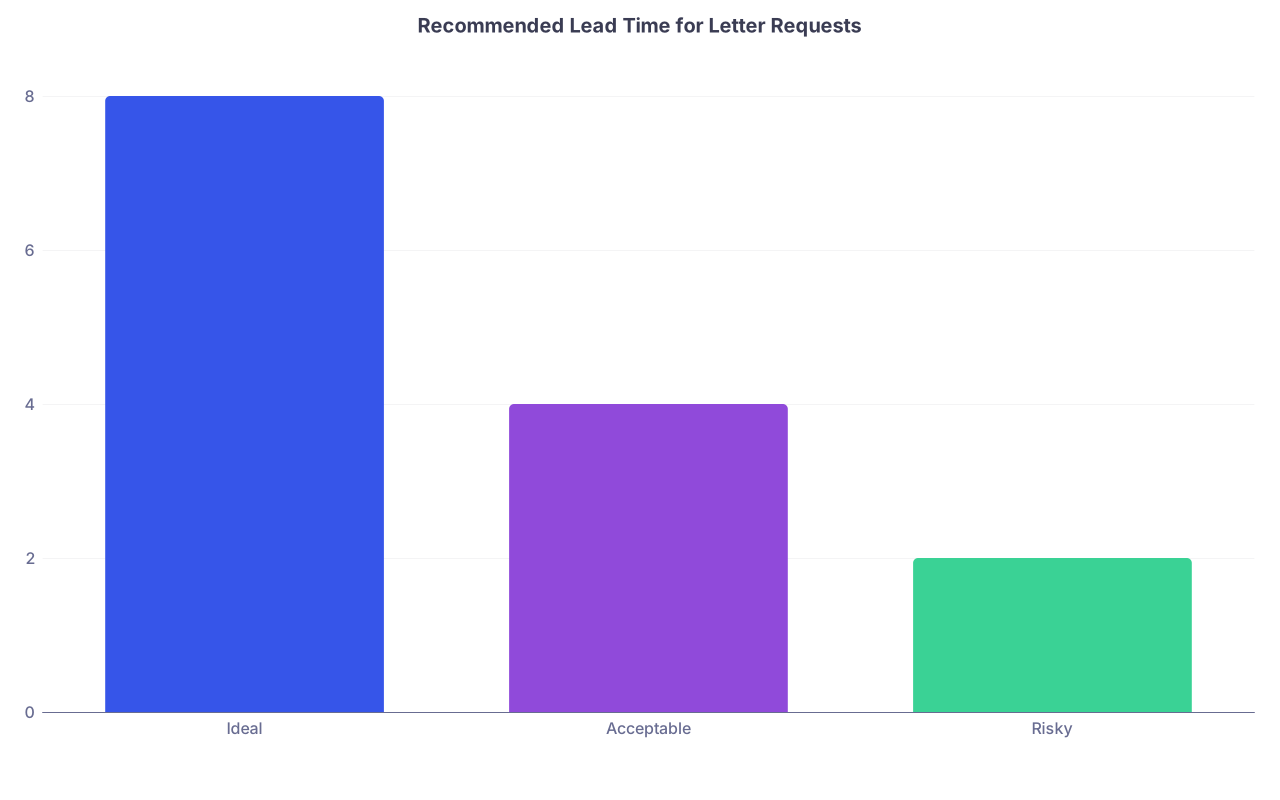
| Category | Value |
|---|---|
| Ideal | 8 |
| Acceptable | 4 |
| Risky | 2 |
(That’s weeks before your ERAS submission.)
Aim for:
- Asking 6–8 weeks before you need letters uploaded
- Following up once, politely, about 2–3 weeks before the deadline
- Providing an organized packet:
- CV
- Personal statement draft (or at least a solid paragraph on “Why this specialty / why me”)
- Score report if you’re comfortable (and you should be, in this context)
- Bullet points of 4–6 specific things they saw you do that you’re proud of
You’re not writing your own letter. You’re reminding them of real moments they already witnessed.
10. Example Scenarios and What I’d Do
Let’s make this concrete.
Scenario 1: Below-average Step, strong IM performance
- Step 1: 205, Step 2: 218
- Honors in IM clerkship and IM Sub-I
- Solid but not stellar in surgery, peds, OB
I’d choose:
- IM Sub-I attending (saw you as “almost intern”)
- IM clerkship attending or director
- Longitudinal IM mentor or strong letter from another core where you turned it around after feedback (shows growth)
Skip:
- Random chair who met you once
- Research-only PI who never saw you on the wards
Scenario 2: Failed Step 1, passed on second attempt, strong clinical comments
- Step 1: Fail then 207
- Step 2: 220
- Great comments about work ethic in multiple rotations
I’d prioritize writers who can explicitly say:
“I’m aware of their exam history, but in my experience, their performance on the wards is equivalent to or better than many residents I’ve supervised with significantly higher board scores.”
So:
- Two attendings who know both your history and your work
- One faculty who followed you over time and can speak to resilience and improvement
11. Quick Comparison: Good vs. Bad Choices for You
| Option | Good or Bad | Why |
|---|---|---|
| Famous chair who barely knows you | Bad | Vague letter, no real advocacy |
| Core clerkship attending you impressed | Good | Direct, specific clinical feedback |
| Research-only mentor with no clinical contact | Risky | Helps only if letter is exceptional |
| Sub-I attending who pushed you hard | Excellent | Can say you function at intern level |
| Chill attending who liked you but saw little | Meh | Letter likely generic |
If you’re still unsure, ask yourself: “If this PD called them on the phone, would they fight for me?” If the answer isn’t “yes,” pick someone else.
12. The Real Goal With Low Scores
You’re not trying to hide your numbers. That never works.
Your goal is simple: by the time a PD finishes reading your letters, they should be thinking:
- “The tests undercalled this person.”
- “Multiple people I trust would take this resident in a heartbeat.”
- “I’m more worried about passing on them than about that score.”
That mindset doesn’t come from one fancy writer. It comes from three aligned, specific, and clearly enthusiastic letters from people who actually know your work.
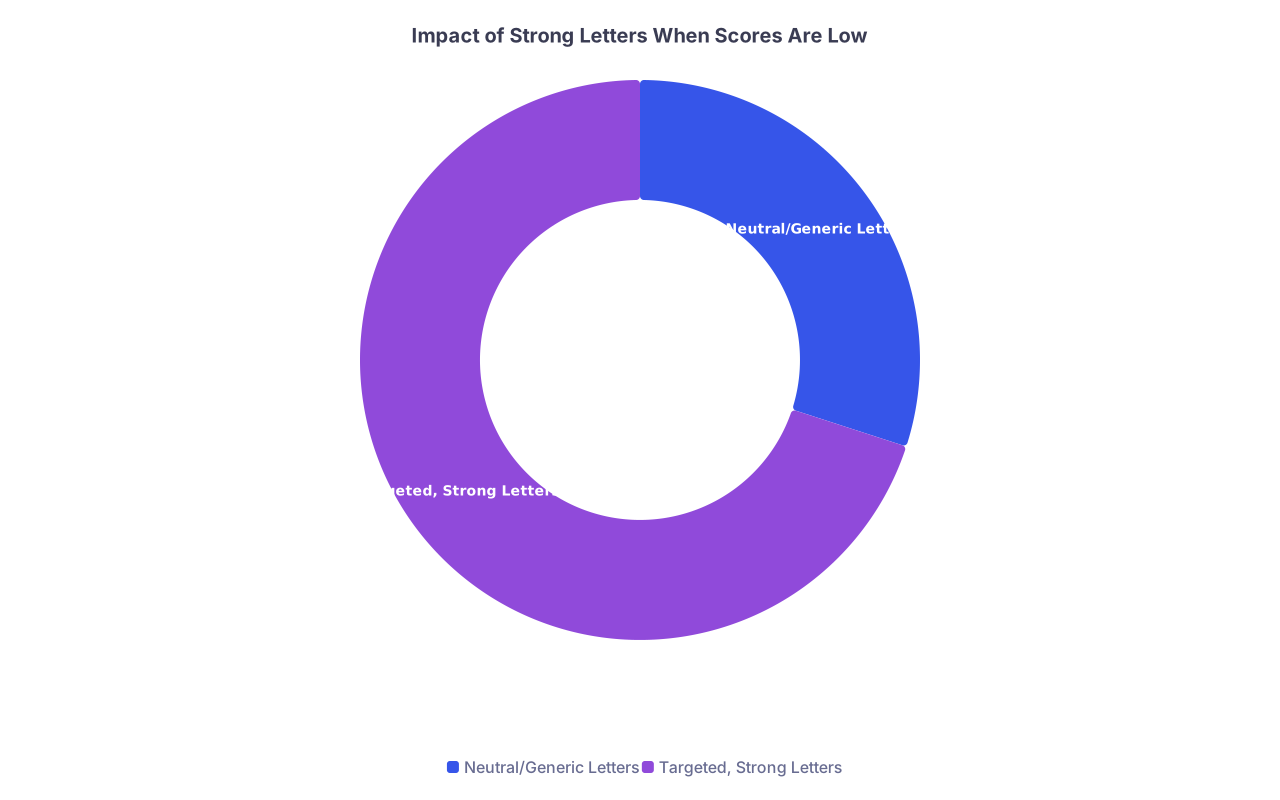
| Category | Value |
|---|---|
| Neutral/Generic Letters | 30 |
| Targeted, Strong Letters | 70 |
That’s roughly how it plays out in real life. Strong, specific letters won’t make you a 270 applicant—but they can take you from “auto-screened out mentally” to “let’s talk to this person.”
FAQ (Exactly 7 Questions)
1. Should I tell potential letter writers my exact Step scores?
Yes. For you, secrecy backfires. Share your score history briefly and matter-of-factly, and pair it with what you’ve done since (strong clinical evals, improved Step 2, etc.). You want writers who are fully informed and still strongly supportive.
2. Is a department chair letter required if my scores are low?
No. “Required” is often overstated. A lukewarm chair letter can hurt more than help. If your school or specialty truly expects a chair letter, meet with them early, make sure they know your story and your strengths, and still prioritize your other letters being from people who know you well.
3. How many letters should directly address my low scores?
At least one, ideally two, should clearly acknowledge and contextualize your scores without dwelling on them. Not a whole paragraph of excuses—just one or two sentences making it clear that your clinical performance contradicts the low numbers.
4. Is a research letter worth it if my scores are below average?
Only if the PI:
- Knows you very well,
- Thinks highly of you, and
- Can comment on traits that translate to residency (follow-through, critical thinking, teamwork).
If they barely know you, skip it. Research fame won’t fix generic content.
5. What if my best letter writer isn’t in my specialty?
That’s fine. For a low-score applicant, a powerful letter from another specialty that says you’re safe, hard-working, and among the strongest students they’ve worked with is extremely valuable. Pair that with at least one in-specialty letter, and you’re fine.
6. How do I know if a letter writer will be strong or just “okay”?
Ask directly: “Do you feel you can write me a strong, supportive letter for residency?” If they hesitate, hedge, or rephrase it as “I can write you a letter,” that’s a sign they might not be as enthusiastic as you need.
7. What if my clinical performance matches my low scores—no standout comments anywhere?
Then your priority shifts to:
- Finding attendings who saw your work ethic and growth, even if you weren’t dazzling,
- Getting Step 2 as high as possible,
- Tightening your personal statement and experiences to show insight and maturity,
- Applying broadly and strategically.
Still aim for writers who like you and saw you improve, even if you weren’t the star.
Open your list of potential letter writers right now and rank them by how strongly and specifically they can vouch for you, not by their titles. If the top three aren’t the “fanciest” people in your department, that probably means you’re finally doing this right.