
The blunt truth: most people with low Step scores either apply to way too few programs…or way too many. Both can sink you.
You’re asking, “How many programs should I apply to with a low Step score?” Here’s the short, real answer:
- If your Step score is significantly below the national mean for your specialty, you should usually be in the 60–120 program range, depending on specialty and red flags.
- If you’re below many programs’ hard cutoffs, you might need 100+ applications, but only if you’re targeting the right tier and the right mix of programs.
- If you’re thinking 25–30 total programs with a low score in a competitive specialty? That’s fantasy-land.
Now let’s turn that into an actual decision framework you can use.
Step 1: Define “Low Step Score” for Your Specialty
“Low” doesn’t mean the same thing for everyone. A 220 in Family Med is not the same as a 220 in Dermatology.
Use this rough guide for Step 2 CK (since Step 1 is now pass/fail, but the logic is similar for older Step 1 scores):
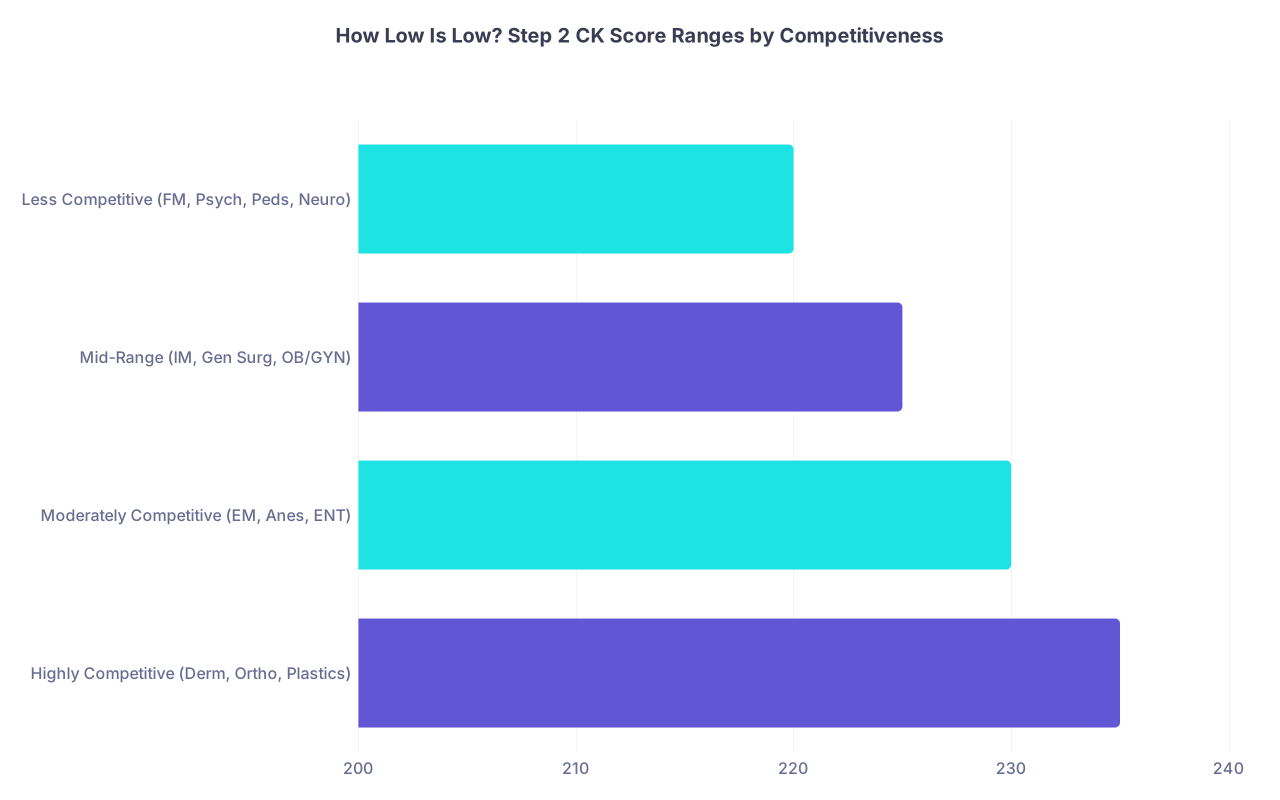
| Category | Value |
|---|---|
| Highly Competitive (Derm, Ortho, Plastics) | 235 |
| Moderately Competitive (EM, Anes, ENT) | 230 |
| Mid-Range (IM, Gen Surg, OB/GYN) | 225 |
| Less Competitive (FM, Psych, Peds, Neuro) | 220 |
Those values are rough “pressure points” where a score starts to feel low relative to the field.
As a working rule of thumb:
- Highly competitive specialties:
- “Low” = <240–245
- Moderately competitive (EM, Anes, ENT, Rad, etc.):
- “Low” = <230–235
- Mid-range (IM, Gen Surg, OB/GYN):
- “Low” = <225–230
- Less competitive (FM, Psych, Peds, Neuro):
- “Low” = <220–225
If you’re 10–15 points below your specialty’s typical matched average, you’re in the “low” category for this discussion.
Step 2: Use This Core Rule – Applications Buy You Interviews, Not Exceptions
I’ve heard this line from more than one PD:
“We don’t bend our cutoffs. We just don’t. I don’t care if they applied to 200 programs.”
That’s the frame you need in your head.
- Programs with hard score cutoffs will not suddenly love you because you spammed applications.
- Your real question isn’t “How many applications total?” It’s:
“How many applications to programs where I’m actually interviewable?”
So first job: sort programs into realistic vs fantasy.
Step 3: The Application Number Framework (By Specialty & Risk)
Here’s the framework I use when advising students with low Step scores.
1. Start with a baseline by specialty
Assuming no catastrophic red flags (no failures, no big professionalism issues), and a below-average but passing score:
| Specialty Group | Example Fields | Typical Range if Score is Low |
|---|---|---|
| Highly Competitive | Derm, Ortho, Plastics, ENT, RadOnc | 80–150 (often 100+ necessary) |
| Moderately Competitive | EM, Anes, Radiology, Urology | 70–120 |
| Mid-Range | IM, Gen Surg, OB/GYN | 60–100 |
| Less Competitive | FM, Psych, Peds, Neuro, Path | 40–80 |
That’s your starting range, not your final number.
2. Adjust up or down based on your risk profile
Ask yourself:
- Any Step failures?
- International med grad (IMG) or DO in an MD-heavy specialty?
- No home program or weak letters?
- Big gaps in training?
If you answer “yes” to any of those, you’re not playing on easy mode.
Rough adjustments:
- Add 20–40 programs if:
- You’re an IMG (especially non-US IMG)
- You have a Step failure but passed later
- You’re changing specialties late without strong specialty-specific backing
- Subtract 10–20 programs (carefully) if:
- You’re US MD with only slightly low score and strong home program support
- You have standout strengths (stellar research in that field, killer letters, AOA, etc.)
Most low-score applicants will end up here:
- Competitive/moderate specialties: 80–130 programs
- Mid-range: 70–110 programs
- Less competitive: 50–80 programs
If your number is under 50 and your score is clearly low, you’re probably under-applying.
Step 4: Build a Smart Mix – Not Just a Big Number
Spraying 120 applications at programs that will auto-screen you out is just burning money.
You need a deliberate mix:
- A small group of reach programs (yes, even with a low score — but keep it reasonable)
- A large core of realistic programs (where your credentials are close to their usual range)
- Some safeties in less desirable locations or lower-tier settings where they historically take applicants like you
Think of it like this:
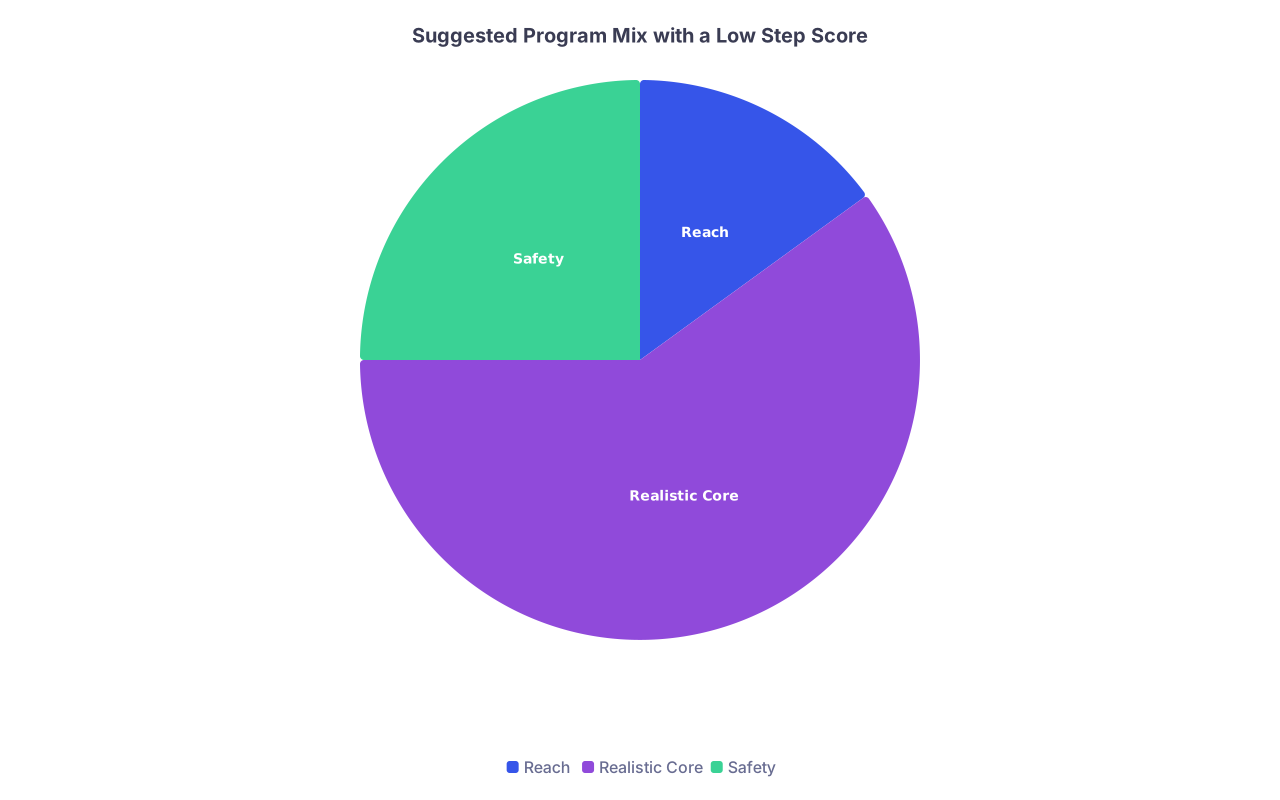
| Category | Value |
|---|---|
| Reach | 15 |
| Realistic Core | 60 |
| Safety | 25 |
So if you’re applying to 100 programs:
- 10–20 reach
- 50–70 realistic
- 20–30 safety
If you’re applying to 40 total (for a truly less competitive field), the proportions stay similar.
Step 5: Reality-Check with Data (Instead of Vibes)
This is where most people get lazy. They “feel” like 60 is a lot. It might not be. Use actual numbers.
Look at three things for each specialty:
- Average number of applications by matched applicants
- Average Step 2 CK scores of matched vs unmatched
- Interview yield (roughly: how many apps → how many interviews)
Then factor in the low-score penalty: you’re going to need more applications to get the same number of interviews.
Rough heuristic a lot of advisors quietly use:
- With a solid, on-par application:
- 30–40 apps → 10–12 interviews in less competitive fields
- 50–60 apps → 10–12 interviews in mid fields
- With a low score:
- You might need 1.5–2x the applications to get the same 10–12 interviews
Why 10–12 interviews? Because that’s around where the match probability really stabilizes.
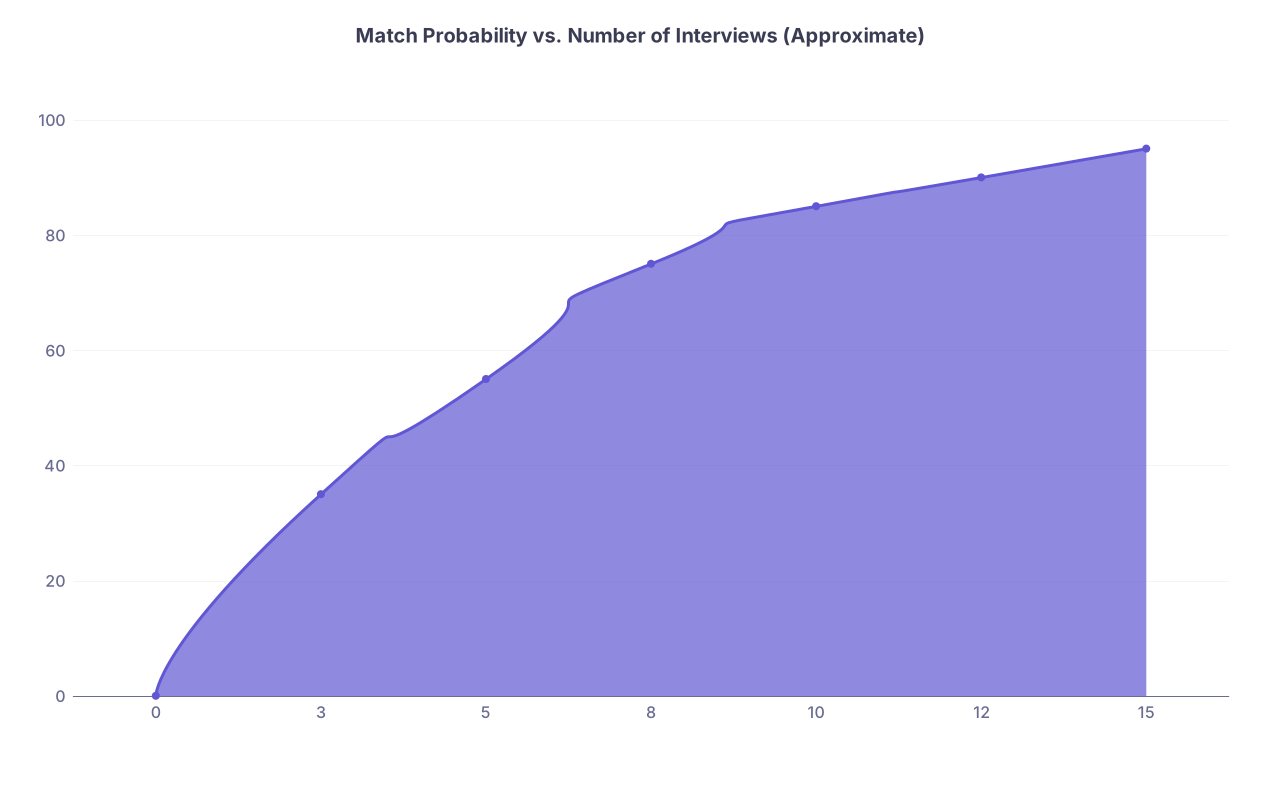
| Category | Value |
|---|---|
| 0 | 0 |
| 3 | 35 |
| 5 | 55 |
| 8 | 75 |
| 10 | 85 |
| 12 | 90 |
| 15 | 95 |
Your goal isn’t “X applications.” Your goal is enough interviews to hit the 80–90% match probability zone. Applications are just the lever.
Step 6: Adjust for Specialty Choice (Hard Truth Time)
If you have a truly low score and you’re gunning for something like Derm, Ortho, or Plastics with no compensating superpower (insane research, insider support, etc.), you have two paths:
- Apply insanely broadly and accept a high risk of not matching, or
- Strategically adjust your specialty choice to one where your score is survivable.
For people with low scores, I’m going to be blunt:
Applying to 120 Derm programs with a 225 and nothing else special is not a “brave” choice. It’s denial.
If you’re not willing to change specialty:
- You’re in the 100–150+ applications territory.
- You absolutely must have a strong parallel plan (prelim year, TY, or backup specialty).
If you are open to changing:
- Pivoting to something like IM, FM, Psych, Peds, Path, Neuro can drop your necessary application number and raise your match odds dramatically.
Step 7: Geography and Program Type Matter More Than You Think
Another mistake: people with low scores aim only at “places I’d be happy to live” and then wonder why they don’t match.
With a low score, your filters shift:
- Priority 1: Places that will actually interview and rank you
- Priority 2: Places you can tolerate
- Priority 3: Dream cities and brand-name programs
You need to lean hard into:
- Community programs
- Smaller cities and non-coastal areas
- States without giant medical school footprints (fewer home-field applicants)
- Programs known historically to take IMGs or DOs, if that’s you
You can trim a bit if:
- You have strong regional ties to specific areas
- Your school sends a lot of grads successfully to a certain region or network
- You’re okay sacrificing some geographic variety to save money
But if you have a low score and you’re saying, “I only want big coastal cities,” don’t be surprised when the Match doesn’t care what you want.
Step 8: Don’t Forget This: Fix What You Still Can
You can’t change your Step score. You can change everything around it.
If you’re going to spend thousands on 80–120 applications, make sure you’re not sabotaging yourself with:
- A lazy, generic personal statement
- Horrible ERAS experiences section (the classic wall-of-text or meaningless fluff)
- Mediocre letters from “famous” people who barely know you
- No signal to programs that you actually care about them (geographic ties, rotations, emails, etc.)
If your Step score is low, programs are asking:
“Is this person lazy/unprepared, or is there more to their story?”
Your application volume only helps you if the rest of your file gives them a reason to say yes.
Practical Numbers: Concrete Examples
To make this less abstract, here’s how I’d talk to three fictional students:
US MD, Step 2 = 222, applying IM, no failures, solid clinical evals, average research
- Target: 70–90 IM programs
- Add 20–30 FM or prelim IM if really nervous or weak regionally
US DO, Step 2 = 230, applying Anesthesiology, no failures, some decent research
- Target: 80–110 Anes programs
- Add 20–30 IM/FM as backup if needed
Non-US IMG, Step 1 pass, Step 2 = 215, applying Psych, one gap year, good US letters
- Target: 70–100 Psych programs
- Consider 20–30 FM/IM or prelim years as backup
Those are realistic, not optimistic.
How to Decide Your Number Today (Simple Checklist)
Here’s the quick framework you can actually use:
- Identify your specialty’s competitiveness level.
- Decide if your score is “slightly low” or “significantly low” for that field.
- Start with the baseline range from the table.
- Add 20–40 if: IMG, Step failure, DO in competitive field, no home program.
- Subtract 10–20 only if: US MD, just slightly low, strong home support, strong letters/research.
- Build a mix: 15% reach, 60% realistic, 25% safety.
- Aim for a path that could realistically yield 10–12 interviews, not just a sexy application count.
Then gut-check:
If your number is under 50 and your score is clearly low? You’re probably under-applying.
If your number is 150+ and half the list are programs that explicitly want high Step scores? You’re probably wasting money.
FAQ (Exactly 6 Questions)
1. Is there such a thing as applying to too many programs with a low Step score?
Yes. “More” stops helping when you’re just adding programs that will auto-screen you out. If your list is stuffed with academic powerhouses that list “average Step 2 > 250” as a brag point, they’re not suddenly going to love your 220 because you applied. Over-applying also means you rush through ERAS, send sloppy personal statements, and ignore program-specific details that could have earned you interviews at realistic places.
2. How many interviews do I actually need to feel safe with a low Step score?
For categorical positions in most specialties, 10–12 solid interviews puts you in a good place. People match with fewer, but when your score is low, you don’t want to play the “I hope 4 interviews is enough” game. Think in terms of “How many interviews can I reasonably generate?” and work backward to your application count from there.
3. Should I apply to a backup specialty, and how many programs there?
If your score is truly low for your chosen specialty, I strongly prefer having a backup. For the backup: something like 30–60 programs is reasonable, depending on competitiveness. Example: Anes primary (90–110 programs), IM backup (40–60 programs). The key is not to send 15 pity apps to a backup field and pretend that’s a real plan. If you’re going to have a backup, commit.
4. Do signals (preference signaling) change how many programs I should apply to?
Signals help, but they do not magically erase a low score. They might let you trim a little at the margins if you’re in a field that uses them (EM, Ortho, some others), but they don’t justify dropping from 100 applications to 35. Think of signals as a way to slightly weight your realistic core, not as an excuse to under-apply.
5. If my school advisor says 40–50 is enough, should I listen?
Maybe, but be skeptical. Many schools are still giving advice anchored to “average applicant” data or to pre-Step 1 pass/fail realities. If your Step score is clearly low, you are not the average applicant. Compare their number to the framework above and to actual NRMP data. If their recommendation puts you below what low-score applicants usually need, push back and expand.
6. What’s one thing I can do this week that matters more than picking an exact number?
Audit your program list for fantasy programs. Go through and delete every program that:
- Publicly boasts very high average Step scores,
- Has a long track record of ignoring IMGs/DOs (if that’s you), or
- Is a brand-name academic powerhouse in a hyper-competitive city with no tie to you.
You’ll probably trim 10–30 programs of pure delusion. Then refill those slots with realistic and safety programs that might actually read your file.
Open your program list today and write the number you’re currently planning to apply to at the top. Then, using the ranges and adjustments above, decide: do you need to move that number up, down, or rebuild your list completely?