
The brutal truth: A transitional year rarely “erases” low Step scores. But used strategically, it can help you recover—if you’re realistic, deliberate, and pick the right program for the right reasons.
Let’s walk through what a transitional year actually does for you, when it helps, when it’s a waste of time, and what you should do instead or in addition.
1. What a Transitional Year Really Is (And Isn’t)
People love to imagine a transitional year (TY) as a magical reset button.
It’s not.
A transitional year is:
- A 1‑year, mostly broad‑based clinical internship (often cushier than prelim medicine or surgery).
- Meant to fulfill the PGY‑1 requirement for certain advanced specialties (radiology, anesthesia, derm, PM&R, optho, rad onc, etc.).
- Sometimes more flexible, sometimes lifestyle‑friendly, sometimes just…generic intern year with a nicer label.
What it is not:
- A formal remediation program for low Step scores
- A guaranteed bridge into a more competitive specialty
- A way to hide, delete, or replace Step 1/Step 2 scores
- An automatic “second chance” in the match
Your Step scores are permanent. ERAS isn’t going to suddenly show “+10 points after TY.” Program directors still see the same numbers.
So if your entire strategy is:
“I’ll match a TY → crush it → then everyone will ignore my Step 220 and let me into derm”
That’s fantasy.
But there are ways a TY can legitimately help you.
2. When a Transitional Year Actually Helps You
Here’s when a transitional year can be a smart move with low Step scores.
Scenario A: You’re targeting an advanced (A) specialty and need any PGY‑1
You’ve got a low Step score, but you still manage to match into something like:
- PM&R (advanced position)
- Radiation Oncology
- Anesthesiology (A spots)
- Diagnostic Radiology
- Ophthalmology (through SF Match, then you need a PGY‑1)
In that case, a TY is just a vehicle. The key thing that helped you overcome low scores? Getting into that advanced specialty in the first place.
Where the TY can help:
You use it to:
- Build stellar clinical evaluations
- Get strong letters from respected attendings
- Show reliability, work ethic, and maturity
- Prove your low Step score doesn’t reflect your actual clinical performance
This makes your life in the PGY‑2+ years easier and helps if you ever need to transfer programs or apply for fellowships later.
Scenario B: You’re trying to switch specialties after not matching or matching something you don’t want
This is where people start asking, “Will a transitional year help me recover from low Step scores?”
Sometimes.
If you:
- Didn’t match at all → SOAPed into a TY or prelim year
- Matched into something you’re not committed to, but want to pivot (e.g., prelim surgery → gas, TY → radiology, etc.)
Then a well‑used year can:
- Generate new, strong letters from US academic programs
- Show improvement in clinical performance, responsibility, and teamwork
- Give you time to:
- Add research
- Rework your personal statement
- Clarify your story: why you missed the first time, why you’re a stronger applicant now
Here’s the catch: if your target specialty is still as competitive or more competitive than your numbers justify, all the great TY evaluations in the world may not make up for a low Step.
You might upgrade from “auto‑screened out” to “we’ll glance at it.” That can matter. But it’s not magic.
Scenario C: You’re an IMG/DO with low Step scores and weak US experience
In this context, a TY or prelim year in the US with:
- Solid clinical performance
- Good letters from US academic attendings
- No professionalism issues
…can be a big upgrade over:
- Only home‑country training
- Observerships and externships with weak letters
- A gap year with no clinical work
For some IMGs, a TY is the bridge from “not in the game” to “serious candidate for community IM/FM/neurology/PM&R.” But again, it doesn’t replace your scores—it adds context and credibility.
3. When a Transitional Year Is a Bad Strategy
Here’s where I’ve seen people burn a year and end up bitter.
Red flag #1: Using TY to chase highly competitive fields with no realistic foundation
If your profile looks like this:
- Step 1: 205 (pass/fail era → weak pass, borderline CCs)
- Step 2: 215
- No strong research, no home advocacy, no hooks
And the plan is:
“I’ll do a transitional year and then go for derm, plastics, ENT, or ortho.”
No. That’s not a plan. That’s denial.
Your energy is better spent:
- Pivoting to a specialty that actually takes applicants with your profile
- Strengthening clinical and research output in that realistic target
- Being strategic about geography and program type (more on that below)
Red flag #2: Thinking TY alone “fixes” a Step fail
Failed Step 1 or Step 2?
A good transitional year can help show:
- You’re clinically safe
- You can juggle responsibilities
- You’ve matured and stabilized
But programs don’t forget a fail.
You need:
- A clear, honest explanation (illness, family situation, poor planning, etc.)
- Subsequent clean record: passed Step 2 and (if taken) Step 3 on first try
- Strong clinical and/or academic performance
If you just hope a TY will make programs ignore your fail without any narrative or improvement? You’ll be disappointed.
Red flag #3: Non‑categorical TY with no forward plan
Some people SOAP into a TY and…stop thinking.
No Step 3.
No new research.
No networking with the specialty they want.
No talking to PDs or advisors about realistic next steps.
They finish the year and apply back to the same overreach list. Same outcome. Different year.
A TY without an aggressive, deliberate application strategy is just 12 months of being tired and underpaid.
4. How Programs Actually View a Transitional Year
Let me translate what’s going through a program director’s head when they see a TY on your application.
Roughly three buckets:
| PD Interpretation | What It Usually Means for You | Impact on Low Step Scores |
|---|---|---|
| Clean TY, strong evals | Reliable, functional intern | Helps slightly |
| Mediocre TY, mixed evals | Concern about performance | Hurts or neutral |
| Red flags during TY | Major risk | Overwhelms any benefit |
If you crush your TY:
- High‑quality evaluations (words like “outstanding,” “top 10%”)
- Strong letters from known faculty
- No professionalism issues
- Maybe some research or QI work on the side
Then many PDs will say:
“Okay, the Step score is low, but this applicant clearly functions well clinically. We can work with this.”
If your TY is average:
- “Pleasant, did their job”
- Generic letters
- Mixed comments about organization, follow‑through, or communication
Then low Steps stay heavy. There’s nothing to counterbalance them.
If your TY has issues:
- Late notes, poor reliability, conflicts with nursing, professionalism concerns
Your low Step score becomes the least of your problems. You’ve added new risk to your file.
5. Concrete Ways to Use a TY to Offset Low Scores
If you decide to pursue or accept a transitional year, do it with a plan. Think of it as 3 buckets you need to fill.
Bucket 1: Clinical reputation
Your goal: be the intern everyone wants back.
Practical moves:
- Own your patients. Know their labs, plans, consults cold.
- Communicate like an adult: closed‑loop with nurses, pages answered, no disappearing.
- Ask for feedback early, especially from senior residents you trust.
- If you’re weak in something (organization, note writing, efficiency), name it and work on it.
You want your attending writing:
“This resident performed at the level of a strong categorical intern in our program. I would gladly take them into our residency if possible.”
Bucket 2: Step 3 (if accessible)
If Step 3 is available to you during the TY year and you struggled on Step 1/2, it can be high‑yield to take it under the right conditions:
- Only after serious, focused prep
- Aim for clear improvement relative to Step 2, not a barely‑passing scramble
- Use it to show: “Given time and structure, I can perform above my earlier level”
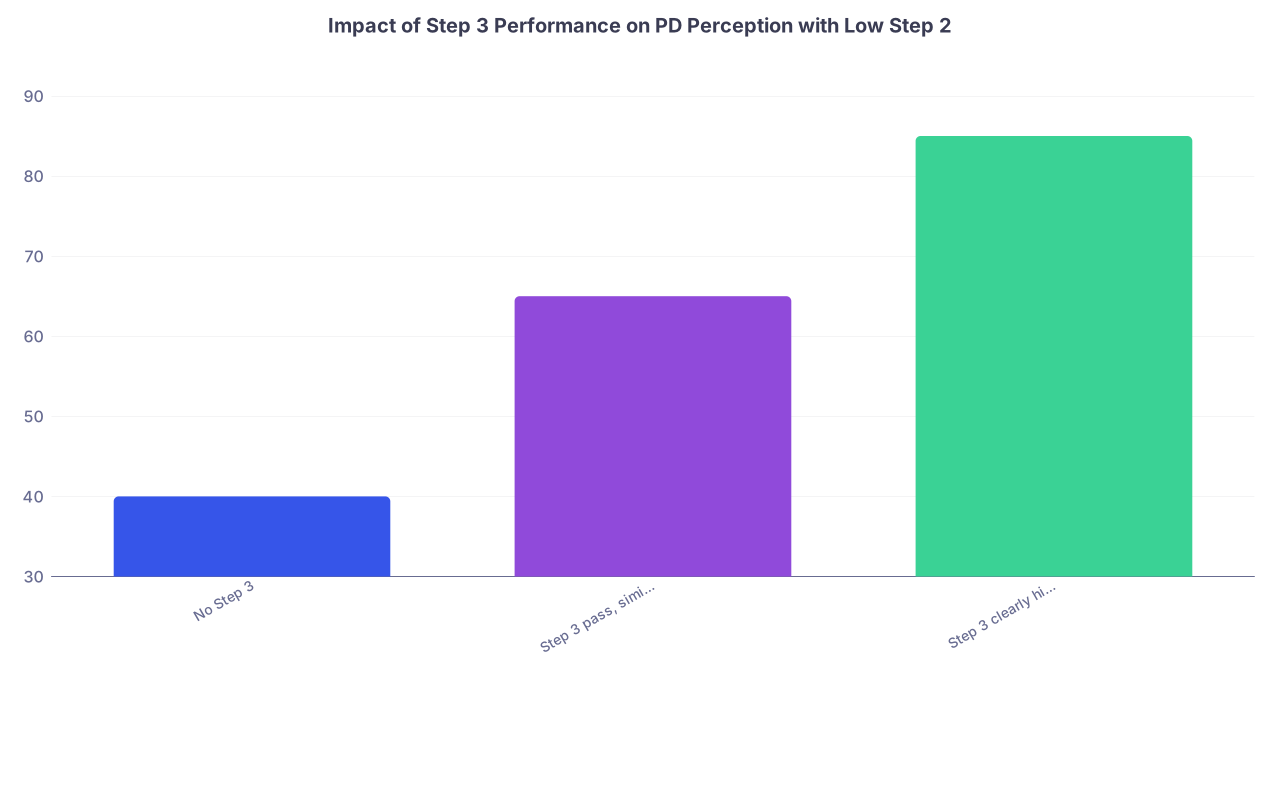
| Category | Value |
|---|---|
| No Step 3 | 40 |
| Step 3 pass, similar score | 65 |
| Step 3 clearly higher | 85 |
Rough translation: higher Step 3 doesn’t erase low Step 2, but it reframes the narrative from “chronic under‑performance” to “late bloomer/improver.”
Bucket 3: Specialty‑specific alignment
If you’re trying to pivot into (or strengthen your shot at) a particular specialty during your TY:
- Schedule elective time in that specialty at institutions that realistically might rank you
- Work closely with at least 1–2 attendings who can write targeted, detailed letters
- Join or start:
- A small QI project
- A case report
- A retrospective chart review
You don’t have to publish in NEJM. But you do need something that says:
“This person isn’t just dabbling; they’re genuinely invested in [field].”
6. Alternatives That Sometimes Make More Sense Than a TY
Depending on where you’re starting from, a transitional year might not be your best play.
Here are some alternatives that can be smarter:
Option 1: Categorical in a less competitive specialty from the start
If your Step scores are low and your dream specialty is ultra‑competitive, the better move is often:
- Shift to a realistic specialty (FM, IM, psych, peds, neuro, PM&R, path in some regions), and
- Go all‑in to become excellent there
You can still subspecialize, still have a meaningful career, still be happy. Plenty of people quietly switch targets and end up far more satisfied than those who spend 3 years chasing a closed door.
Option 2: Research year in that specialty (for certain fields)
For highly academic or research‑heavy fields like:
- Radiation oncology
- Dermatology
- Some IM subspecialties (cards, GI later on)
- Radiology (at certain institutions)
A focused research year with:
- A known PI
- Multiple abstracts/posters/papers
- Strong mentorship
…can sometimes move the needle more than a generic TY.
But again, this only helps if you’re in the ballpark. A 198 Step 1, 205 Step 2 + derm research year is still far outside normal match stats.
Option 3: Go all‑in on geographic and program tier flexibility
For a lot of low Step score applicants, where you’re willing to go matters more than what you do in between.
You should be thinking:
- Community programs
- Less desirable locations
- Newer programs
- Programs that historically take:
- DOs
- IMGs
- People with nontraditional paths

Your best leverage is often:
- Widening your net
- Matching somewhere that will take a chance on you now
- Then proving yourself clinically and building from there
7. Choosing a TY Program if You Go That Route
If you do commit to a transitional year, pick like someone who’s playing the long game.
| Factor | Better for Low Step Recovery |
|---|---|
| Program type | Academic or strong community |
| LOR potential | Attendings known in your target field |
| Elective time | Enough blocks in target specialty |
| Culture | Supportive, not malignant |
| Step 3 policy | Allows time and support to take it |
Ask current or recent residents:
- “Did anyone use this TY to successfully switch specialties?”
- “Do attendings actually write strong letters here?”
- “Is there real mentorship, or are you just service coverage?”
You want a program where people say things like:
“Yeah, X came in prelim, blew everyone away, and matched gas here/at Y program.”
Not:
“Honestly, prelims here are invisible and just carry the scut.”
8. What I’d Do If I Were You (Step‑by‑Step)
Here’s the blunt framework.

| Step | Description |
|---|---|
| Step 1 | Low Step scores |
| Step 2 | Take TY/prelim with plan |
| Step 3 | Research or reapply strategically |
| Step 4 | Commit to specialty or plan switch |
| Step 5 | Strengthen within program |
| Step 6 | Pivot to realistic field |
| Step 7 | Maximize TY - LORs, Step 3, electives |
| Step 8 | Use TY to aim for achievable specialties |
| Step 9 | Matched to anything? |
| Step 10 | SOAP TY/prelim available? |
| Step 11 | Still realistic target? |
| Step 12 | Target field realistic with scores? |
Short version of the playbook:
- Be honest about which specialties are truly still in reach with your numbers.
- Decide if a TY:
- Adds leverage (US experience, letters, Step 3, clinical narrative), or
- Just delays the inevitable pivot
- If you do a TY, treat it like a one‑year audition. Every rotation is a job interview.
- Build evidence that contradicts what your Step score implies:
- “Not smart enough?” → You passed Step 3 solidly.
- “Not hardworking?” → You’re the intern everyone counts on.
- “Not committed to this field?” → You’ve got projects/letters proving otherwise.
- Aim for pathways where programs have actually taken low‑score applicants before. Fantasy match lists will break you.
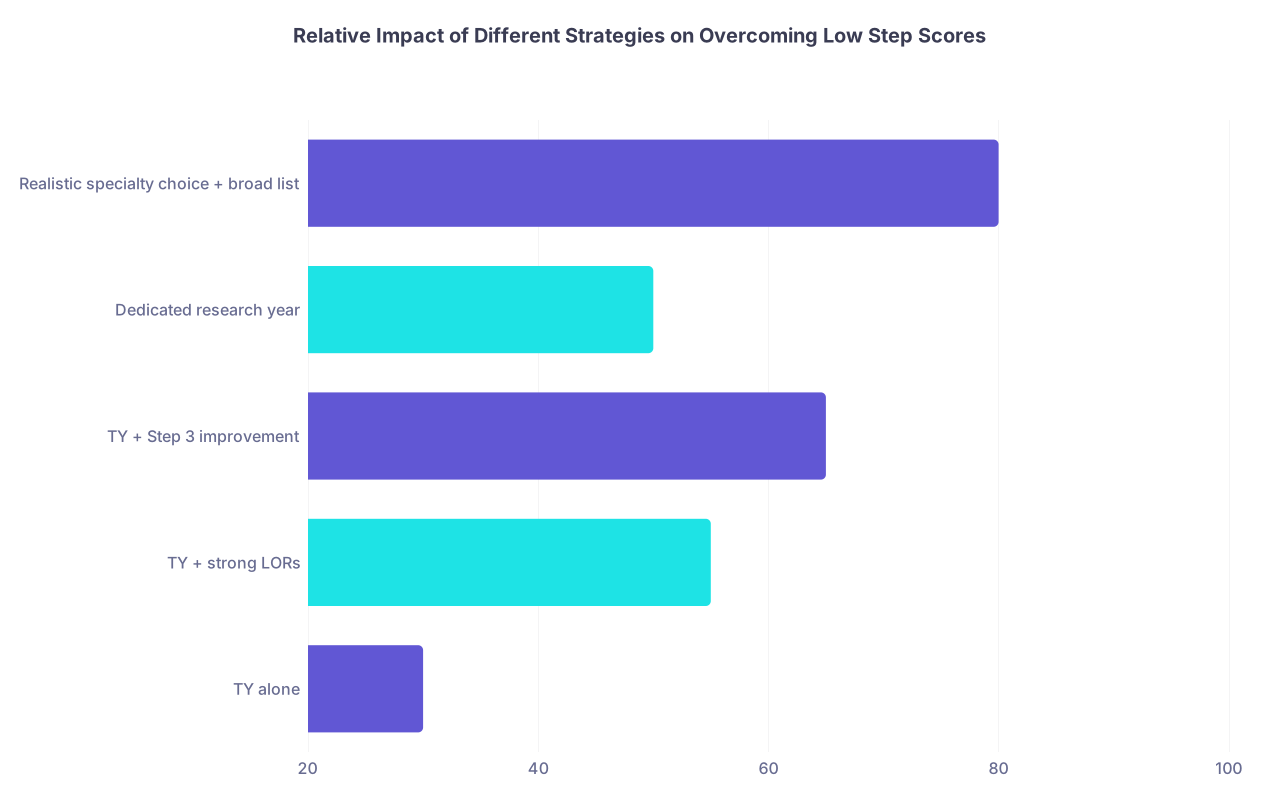
| Category | Value |
|---|---|
| TY alone | 30 |
| TY + strong LORs | 55 |
| TY + Step 3 improvement | 65 |
| Dedicated research year | 50 |
| Realistic specialty choice + broad list | 80 |
Interpretation: transitional year by itself is modest. Transitional year plus smart strategy and realistic specialty choice is where people actually recover.

FAQs: Transitional Year and Low Step Scores

Will a transitional year improve my chances of matching into a competitive specialty like derm, ortho, or plastics if I have low Step scores?
Very unlikely. Those fields care heavily about Step performance, research, and strong connections. A TY can add good letters and clinical performance, but it doesn’t reset the numerical cutoff culture in those specialties. If your scores are far below typical matches, you’re usually better off redirecting to a more realistic specialty instead of burning a year chasing low‑probability dreams.Is a TY better than a prelim medicine or prelim surgery year for low Step scores?
Not automatically. For low Step scores, what matters more is program type, mentorship, and letter quality—whether that’s TY, prelim med, or prelim surg. An academic prelim medicine year can sometimes help more than a random community TY if you get strong advocacy and exposure in your target specialty.Should I take Step 3 during my transitional year if my Step 1 and 2 are low?
In many cases, yes—if you can prep properly. A clearly better Step 3 score is a nice signal that you’ve improved. But rushing Step 3 and barely passing or failing makes things worse. If your schedule is punishing and you can’t study, hold off rather than adding another weak performance.Can great TY evaluations overcome a prior Step fail?
They help, but they don’t erase a fail. Programs will still see the failure and want an explanation. What excellent TY performance does is prove that, despite that failure, you’re reliable, safe, and capable in real clinical work. That can move you from “immediate rejection” to “we’ll take a serious look” in some programs, especially in less competitive specialties.What should I prioritize during a TY if I want to reapply?
Three things: top‑tier clinical performance (be the intern everyone trusts), at least two strong, detailed letters (ideally from your target specialty or respected generalists), and one additional “proof of growth” element—either Step 3 improvement or meaningful research/QI aligned with your chosen field.If I didn’t match and SOAP into a TY, should I reapply right away or wait a year?
Often you’ll reapply during your TY, but you must change something significant: broader list, more realistic specialty, stronger letters, clearer personal statement, possibly Step 3. If you send effectively the same application that failed the first time, you’ll likely get the same answer. Some people benefit from one post‑grad year (TY/prelim or research) to build a much stronger reapplication.Bottom line: will a transitional year “help me recover” from low Step scores?
It can support your recovery but won’t magically fix it. Think of a TY as a multiplier, not a cure. If you pair it with realistic specialty selection, strong letters, potential Step 3 improvement, and strategic applications, it can absolutely help you land on your feet. If you treat it as a cosmetic patch over fundamentally mismatched goals, you’ll just end up another year older with the same problem.
Key takeaways:
- A transitional year does not erase low Step scores; it only helps if you use it to build a strong counter‑narrative (clinical performance, letters, improvement).
- It’s most useful when paired with realistic specialty choices, Step 3 done well, and deliberate networking/mentorship.
- The smartest move isn’t “TY vs no TY”; it’s “What combination of steps gives me the best realistic path to a solid, satisfying residency?”