
The blunt truth: retaking a Step exam just to bump a borderline passing score is usually a bad move—and in some situations, it can quietly hurt your residency application more than you think.
Let’s unpack when a retake actually helps you, when it’s pointless, and when it’s actively dangerous.
Step 1: Get Clear on What “Borderline” Actually Means
“Borderline” is vague. PDs don’t think in vague. They think in numbers and patterns.
For Step 1 (now Pass/Fail) it’s simple:
- You either passed or you didn’t.
- A “barely passed” Step 1 today matters way less than you think, unless it’s paired with other weak spots (low Step 2, failures, poor school performance).
For Step 2 CK (or Level 2-CE, etc.), borderline typically means:
- You passed, but your score is at or slightly above the minimum many programs like to see.
Think ranges like:
- Internal Medicine: low 220s can feel borderline for strong academic programs, but fine for many community programs.
- Competitive fields (Derm, Ortho, Plastics): 240s–250s can feel borderline if you’re aiming very high.
- For many primary-care–heavy specialties: anything above the “red flag” zone (often ~210–220) is simply “ok.”
Here’s the reality:
Most programs don’t differentiate much between, say, a 221 and a 232. They care way more about:
- Any fail attempts
- A Step 2 CK that is clearly below their usual range
- The overall pattern of your performance
So before you freak out about a “borderline” score, translate it into how programs actually see it.
Step 2: The One Question That Decides Almost Everything
Ask yourself this and answer brutally honestly:
“Will retaking this exam meaningfully change how programs categorize me?”
Not:
“Will it make me feel better?”
“Will it look more competitive on paper?”
“Will it prove I can do better?”
Programs don’t care about your proof. They care about:
- Pass vs fail
- Significant outliers (very low scores, giant jumps, multiple attempts)
- Alignment with their usual resident profile
If a retake will likely move you from:
- “automatic screen-out” to “consider,”
then it can be worth it.
If it will move you from:
- “okay” to “slightly better okay,”
it’s almost never worth it.
Step 3: Understand the Risks of Retaking
Retaking a Step isn’t neutral. It comes with landmines.
1. You’re stuck with all attempts
Every score. Every attempt. Programs see them all.
- If your first attempt is 221 and your retake is 229? That doesn’t impress anyone.
- If your retake is lower (and that happens more than you think), that’s a real problem.
Program directors like consistency and reliability. A retake that doesn’t clearly fix a problem can look like:
- Poor judgment
- Anxiety-driven decision-making
- Inefficient use of time
No one says that out loud on Zoom info sessions. But I’ve heard it in actual PD rooms.
2. You risk a failure on the retake
If you fail a retake you didn’t absolutely need? That can tank an entire cycle.
You’ve just converted:
- “Decent but not amazing score”
into - “Multiple attempts / fail” — a much bigger red flag.
3. Time trade-offs during application season
While you’re:
- Restudying an exam you already passed, you’re not:
- Improving your letters
- Doubling down on clinical performance
- Fixing your personal statement and ERAS
- Networking and reaching out to programs
That trade often makes no sense mathematically for most applicants.
Step 4: When Retaking Is Actually Worth Considering
There are situations where a retake is rational. But they’re narrower than most students think.
Situation 1: You actually failed
If you failed Step 1 or Step 2 CK, this isn’t about “borderline.” Different question.
Here, retaking isn’t optional. It’s mandatory. Your goal:
- Pass cleanly
- Show upward trend if possible
- Use everything else in your app to demonstrate reliability
This article is about those on the edge who already passed. If you failed, your question isn’t “Is it worth retaking?” It’s “How do I make my comeback as strong as possible?”
Situation 2: You haven’t taken Step 2 CK yet and Step 1 was weak
If:
- Your Step 1 pass looked borderline (barely above passing, or lots of red flags in your preclinical record),
and - You haven’t taken Step 2 CK yet,
then your “retake” is not Step 1. It’s Step 2.
You don’t fix a weak Step 1 by retaking Step 1. You fix it by:
- Crushing Step 2 CK
- Showing a clear upward trajectory
This is widely respected by PDs:
- Low Step 1 → Strong Step 2 = “They improved, they matured, maybe Step 1 was a fluke.”
- Barely passed Step 1 → Barely passed Step 2 = “Consistently marginal.”
Your energy is better spent acing Step 2 than going back for an unnecessary Step 1 rematch.
Situation 3: Your Step 2 CK is clearly below the bar for your chosen specialty
Borderline in competitive specialties is not the same as borderline in less competitive ones.
If your Step 2 CK is:
- So low that many programs in your chosen specialty likely auto-screen you out
then a retake can make sense, if:
- You genuinely underperformed vs your baseline (practice tests much higher)
- You have solid evidence you can improve significantly (15–20+ points, not 3–5)
- You’re willing to delay graduation or the Match cycle if needed
- Your school and advisors support the plan
This is rare, but real. Example:
- You want Derm, your practice NBME scores were 245–250, you scored 226 on test day due to illness. You’re willing to delay application or pivot if needed. A retake might be reasonable, but only with a realistic plan.
Step 5: When Retaking Is a Bad Idea (For Most People)
This is where most students fall.
Retaking is generally a bad idea if:
You already passed on the first attempt and your score is not catastrophic.
215–225 may not be “wow,” but it’s not a disaster for many fields, especially if:- You’re open to community programs
- You have strong letters and clinical evals
- You’re willing to apply broadly and strategically
Your target specialty isn’t hyper-competitive.
FM, IM, Psych, Peds, EM (outside top academic powerhouses) can often work with a “borderline” Step 2, especially if the rest of your app is solid.You don’t have clear evidence you’ll massively improve.
If recent practice tests are clustering at or near your real score, belief won’t move it 15–20 points. And a 5-point bump doesn’t change your category.Your timeline is tight.
Retaking close to ERAS submission or during interview season just screams disorganization. Programs don’t want applicants scrambling to “fix” scores that weren’t broken.
Step 6: What Programs Actually Care About More Than Your Borderline Score
Here’s where you should probably be putting your energy instead of a retake.
1. Step 2 CK (if not yet taken, or if weak but salvageable)
If your Step 1 was borderline, Step 2 CK becomes your redemption arc.
You should:
- Treat Step 2 like your most important exam
- Build a real study calendar (UWorld, NBMEs, practice exams, not just “review FA again”)
- Aim for clear improvement, not perfection
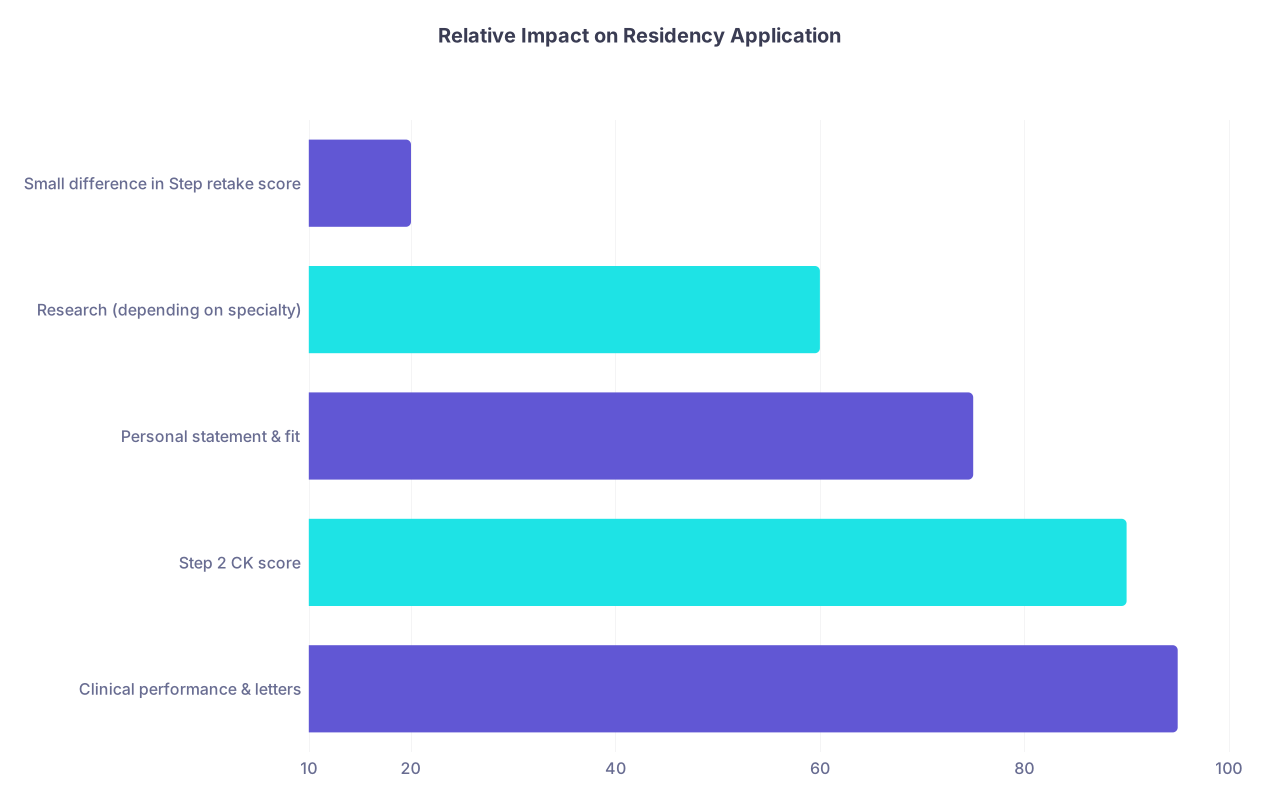
| Category | Value |
|---|---|
| Clinical performance & letters | 95 |
| Step 2 CK score | 90 |
| Personal statement & fit | 75 |
| Research (depending on specialty) | 60 |
| Small difference in Step retake score | 20 |
2. Clinical rotations and letters of recommendation
For a borderline Step score, what saves you is:
- Honors in key clerkships (IM, Surgery, specialty of interest)
- Concrete praise in narrative comments
- Strong, specific letters from people who know you
A high-impact IM letter that says:
“I’d be thrilled to have this person as a resident in our program”
does more for you than a 7-point improvement on a retaken Step exam.
3. Specialty and program list strategy
This is where a lot of borderline-score applicants blow it.
You need:
- The right specialty choice for your stats and profile
- A program list that includes:
- A solid core of “safety” community programs
- A mix of mid-range programs where you’re competitive
- A few reaches if you want, but not all reaches
| Specialty Group | Typical Strategy Focus |
|---|---|
| Ultra-competitive (Derm, Ortho) | Consider backup specialty, research, networking over retake |
| Competitive (Anes, EM, Rad) | Strong Step 2, targeted letters, broad application list |
| Moderate (IM, OB/GYN, Psych) | Emphasize rotations, letters, geographic ties |
| Less competitive (FM, Peds) | Show fit, service, reliability, apply broadly |
Step 7: A Simple Decision Framework You Can Use Today
Here’s the short version. If you’re wrestling with this, walk through this honestly.

| Step | Description |
|---|---|
| Step 1 | Borderline Step score |
| Step 2 | Retake required - focus on pass and improvement |
| Step 3 | Do NOT retake - focus on full application |
| Step 4 | Do NOT retake - adjust specialty or program list |
| Step 5 | Do NOT retake - strengthen other parts of app |
| Step 6 | Consider retake with advisor support and solid plan |
| Step 7 | Failed exam? |
| Step 8 | Score below common cutoffs for chosen specialty? |
| Step 9 | Practice exams show 15 to 20 point higher range? |
| Step 10 | Willing to delay Match or change timeline? |
Notice how many steps point to “Do NOT retake.” That’s not by accident.
Step 8: How to Recover If You Already Have a Borderline Score (Without a Retake)
Assume you accept the reality: a retake won’t change your life. What now?
Here’s what actually moves the needle:
Double down on Step 2 CK (if not done) or shelf exams.
Show that upward trend. This is the healthiest, most PD-friendly way to “fix” a borderline earlier score.Be strategic in your specialty choice.
If you’re on the margin for something like Ortho or Derm, you need:- Strong mentorship in that field
- Honest feedback about competitiveness
- A realistic backup plan that you’d truly be okay with
Crush your audition rotations/sub-Is.
When you’re physically in front of attendings and residents:- Be prepared, reliable, team-oriented
- Volunteer for work but don’t be needy
- Leave the rotation with at least one person willing to go to bat for you
Tell a coherent story in your ERAS and interviews.
If your score is low but your story is strong—resilience, growth, responsibility—programs can work with that.
If your score is low and your narrative is scattered and reactive, that’s harder.
Step 9: When You Should Talk Directly to Advisors or PDs
If you’re in any of these situations, don’t guess alone:
- Your Step 2 CK is below ~210–215 and you want something even moderately competitive.
- You’re an IMG or DO with a borderline score and aiming for a limited geographic area.
- You’re considering delaying graduation or the Match solely to retake.
You want specific, personalized data from:
- Your dean’s office
- Specialty advisors
- Recent grads from your school who matched in what you want
They can usually tell you:
- The range of scores your school matched with in that specialty
- Whether a retake helped or hurt past students
- Whether a backup specialty is smart
The Bottom Line
Retaking a Step exam just to polish a borderline passing score is usually not worth it.
It’s worth considering only when:
- Your score is clearly below specialty/program cutoffs
- You have strong, consistent practice evidence that you can significantly improve
- You’re prepared to accept the timeline and risk trade-offs
For everyone else, the smarter play is this:
Today, pull up your score report, your specialty target, and a list of programs you’re considering.
Ask: “Will a 10-point score change actually shift how these programs categorize me?”
If the honest answer is “probably not,” close the question of retaking and put your energy where it counts: Step 2 (if pending), rotations, letters, and a ruthless, realistic application strategy.