
The worst advice people get after a low Step score is “just delay a year, it’ll fix everything.” It might help—or it might quietly wreck your chances.
Here’s the real answer: delaying your application is a strategy, not a reflex. Sometimes it dramatically boosts your odds. Sometimes it does absolutely nothing except age your file and drain your energy.
Let me walk you through how to decide.
The Core Question: Does Delaying Change Your Story, Or Just the Calendar?
Start here:
If you delay a cycle, will your application be substantially different and stronger, or will it be basically the same with one more line on your CV?
If nothing major is going to change, do not delay. Programs do not care that you “took time to reflect.” They care about evidence that you can perform and are trending upward.
If you can add one or more of these during a delay year, then delaying is worth a serious look:
- A significantly stronger test signal (e.g., much higher Step 2 CK or strong COMLEX level)
- Robust clinical experience and fresh letters in your target specialty
- Serious research output in your field (posters, manuscripts, not just “volunteering in a lab”)
- A clear, explainable narrative for the gap that makes sense for your specialty (especially for competitive fields)
If you cannot realistically do that, you’re usually better off applying on time, strategically, with backup plans.
Step 1 vs Step 2 CK: How Bad Is “Low” and What Fixes It?
Let’s be blunt. In the current landscape, Step 2 CK is king for most US residencies.
If your low score is Step 1 (P/F era = barely passed) and Step 2 CK is still ahead, delaying an application to:
- Crush Step 2 CK, and
- Build a coherent year around that
…can absolutely help.
If your low score is Step 2 CK, the decision is more complex. You don’t usually get another big standardized-test “signal” for most specialties. Some people lean hard into research or prelim years to compensate. That works for some, fails for others.
Here’s the simple reality:
- A single low Step with a strong upward trend and solid clinical letters is often survivable in less competitive specialties.
- Multiple weak signals (low Step + mediocre grades + no strong letters) are a problem. Delaying only helps if you change more than one of those.
Quick Decision Framework: Apply Now vs Delay
Use this as your working flowchart.

| Step | Description |
|---|---|
| Step 1 | Low Step Score |
| Step 2 | Strong case to delay and boost Step 2 |
| Step 3 | Apply now with strategic list |
| Step 4 | Apply on time using Step 2 emphasis |
| Step 5 | Consider delay with focused gap year |
| Step 6 | Apply now and broaden targets |
| Step 7 | Step 2 CK Done? |
| Step 8 | Can score 15+ points higher? |
| Step 9 | Step 2 Much Higher? |
| Step 10 | Can you get major upgrades in a year? |
Now let’s unpack the pieces.
When You Should Seriously Consider Delaying
1. You Haven’t Taken Step 2 CK Yet, And You Know You Can Crush It
Scenario I’ve seen multiple times:
- Step 1: barely passed or low (in P/F era, something like “remediated attempt” or borderline)
- Strong clinical performance potential, but you rushed or stumbled
- You were planning to take Step 2 CK late (Aug–Sep), after ERAS opens
If you’re honestly capable of a 15–20+ point improvement over what your practice tests predicted earlier, and you give yourself time to prep properly, delaying can flip your narrative from “borderline” to “strong comeback.”
Programs love an upward trend. A weak Step 1 followed by a 240+ Step 2 CK (just an example number) is much easier to sell in IM, FM, peds, psych, neurology, etc.
Delaying makes sense here if:
- You’ll have your new Step 2 score well before the next cycle opens
- You can spend the year doing clinical or research work that feeds directly into your specialty
- You line up fresh letters from that work
If you just plan to “take Step 2 someday and chill,” do not delay. That reads as drift, not strategy.
2. You’re Aiming Very High Relative to Your Score
If your dream is:
- Derm, ortho, plastics, ENT, rad onc, ophtho, neurosurgery
- Or a top-tier academic program in any specialty
…and your Step 2 CK is significantly below the typical threshold for those programs, you have three options:
- Drop the specialty target
- Apply on time but pivot heavily toward less competitive programs and backup specialties
- Delay and spend a year stacking serious evidence that you belong in that field
That “serious evidence” is not a random research volunteer stint.
We’re talking:
- Full-time research with publications, posters, abstracts
- One or more sub-internship equivalents or observerships leading to strong letters
- A clear, specialty-focused narrative
Even then, some ultra-competitive fields may still be a reach. But I’ve seen people claw into ortho or derm after a rough test score because they used a dedicated year to become impossible to ignore on everything else.
3. You Had a Genuine, Significant Disruption
Major illness. Family crisis. War or displacement. Anything that severely undermined your ability to prep or perform—and is now resolved.
In this case, delaying for a year can make sense if:
- The situation is truly resolved or controlled (e.g., illness treated, family stability restored)
- You use the year to show normal, strong performance: research, clinical work, or a master’s with high-level academic performance
- You can explain the story succinctly and factually in your application and personal statement
This converts a vague red flag (“low score, why?”) into a clear arc: disruption → recovery → proof of stability.
When You Should Probably Apply On Time
1. Your Score Is Low-But-Passable for Less Competitive Fields
If you’re sitting on, say, a Step 2 CK in the 210–225 range (numbers vary by year, but you get the idea), and you’re aiming for:
- Family medicine
- Internal medicine (community or mid-tier academic)
- Pediatrics
- Psychiatry
- Pathology
- Some neurology and EM programs (score expectations vary)
You may be better off applying broadly, early, with a smart list than burning a year for marginal gains.
Delaying only makes sense here if you can meaningfully change your application: high-quality U.S. clinical experience, stronger letters, or a standout research year in your chosen field.
If your future self looks almost identical to your current self on paper? Apply now. Just with a realistic list and strategic backups.
2. You Don’t Have a Concrete Plan for the Gap Year
“I’ll just do some research, maybe volunteer, maybe teach…” is not a plan. Programs see through that instantly.
If you can’t answer these clearly:
- Who will you work with, exactly?
- What are the expected outputs (papers, posters, teaching evals)?
- What letters will you get, and from whom?
- How does this specific year make you a better resident in your target specialty?
…then you’re not ready to delay. You’re stalling.
Better to apply now and adjust your target specialty and program list than wander for 12 months and end up with a vague “research year” that produced nothing concrete.
3. You’re Already Relatively “Old” In Training
If you’ve already had:
- Multiple leaves of absence
- Extra years in med school
- Prior degrees or long pre-med careers
Another year off needs a very strong justification. Programs start worrying about clinical rust, stamina, and long training duration.
In this scenario, a gap year that does not produce big, obvious upgrades may hurt more than help. Applying now to more realistic programs can be smarter than trying to polish your way into a long-shot outcome.
What a “Good” Delay Year Actually Looks Like
If you decide to delay, it needs to look intentional and productive. Not like you drifted.
Here are realistic, strong structures for a gap year:
| Plan Type | Strong Example | Weak Example |
|---|---|---|
| Research Year | Full-time clinical research in IM with 2 posters and 1 manuscript under review | Unpaid lab “volunteering,” no specific project |
| Clinical Work | Full-time clinical fellowship or externship with 2 letters from attendings | Occasional shadowing, no formal role |
| Degree Program | One-year MPH with high GPA and capstone in your specialty | Random online courses, no credential |
| Teaching/Service | Full teaching role with formal evaluations and leadership responsibilities | Tutoring a few students informally |
And here’s how you present it:
- In your CV: Clear role, dates, supervisor, outputs
- In letters: Mentors highlighting your reliability, work ethic, clinical reasoning
- In your personal statement: Brief explanation of why you stepped aside and how it prepared you better
How Program Directors Actually View Delayed Applications
I’ve heard versions of this from PDs in IM, FM, EM, and psych:
- “If they took a year and did something impressive with it, I’m more interested, not less.”
- “A blank or fluffy year is worse than just applying earlier with a weaker score.”
- “I don’t mind a nontraditional path, but I do mind lack of direction.”
They’re not allergic to delays. They’re allergic to applicants who seem like they’re drifting, hiding from exams, or padding their CV with noise.
So your test is simple: if a PD looked at your gap year on one page, would they think, “That’s serious work,” or “That’s what people do when they don’t know what to do”?
If it’s the second one, don’t bother delaying.
Specialty-Specific Notes (Because It’s Not One Size Fits All)
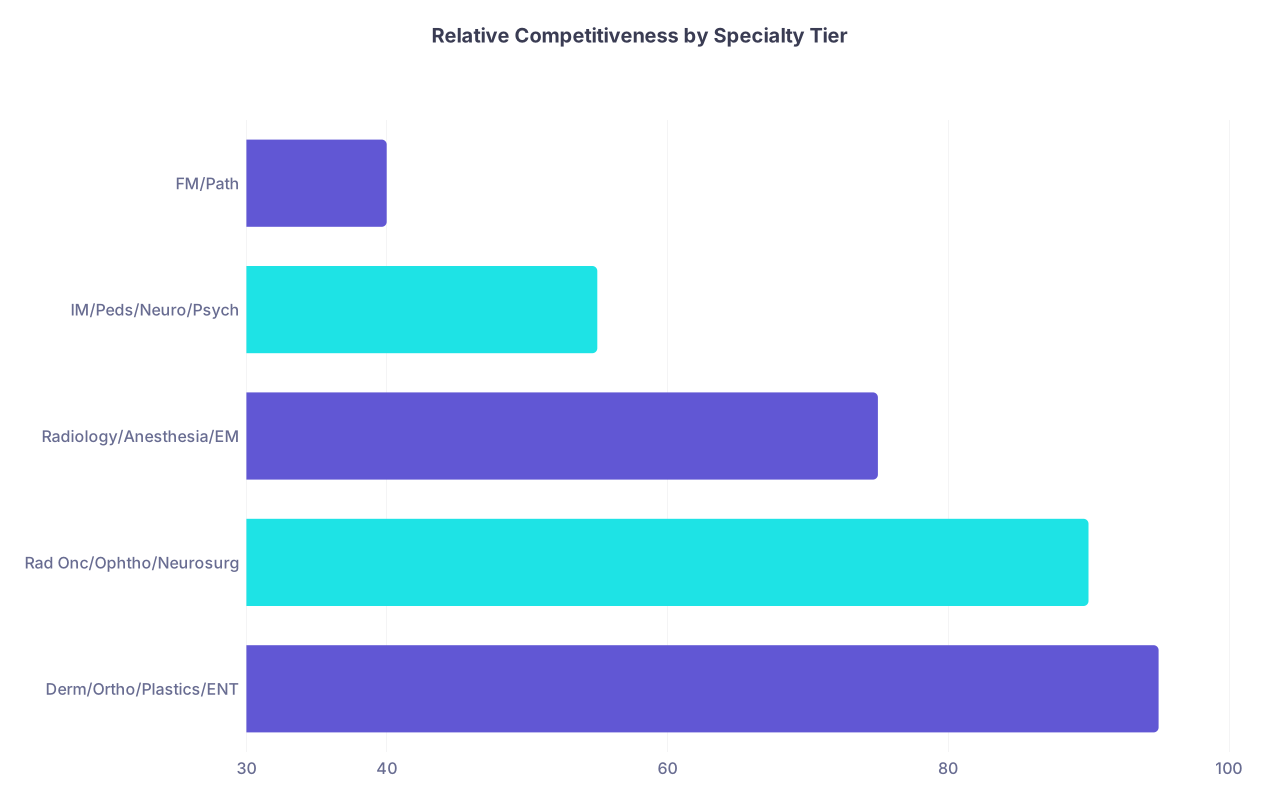
| Category | Value |
|---|---|
| Derm/Ortho/Plastics/ENT | 95 |
| Rad Onc/Ophtho/Neurosurg | 90 |
| Radiology/Anesthesia/EM | 75 |
| IM/Peds/Neuro/Psych | 55 |
| FM/Path | 40 |
Very rough and simplified, but it tracks with match difficulty.
- FM, psych, pathology: One low Step is often survivable with good clinical work, strong letters, and a realistic list. Delay only if you can clearly do something substantial (e.g., U.S. experience if you’re an IMG).
- IM/peds/neurology: Academic programs care more about Step 2 CK. A strong Step 2 can outweigh a bad Step 1. Delay if you can credibly transform your Step 2 and add research in the field.
- EM, anesthesia, radiology: Trend and scores matter. A bad Step 2 + nothing else strong? You may need a serious research/clinical year or a change in specialty target.
- Derm, ortho, plastics, ENT, neurosurg, ophtho, rad onc: A low Step score is often a major hurdle. Many successful applicants with a blemish here used a structured research year with real output. If you’re dead set on these fields, a well-designed delay can be critical—but there are no guarantees.
International Medical Graduates (IMGs): Extra Considerations
For IMGs, the bar is higher and narrower.
A low Step 2 CK is much harder to offset as an IMG. Programs often use filters, and you may never clear them. A delay year only helps if it gives you:
- A substantial Step 2 improvement (if not yet taken)
- U.S. clinical experience with strong letters from U.S. attendings
- Research or degree work that makes you competitive in specific programs known to take IMGs
If you already took both Step 1 and Step 2 CK and both are low, a delay year without a new test signal may not fix the problem. At that point, you should very seriously consider:
- Changing specialty target
- Focusing on programs and countries that match IMGs with your profile
- Or rethinking the timeline entirely
Practical Timeline: If You Decide to Delay
If you choose to delay, structure the year deliberately.
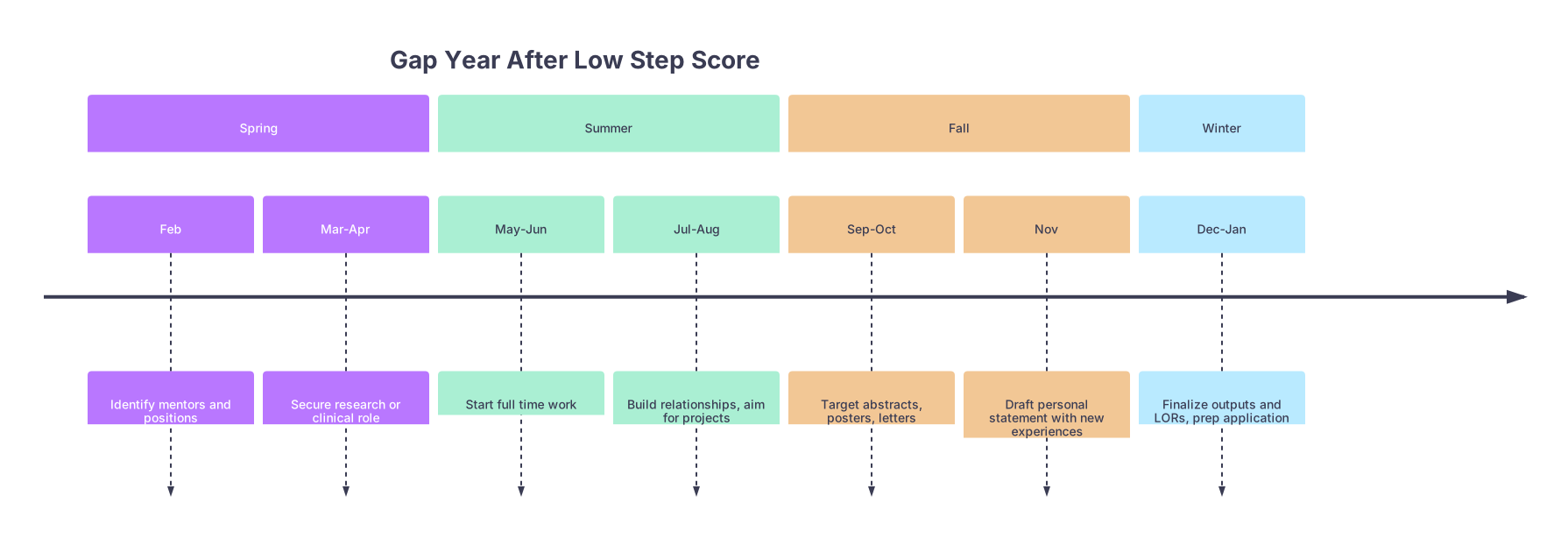
| Period | Event |
|---|---|
| Spring - Feb | Identify mentors and positions |
| Spring - Mar-Apr | Secure research or clinical role |
| Summer - May-Jun | Start full time work |
| Summer - Jul-Aug | Build relationships, aim for projects |
| Fall - Sep-Oct | Target abstracts, posters, letters |
| Fall - Nov | Draft personal statement with new experiences |
| Winter - Dec-Jan | Finalize outputs and LORs, prep application |
You want to enter the next ERAS cycle with:
- Work already underway for months
- At least some tangible products (abstracts submitted, papers in progress)
- Clear letter writers lined up and committed
Not with “I just started a position last month; trust me, good things are coming.”
FAQs: Delay vs Apply With a Low Step Score

1. If I delay a year, will programs automatically see that as a red flag?
No. They’ll see it as a red flag only if the year looks empty or vague. If your delay year is packed with concrete, relevant work—research in your specialty, meaningful clinical work, strong letters—it often improves how they see you. The problem isn’t the delay; it’s the lack of substance.
2. Should I apply to a small number of “reach” programs now or wait until I’m stronger?
If you’re asking this, you probably already know the answer: a tiny list of reach-only programs after a low Step score is basically a lottery ticket. If you’re going to apply on time, either:
- Apply broadly with a mix of realistic and stretch programs, or
- Commit to a planned, substantive delay year to change your profile, then re-approach the reaches with a stronger file.
3. Can a strong Step 2 CK completely “erase” a low Step 1?
Not erase. But it can dominate the narrative. For many core specialties (IM, FM, peds, psych, neuro), a clearly stronger Step 2 CK (especially 15–20+ points higher than your Step 1 percentile equivalent) plus good clinical evaluations and letters is often enough for you to be seriously considered. It won’t magically unlock derm or ortho, but it can absolutely rescue a primary-care or medicine-focused trajectory.
4. Is doing a research year always better than applying with a low score?
Absolutely not. A bad or unproductive research year (no clear role, no outputs, no letters) is worse than applying earlier with a weaker test and a clean training timeline. A research year only helps if you’re in a legitimate role with real projects and mentors who will advocate for you. If you can’t secure that, don’t hide behind the word “research.”
5. What’s your bottom-line rule for deciding?
Use this checklist. You should delay only if you can say “yes” to at least two of the following:
- I can get a substantially stronger test result (usually Step 2 CK) during the delay.
- I have a specific, lined-up position (research, clinical, degree program) with credible mentors.
- I know exactly which letters I’ll get from this year and how they’ll be strong.
- I can explain my delay in two clear sentences that make me look more prepared, not less.
If you can’t hit those, apply on time, pick a realistic specialty and program list, and build your career forwards instead of sideways.
Key takeaways:
- Delaying only makes sense if it changes your story, not just your age—new strong test scores, substantial work, and real letters.
- A single low Step is survivable in many fields with smart targeting and strong clinical signals; don’t reflexively throw away a cycle.
- If you delay, treat that year like a high-stakes job: structured, intentional, and directly aligned with the specialty you want.