
The biggest mistake with a low Step score is talking about it the wrong way—or in the wrong place.
You usually should not lead your personal statement with your low Step score and turn it into a confession letter. But in some cases, you absolutely should address it directly. The trick is knowing which camp you’re in and how to do it without making your entire application about your weakest number.
Let me walk you through it like I would with an advisee sitting across from me, ERAS open, cursor blinking on “Personal Statement.”
The Core Answer: Should You Address It?
Here’s the blunt answer:
- If your low Step score is the only major red flag, and you have evidence you’ve improved or overcome what caused it → yes, briefly address it.
- If you have multiple red flags (Step + failed course + leave of absence) → don’t dump all of that into your personal statement; use other spaces (MSPE, advisor letter, additional info sections).
- If your score is borderline but not terrible for your specialty and the rest of your app is strong → you usually don’t need to address it at all.
- If you failed Step 1 or Step 2, or had a huge drop between them → you probably should address it, but carefully and briefly.
If you decide to address it, the personal statement should contain a short, controlled explanation—not a detailed defense, not an emotional essay, and definitely not the main theme of your story.
Step One: Figure Out If Your Score Is Truly “Low” For Your Target
“Low” is relative. A 225 for dermatology is very different from a 225 for family medicine.
Here’s a rough comparison to anchor you:
| Specialty Type | Example Fields | Step 2 CK ~“Comfort Zone” | Probably Needs Context? |
|---|---|---|---|
| Very competitive | Derm, Ortho, Plastics, ENT | 250+ | < 235–240 |
| Moderately competitive | EM, Anesthesia, Gen Surg | 240+ | < 230–235 |
| Less competitive* | FM, IM, Psych, Peds | 230+ | < 220–225 |
*“Less competitive” does NOT mean easy; it just means more forgiving of a lower score if the rest of your app is strong.
If your score is:
- Way below the typical matched range for that field → programs will notice. You should assume they’ll have questions.
- Slightly below but you have strong clinicals, solid letters, and maybe a strong Step 2 after a weak Step 1 → you can often let your transcript speak and not call attention to it in the statement.
Where To Address a Low Score (And Where Not To)
Here’s the structure I tell people to use.
Best places to address a low Step score
MSPE / Dean’s Letter
Often the best home for “context” like illness, family crisis, testing accommodations, etc. It carries institutional weight.Advisor / Chair / PD letters A strong letter that says, “Yes, their score is lower, but I’d take this person on my own team without hesitation,” is worth gold.
Additional information / ERAS comments boxes
Short, factual explanations work well there.Personal statement – but only if:
- You failed a Step exam
- You had a big jump that tells a story of growth
- You had a genuine, brief, explainable issue (illness, language barrier early on, test anxiety that you clearly improved, etc.)
Places you should NOT use for a long Step score apology
- The opening paragraph of your personal statement
- The central theme of your statement
- Every interview answer
If your personal statement reads like, “I promise I’m not my Step 2 score,” you’re doing it wrong.
A Simple Decision Flow: Do I Put This in My Personal Statement?

| Step | Description |
|---|---|
| Step 1 | Low or failed Step score |
| Step 2 | Brief explanation in PS OK |
| Step 3 | Use MSPE or advisor letter instead |
| Step 4 | Do not highlight in PS |
| Step 5 | Failed Step 1 or 2? |
| Step 6 | Clear reason and improvement? |
| Step 7 | Score below typical range for specialty? |
| Step 8 | Strong evidence of growth? |
If you land on E, you’re in the “address it briefly and strategically” group.
How To Address It If You Decide To
Here’s the framework: Acknowledge → Attribute → Demonstrate Growth → Move On
Aim for 3–6 sentences max, ideally one short paragraph buried in the middle or later part of the statement.
1. Acknowledge (direct but neutral)
You want to show you’re not hiding it, but you’re also not dramatizing it.
Bad:
“I was devastated to receive a Step 2 score that doesn’t reflect my true potential…”
Better:
“My Step 2 score is below the level I aim to perform at.”
Short. Direct. No melodrama.
2. Attribute (concise and responsible)
You can share relevant context, but avoid blaming and long narratives.
Weak:
“I had multiple family issues, a breakup, moving apartments, and a roommate problem that all affected my performance…”
Stronger:
“During the lead-up to that exam, I struggled with poorly managed test anxiety and inefficient study strategies.”
You take responsibility and name something you then show you fixed.
3. Demonstrate Growth (this is the key)
This is where many people fall flat. Don’t just say “I learned from it.” Prove it.
Stronger examples:
- “Since then, I worked with my learning specialist to build a structured test-taking approach, which contributed to honors on my ICU and cardiology sub-internships.”
- “I shifted to active question-based learning and regular self-assessment, reflected in my clerkship performance and strong end-of-rotation exams.”
You’re drawing a line from the problem to specific, measurable improvements.
4. Move On (fast)
End by pivoting back to your strengths or your fit for the specialty.
Example pivot:
“While I can’t change that score, I can—and do—bring the same disciplined approach I’ve built since then to patient care, teamwork, and continuous improvement in internal medicine.”
Then go right back to your story.
Concrete Sample Paragraphs
Use these as templates, not scripts.
Scenario 1: Low Step 1, stronger Step 2
“Earlier in medical school, my Step 1 score was below my expectations. At that time, my study approach leaned heavily on passive review and last-minute cramming, which I’ve since recognized as ineffective for me. For Step 2 and my clinical rotations, I adopted a more structured, question-based method, sought feedback early, and focused on consistent daily work. That shift contributed to a significantly stronger Step 2 score and honors on my medicine and surgery clerkships. The experience has made me more intentional about how I learn and how I prepare for high-stakes situations.”
Scenario 2: Step failure with clear improvement
“I failed Step 1 on my first attempt. This was a painful wake-up call that my existing study habits and unmanaged test anxiety weren’t compatible with the demands of medical training. I worked closely with our learning specialist, engaged in counseling to address anxiety, and rebuilt my schedule and strategies from the ground up. On my second attempt I passed comfortably, and I later scored well on Step 2 while also performing strongly in my core clerkships. That setback reshaped how I prepare, how I ask for help, and how I respond to pressure—less with panic, and more with planning and persistence.”
Scenario 3: Single low Step 2 with strong clinical record
“My Step 2 score is lower than I would have liked and does not fully reflect my usual performance. I underestimated the time I needed for dedicated preparation while simultaneously taking on too many commitments on the wards. Since then, I’ve become much more deliberate about setting boundaries and maintaining a realistic schedule, which has helped me perform consistently on my sub-internships and take on more responsibility caring for complex patients. The experience has made me more thoughtful about sustainability, both for myself and my future team.”
That’s enough. You’ve shown insight, change, and maturity. Don’t write a second paragraph about it.
What You Should Absolutely Avoid Saying
There are some phrases that set off alarm bells instantly.
Avoid:
- “The exam doesn’t measure my true intelligence.”
- “I don’t test well.” (without describing how you’ve improved testing)
- Long stories about breakups, roommates, travel issues, or “just a bad day”
- Overly emotional language: “devastated,” “crushed,” “unfair,” “unjust”
- Blaming the exam format, NBME, or your school
Program directors read hundreds of these. They can tell the difference between owning a setback and rationalizing it.
How Much Weight Does This Actually Have?
Your Step score matters. Pretending it doesn’t is dishonest.
But once you’ve “cleared the screen” enough to get an interview, your story and fit become much more important. Many programs essentially use scores as a filter, then shift to:
- Clinical performance and comments
- Strength and specificity of letters
- Evidence you understand and actually want the specialty
- Professionalism and reliability
- Interview impression
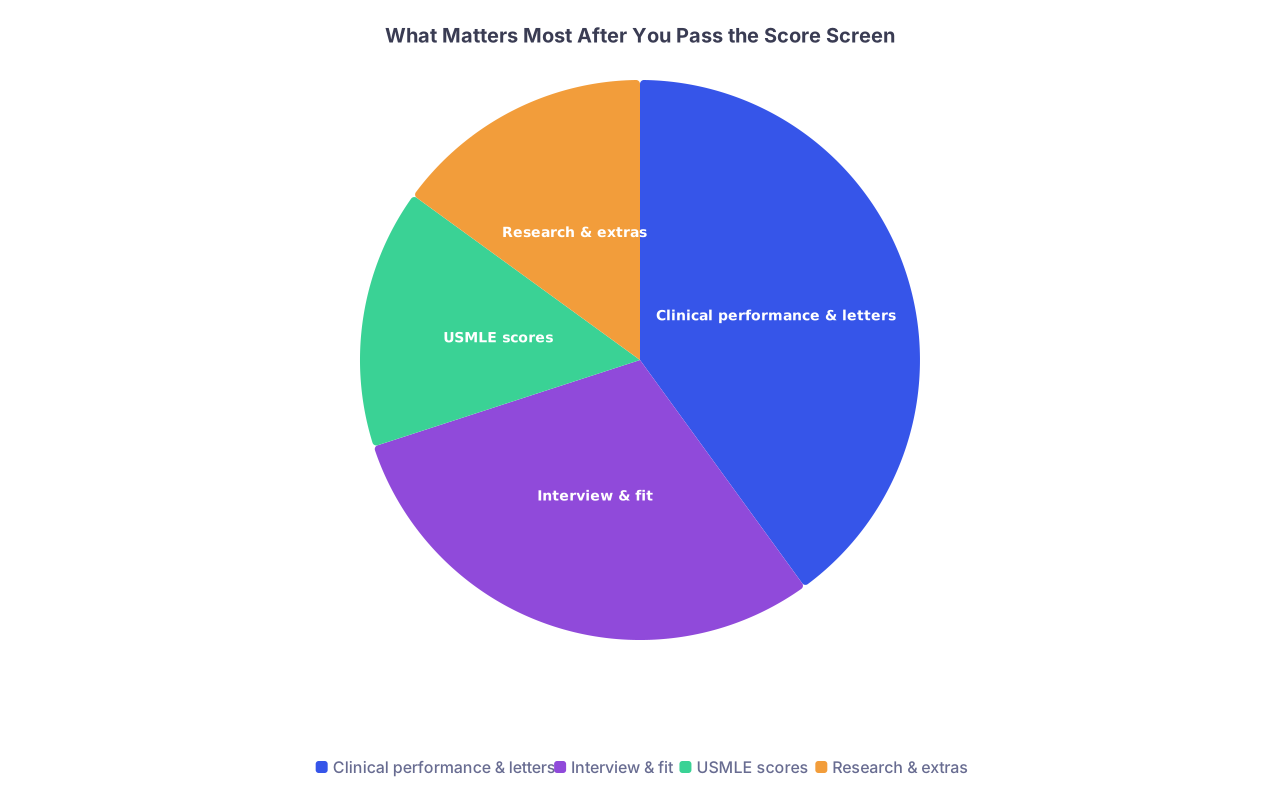
| Category | Value |
|---|---|
| Clinical performance & letters | 40 |
| Interview & fit | 30 |
| USMLE scores | 15 |
| Research & extras | 15 |
So your personal statement’s primary job is not to litigate your Step score. It’s to make them want to meet you.
Use at most 10% of your statement for explanation. The other 90% should be:
- Why this specialty
- Who you are clinically and personally
- How you’ve shown commitment and growth
- What kind of resident and colleague you’ll be
Strategy by Specialty Type
You also need to adjust based on how picky your field is with scores.
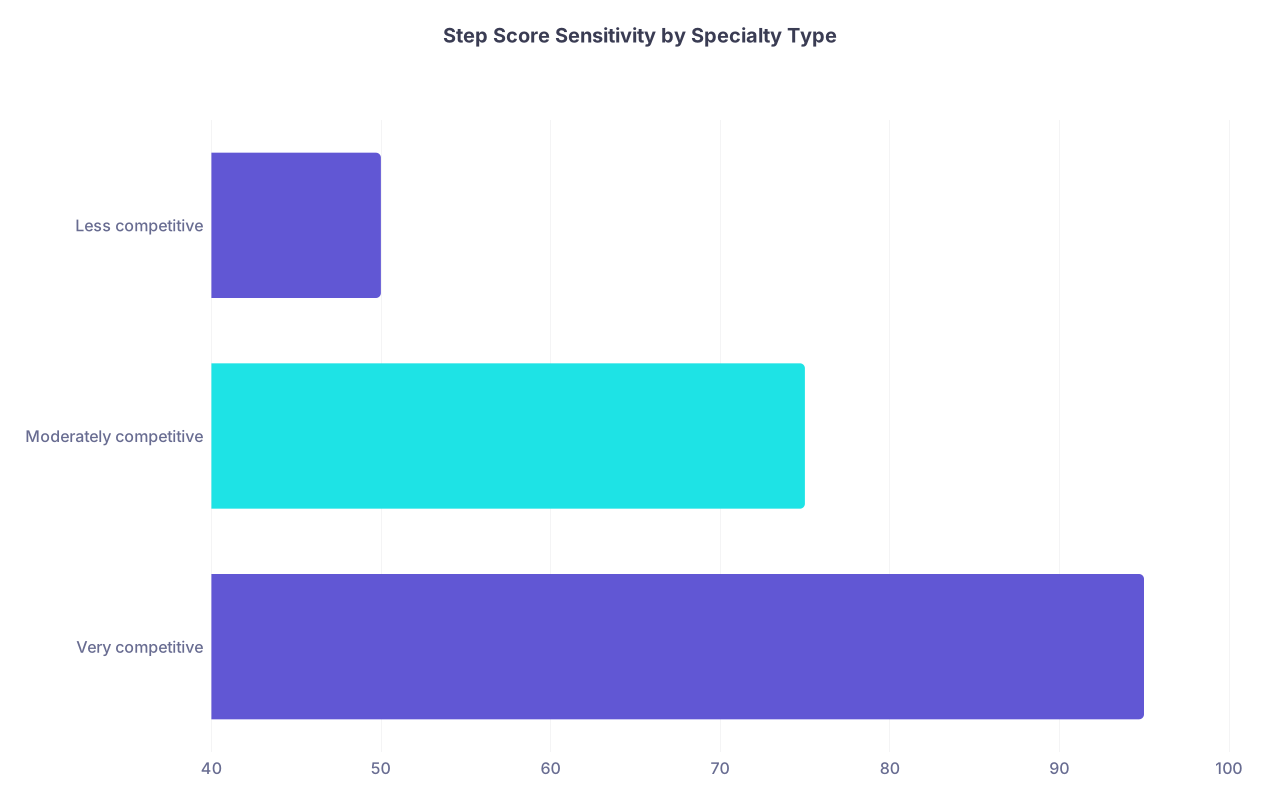
| Category | Value |
|---|---|
| Very competitive | 95 |
| Moderately competitive | 75 |
| Less competitive | 50 |
Rough rule:
Very competitive fields (Derm, Ortho, Plastics, ENT, some road specialties):
If your score is significantly below typical matched ranges, no paragraph in the world will fully “fix” that. You can still apply, but you should:- Cast a very broad net
- Strongly consider backup specialties
- Focus your statement on your genuine interest, research, and clinical excellence, with just a short, polished acknowledgment of the score if you address it at all
Moderately competitive (EM, Anesthesia, Gen Surg):
A well-written, brief explanation with strong clinical backing can genuinely help differentiate you from someone with the same score but no insight.Less competitive (FM, IM, Psych, Peds):
Many PDs here care a lot more about who you’ll be with their patients than whether you scored 218 vs 228. Address a truly low/failed score briefly if there’s a real story and clear improvement, but don’t over-focus on it.
Quick Checklist: Before You Hit “Upload”
Use this before you lock your personal statement in ERAS:
- Is the Step explanation under 6 sentences?
- Is it in the middle or later part of the statement, not the intro?
- Do I take responsibility without sounding self-punishing?
- Do I clearly show what changed and where that’s visible in my record?
- Does at least 80–90% of my statement focus on my strengths, motivations, and fit for the specialty?
If you answer no to any of those, revise.
FAQ: Low Step Scores and Personal Statements
1. Do programs expect me to explain a low Step score?
If your score is just a bit below average, no. They see that all the time. If you failed or are significantly below the usual matched range, many PDs will wonder what happened and want some indication you’ve reflected and improved. That doesn’t mean you need a long story—often a few well-written lines are enough.
2. Should I talk about my anxiety, depression, or personal hardship as the reason?
Carefully. If mental health or a major life event truly impacted your performance, you can mention it, but keep it brief, factual, and focused on treatment and stability, not trauma details. You’re trying to show, “Here’s what happened; here’s what I did; here’s why it’s different now,” not, “Here’s why you should feel bad for me.”
3. What if my school already addressed my score in the MSPE?
If the MSPE provides a clear explanation, you often don’t need to repeat the whole thing. You can either skip it entirely or add one short line in your statement that aligns with the MSPE and emphasizes growth: “As reflected in my MSPE, my Step 1 performance was below my expectations, and it prompted me to overhaul my study and test-taking approach, which contributed to my later clinical performance.”
4. Should I write different personal statements for different tiers of programs?
Not just for the score piece. It’s overkill for most applicants. What you can do is have slight variations by specialty or by program type (academic vs community) and, if needed, adjust how directly you mention your score. But the core message—who you are, why this field, what you bring—should be consistent.
5. Can a great personal statement “overcome” a low Step score?
It can’t magically erase a hard numeric screen at some programs. If a place has an auto-cutoff at 230 and you have a 215, your personal statement never gets read. Where it can help is at programs that do holistic review, or once you’re past the screen and in the interview conversation. A strong, mature explanation plus a compelling narrative about your clinical work, resilience, and fit can absolutely tip a borderline file into the “interview” pile.
Key takeaways:
- Only address your low Step score directly if it’s a clear outlier or failure and you can show real growth—then keep it short and specific.
- Don’t let your weakest metric become the main character of your personal statement; 80–90% of it should be about your strengths, motivation, and fit.
- Own the setback, show what changed, and then move on—your goal is to make them want to train you, not to feel sorry for your score.