
You just opened your Step 2 CK score report. It’s high. Way higher than your Step 1 ever was. For the first time in a while, you’re thinking, “Maybe this isn’t over.”
But then the doubt creeps in:
Can a strong Step 2 CK actually offset that low Step 1 score when it comes to the Match… or are you still cooked for the competitive programs you want?
Here’s the answer you’re looking for.
Short Answer: Yes, It Can Help. But Not Equally for Everyone.
Let me be direct.
A strong Step 2 CK can meaningfully offset a low Step 1, especially now that Step 1 is pass/fail for recent cohorts. But how much it helps depends on:
- How low your Step 1 was (barely passed vs. failed vs. multiple attempts)
- How strong your Step 2 CK is (solid vs. “whoa”)
- The specialty and tier of programs you’re targeting
- How early you get that Step 2 score in before programs review applications
- What the rest of your application looks like (clerkship grades, letters, research, school reputation)
Programs don’t magically forget Step 1. But they do re-frame you when they see a big Step 2 jump. I’ve seen applicants with marginal Step 1 but 250+ Step 2 CK go from “probably no interview” to “solid mid-tier interview season” in IM, peds, psych, EM, and even some borderline competitive specialties.
Is a 270 Step 2 going to make neurosurgery forget a 205 Step 1? No.
Can a 250 Step 2 make you viable for solid academic IM or anesthesia after a 210 Step 1? Yes. Absolutely.
Let’s break that down realistically.
How Programs Actually View Step 2 CK vs Step 1 Now
Most students imagine some mythical committee staring only at numbers. That’s wrong, but not as wrong as people want to believe.
Here’s how it usually works now:
Initial screen / filter
- Older era: Step 1 was king.
- Now: Many programs lean heavily on Step 2 CK as their main numeric filter, especially for recent grads.
- If Step 1 is low but Step 2 is excellent, you can clear a filter you’d otherwise fail.
Risk assessment
Programs hate risk. A low Step 1 can signal:- Weak test-taking
- Unreliable performance
- Borderline for boards pass rates
A high Step 2 tells them:
- You improved
- You can handle clinical material
- Their board pass stats are likely safe
Trajectory matters more than a single number
They love upward trends:- Step 1 low → Step 2 high? That’s a story they can live with.
- Step 1 high → Step 2 low? Massive red flag.
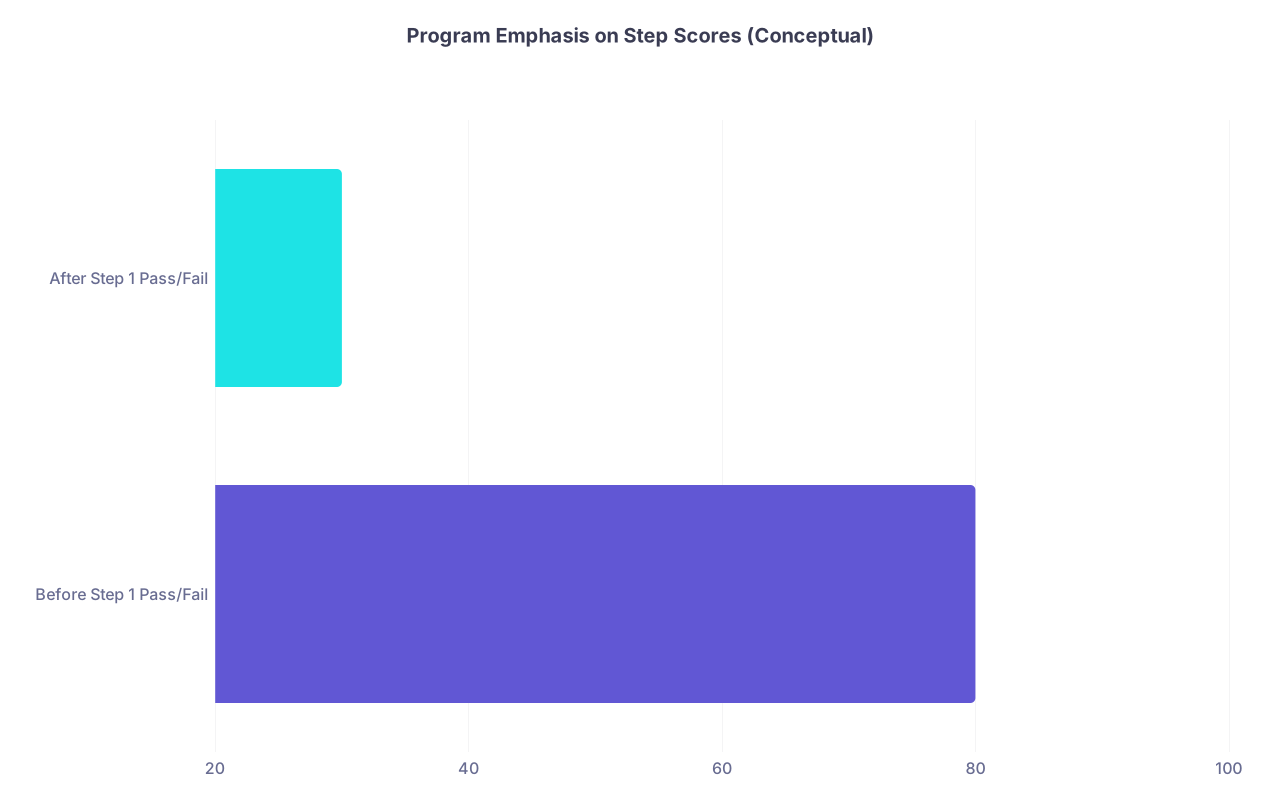
| Category | Value |
|---|---|
| Before Step 1 Pass/Fail | 80 |
| After Step 1 Pass/Fail | 30 |
The exact percentages aren’t published for every program, but qualitatively: Step 2 CK carries much more weight now. That’s good news for you.
What Counts as “Strong Enough” to Offset a Low Step 1?
Let’s talk ranges.
Assume:
- Low Step 1 = barely passed, old numeric score < 215, or a fail on record
- Mid Step 2 = 230–239
- Strong Step 2 = 240–249
- Very strong Step 2 = 250+
Here’s a realistic sense of how much “offset” you get, by specialty tier.
| Specialty Tier | Example Fields | How Much a Strong Step 2 Helps |
|---|---|---|
| Ultra-competitive | Derm, Ortho, Plastics, ENT | Limited; helps only if rest is stellar |
| Very competitive | EM, Anesthesia, Rad Onc, Urology | Moderate; can get you on some radars |
| Moderately competitive | IM (academic), Gen Surg, OB/GYN | Significant; can open many doors |
| Less competitive | FM, Peds, Psych, Neuro | Very significant; can almost reset view |
Blunt reality:
FM / Psych / Peds / many IM programs:
A 240–250+ Step 2 can heavily blunt a low Step 1. You’re very much in the game if the rest of your app isn’t a disaster.Gen Surg / OB / academic IM / EM / Anesthesia:
A 245–255+ Step 2 will get you looks at many mid-tier places and even some strong academic programs if your letters and clinicals are strong.Derm / Ortho / Plastics / ENT / Neurosurg:
One low Step 1 can be survivable if everything else screams elite (research, honors, home program support, connections, clinical performance) and your Step 2 is exceptional. But Step 2 alone doesn’t erase the earlier signal.
So yes, Step 2 can offset Step 1. But it’s not a magical reset button in the hyper-competitive fields.
Different Scenarios: Where You Actually Stand
Scenario 1: Low Step 1 (passed) + High Step 2 (≥245)
This is the classic “redemption arc.”
Program reads:
- “Ok, Step 1 was rough. But Step 2 looks great. Upward trend. Probably matured, figured out how to study, does fine with clinical material.”
You can realistically:
Be competitive for:
- Many academic IM programs
- Strong community programs in EM, anesthesia, gen surg, OB/GYN
- Most programs in FM, peds, psych
Struggle more for:
- Top 10 academic programs in competitive fields
- Ultra-competitive specialties without strong institutional support
The key: don’t pretend Step 1 didn’t happen. But don’t obsess over it either. Let Step 2 and your clinical story speak.
Scenario 2: Step 1 Fail + Strong Step 2 (≥240–245)
This is trickier, but not hopeless.
Here’s how PDs think:
- Fail = major risk signal
- Strong Step 2 = maybe this was a one-time mess, not a permanent issue
I’ve seen these applicants match:
- Family Med, Psych, Peds, Community IM, even some academic IM
- Occasionally EM / Anesthesia / OB with strong home support and killer letters
The Step 2 score does blunt the damage. But you must:
- Be very strategic with your list (more on that later)
- Have a crystal-clear explanation in your MSPE / advisor note if needed
- Show consistent clinical honors / strong evals to reinforce the “this was an outlier” narrative
Scenario 3: Mediocre Step 1 (215–225) + Mediocre Step 2 (225–235)
This is where people get stuck.
You’ve technically “passed the bar,” but you’re not impressing anyone numerically. That’s where:
- Clinical grades
- Letters
- Fit with specialty
- Research or meaningful work
start to matter more than trying to spin the numbers. In this situation, Step 2 didn’t offset anything; it just confirmed you’re average on tests. That’s workable for many fields, but you lose the “wow” redemption story.
Concrete Strategies If You Have a Low Step 1 and Strong Step 2 CK
Step 2 alone isn’t your whole recovery plan. You need to align the rest of your application with the story your scores are telling:
“I had a rough start with Step 1, but I adapted, improved, and now perform at a high level with clinical material.”
Here’s how you do that.
1. Time Your Step 2 Right
If you haven’t taken it yet:
- You must have your Step 2 CK score in before programs start reviewing apps if you’re using it to offset Step 1. That usually means taking it by late July / early August for most cycles.
If you already took it and it’s strong:
- Make sure ERAS is updated immediately.
- Tell your mentors and letter writers so they can explicitly mention your improvement.
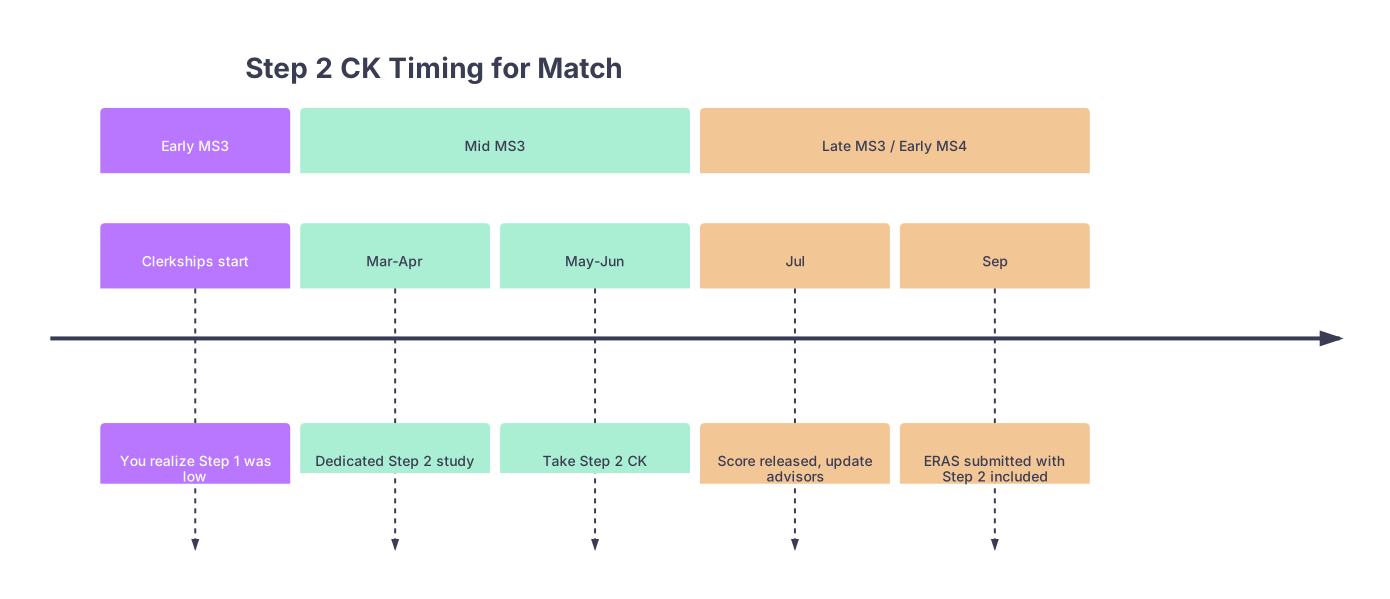
| Period | Event |
|---|---|
| Early MS3 - Clerkships start | You realize Step 1 was low |
| Mid MS3 - Mar-Apr | Dedicated Step 2 study |
| Mid MS3 - May-Jun | Take Step 2 CK |
| Late MS3 / Early MS4 - Jul | Score released, update advisors |
| Late MS3 / Early MS4 - Sep | ERAS submitted with Step 2 included |
2. Hammer Your Clinical Rotations
Programs will forgive a low Step 1 much faster if:
- You’re getting honors in core clerkships
- Your narrative comments say things like “reads ahead,” “strong clinical reasoning,” “excellent team member,” “top of the rotation”
Ask attendings directly:
“I’m applying to [specialty] and had a weak Step 1 but strong Step 2. Would you feel comfortable commenting on my clinical growth and performance in a letter?”
You want your letters to implicitly say: this person’s true ability is closer to Step 2, not Step 1.
3. Be Smart With Your Specialty and Program List
If your numbers are mismatched with your dream specialty, there are only three honest paths:
- Adjust your expectations within the specialty
- From top 10 academic to solid mid-tier / community
- Add a safety specialty
- Example: EM primary + IM backup; Ortho dream + FM/IM serious backup
- Take extra time (research year, prelim year, extra publications)
- Only makes sense if you’re truly committed and have real institutional support
| Step 1 / Step 2 Profile | Specialty Target | Application Strategy |
|---|---|---|
| 204 (fail first) / 245 | FM, Psych, Peds | Heavy application volume, strong letters focus |
| 215 / 248 | Anesthesia, OB/GYN | Mix of community + academic, consider backup |
| Pass only / 250 (P/F cohort) | Moderately competitive | Lean on Step 2 as main numeric signal |
4. Craft a Coherent Narrative (But Don’t Over-explain)
You don’t need a pity essay about Step 1. You need a coherent story of growth.
That looks like:
- Personal statement: future-focused, clinical stories, why this specialty. Maybe one sentence about learning to adapt and improve studying, if you can do it without sounding defensive.
- Interviews: If asked, own Step 1. Briefly explain what went wrong, what changed, how you studied differently, and how that led to your Step 2 performance.
Programs want to see:
- Insight
- Responsibility
- Concrete change (different resources, question-heavy approach, structured schedule)
- Result (your Step 2 score)
Not a long emotional saga.
When a Strong Step 2 Isn’t Enough on Its Own
There are some situations where even a monster Step 2 can’t fully rescue things:
- Multiple Step 1 failures
- Step 2 taken late (after programs already screened)
- Red flags elsewhere: professionalism issues, failed clerkship, terrible evals
- Hyper-competitive specialty + no home program + weak research
In those cases, Step 2 is still better than not having it, but you have to be honest with yourself: your path probably requires either:
- A different specialty
- A heavier emphasis on community programs, prelim years, or SOAP as a real contingency
- Another year building your application (research, MPH, chief year, etc.)
Visualizing Step 2 as Part of the Whole Application
Think of Step 2 as one strong pillar, not the entire building.
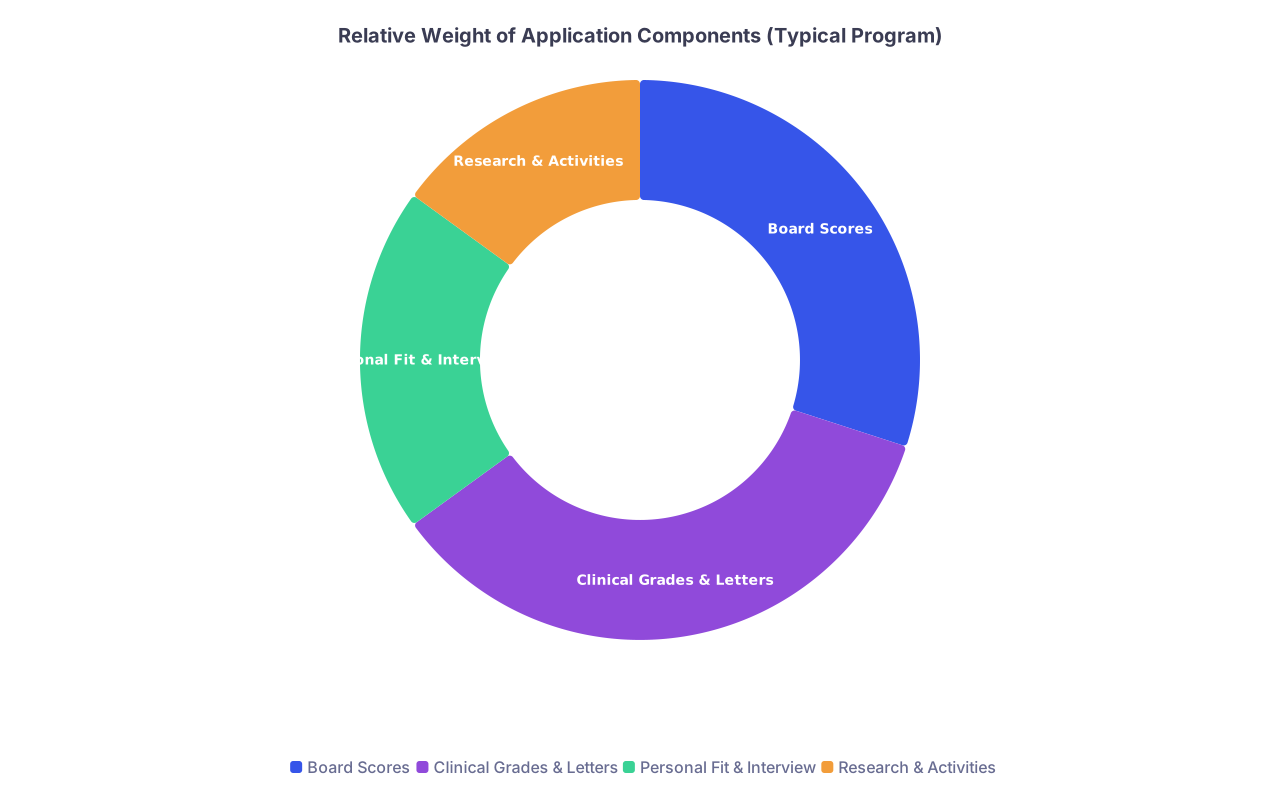
| Category | Value |
|---|---|
| Board Scores | 30 |
| Clinical Grades & Letters | 35 |
| Personal Fit & Interview | 20 |
| Research & Activities | 15 |
A strong Step 2 gives you a solid “board scores” slice. That earns you a chance to show off the rest. Whether you match isn’t decided by that number alone.
Bottom Line: What You Should Do Next
Here’s the compressed truth:
- Yes, a strong Step 2 CK can realistically offset a low Step 1 for many specialties, especially IM, FM, peds, psych, neuro, and a lot of EM/anesthesia/gen surg/OB programs.
- No, it doesn’t erase Step 1 for ultra-competitive fields, but it can turn “no way” into “maybe, with a great overall app and strong support.”
- Programs care a lot about trajectory. Low → high = redeemable. High → low = concerning.
- Your job now is to make the rest of your application align with the Step 2 story: mature, capable, clinically strong, upward trend.
Do this today:
Open your Step 2 CK score report, write the number at the top of a blank page, and beneath it list three things you’ll do in the next 30 days to reinforce that number: a specific attending to ask for a strong letter, 10 programs to add at the right competitiveness level, and one mentor you’ll email for honest feedback about your specialty list. That’s how you turn a good score into an actual match.
FAQ (Exactly 6 Questions)
1. What Step 2 CK score is “high enough” to offset a low Step 1 for most IM/psych/FM programs?
For most internal medicine, psych, and family medicine programs, a Step 2 CK in the 240+ range is usually strong enough to make them feel comfortable that Step 1 doesn’t represent your true ceiling. If your Step 1 was just barely above passing, 245–250+ gives you even more breathing room, especially at academic programs.
2. Can I still match into a competitive specialty like EM or anesthesia with a low Step 1 but high Step 2?
Yes, it’s possible, but you’ll need a Step 2 that’s not just “good,” but very strong—typically 245–255+—plus solid clinical grades, strong letters in the specialty, and a well-chosen program list that includes plenty of mid-tier and community programs. You probably won’t be competitive for the most elite places, but you can absolutely match into the field.
3. If I failed Step 1 once but got a high Step 2, should I still apply to competitive fields?
You can, but you should be careful. A Step 1 failure is a permanent red flag for many competitive specialties. A strong Step 2 (think 240–250+) makes you viable for less competitive fields and some moderate ones (FM, psych, peds, community IM, maybe some EM/anesthesia/OB). For derm/ortho/ENT/plastics/neurosurg, a Step 1 fail is very hard to overcome even with a high Step 2, unless you have extraordinary support and credentials.
4. Do programs care if my Step 2 is only slightly higher than Step 1?
Yes, they notice the trajectory. If Step 1 was weak and Step 2 is only 5–10 points better (or just “average”), that doesn’t really feel like redemption. It says you’re about the same test-taker you were before. That’s not fatal for many specialties, but it doesn’t “offset” the low Step 1 in the way people hope. In that case, your strength has to come from clinical performance, letters, and fit.
5. Should I delay applying a year to get a higher Step 2 for offsetting a low Step 1?
Usually no, unless:
- You haven’t taken Step 2 yet, and you’re clearly not ready to score well
- You’re aiming for a moderately or highly competitive specialty
- You have a realistic way to spend the year (research, strong mentorship, away rotations) that will materially boost your chances
If you’ve already taken Step 2 and the score is out, delaying a year rarely transforms your competitiveness unless you also fix other weaknesses.
6. How do I talk about my low Step 1 and high Step 2 during interviews?
Keep it short and concrete. Something like: “I was disappointed in my Step 1 performance. I realized my study approach wasn’t question-heavy enough or structured. For Step 2, I changed that completely—more timed questions, better schedule, more review of missed concepts—and I’m proud that my Step 2 score reflects my true ability with clinical material.” Then stop. Own it, show growth, and move on to what you bring to their program.