
What do program directors really think when they see your Step score—and how do you know if SOAP is a real risk for you this cycle?
Let me be blunt: SOAP almost never happens “out of nowhere.” There are usually warning signs on your application, and your step scores are a big one. The good news? You can audit your situation right now and decide if you need to shift into SOAP‑prevention mode.
This guide walks you through exactly that.
1. How Much Do Step Scores Actually Matter for SOAP Risk?
Step scores don’t decide everything. But they set the ceiling (and sometimes the floor) for how programs sort you.
Here’s the pattern I see over and over:
- High Step scores + catastrophic red flags (failed courses, professionalism issues, late applications) → still at risk
- Average scores + weak application strategy → surprisingly high SOAP risk
- Low scores + smart strategy → match more often than you’d think
- Very low scores or failures + poor strategy → SOAP is almost inevitable
To self-assess, you need context. Not panic. Context.
Rough score tiers (for most specialties)
For US MD and DO students in relatively non‑competitive fields (FM, IM, Peds, Psych, etc.):
- “Comfortable” Step 2 CK: ~240+
- “Workable but not impressive”: ~225–239
- “Concerning, need strategy”: ~215–224
- “High SOAP risk alone”: <215 or any failure
For competitive specialties (Derm, Ortho, ENT, Optho, Rad Onc, some EM):
- Below ~240 Step 2 already pushes you to the margins
- Below ~230 makes SOAP risk very real unless you have a stellar parallel plan
Are these strict cutoffs? No. But they’re honest ballparks based on how PDs screen.
2. A 10-Point SOAP Risk Self-Assessment
Let’s build a fast, realistic risk estimate. Don’t sugarcoat your answers.
Rate yourself on each item, then I’ll show you how to interpret the pattern.
1. Step 1 result
- Pass on first attempt → neutral
- Fail then pass → moderate risk flag
- Multiple failures → major risk flag
2. Step 2 CK score
Use your actual number:
- 245+ → strong
- 230–244 → okay but not strong
- 220–229 → concern range
- <220 → significant concern
- Fail → huge red flag
3. Specialty competitiveness
- You’re applying only to: derm, ortho, ENT, plastics, neurosurg, rad onc, IR, urology, optho, integrated plastics → very high baseline SOAP risk with anything less than stellar scores
- You’re applying to: anesthesia, EM, gen surg, diagnostic radiology → moderate baseline risk with below‑average scores
- You’re applying to: IM, FM, psych, peds, neurology, pathology, PM&R → lower baseline risk, but low scores + poor strategy can still burn you
4. Backup / parallel plan
Be honest:
- I have a true parallel specialty list (e.g., EM + IM, gen surg + prelim + FM) and I’m applying broadly
- I have a “backup” I barely applied to (5–10 programs)
- I have no real backup
5. Number of programs applied to
For US MD/DO in non‑competitive specialties with low-ish scores, minimums I like to see:
- IM: 60–80+
- FM: 40–60+
- Psych: 50–70+
- Peds: 40–60+
- Neuro, Path, PM&R: 40–60+
- Gen Surg (categorical): 60–80+ plus prelims if weaker
If you’re below these numbers with weak scores, your SOAP risk climbs fast.
6. Application timing
- Submitted ERAS within first 1–3 days, letters ready early → good
- Submitted 2–3 weeks in → riskier, especially with low scores
- Submitted after that → you’re starting on the back foot
7. Home program & connections
- You have a home program in the specialty, and they know you → protective factor
- You rotated with multiple programs that know you well → protective
- No home program, no strong away rotations → adds to risk
8. Class status
- US MD, no delays → best odds
- US DO → solid odds in many fields, but more vulnerable in the match with low scores
- IMG (US citizen or not) → Step scores and strategy matter a lot more; low scores put you at high SOAP risk unless everything else is excellent and you apply very broadly
9. Red flags outside of scores
- Failed courses/clerkships, LOA, professionalism issues, major gaps → all amplify SOAP risk
- No red flags → good; your low score hurts less when you’re otherwise clean
10. Interview numbers
This is the single biggest real‑time predictor, and it’s often ignored until too late:
- Non‑competitive specialties: Aim for ~12–15+ solid interview invites
- Competitive specialties: More like 15–20+
- If you’re sitting in December with <8 interviews total → you’re entering real SOAP territory
3. Translating Your Self-Assessment into SOAP Risk Categories
Let’s categorize you roughly, then I’ll show you what to actually do.
Low SOAP risk
You’re probably here if:
- Step 2 CK ≥ 235 (no failures),
- You’re applying to a non‑competitive or mid‑tier specialty,
- You applied early to a broad list,
- You’ll probably land 12–15+ interviews.
Could you still SOAP? Sure. But it’s unlikely because of scores alone.
Moderate SOAP risk
Typical profile:
- Step 2 CK 220–234 or a Step 1 failure now passed,
- Specialty is somewhat competitive or you’re a DO/IMG in a popular field,
- You applied to a decent number of programs but not maximal,
- You’re not confident you’ll hit double‑digit interviews.
Here, your actions from now through ranking day really matter.
High SOAP risk
You’re here if any of these feel like you:
- Step 2 CK < 220, or Step 2 failure, or multiple Step failures
- You’re aiming at competitive specialties without a robust parallel plan
- You applied late or to few programs given your stats
- You’re an IMG or DO with low scores and didn’t apply insanely broadly
- You’re in January/February with ≤6 interviews total
SOAP isn’t guaranteed. But you’d be irresponsible not to prepare.
4. How Your Specialty Choice Changes the Equation
Same score, different specialty, completely different risk. Here’s the general pattern:
| Specialty | SOAP Risk Level | Comments |
|---|---|---|
| Family Med | Low–Moderate | Broad apps usually rescue you |
| Internal Med | Moderate | More competitive programs screen |
| Pediatrics | Moderate | Needs broad and early apps |
| Psychiatry | Moderate–High | Very popular in recent years |
| General Surgery | High | Especially categorical positions |
| Emergency Med | High | EM has tightened a lot recently |
And if you’re DO or IMG, bump each of those risk levels up a notch unless you’re over‑applying and have strong clinical letters.
5. Early Warning Signs You’re Headed Toward SOAP
Don’t wait for that awful Monday of Match Week to realize you’re in trouble. Some red flags mid‑cycle:
- You have a low Step 2 and:
- You get almost no interview responses from mid‑tier community programs
- Only a few interviews, mostly at places where you rotated
- Programs with historically lower fill rates or many IMGs aren’t inviting you
- You applied heavily to reach programs and “balanced” your list with only a handful of safer options
The biggest mistake I see? Students with low-ish scores who act like their scores are average when choosing programs.
6. Concrete Moves to Lower Your SOAP Risk Now
Here’s where the “self-assessment” turns into an actual strategy.
If you’re pre‑ERAS submission (or early in the season)
Be brutally realistic about competitiveness
If your Step 2 is < 230, you shouldn’t be applying only to EM, gen surg categorical, anesthesia, or radiology without a robust backup plan.Build a real parallel plan
Not “I’ll throw 10 apps to FM.” That’s not a plan.
Real plan:- 40–60+ FM or
- 60–80+ IM (mostly community) or
- 40–60+ psych/peds/neuro/path/PM&R
along with your preferred specialty.
Heavily favor community and lower-tier academic programs
The “big name” program that looks good on paper and gets 4000 apps? Not for you right now.Fix everything else you can
Strong personal statement, clean, well‑explained red flags, targeted letters from people who actually know you.
If you’re mid‑season with few interviews
You can’t change your Step score. You can still change your odds.
Add more programs if the window is still open
Email program coordinators at realistic programs with:
- Brief interest statement
- Updated CV and Step 2 if it’s stronger
Don’t beg. Just signal interest.
Lean hard into connections:
- Ask letter writers or mentors if they can “nudge” specific programs
- Use alumni networks, med school advisors, specialty interest groups
And start mentally preparing a SOAP plan now, not on Match Monday.
7. How to Prepare for SOAP Without Defeating Yourself
There’s a weird psychological trap here. If you prepare for SOAP, it can feel like you’re “admitting defeat.” That’s dumb. You can walk and chew gum: aim to match AND prepare for SOAP like an adult.
Here’s what to line up before Match Week:
Updated CV in a clean, SOAP‑ready format
Short, flexible personal statement that works for:
- IM
- FM
- Psych
- Peds
depending on what you’d be willing to pivot into
A ranked list (for yourself) of:
- Which specialties you’d accept in SOAP
- Which geographic regions you’d be okay with
- How far you’re willing to compromise (prelim year, community only, etc.)
Honest conversation with:
- Your dean’s office
- A mentor in a lower‑risk specialty
Let them know you want help positioning yourself before SOAP chaos hits.
SOAP week is frantic. If you’re building your CV and arguing with yourself about “Would I do FM?” on that Monday, you’re already behind.
8. When Is SOAP Essentially Inevitable from Scores Alone?
There are a few patterns where, unless something unusual happens, you should assume very high SOAP risk:
- Multiple Step failures with no strong upward trend
- Step 2 CK < 210 as US MD/DO with no truly broad backup plan
- Step 2 CK < 220 as IMG in almost any field, unless you’ve applied extraordinarily broadly (think 100+ programs) and have outstanding other metrics
- Applying only to competitive specialties with Step 2 scores below the 230s
If this is you and you’re still pre‑application, the smart move may be:
- Take extra time to strengthen your application (research year, extra rotations, improved Step 2 if possible)
- Or drastically reorient toward a field and application strategy where your current scores are survivable
It’s not “giving up.” It’s playing the long game to end up as a physician, not as “almost matched.”
9. One Reality Check You Need to Hear
Program directors don’t care about your self‑esteem. They care about:
- Board pass rates
- Service coverage
- Residents who can function independently
Your Step scores signal risk to them. That’s it. They’re not judging your worth as a human. But they are making risk calculations.
Your job is to:
- Make yourself look like a smaller risk (strong letters, good clinical performance, no nonsense)
- Apply where your risk profile is acceptable
- Have a backup plan when it’s not
You cannot “confidence” your way past a 210 Step 2 in ortho with no backup. You can, however, build a smart path to a solid career in a field where your scores are not career‑ending.
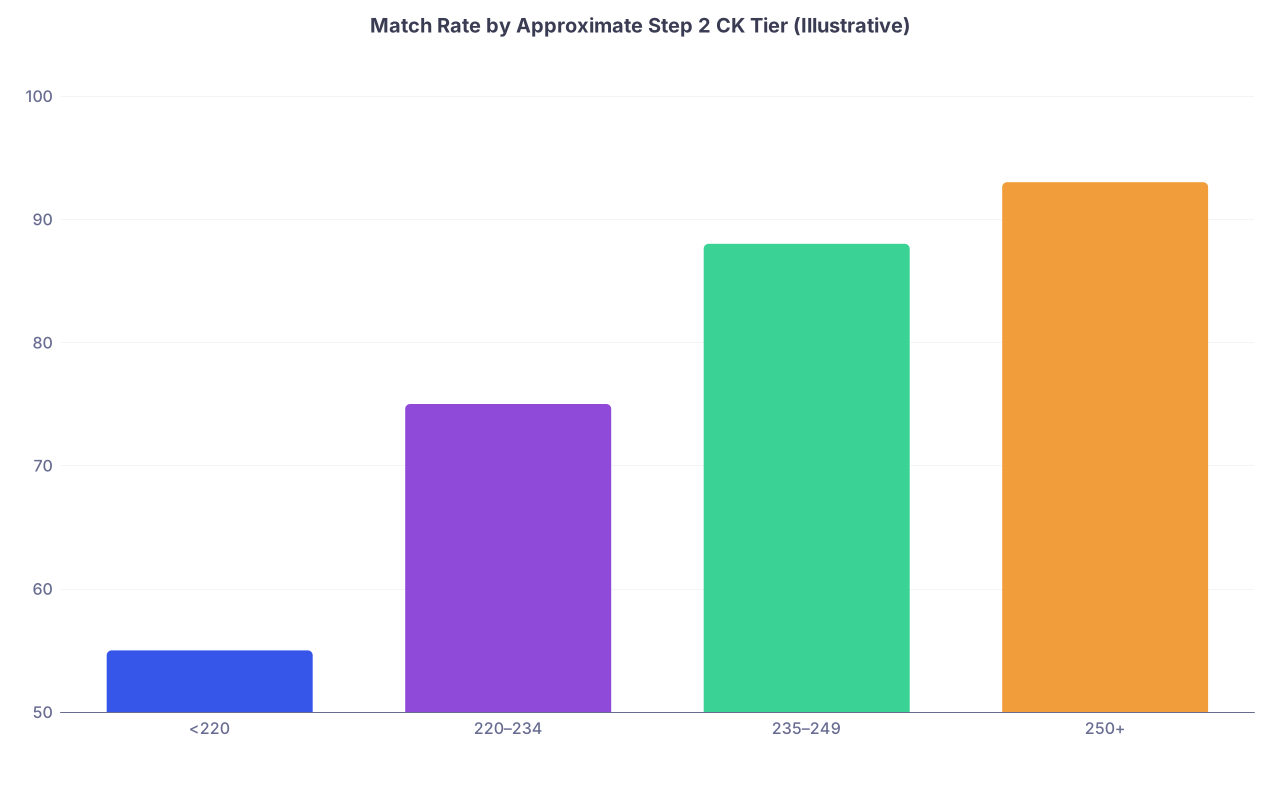
| Category | Value |
|---|---|
| <220 | 55 |
| 220–234 | 75 |
| 235–249 | 88 |
| 250+ | 93 |

| Step | Description |
|---|---|
| Step 1 | Know your Step 2 score |
| Step 2 | Standard strategy |
| Step 3 | High SOAP risk - need backup |
| Step 4 | Moderate risk - monitor |
| Step 5 | Increase applications and prepare SOAP |
| Step 6 | Below 230? |
| Step 7 | Competitive specialty? |
| Step 8 | Enough programs and interviews? |
FAQ: SOAP Risk and Low Step Scores (6 Questions)
1. I failed Step 1 but passed Step 2 CK with a 230. Is SOAP still likely?
Less likely than if you’d never recovered. A solid Step 2 (230+) bluntly “rescues” a Step 1 failure a lot of the time, especially in non‑competitive specialties. You’re still flagged, though. You need a broad list, early application, and honest specialty choice. If you aim at IM/FM/Peds/Psych with 60+ apps and decent clinical performance, SOAP isn’t inevitable—but you should still prepare for it.
2. My Step 2 CK is 218. Can I still match into a categorical position?
Yes, but not anywhere and not in every field. With a 218, you should focus on: FM, IM (especially community), psych, peds, neuro, path, PM&R, and apply broadly (50–80+ programs). Categorical gen surg, EM, anesthesia, and radiology become extremely risky without prelim/backup plans. The match becomes a game of odds; wide, realistic applications are mandatory.
3. Does being a DO or IMG change how low scores affect SOAP risk?
Absolutely. With the same low score, DO and IMG applicants are more vulnerable to SOAP, especially in popular or competitive specialties. For DOs, some programs still quietly favor MDs. For IMGs, many programs simply hard‑filter. That means if your Step 2 is <225 as a DO or IMG, you should assume higher SOAP risk and respond with volume (more apps), realism (less competitive fields), and stronger backup planning.
4. I only have 6 interviews so far. Should I assume I’ll SOAP?
Not automatically, but you should take it seriously. For non‑competitive specialties, you can match with 6 interviews, but your odds drop compared to someone with 12–15. What you should do now:
- Ask if you can still add programs
- Reach out to realistic programs politely expressing interest
- Talk to your dean/advisor about parallel plans and SOAP prep
Act as if SOAP is a real possibility, even if you still might match.
5. Do programs see that I participated in SOAP in previous years if I reapply?
They don’t see “SOAP” stamped on your forehead, but they can infer prior unmatched cycles from your graduation year and CV. Most don’t care that you SOAPed; they care why you didn’t match the first time and whether your application is stronger now. If you’re a reapplicant with low scores, you need meaningful upgrades: stronger letters, more clinical experience, possibly a better Step 2 or specialty shift.
6. What’s the single most effective way to reduce my SOAP risk with low Step scores?
Pick the right specialty and apply broadly and early. That’s it. Not a magical personal statement. Not one fancy away rotation. Choosing a realistic field for your numbers (e.g., IM/FM/Psych instead of EM/Ortho) and sending a high volume of well‑constructed applications to community and mid‑tier programs does more to keep you out of SOAP than anything else you can do with a 210–225 range score.
Open a note right now and write three lines:
- My actual Step 2 score
- My current specialty target(s)
- How many programs I’m realistically willing to apply to in a safer backup field
If those three lines don’t look aligned, your next move is clear: fix your specialty and program list before SOAP fixes it for you.