
It’s July. Your Step 2 score just posted. You stared at it for a long time, closed the browser, reopened it… and it’s still the same number. You wanted 250+. You got 222. Or you barely passed Step 1 on the first shot, and your school advisor just tossed out the phrase “Maybe consider a research year” like it was nothing.
Here’s what you’re really asking:
“Is an extra research year going to save my application, or am I about to waste a year of my life for nothing?”
Let me be direct:
Sometimes a research year is exactly the right move.
Sometimes it’s a complete distraction from what would actually help you match.
Your job is to figure out which camp you’re in.
We’ll walk through that—step by step—and by the end you’ll know if you’re a “should absolutely do a research year” person, a “definitely don’t,” or a “only if I can get X-type position at Y-type place.”
Step 1: Be Honest About How “Low” Your Step Score Actually Is
People throw around “low score” like it means the same thing for everyone. It does not.
Use this table as a reality check:
| Situation | Example Score | How Programs Often See It |
|---|---|---|
| Barely passed / below ~215 | 197–215 | Concerning almost everywhere |
| Below average but passable | 216–225 | Fine for less competitive fields |
| Slightly below average | 226–235 | Very workable for many specialties |
| Average for many applicants | 236–245 | Okay even for some competitive fields |
| Above average | 246+ | Strength in most specialties |
Now combine that with specialty competitiveness. A 222 in Family Medicine is one thing. A 222 in Dermatology is another universe.
Rule of thumb:
- Very competitive: Derm, Plastics, Ortho, ENT, Neurosurgery, Radiation Oncology, some integrated programs (PRS, Vascular, CT).
- Mid-competitive: EM, Anesthesia, General Surgery, OB/GYN, some IM programs, some Neuro.
- Less competitive: FM, Psych, Peds, many community IM programs, PM&R, Pathology.
So your first sanity check:
- Low score + very competitive specialty = research year might matter.
- Low score + mid or less competitive specialty = research year is rarely the main thing that fixes your application.
If you’re aiming at Derm/Ortho/Neurosurg with a 210 and zero research? Yeah, we’re having a very different conversation than if you’re aiming for Psych with a 224 and good clinical grades.
Step 2: What Does a Research Year Actually Do For You?
People say “Do a research year” like it’s some magical buff. It isn’t. It can help in very specific, limited ways:
A research year can:
- Show commitment to a competitive field
- Get you strong specialty-specific letters from known faculty
- Build a network at a program (or department) that might interview you later
- Add productivity: abstracts, posters, maybe a few pubs
- Give you time to clean up the rest of your application (CK retake if allowed, improve electives, etc.)
A research year cannot:
- Erase a failing score
- Turn a 205 into the equivalent of a 260
- Force competitive programs to ignore strict score cutoffs in their initial filters
- Make a poor clinical reputation suddenly disappear
So the real question is never “Research year: yes or no?”
It’s: “Will one extra year of research move me from ‘auto-screened out’ to ‘realistic interview candidate’ for the specialty and tier of programs I’m targeting?”
If the honest answer is “Probably not,” then you’re buying very expensive hope.
Step 3: Situations Where a Research Year Makes Sense
Let me give you the scenarios where I’ve actually seen a research year make a meaningful difference.
1. Low Step scores + very competitive specialty + no prior research
Example:
- Step 2 CK: 219
- No research
- Wants Derm, ENT, or Ortho
- No red flags otherwise, decent clerkship evaluations
If you refuse to change specialties, then yes, a funded, full-time research year with a big-name department may be the only realistic way to even get in the door. Even then, you’ll probably need:
- 1+ strong letters from known faculty in that specialty
- Multiple abstracts/posters, ideally a couple of papers
- Real mentorship and advocacy: people emailing PDs, making calls
If you “kind of like derm” but would also be happy in IM, then doing a research year just to chase low-probability derm may not be rational.
2. You’re willing to geographically or tier-shift, but need a hook
Example:
- Step 2 CK: 225
- Wants academic neurosurgery or ortho, but is willing to go to a mid-tier program
- Has some basic research but nothing serious
Doing a research year at a mid-level academic program that frequently takes their own research residents as categorical could be very smart. Here, the year is mainly about:
- Becoming the known quantity
- Being “the safe pick” for that department
- Showing grit and specialty commitment
3. You have a serious early mark against you, but the rest is strong
Example:
- Step 1: fail then pass
- Step 2 CK: 238
- Strong clinical grades, good comments
- Wants a mid-competitive specialty (OB/GYN, Anesthesia, EM, Gen Surg)
Here, a research year might help at selected programs, but only if:
- You get outstanding letters
- Your PI and faculty explicitly address your growth and reliability
- You stay clinically visible (shadowing, conferences, grand rounds)
I’ve seen people with a fail + research year match into solid programs. The key is that the research year isn’t just “papers”—it’s a year of proving you’re reliable, hardworking, and fully recovered from whatever caused that fail.
Step 4: Situations Where a Research Year Is Usually a Bad Use of Time
Now the part no one likes hearing.
1. You’re switching to a less competitive specialty
If you:
- Have low Step scores AND
- Are aiming at FM, Psych, Peds, PM&R, or community IM
Then a research year is almost never the primary thing that helps you match.
Programs in these fields care more about:
- Passing scores
- Decent (not stellar) clinical performance
- Being normal to work with
- Clear, sincere interest in the specialty
- A well-thought-out, broad and realistic application list
A year of research won’t hurt, but it rarely moves the needle more than:
- Doing strong away rotations
- Getting great letters
- Broadening your geographic and program range
- Tightening your personal statement and application strategy
2. You already have some research and still no clear path
If you already have:
- A handful of posters/abstracts
- Maybe 1–2 pubs
- Good specialty exposure
And your Step is just mediocre (say 225–235) for a competitive-ish specialty, a research year often doesn’t change your category. You’re still:
- Not a “scores monster”
- Not rebranding yourself as “hardcore research”
- Just… another applicant with some extra stuff
You may be better off:
- Targeting a slightly less competitive program tier
- Widening your net across more programs and regions
- Tightening all the non-score elements of your application
3. You’re doing it just because someone vague said “probably do research”
If your advisor’s entire reasoning is:
“Your Step’s a little low. Maybe do a research year,”
and they can’t name:
- Specific departments or PIs that place people well
- The typical success rate from that research program into your field
- The programs that routinely take their research residents into categorical spots
Then you’re gambling a year on vibes.
Demand specifics or get a second opinion.
Step 5: What Kind of Research Year Actually Matters?
Not all “research years” are created equal. Some are glorified gap years with a fancy title.
Here’s how to think about quality:
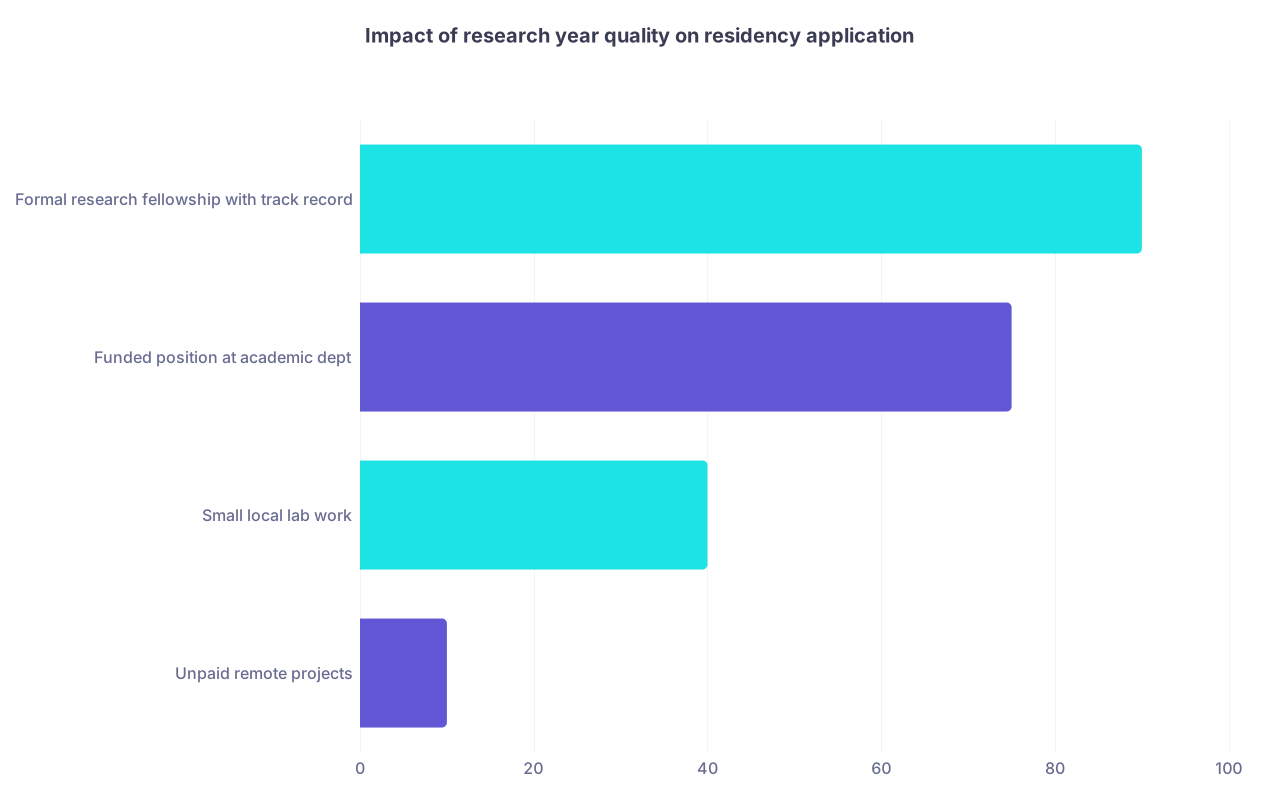
| Category | Value |
|---|---|
| Unpaid remote projects | 10 |
| Small local lab work | 40 |
| Funded position at academic dept | 75 |
| Formal research fellowship with track record | 90 |
Rough hierarchy, from weakest to strongest impact:
Unpaid, part-time, remote volunteer research
- Minimal face time, minimal letters, slow output.
- Good if it’s all you can do alongside something else, but don’t call this a “research year.”
Local, low-output projects with no specialty connection
- Generic research, minor publications.
- Adds a line or two to your CV but doesn’t sway specialty PDs much.
Full-time, funded research position in the specialty you want, at a program that sometimes takes their research people
- Strong choice. This is where you can actually build relationships and get powerful letters.
Formal research fellowship with a known “pipeline” into that field
- For example: Ortho research fellows at a big name program where 40–60% end up matching somewhere respectable in Ortho.
- This is the gold standard if you insist on a competitive specialty despite a weaker score.
If your research year doesn’t look like #3 or #4, you need to really question whether it’s the right lever to pull.
Step 6: What Might Help You More Than a Research Year?
Let’s be blunt: for many students with low Step scores, other moves give a much better return.
Stronger options in a lot of cases:
Reconsidering specialty competitiveness
Going from Derm to IM, or from Ortho to Anesthesia, can instantly move you from “long shot” to “solid candidate.”Strategic away rotations
For mid-competitive fields, 1–2 well-executed away rotations can matter more than another publication. Programs remember the student who worked hard in their OR, not the random abstract they co-authored.Broadening your program list
The number of people who go unmatched because they applied to 25 programs in a competitive specialty “only on the coasts” is higher than it should be. Geography snobbery kills matches.Fixing obvious red flags in your application
Weak letters, a messy personal statement, or poor interview skills can absolutely sink you more than the Step number.Taking Step 3 early (for certain situations)
For some IM/FM/psych programs, a solid Step 3 can reassure them if Step 1/2 were weak. Not always necessary, but sometimes very strategic.

| Step | Description |
|---|---|
| Step 1 | Low Step score |
| Step 2 | Consider strong research year |
| Step 3 | Focus on away rotations and broad list |
| Step 4 | Switch specialty, no research year |
| Step 5 | Research year only if at strong program |
| Step 6 | Very competitive specialty? |
| Step 7 | Any research yet? |
| Step 8 | Open to less competitive specialty? |
Step 7: How to Decide – A Simple Framework
Let’s compress this into a decision tool you can actually use.
Ask yourself these questions in order:
What is my exact Step 2 CK score and specialty target?
- If you’re <215 and want a highly competitive field, a research year alone probably won’t save you. You may need to strongly consider a different specialty.
- If you’re low 220s and dead-set on a competitive field, then a research year at a strong program can be rational.
Do I already have meaningful research in this specialty?
- If yes and it’s decent, a research “redo” year usually isn’t the best move.
- If no, and your field highly values research (Derm, Rad Onc, Neurosurg), that’s a point in favor.
Can I get into a high-yield research position?
- Funded, in your specialty, with a track record of placing people into residency.
- If not, the value of the year drops a lot.
What would I do instead of the research year?
- If the alternative is drifting, missing application cycles, or doing nothing meaningful, a structured research year can be better than that.
- If you have the option to go straight into a realistic specialty this cycle, that may be safer.
What do actual PDs and recent grads in your field say about your chances?
- Not your anxious classmates. Not your random school dean who graduated in 1990.
- Email or talk to people who match or interview in your target specialty now.
If after this, the picture is:
- Very competitive specialty + low score + zero research + access to a strong research position → Research year is worth serious consideration.
- Less competitive or mid-competitive specialty + passable score → You probably don’t need a research year; you need strategy.
- No access to credible, high-yield research positions → For most, not worth losing a year.
FAQs
1. If I take a research year, will programs assume it’s because of low Step scores?
Some will, yes. But that’s not fatal. You control the story. If your application shows clear specialty interest, productivity, and strong letters, the narrative becomes: “This person really committed to the field and built a strong academic profile,” not “They were hiding from their Step score.”
2. Does a research year compensate for a Step 1 fail?
Sometimes. If you follow a fail with a pass, a solid Step 2, and a year of excellent, well-documented work with glowing letters, many programs will look past the initial fail—especially in less competitive specialties. For ultra-competitive fields, it helps, but it doesn’t erase.
3. How many publications do I need from a research year to “make it worth it”?
There’s no magic number. For competitive specialties, I’d want to see at least: several abstracts/posters and realistically 1–3 manuscripts (published or clearly in submission) where you’re meaningfully involved. Quality and advocacy from your mentors matter more than raw count.
4. Does research outside my chosen specialty still help?
It helps some, but not nearly as much as specialty-specific research. A year of cardiology research when you want Derm is less compelling than 6–9 months of solid Derm-focused work. If you are going to pause your trajectory for a year, align it with the field you want.
5. Will a research year hurt me if I decide to switch to a different, less competitive specialty later?
Usually no. It might look a bit confusing if completely unrelated, but most programs will see it as: motivated, capable of sustained work, and academically inclined. You just have to explain the pivot clearly in your personal statement and at interviews.
6. Should I delay graduation for a research year or do it after graduating?
If possible, stay enrolled. Being a current student usually makes it easier for insurance, access, and mentorship, and it prevents the “What were you doing after graduation?” gap. Post-grad research years can still work, but you want them formal and well-structured, not just floating volunteer work.
7. Who should I talk to before committing to a research year?
At minimum: a specialty-specific advisor at your school, a faculty member in your target field at a place you’d like to match, and at least one recent applicant (1–3 years ahead of you) who matched into that specialty with a similar Step profile. If those three sources don’t all think the research year is a good move, pause.
Key takeaways:
- A research year is powerful only in specific situations: low Step + very competitive specialty + little prior research + access to a strong, specialty-specific position.
- For many applicants with low or mediocre Step scores, changing specialty tier, doing high-yield rotations, and broadening applications will help more than disappearing into a random lab for a year.
- Do not do a research year on autopilot. Demand specifics, target high-yield positions, and make sure it actually changes your category as an applicant—not just your CV length.