
Most students change specialties for the wrong reason after a low Step score. Do not be one of them.
You’re not actually asking, “Should I change specialties?”
You’re asking two separate questions:
- “Can I still match into the specialty I want with this Step score?”
- “If yes, what would it realistically cost me in time, effort, and strategy compared with pivoting to something less competitive?”
Let’s answer both.
1. The core rule: do not change specialties until you know these three numbers
Before you even think about pivoting, you need three data points:
- Your exact Step score
- The recent match statistics for your intended specialty
- How the rest of your application stacks up (research, school tier, grades, letters, connections)
Most people stare at the first number and panic. They don’t do the other two. That’s a mistake.
Here’s the real question:
“Am I below average, or am I non‑competitive?”
Those are not the same thing.
A 220 applying to neurology? Below average at some programs, competitive at many.
A 220 applying to dermatology? Functionally non‑competitive at almost all.
You need to know where you sit for your field.
| Specialty | Roughly Competitive | Borderline Zone | Very High-Risk Zone |
|---|---|---|---|
| Dermatology | ≥ 250 | 240–249 | < 240 |
| Orthopedic Surg | ≥ 248 | 238–247 | < 238 |
| Anesthesiology | ≥ 240 | 230–239 | < 230 |
| Internal Med (U.S.) | ≥ 235 | 225–234 | < 225 |
| Family Medicine | ≥ 220 | 210–219 | < 210 |
These are ballpark ranges, not exact cutoffs, but they give you the idea: same score, very different reality depending on specialty.
2. Step back: what kind of specialty were you aiming for?
Let me split this into four buckets:
- Ultra‑competitive: Dermatology, Plastic Surgery, Neurosurgery
- Competitive surgical: Ortho, ENT, Urology, General Surgery (top places)
- Competitive but attainable: Anesthesia, EM, Radiology, IM at top academic centers
- Broadly accessible: FM, Psych, Peds, Community IM, Path, PM&R (with caveats)
If you were aiming ultra‑competitive (derm, plastics, neurosurg)
Harsh truth: a clearly below‑average Step score is usually a hard stop unless you have something extreme going for you:
- National‑level research with first‑author pubs in that field
- A very strong home department that loves you and will go to bat for you
- Personal connections plus an otherwise spotless record (AOA, high clerkship grades, etc.)
If that’s not you and your score is significantly below typical matched applicants in that field, you’re probably looking at:
- A research gap year (or two)
- A very narrow list of programs that might look past the score
- A much higher risk of not matching at all
Do people still match these specialties with mid or low scores? Yes. But they’re the 1 in 20 with a perfect storm of other strengths.
If your score is only slightly below average (say derm target 250, you got a 244) and you already have:
- Multiple publications in the field
- Strong letters from known people
- A home residency that likes you
…then you can still stay in the game. But you’re now a targeted, strategy-heavy applicant, not a broad, “cast a wide net and relax” applicant.
If you were aiming competitive surgical (ortho, ENT, etc.)
The pattern is similar but slightly more forgiving.
One low score is not always fatal, but it does this:
- Pushes you away from big-name academic powerhouses
- Makes audition rotations (sub‑Is) essentially mandatory
- Forces you to be perfect on everything else: letters, grades, professionalism
If your score is very low for these fields (e.g., 225 in ortho without spectacular research or backing), you can keep going, but the reality is:
You’re banking your entire future on a razor‑thin probability. I have seen people do it and regret not pivoting until they went unmatched twice.
3. When a low Step score is a “yellow light” vs a “red light”
Think of your decision as a traffic light.
Green light – keep your specialty
Stay the course if all three are true:
- Your score is within ~5–10 points of the average matched score for your specialty
- You have at least one strong compensating strength (research, school reputation, major leadership, or an insanely strong mentor in the field)
- You’re willing to apply broadly, including less‑desirable locations and community programs
Here, you don’t change specialties. You change strategy.
Yellow light – proceed, but with a backup plan
Yellow means: your score is clearly below average for the field, but not catastrophic, and you have some support or unique value.
You should:
- Continue building your primary specialty application
- Simultaneously prepare a realistic backup (another specialty you’d actually do, not one you picked out of panic)
- Be brutally honest with mentors in that specialty and listen carefully to the tone behind their words
If multiple honest mentors say, “You can try, but I’d be worried,” that’s code for: you’re in the danger zone.
Red light – strongly consider changing specialties
Red means:
- Your score is well below the typical matched applicant in your field
- You don’t have game‑changing strengths (major research, home department champion, etc.)
- Multiple advisors quietly suggest an alternative, not just “cast a wide net”
In this zone, staying fixed on your original specialty is more about denial than strategy.
4. Signs you should not change your specialty (yet)
Here’s when people panic-change, and it’s premature:
- You failed one Step exam, then passed on a retake with a decent score
- Your score is slightly below your classmates but still within matching range
- You haven’t talked to a single PD or honest mentor yet
- You’re embarrassed, and you’re trying to “erase” the score by fleeing to another specialty
Switching only makes sense if it materially improves your chances of matching and you could live with that specialty long‑term.
If you’re still in love with your original field, and your score puts you in yellow, not red, you probably shouldn’t jump ship purely on emotion.
5. How changing specialties actually affects your match odds
People imagine it like this:
Low score → choose “easier” specialty → guaranteed safety.
Reality is more nuanced.
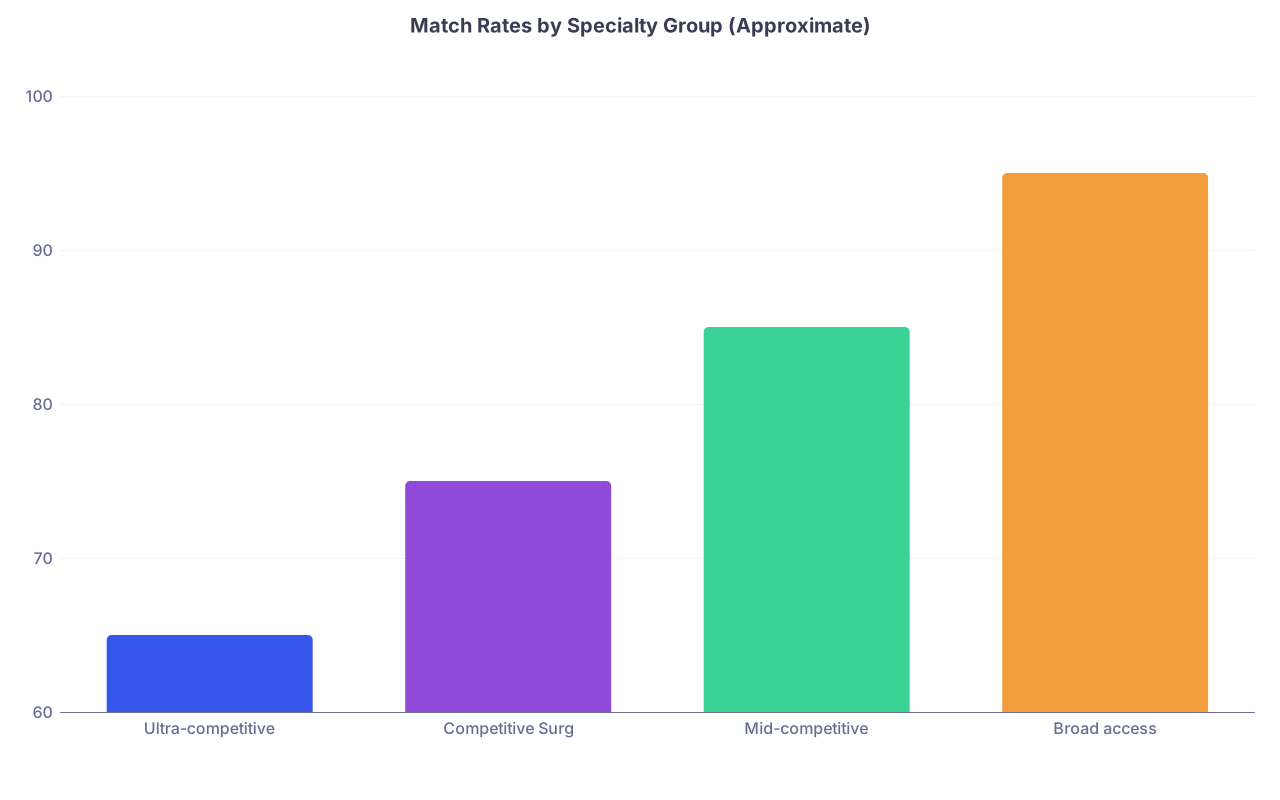
| Category | Value |
|---|---|
| Ultra-competitive | 65 |
| Competitive Surg | 75 |
| Mid-competitive | 85 |
| Broad access | 95 |
If you pivot from derm to family medicine, yes, your odds go up dramatically.
If you pivot from ortho to EM or radiology with the same weak Step score and no targeted experience in the new field, your odds may not improve much at all. You’ve just become a weak applicant in a different lane.
A change helps when:
- The new field’s usual Step range is clearly lower
- You still have time to build legit commitment (electives, letters, maybe a project)
- You’re actually OK living that specialty life for 30 years
6. How to evaluate a backup specialty without wasting a year
Do this quickly:
- Talk to two people in that specialty: one resident, one attending
- Do at least one brief shadowing or elective if you can
- Ask yourself bluntly:
- Can I see myself doing this work on an average Tuesday?
- Does the lifestyle (nights, procedures, clinic load) make sense with my actual personality?
- Am I choosing this because I like it, or because I’m scared?
Bad reasons to choose a specialty:
“I heard it’s easy to match.”
“They make a lot of money and don’t work that hard.”
“My Step score forced me.”
Good reason:
“I like the day-to-day work and would’ve considered this even with a higher score.”
7. Concrete strategy if you stay with your original specialty
If you decide not to pivot, your margin for error is gone. Here’s what I’d tell a student in my office:
Clarify your tier
- Top‑tier academic? Probably off the table if you’re far below their average.
- Focus on mid‑tier or community programs with reputations for holistic review.
Build relationships early
- Get in front of attendings and residents in that field.
- Tell them your story honestly: “My score is X, but here’s what I’ve done and why I care about this field.”
- You want at least two letters saying, “I’d gladly work with this resident.”
Overperform on rotations
- Be the reliable, teachable, friendly, no‑drama student.
- This sounds trivial; it isn’t. I’ve watched PDs overlook scores for students they trust.
Polish everything you can control
- Personal statement targeted and specific, not generic fluff.
- CK if it’s still upcoming: study like your life depends on it. This is where you make up ground.
- Apply very broadly—geographically flexible, including less glamorous areas.
8. Concrete strategy if you change your specialty
If you decide to pivot, you can’t just flip a dropdown in ERAS and hope for the best.
You need to rapidly build a credible narrative:
- New field electives or sub‑Is
- At least one meaningful project or involvement (QIP, case report, small research) in the new field
- Letters from people in that specialty who can vouch that you belong there
- A personal statement that explains the change without sounding like you’re fleeing
You do not need to confess your low Step score in your personal statement. But the story has to hang together:
- What attracted you to the new field
- What experiences confirm that interest
- How others in that field have seen you perform
9. The single biggest mistake: binary thinking
Students treat this decision like it’s yes/no:
- Stay with my dream vs abandon it completely.
You often have better options:
- Apply to your original specialty and a realistic backup
- Adjust which programs and locations you target
- Take an extra year to strengthen your application if that year will truly change your odds (research year in ortho with no research output does not help you)
The question isn’t “Am I good enough?”
It’s “What strategy gives me the highest chance of matching into a specialty I can live with?”
10. Decision framework you can use this week
Here’s a quick structure that works:
Get your data
- Your score
- NRMP data for your specialty
- Honest feedback from at least two mentors (ideally one PD or associate PD)
Sort yourself into color zone
- Green: Within range → stay, adjust expectations
- Yellow: Below, but not hopeless → stay with backup plan
- Red: Way below, no major compensating strengths → strongly consider pivot
Sketch 2 paths on paper
- Path A: Stay specialty X – list required steps (research, away rotations, # of programs, likely locations)
- Path B: Switch to specialty Y – list what you’d need to do to look serious and competitive there
Ask: which path has
- Higher match probability
- Acceptable long‑term life for you
- Fewer “I hope this miracle happens” assumptions
Then choose.
FAQ (exactly 6 questions)
1. Is one low Step score enough to kill my chances at a competitive specialty?
Not automatically. One low score can often be buffered by strong clinical grades, excellent letters, and a strong Step 2 CK if Step 1 was low. For ultra‑competitive fields like derm or plastics, though, a significantly low score without major research or departmental support often is effectively disqualifying at most programs. It moves you into “edge-case success story” territory rather than “reasonable applicant.”
2. Should I explain my low Step score in my personal statement?
Usually no. Unless you have a clear, specific, resolved reason (e.g., documented medical issue now under control, family emergency), “explaining” just highlights it. Programs can already see the score. Use the personal statement to show fit, motivation, and maturity. If there’s a genuine context that reflects growth and is corroborated in your MSPE or by mentors, that can sometimes be addressed in interviews rather than the essay.
3. Is it smart to apply to two specialties at once after a low score?
It can be. Applying to two specialties is reasonable when: your score is borderline for your first choice, the two specialties share overlapping skills or rotations, and you can assemble credible letters and experiences for both. It’s not smart if your second specialty application is obviously weak and purely “backup on paper.” That just wastes money and spreads your efforts thin.
4. How much does a strong Step 2 CK help if my Step 1 (or earlier exam) was low?
A lot, especially now that Step 1 is pass/fail (for those cohorts) and many programs lean on Step 2 CK. A big jump shows improvement, resilience, and that your low score wasn’t your true ceiling. For some programs, a strong Step 2 can almost reset the conversation, particularly in mid‑competitive specialties. It won’t fully erase a failure or deeply low score, but it can turn a red light into yellow or even green.
5. Do community programs care less about Step scores than academic programs?
Generally yes, but not “ignore it” yes. Community programs are often more holistic and care a lot about work ethic, coachability, and whether you’ll fit the team. They may screen less aggressively by score and be more open to applicants with a bump or two in their record, especially if you rotate there and impress them. But an extremely low score can still be a problem anywhere.
6. If I change specialties now, will programs assume I’m only switching because of my score?
Some will suspect it if your record doesn’t show prior interest. That’s why you need to quickly build real engagement: electives, letters, maybe a small project, and a coherent explanation of what you like about the new field. If you can point to concrete experiences and mentors in the new specialty who support you, most programs will accept the story—many physicians changed course during training themselves.
Open a blank page and write down two headings: “Stay with [original specialty]” and “Switch to [realistic backup].” Under each, list what you would have to do in the next 6–12 months to be a strong applicant. When you see both paths side‑by‑side, the right move usually becomes a lot clearer.